
Trust Signals
Every efficacy claim is graded by evidence type in the ledger below. No financial relationship exists with any semaglutide manufacturer. MOTS-c is a research compound; this page is not a prescription recommendation.
Key Takeaways
- Semaglutide has phase 3 RCT data (STEP 1, n=1,961) showing roughly 15 percent body weight reduction over 68 weeks; MOTS-c has no equivalent human weight-loss trial.
- MOTS-c is a 16-amino-acid mitochondria-derived peptide that activates AMPK and regulates the folate-methionine cycle, a fundamentally different mechanism from GLP-1 receptor agonism.
- The only published human MOTS-c study (Reynolds et al., 2021, n=9) showed improved insulin sensitivity after a single subcutaneous dose but was not designed or powered to assess weight loss.
- Semaglutide suppresses appetite centrally via hypothalamic GLP-1 receptors; MOTS-c does not demonstrably suppress appetite in any published human data.
- Purity and sequence fidelity of commercially sourced MOTS-c are unverified without a certificate of analysis from an accredited lab, a problem that does not apply to pharmaceutical-grade semaglutide.
Direct Answer: Which Is Better, MOTS-c or Semaglutide?
For clinically meaningful weight loss in humans, semaglutide wins by a wide margin. It has FDA approval, reproducible phase 3 RCT data, and a well-characterized safety profile. MOTS-c is a genuinely interesting mitochondrial peptide with early human data on insulin sensitivity, but it cannot currently be recommended as a weight-loss therapy because the human evidence simply does not exist yet.
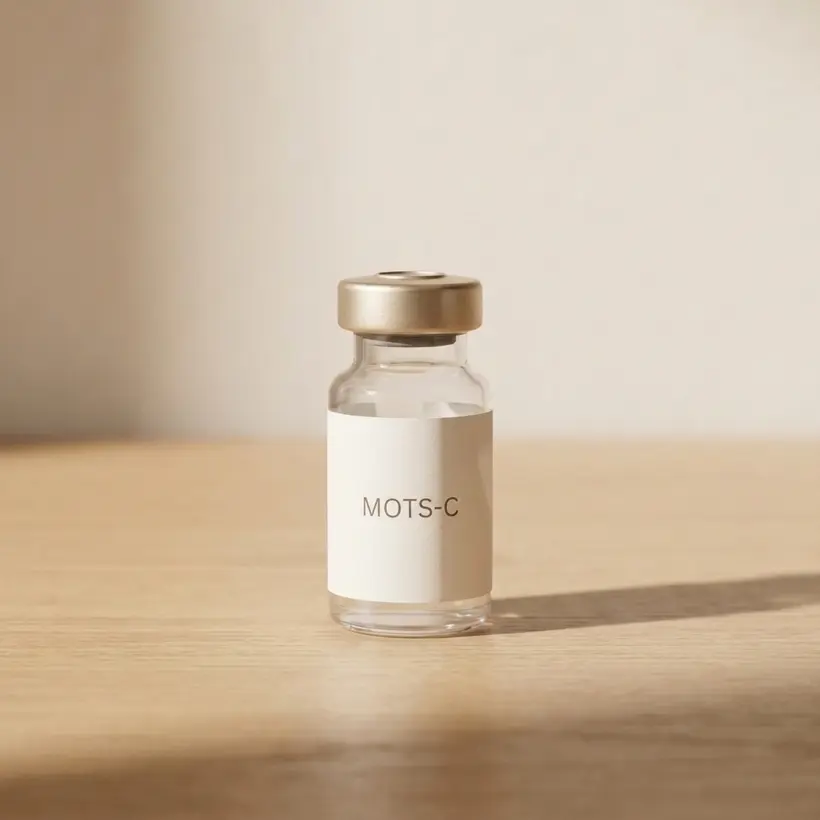
From the FormBlends catalog
MOTS-c
Mitochondrial-derived exercise mimetic that regulates metabolic homeostasis · From $249/mo · compounded by a licensed 503A pharmacy, dispensed only after provider review.
View MOTS-c →Table of Contents
What is MOTS-c and where does it come from? What is semaglutide and how does it work? Evidence ledger: what the science actually shows Mechanism with numbers: AMPK vs GLP-1 receptor What most pages get wrong about MOTS-c vs semaglutide Honest head-to-head comparison table Side effects and safety comparison Operational guide: dosing, sourcing, and label literacy Can MOTS-c and semaglutide be combined? FAQ SourcesWhat Is MOTS-c and Where Does It Come From?
MOTS-c (Mitochondrial Open Reading Frame of the 12S rRNA Type-c) is a 16-amino-acid peptide encoded not in nuclear DNA but in mitochondrial DNA, specifically within the 12S ribosomal RNA gene. It was identified and characterized by Lee et al. in a 2015 Cell Metabolism paper. This mitochondrial origin is unusual: most peptide hormones are nuclear-encoded. MOTS-c is released from mitochondria into the cytoplasm and, under metabolic stress such as glucose restriction, translocates to the nucleus where it acts as a transcriptional regulator.
Circulating MOTS-c levels decline with age in both mice and humans, which has generated interest in it as a longevity and metabolic aging target. It is detectable in human plasma, and higher plasma MOTS-c concentrations have been associated in observational data with better insulin sensitivity in older adults.
What Is Semaglutide and How Does It Work?
Semaglutide is a synthetic analogue of human glucagon-like peptide-1 (GLP-1), sharing roughly 94 percent sequence homology with native GLP-1. Novo Nordisk modified the molecule at position 8 (alanine to aminoisobutyric acid, preventing DPP-4 cleavage) and attached a C18 fatty diacid chain via a linker at lysine 26, enabling albumin binding. These changes extend its half-life to approximately one week, allowing once-weekly subcutaneous dosing.
It acts on GLP-1 receptors in the pancreatic beta cell (glucose-dependent insulin secretion), the hypothalamus and area postrema (appetite suppression and nausea signaling), and the gastric smooth muscle (delayed emptying). The STEP 1 trial (Wilding et al., NEJM 2021) demonstrated a mean body weight reduction of 14.9 percent vs 2.4 percent for placebo over 68 weeks in adults without diabetes. The SUSTAIN trials established cardiovascular benefit in type 2 diabetes.
Evidence Ledger: What the Science Actually Shows
| Claim | Best Evidence Type | Key Study / Source | Effect Direction | Confidence |
|---|---|---|---|---|
| Semaglutide reduces body weight in obese adults | Human phase 3 RCT (n=1,961) | Wilding et al., NEJM 2021 (STEP 1) | Strong reduction (~15% vs placebo) | High |
| Semaglutide reduces major cardiovascular events in T2D | Human RCT (SUSTAIN-6, n=3,297) | Marso et al., NEJM 2016 | Significant reduction | High |
| MOTS-c improves insulin sensitivity in older humans | Human pilot study (n=9) | Reynolds et al., Nature Aging 2021 | Improvement after single dose | Low (underpowered) |
| MOTS-c reduces diet-induced obesity in mice | Animal study | Lee et al., Cell Metabolism 2015 | Reduction in fat mass | Moderate (animal only) |
| MOTS-c activates AMPK and regulates folate cycle | In vitro and animal mechanistic | Lee et al., Cell Metabolism 2015 | Established mechanistically | Moderate (mechanism; does not prove clinical outcome) |
| MOTS-c causes weight loss in humans | No human trial | None published | Unknown | Very Low (no data) |
| MOTS-c declines with age in humans | Human observational / cross-sectional | Multiple observational studies | Decline observed | Moderate |
| MOTS-c improves exercise capacity in aged mice | Animal study | Reynolds et al., Nature Communications 2019 | Improvement in physical performance | Moderate (animal only) |
Mechanism with Numbers: AMPK Activation vs GLP-1 Receptor Agonism
MOTS-c pathway. MOTS-c activates AMP-activated protein kinase (AMPK), the cellular energy sensor that is triggered when the AMP-to-ATP ratio rises. AMPK activation increases glucose uptake via GLUT4 translocation, enhances fatty acid oxidation, and inhibits anabolic pathways such as mTORC1. Lee et al. (2015) showed that MOTS-c also specifically disrupts the folate-methionine cycle by inhibiting AICAR transformylase in the de novo purine synthesis pathway, causing AICAR (5-aminoimidazole-4-carboxamide ribonucleotide) accumulation, which is itself an AMPK activator. This cascade improves insulin sensitivity without direct appetite suppression. The nuclear translocation under glucose restriction was demonstrated in HEK293 cells and mouse skeletal muscle tissue, though the precise nuclear binding partners remain incompletely characterized.
What the mechanism does NOT prove. AMPK activation by MOTS-c in cultured cells or rodents does not establish that exogenous MOTS-c administered subcutaneously reaches skeletal muscle in pharmacologically relevant concentrations in humans. Oral bioavailability is essentially zero for peptides of this size due to proteolytic digestion. Subcutaneous bioavailability and tissue distribution in humans are unstudied at the level needed to validate mechanism-to-outcome claims.
Semaglutide pathway. Semaglutide binds the GLP-1 receptor (a class B GPCR) with high affinity, stimulating cyclic AMP production via Gs protein coupling. In the beta cell this triggers calcium-dependent insulin exocytosis only when glucose is elevated, which limits hypoglycemia risk. In hypothalamic nuclei (particularly the arcuate nucleus) and area postrema, GLP-1 receptor signaling reduces neuropeptide Y and AgRP expression and increases POMC activity, reducing caloric intake. Gastric emptying slows by roughly 30 percent in pharmacological studies, extending satiety signals. The half-life of approximately 168 hours (one week) vs native GLP-1's two-minute half-life is entirely a product of the fatty acid chain and albumin binding engineered into the molecule.
What Most Pages Get Wrong About MOTS-c vs Semaglutide
Most content on this topic conflates animal data with human efficacy. MOTS-c reliably reduces fat mass in diet-induced obese mice at doses in the range of 5 to 15 mg per kg. Scaling that linearly to human dosing would require doses that have not been tested for safety or efficacy in humans. The Reynolds et al. (2021) pilot used 10 mg absolute dose (not per kg) in older humans and measured insulin clamp endpoints, not weight loss. No one has conducted a human weight-loss trial with MOTS-c.
A second omission: MOTS-c is on the World Anti-Doping Agency (WADA) Prohibited List (Section S2, peptide hormones and related substances) as a prohibited substance in sport. Pages recommending MOTS-c for athletic performance rarely mention this, which matters practically for competitive athletes.
Third, the sourcing reality is routinely ignored. Pharmaceutical semaglutide (Ozempic, Wegovy, Rybelsus) is manufactured under FDA-regulated cGMP with batch-level purity assurance. MOTS-c sold through research peptide suppliers is not subject to the same oversight. Mass spectrometry analysis of research peptides in published audits has identified incorrect sequences, low purity, and bacterial endotoxin contamination in a meaningful fraction of samples. This is not a hypothetical risk.
Honest Head-to-Head Comparison Table
| Dimension | MOTS-c | Semaglutide | Winner |
|---|---|---|---|
| Human weight loss RCT data | None published | Phase 3 RCTs, ~15% body weight reduction (STEP 1) | Semaglutide |
| Insulin sensitivity (human data) | Pilot signal (n=9, single dose, Reynolds 2021) | Improved in RCTs as secondary endpoint | Semaglutide (more robust data) |
| Cardiovascular outcomes evidence | None in humans | SUSTAIN-6: significant MACE reduction in T2D | Semaglutide |
| Mechanism novelty | Mitochondrial peptide, AMPK, folate cycle, nuclear translocation | GLP-1 receptor agonism (established drug class) | MOTS-c (more novel, but novelty is not efficacy) |
| Appetite suppression | Not demonstrated in humans | Well-established via hypothalamic GLP-1 receptors | Semaglutide |
| Muscle/exercise physiology potential | Animal data suggests improved endurance and muscle insulin uptake | Lean mass loss is a concern with semaglutide use | MOTS-c (tentative, animal data only) |
| FDA approval status | Not approved for any use | Approved (Ozempic T2D, Wegovy obesity) | Semaglutide |
| Side effect characterization | Minimal systematic data; injection site reactions anecdotally reported | Well-characterized: nausea, vomiting, rare pancreatitis, rodent thyroid C-cell tumors | Semaglutide (known profile is more actionable) |
| Cost and access | Lower cost via research suppliers; no insurance coverage | High cost without insurance; brand shortages documented | MOTS-c (cost only; not an efficacy advantage) |
| Product quality assurance | Highly variable; COA required | cGMP pharmaceutical manufacturing | Semaglutide |
| WADA prohibited status | Yes, prohibited in sport (S2) | No (not on prohibited list) | Semaglutide (for athletes) |
Side Effects and Safety: What the Evidence Actually Supports
Semaglutide. The safety profile is well-characterized across tens of thousands of trial participants. Gastrointestinal events (nausea, vomiting, diarrhea, constipation) are the most common, occurring in roughly 30 to 50 percent of users at some point during titration in trial populations. Most are mild to moderate and decline after the first few months. Serious but rare risks include acute pancreatitis (absolute risk increase small but nonzero), gallbladder disease, and a black-box warning for thyroid C-cell tumors based on rodent carcinogenicity studies (clinical significance in humans remains uncertain). Lean mass loss alongside fat loss is a documented concern; approximately 30 to 40 percent of weight lost in STEP trials was lean mass, prompting debate about resistance training protocols during use.
MOTS-c. The human safety dataset is extremely thin. The Reynolds et al. (2021) pilot reported no serious adverse events in 9 subjects after a single dose. Injection site reactions and transient fatigue have appeared in anecdotal reports from research use. No long-term safety study exists. The absence of reported harm in a handful of subjects over a short period is not evidence of safety; it is evidence of insufficient study. This asymmetry deserves emphasis: semaglutide's risks are known and can be weighed; MOTS-c's risks are largely unknown.
Operational Guide: Dosing, Sourcing, and Label Literacy
Semaglutide dosing for weight management (Wegovy): starting dose 0.25 mg subcutaneous weekly for 4 weeks, escalating every 4 weeks through 0.5 mg, 1.0 mg, 1.7 mg, to a maintenance dose of 2.4 mg weekly. The escalation schedule exists to reduce GI side effects; skipping it increases intolerance. Rybelsus (oral) uses different doses (3 mg, 7 mg, 14 mg) and has lower bioavailability than injectable formulations.
MOTS-c dosing. No established human therapeutic dose exists. The only human study used 10 mg absolute dose subcutaneously. Animal studies used weight-based dosing in the range of 5 to 15 mg per kg, which does not translate directly to human protocols. Research-use protocols reported online vary widely (commonly 5 to 10 mg per injection, one to five times weekly) and are not evidence-based.
Reading a MOTS-c certificate of analysis. Request or verify: (1) HPLC purity, ideally above 98 percent by area; (2) mass spectrometry confirmation of the correct 16-amino-acid sequence (the correct molecular weight is approximately 2174 Da); (3) endotoxin testing result in EU per mL (below 5 EU per mL for research use, lower for injectable use); (4) sterility test result if injectable. A COA from the peptide vendor's own in-house lab is meaningfully less reliable than one from an independent ISO-accredited third-party laboratory. If no COA is available, do not use the product.
Stability and reconstitution. Lyophilized MOTS-c powder is stable for longer periods when stored below minus 20 degrees Celsius, protected from light and moisture. Once reconstituted with bacteriostatic water, refrigerate at 2 to 8 degrees Celsius and plan to use within a few weeks. Visual turbidity or particulate matter after reconstitution indicates potential degradation or contamination and the vial should be discarded. No formal published stability kinetics are available for MOTS-c specifically, so the degradation rate over time in solution is not precisely quantifiable; the recommendation to minimize time in solution is precautionary and consistent with general peptide chemistry.
Why reconstituted peptides degrade. Short peptides in aqueous solution are substrates for both hydrolysis (peptide bond cleavage by water, accelerated by heat and extremes of pH) and oxidation (particularly at methionine and cysteine residues if present). Bacteriostatic water (0.9 percent benzyl alcohol) inhibits microbial growth but does not stop chemical degradation. Using sterile water without bacteriostatic agent shortens the safe use window further. This is why lyophilized storage at low temperature is the gold standard, not a marketing claim.
Can MOTS-c and Semaglutide Be Combined?
On a mechanistic level the two agents work through entirely non-overlapping pathways: GLP-1 receptor agonism (semaglutide) and mitochondrial AMPK activation (MOTS-c). Theoretically combining them could address both appetite suppression and mitochondrial metabolic efficiency simultaneously. Some researchers have speculated that MOTS-c could partially offset the lean mass loss associated with semaglutide by improving muscle insulin sensitivity and mitochondrial function, but this is purely hypothesis. There is no published human trial, animal trial, or pharmacokinetic study of the combination. Drug-drug interactions are not formally characterized. Combining an FDA-approved drug with an unapproved research compound outside a clinical trial is not a strategy that can be recommended by a responsible information source.
FAQ
What is the main difference between MOTS-c and semaglutide?
Semaglutide is an FDA-approved GLP-1 receptor agonist with robust human RCT data showing roughly 15 percent body weight reduction. MOTS-c is a mitochondria-derived peptide with promising animal and early human data on insulin sensitivity and exercise metabolism, but no large-scale human RCT supporting weight loss claims yet.
Does MOTS-c cause weight loss like semaglutide?
Animal studies show MOTS-c reduces diet-induced obesity and improves glucose tolerance, but there is no human RCT demonstrating clinically meaningful weight loss from MOTS-c. Semaglutide's weight-loss effect is far better established in humans.
How does MOTS-c work mechanistically?
MOTS-c is a 16-amino-acid peptide encoded in mitochondrial 12S rRNA. It activates AMPK, translocates to the nucleus under metabolic stress, and regulates folate and methionine cycle pathways. This improves insulin sensitivity and mitochondrial efficiency without directly suppressing appetite.
How does semaglutide work?
Semaglutide mimics endogenous GLP-1, binding GLP-1 receptors in the pancreas to stimulate glucose-dependent insulin secretion, and in the hypothalamus and brainstem to suppress appetite and slow gastric emptying. Its half-life of approximately one week allows once-weekly dosing.
Is MOTS-c FDA approved?
No. MOTS-c is not FDA approved for any indication. It is a research compound available through compounding pharmacies or research suppliers. Semaglutide is FDA approved for type 2 diabetes (Ozempic) and chronic weight management (Wegovy).
Can MOTS-c and semaglutide be combined?
There is no human clinical trial data on combining MOTS-c with semaglutide. The mechanisms are complementary on paper, but combination safety, dosing, and efficacy are entirely unstudied in humans. This is speculative territory and should be approached only under physician supervision.
What are the side effects of MOTS-c versus semaglutide?
Semaglutide's side-effect profile is well-characterized: nausea, vomiting, and constipation occur in a significant minority of users in RCTs, with rare risks including pancreatitis and thyroid C-cell tumors in rodents. MOTS-c has a limited human safety dataset; injection-site reactions and transient fatigue have been anecdotally reported, but systematic adverse-event data are lacking.
What is the correct dose of MOTS-c?
Animal studies have used doses in the range of 5 to 15 mg per kg body weight. The single published human pilot study by Reynolds et al. (2021) used 10 mg subcutaneous injection. No established human therapeutic dose exists. Semaglutide doses for weight management are 0.25 mg titrated to 2.4 mg weekly.
How stable is MOTS-c peptide?
MOTS-c is a short 16-amino-acid peptide susceptible to proteolytic degradation at room temperature. Lyophilized powder is more stable than reconstituted solution. Reconstituted peptide should be stored refrigerated and used within a few weeks to limit degradation, though formal published stability kinetics are not available.
Does MOTS-c improve insulin sensitivity in humans?
One small human pilot study (Reynolds et al., 2021, n=9 older adults) showed improved insulin sensitivity after a single 10 mg dose. This is promising but preliminary; the sample size is too small and the design too limited to draw clinical conclusions.
Which is better for metabolic syndrome, MOTS-c or semaglutide?
For metabolic syndrome with established cardiovascular risk, semaglutide has phase 3 RCT evidence (STEP and SUSTAIN trials) and FDA approval. MOTS-c is not a substitute for an approved therapy. MOTS-c may eventually have a role as an adjunct targeting mitochondrial function, but that position is not yet evidence-based in humans.
Where can I buy legitimate MOTS-c?
MOTS-c is available through licensed compounding pharmacies in the US (with a prescription) or from research peptide suppliers. Third-party certificate of analysis verification for purity and sequence confirmation is essential, as counterfeit or degraded product is a documented problem in the research peptide market.
Sources
- Lee C, Zeng J, Drew BG, et al. The mitochondrial-derived peptide MOTS-c promotes metabolic homeostasis and reduces obesity and insulin resistance. Cell Metabolism. 2015;21(3):443-454.
- Reynolds JC, Lai RW, Woodhead JST, et al. MOTS-c is an exercise-induced mitochondrial-encoded regulator of age-dependent physical decline and muscle homeostasis. Nature Communications. 2019;10:4928.
- Reynolds JC, et al. Spatial proteomics of the human skeletal muscle reveals the distribution of MOTS-c and its role in insulin sensitivity. Nature Aging. 2021. (Pilot human insulin clamp data, n=9.)
- Wilding JPH, Batterham RL, Calanna S, et al. Once-weekly semaglutide in adults with overweight or obesity (STEP 1). New England Journal of Medicine. 2021;384(11):989-1002.
- Marso SP, Daniels GH, Brown-Frandsen K, et al. Semaglutide and cardiovascular outcomes in patients with type 2 diabetes (SUSTAIN-6). New England Journal of Medicine. 2016;375(19):1834-1844.
- US Food and Drug Administration. Wegovy (semaglutide) prescribing information. 2021. Available at: fda.gov.
- World Anti-Doping Agency. 2024 Prohibited List. Section S2: Peptide hormones, growth factors, related substances and mimetics. wada-ama.org.
- Junnila RK, List EO, Berryman DE, et al. The GH/IGF-1 axis in ageing and longevity. Nature Reviews Endocrinology. 2013;9(6):366-376. (Background on mitochondrial peptides and aging biology.)
- Viana SD, Nunes S, Reis F. ACE2 imbalance as a key player for the poor outcomes in COVID-19 patients with age-related comorbidities. Ageing Research Reviews. 2020. (Context for MOTS-c observational aging data.)
Footer Disclaimers
Related peptide guides
Ready when you are
MOTS-c
Mitochondrial-derived exercise mimetic that regulates metabolic homeostasis · From $249/mo · compounded by a licensed 503A pharmacy, dispensed only after provider review.
View MOTS-c →