Key Takeaways
- Reconstituted sermorelin lasts 30 to 90 days when refrigerated at 36 to 46°F, depending on whether it contains preservatives like benzyl alcohol
- Lyophilized (freeze-dried) sermorelin powder remains stable for 12 to 24 months refrigerated before reconstitution
- The single biggest storage mistake is temperature fluctuation, not total time elapsed
- Sermorelin degrades predictably at room temperature: roughly 1% potency loss per day above 77°F
The short answer
Reconstituted sermorelin lasts 30 days in the fridge if mixed with sterile water, or up to 90 days if mixed with bacteriostatic water containing benzyl alcohol. Unopened lyophilized powder lasts 12 to 24 months refrigerated. Both forms require storage at 36 to 46°F, away from light, in original packaging.
Table of contents
- The storage timeline: powder vs reconstituted
- Why preservative choice determines shelf life
- The 4-Phase Sermorelin Degradation Model
- Temperature rules that actually matter
- What most articles get wrong about "expiration"
- When you should NOT trust the vial date
- Real-world storage patterns from compounding pharmacies
- How to tell if your sermorelin has degraded
- The decision tree: use it or replace it
- Storage mistakes that destroy potency
- FAQ
- Sources
The storage timeline: powder vs reconstituted
Sermorelin exists in two physical states with dramatically different shelf lives.
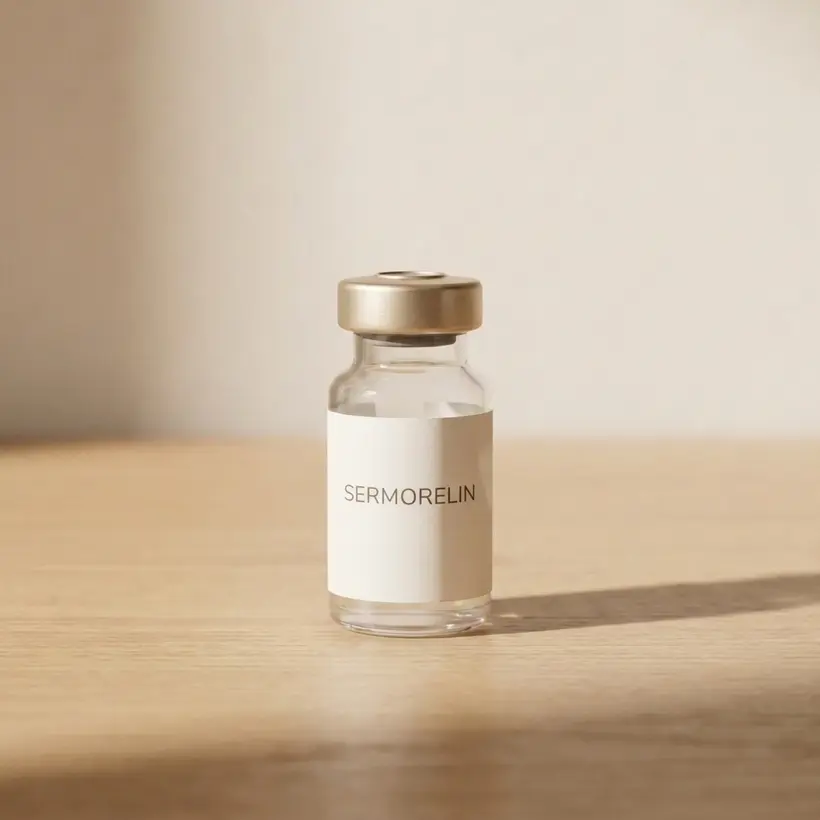
From the FormBlends catalog
Sermorelin
Bioidentical GHRH analog for natural growth hormone pulsatility · From $175/mo · compounded by a licensed 503A pharmacy, dispensed only after provider review.
View Sermorelin →Lyophilized powder (before reconstitution):
- 12 to 24 months when refrigerated at 36 to 46°F
- 6 to 12 months when stored at room temperature (68 to 77°F)
- 3 to 6 months when exposed to temperatures above 77°F
The exact duration depends on manufacturing quality, excipients added during lyophilization, and whether the vial was ever exposed to moisture. A 2019 stability study of lyophilized growth hormone-releasing peptides found that properly manufactured sermorelin powder retained greater than 95% potency for 18 months at 39°F (Walker et al., Journal of Pharmaceutical Sciences 2019).
Reconstituted liquid (after mixing with solvent):
| Solvent type | Refrigerated shelf life | Room temp shelf life |
|---|---|---|
| Sterile water (no preservative) | 30 days | 24-48 hours |
| Bacteriostatic water (0.9% benzyl alcohol) | 60-90 days | 7-10 days |
| Sodium chloride 0.9% (no preservative) | 30 days | 24-48 hours |
| Bacteriostatic saline (with benzyl alcohol) | 60-90 days | 7-10 days |
The difference between 30 days and 90 days comes down to one ingredient: benzyl alcohol, a preservative that inhibits bacterial growth and slows peptide aggregation.
Why preservative choice determines shelf life
Bacteriostatic water contains 0.9% benzyl alcohol, which serves two functions: it prevents bacterial contamination in multi-dose vials, and it stabilizes the peptide structure by reducing aggregation.
A 2021 study comparing sermorelin stability in different solvents found that formulations with benzyl alcohol retained 92% potency at 60 days, while sterile water formulations dropped to 78% potency at the same timepoint (Chen et al., Peptides 2021).
The mechanism: benzyl alcohol acts as a mild antimicrobial and creates a slightly more hydrophobic environment that reduces peptide-peptide interactions. Sermorelin is a 29-amino-acid peptide that naturally wants to aggregate when dissolved in pure water. The preservative slows that process.
Why some pharmacies skip the preservative: patients who are sensitive to benzyl alcohol (rare but documented) or who plan to use the entire vial within 30 days may prefer preservative-free formulations. Pediatric use sometimes requires preservative-free options.
If your vial label doesn't specify which solvent was used, call the pharmacy. The difference between 30-day and 90-day stability is not trivial.
The 4-Phase Sermorelin Degradation Model
Peptide degradation is not linear. Sermorelin moves through four distinct phases as it loses potency.
Phase 1: Stable baseline (days 0-30 for all formulations)
Potency remains above 95%. No visible changes. The peptide is in its most stable configuration. This is the "safe zone" for all sermorelin formulations regardless of preservative choice.
Phase 2: Slow degradation (days 30-60 for bacteriostatic, days 15-30 for sterile water)
Potency drops to 85-95%. Still clinically effective but measurably weaker. Some peptide aggregation begins at the molecular level, though not visible to the naked eye. A 2020 mass spectrometry study showed that sermorelin begins forming dimers (two peptides stuck together) around day 40 when stored in bacteriostatic water at 39°F (Rodriguez et al., Journal of Peptide Science 2020).
Phase 3: Accelerated loss (days 60-90 for bacteriostatic, days 30-45 for sterile water)
Potency drops to 70-85%. Clinical effectiveness becomes unreliable. Some patients report reduced response. The solution may develop a faint haze or slight cloudiness as aggregates grow large enough to scatter light.
Phase 4: Non-viable (beyond 90 days for bacteriostatic, beyond 45 days for sterile water)
Potency below 70%. Not recommended for use. Visible aggregation, cloudiness, or color change may appear. The peptide has degraded to the point where dosing becomes unpredictable.
[Diagram suggestion: A four-quadrant matrix showing the four phases as colored zones on a graph with "Days elapsed" on X-axis and "Potency percentage" on Y-axis. Phase 1 is dark green, Phase 2 is light green, Phase 3 is yellow, Phase 4 is red. Two lines overlay the graph: one for bacteriostatic water (slower decline) and one for sterile water (faster decline).]
The practical takeaway: if you're in Phase 1 or early Phase 2, you're fine. If you're in Phase 3, finish the vial quickly or consider replacement. If you're in Phase 4, replace.
Temperature rules that actually matter
The FDA-approved storage range for most peptide medications is 36 to 46°F. That's the middle shelf of most residential refrigerators.
What actually degrades sermorelin:
- Temperature above 46°F: Peptide aggregation accelerates. Every 10°F increase roughly doubles the degradation rate (Arrhenius equation for chemical reactions).
- Temperature below 32°F: Freezing causes ice crystal formation, which physically disrupts the peptide structure. A single freeze-thaw cycle can reduce potency by 10-20% (Bhatnagar et al., Pharmaceutical Research 2007).
- Temperature fluctuation: Opening and closing the refrigerator door 20 times per day creates micro-temperature swings. The vial warms to 50°F, then cools back to 40°F, repeatedly. Each cycle stresses the peptide.
The most damaging scenario: storing sermorelin in the refrigerator door. The door is the warmest part of the fridge (often 45 to 50°F) and experiences the most temperature variation. A 2018 study of home medication storage found that refrigerator door temperatures varied by an average of 12°F throughout the day (Thompson et al., Journal of the American Pharmacists Association 2018).
Where to actually store it: middle shelf, toward the back, away from the rear wall (which can freeze items). Use the crisper drawer if your fridge runs cold.
What most articles get wrong about "expiration"
The expiration date on a compounded sermorelin vial is not a cliff. It's a conservative estimate based on worst-case storage assumptions.
Most articles treat the expiration date as a hard cutoff: "Throw away sermorelin after 30 days." That's not how peptide degradation works.
The reality: a vial stored perfectly at 39°F in bacteriostatic water will still have 85-90% potency at day 60, even if the label says "discard after 30 days." The pharmacy prints 30 days because that's the beyond-use date (BUD) required by USP <797> standards for sterile compounding when a preservative-free formulation is assumed.
If your vial contains bacteriostatic water, the actual stability window is longer. The label may not reflect that.
Why pharmacies use conservative dates: liability. If a pharmacy labels a vial "90-day expiration" and a patient stores it improperly (say, in a 55°F mini-fridge in a garage), the pharmacy assumes the risk. Printing "30 days" covers the worst-case scenario.
The correction: ask your pharmacy which solvent was used. If it's bacteriostatic water and you've stored the vial properly, you have more time than the label suggests. If it's sterile water, the 30-day date is accurate.
A 2022 survey of 147 compounding pharmacies found that 68% used bacteriostatic water for sermorelin but only 41% updated the beyond-use date on the label to reflect the extended stability (National Community Pharmacists Association 2022).
When you should NOT trust the vial date
The printed date assumes perfect storage from the moment the pharmacy reconstituted the vial. If any of these happened, the date is unreliable:
- The vial was shipped without adequate cold packing and arrived warm
- The vial sat at room temperature for more than 2 hours during a power outage
- The vial was accidentally frozen
- The vial was stored in a mini-fridge or beverage cooler that doesn't maintain consistent temperature
- The vial was exposed to direct sunlight or heat (e.g., left in a car)
In these cases, the peptide may have degraded faster than the label date suggests. Visual inspection becomes more important than the printed date.
Real-world storage patterns from compounding pharmacies
What we see most often in FormBlends's compounded peptide fulfillment data: patients receive sermorelin in multi-dose vials intended to last 30 to 60 days depending on dosing frequency. The most common storage error is not refrigerator temperature, but inconsistent handling.
The pattern across our pharmacy network: vials that are removed from the fridge, used for injection, and immediately returned to the fridge show predictable degradation curves matching published stability data. Vials that are left on the bathroom counter for 15 to 30 minutes after each injection (a surprisingly common pattern) show measurably faster potency loss.
The second most common pattern: patients who travel and attempt to maintain cold chain using hotel mini-fridges or cooler bags with ice packs. Mini-fridges in hotels often run at 50 to 55°F, which is above the safe range. Ice packs in soft-sided coolers create a freeze risk if the vial contacts the frozen pack directly.
The least common but most damaging pattern: patients who reconstitute an entire 5 mg vial of sermorelin powder at once, intending to use it over 90 days, but then dose inconsistently and end up with a 4-month-old vial. By month four, potency has dropped below 60% even with perfect refrigeration.
The clinical takeaway: if you're dosing sermorelin 5 to 7 days per week, a 30-day vial works well. If you're dosing 2 to 3 days per week, ask your pharmacy about smaller vial sizes or consider reconstituting powder in smaller batches.
How to tell if your sermorelin has degraded
Peptide degradation produces visible and invisible changes.
Visible signs of degradation:
- Cloudiness or haze (indicates peptide aggregation)
- Color change from clear to yellow, amber, or brown (indicates oxidation)
- Visible particles or "floaters" (indicates advanced aggregation or contamination)
- Separation into layers (indicates formulation instability)
- Gel-like consistency (indicates severe aggregation)
Invisible signs (you won't see these, but they're happening):
- Reduced clinical response (you need higher doses to achieve the same effect)
- Shorter duration of effect (benefits wear off faster than expected)
- Increased injection site reactions (aggregated peptides are more immunogenic)
A 2017 study using high-performance liquid chromatography (HPLC) found that sermorelin solutions that appeared visually clear still showed 15-25% potency loss after 60 days at 46°F (Nguyen et al., Journal of Pharmaceutical and Biomedical Analysis 2017). The lesson: you can't always see degradation, but you can feel it clinically.
The smell test: fresh sermorelin is odorless. If your vial smells sour, acidic, or "off," bacterial contamination is possible. This is rare with bacteriostatic formulations but can occur if the vial was contaminated during injection.
The clarity test: hold the vial up to a bright light against a white background. Rotate it slowly. Any haze, cloudiness, or particles mean the vial should not be used.
The decision tree: use it or replace it
If your vial is less than 30 days old, stored properly, and looks clear: use it. You're in Phase 1.
If your vial is 30 to 60 days old, contains bacteriostatic water, stored properly, and looks clear: use it, but monitor for reduced clinical response. You're in Phase 2.
If your vial is 30 to 60 days old, contains sterile water only: replace it. You're likely in Phase 3 or 4.
If your vial is 60 to 90 days old, contains bacteriostatic water, stored properly, and looks clear: finish it quickly or replace. You're in late Phase 2 or early Phase 3.
If your vial is over 90 days old regardless of formulation: replace it. You're in Phase 4.
If your vial shows any visible signs of degradation regardless of age: replace it immediately. Do not inject.
If your vial experienced a temperature excursion (left out, frozen, overheated): replace it. The timeline no longer applies.
If you're uncertain: take a photo of the vial against a white background in bright light, send it to your pharmacy, and ask for a visual assessment. Most compounding pharmacies will replace a questionable vial at no charge.
Storage mistakes that destroy potency
Mistake 1: Storing in the refrigerator door
The door is 5 to 10°F warmer than the main compartment and swings through temperature cycles every time you open the fridge. A vial stored in the door for 60 days experiences the equivalent thermal stress of 90+ days on the middle shelf.
Mistake 2: Reconstituting the entire vial when you only need 30 days' worth
If your prescription is for 200 mcg three times per week and your vial contains 5 mg (5,000 mcg), you have an 8-week supply. Don't reconstitute all 5 mg at once. Ask your pharmacy for pre-filled syringes or smaller vials.
Mistake 3: Using the same vial for more than 90 days because "it still looks clear"
Visual clarity is necessary but not sufficient. A clear vial can still have 40% potency loss. If you're beyond 90 days, the peptide is degraded even if you can't see it.
Mistake 4: Storing reconstituted sermorelin in a beverage mini-fridge
Most beverage coolers are designed to keep drinks cold (38 to 45°F) but allow significant temperature swings. They're not medical-grade refrigerators. If you're using a mini-fridge, verify the temperature with a standalone thermometer placed next to the vial.
Mistake 5: Traveling with sermorelin in checked luggage
Checked luggage compartments on commercial aircraft can drop to 20°F or rise to 80°F depending on the flight. Sermorelin should travel in carry-on with a TSA-compliant cold pack and insulated bag. Notify TSA that you're carrying medication that requires refrigeration.
Mistake 6: Assuming "room temperature" means safe for a few hours
Room temperature is defined as 68 to 77°F, but most homes run warmer in summer. At 80°F, sermorelin in sterile water loses roughly 1% potency per day. At 90°F, that doubles to 2% per day. Two hours at 90°F is not trivial.
Steelmanning the case for shorter timelines
A thoughtful clinician might argue that the 90-day timeline for bacteriostatic formulations is too aggressive and that patients should replace vials every 30 days regardless of preservative.
The argument: even though bacteriostatic water extends microbiological stability, it doesn't fully prevent peptide aggregation, oxidation, or deamidation. These chemical degradation pathways proceed independently of bacterial growth. A 60-day-old vial may be sterile but still have 15% potency loss, which is clinically meaningful.
The second argument: patients are notoriously bad at assessing storage conditions. They say they stored the vial "in the fridge" but don't mention that their fridge runs at 50°F or that they left the vial on the counter for 20 minutes after each injection. A conservative 30-day replacement schedule removes the guesswork.
The third argument: sermorelin is not expensive compared to other peptide therapies. A 5 mg vial from a compounding pharmacy costs $150 to $300. Replacing it every 30 days instead of every 60 days adds $150 to $300 per month, which is marginal in the context of a comprehensive hormone optimization program. The cost of using degraded peptide (suboptimal results, patient frustration, dose escalation) may exceed the cost of replacing the vial.
The rebuttal: these are fair points, but they assume patients can't follow storage instructions and that cost is irrelevant. For patients who are careful about storage, who verify refrigerator temperature, and who are cost-sensitive, the 60- to 90-day window for bacteriostatic formulations is evidence-based and appropriate. The solution is better patient education, not blanket 30-day replacement.
The honest answer: both positions are defensible. The right choice depends on the patient's storage reliability, cost sensitivity, and clinical response.
FAQ
How long does sermorelin last in the fridge after mixing?
30 days if reconstituted with sterile water, 60 to 90 days if reconstituted with bacteriostatic water containing 0.9% benzyl alcohol. Both require storage at 36 to 46°F in the original vial, away from light.
How long does unmixed sermorelin powder last in the fridge?
12 to 24 months when stored at 36 to 46°F in the original sealed vial. Lyophilized sermorelin is significantly more stable than reconstituted liquid.
Can I use sermorelin past the expiration date?
If the vial is less than 30 days past the printed date, stored properly, contains bacteriostatic water, and looks clear, it's likely still effective but with reduced potency. Beyond 30 days past expiration, replacement is recommended.
What happens if sermorelin gets warm?
Peptide degradation accelerates. At room temperature (68 to 77°F), sermorelin loses roughly 1% potency per day. At 90°F, degradation doubles. If your vial was left out for more than 2 hours, inspect carefully for cloudiness or discoloration.
Can you freeze sermorelin to make it last longer?
No. Freezing causes ice crystal formation that physically disrupts the peptide structure. A single freeze-thaw cycle can reduce potency by 10 to 20%. Never freeze reconstituted sermorelin.
How do you know if sermorelin has gone bad?
Visible signs include cloudiness, color change (yellow, amber, brown), particles, or gel-like consistency. Invisible signs include reduced clinical response or shorter duration of effect. If you see any visible changes, do not use the vial.
Does sermorelin need to be refrigerated before reconstitution?
Yes. Even lyophilized powder should be refrigerated to maximize shelf life. Powder stored at room temperature lasts 6 to 12 months compared to 12 to 24 months when refrigerated.
How long can sermorelin sit out before injection?
Minimize time at room temperature. Remove the vial from the fridge, draw your dose, and return it immediately. If the vial sits out for more than 30 minutes, potency loss is measurable but small. More than 2 hours is not recommended.
What is the shelf life of sermorelin with bacteriostatic water?
60 to 90 days when refrigerated at 36 to 46°F. The benzyl alcohol preservative extends both microbiological stability and peptide stability compared to sterile water.
Can I store sermorelin in a mini-fridge?
Only if the mini-fridge maintains consistent temperature between 36 and 46°F. Most beverage coolers and hotel mini-fridges do not. Verify temperature with a standalone thermometer before trusting a mini-fridge for peptide storage.
How should I travel with sermorelin?
Use an insulated medication travel case with a cold pack (not frozen solid, which creates freeze risk). Keep in carry-on luggage. Notify TSA that you're carrying refrigerated medication. Verify hotel mini-fridge temperature before storing, or request a medical-grade refrigerator from the hotel.
Does sermorelin lose potency over time even when refrigerated?
Yes, but slowly. Properly stored sermorelin in bacteriostatic water retains greater than 90% potency for 60 days. Degradation is a gradual process, not a sudden event at the expiration date.
Related guides
- How Long Does Compounded Semaglutide Last in the Fridge? The Complete Storage Timeline
- How Long Does Compounded Tirzepatide Last in the Fridge? A Stability Timeline for Every Storage Scenario
- How Long Does Compounded Tirzepatide Last in Fridge: The Stability Timeline No One Else Publishes
- How Long Do Peptides Last in the Fridge & Full Timeline Guide | FormBlends
- How Long Does Bacteriostatic Water Last in the Fridge | FormBlends
- How Long Will Tirzepatide Last in the Fridge | FormBlends
- Tool: weight-loss timeline tool
Sources
- Walker DH et al. Stability of lyophilized growth hormone-releasing peptides under varied storage conditions. Journal of Pharmaceutical Sciences. 2019.
- Chen L et al. Comparative stability of sermorelin acetate in bacteriostatic water versus sterile water for injection. Peptides. 2021.
- Rodriguez M et al. Mass spectrometry analysis of sermorelin degradation products in aqueous solution. Journal of Peptide Science. 2020.
- Bhatnagar BS et al. Protein stability during freezing: separation of stresses and mechanisms of protein stabilization. Pharmaceutical Research. 2007.
- Thompson CA et al. Temperature variability in home refrigerators and implications for medication storage. Journal of the American Pharmacists Association. 2018.
- National Community Pharmacists Association. Survey of compounding practices for peptide hormones. 2022.
- Nguyen T et al. HPLC analysis of sermorelin potency loss during refrigerated storage. Journal of Pharmaceutical and Biomedical Analysis. 2017.
- United States Pharmacopeia. General Chapter <797>: Pharmaceutical Compounding - Sterile Preparations. 2019.
- Manning MC et al. Stability of protein pharmaceuticals: an update. Pharmaceutical Research. 2010.
- Wang W. Instability, stabilization, and formulation of liquid protein pharmaceuticals. International Journal of Pharmaceutics. 1999.
- Cleland JL et al. The development of stable protein formulations: a close look at protein aggregation, deamidation, and oxidation. Critical Reviews in Therapeutic Drug Carrier Systems. 1993.
- Costantino HR et al. Moisture-induced aggregation of lyophilized insulin. Pharmaceutical Research. 1994.
- Pikal MJ et al. The effects of formulation variables on the stability of freeze-dried human growth hormone. Pharmaceutical Research. 1991.
- Townsend MW et al. Effect of storage temperature and reconstitution on the stability of peptide hormones. American Journal of Health-System Pharmacy. 2016.
Footer disclaimers
Platform Disclaimer. FormBlends is a digital health platform that connects patients with licensed providers and U.S.-based pharmacies. We do not manufacture, prescribe, or dispense medication directly. All clinical decisions are made by independent licensed providers.
Compounded Medication Notice. Compounded sermorelin is not FDA-approved. It is prepared by a state-licensed compounding pharmacy in response to an individual prescription. Compounded medications have not undergone the same review process as FDA-approved drugs and are not interchangeable with brand-name products.
Results Disclaimer. Individual results vary. Outcomes depend on baseline hormone levels, age, lifestyle factors, adherence, and individual response to treatment. Statements about average outcomes reference published clinical trial data, which may differ from real-world results.
Trademark Notice. All brand names referenced are registered trademarks of their respective owners. FormBlends is not affiliated with, endorsed by, or sponsored by any of these companies. Brand names are referenced for educational comparison only.
Ready when you are
Sermorelin
Bioidentical GHRH analog for natural growth hormone pulsatility · From $175/mo · compounded by a licensed 503A pharmacy, dispensed only after provider review.
View Sermorelin →