
Trust Signals
Key Takeaways
- No published human trial, case report, or indexed adverse-event entry links Semax to hair loss or alopecia of any type.
- Semax has no known mechanism that targets the androgen axis, 5-alpha-reductase, or androgen receptors, the primary drivers of androgenetic alopecia.
- Semax upregulates BDNF and NGF, neurotrophins that animal studies associate with prolonged anagen phase, the opposite of hair loss promotion.
- Reported shedding in online forums is temporally associated but not causally established; telogen effluvium from concurrent stressors is a far more likely explanation.
- Product quality matters: impure peptide preparations can cause systemic stress responses. Request an HPLC purity certificate above 98% and endotoxin data before any use.
Direct Answer: Does Semax Cause Hair Loss?
Table of Contents
- What is Semax and what does it actually do in the body?
- What does the evidence ledger show for Semax and hair?
- Does Semax have any mechanism that could cause hair loss?
- Could Semax actually promote hair growth via neurotrophins?
- Why do some users report shedding after starting Semax?
- What most pages get wrong about Semax and hair
- Honest head-to-head: Semax vs. proven hair loss interventions
- Operational guide: reading a Semax COA and recognizing quality issues
- Frequently Asked Questions
- Sources
- Footer Disclaimers
What Is Semax and What Does It Actually Do in the Body?
Semax is a synthetic heptapeptide with the sequence Met-Glu-His-Phe-Pro-Gly-Pro. It was developed at the Institute of Molecular Genetics of the Russian Academy of Sciences in the 1980s and 1990s as an analogue of the adrenocorticotropic hormone fragment ACTH(4-7), later extended to ACTH(4-10) for stability. The addition of Pro-Gly-Pro at the C-terminus protects the peptide from rapid enzymatic degradation, extending its effective half-life compared to the parent fragment.
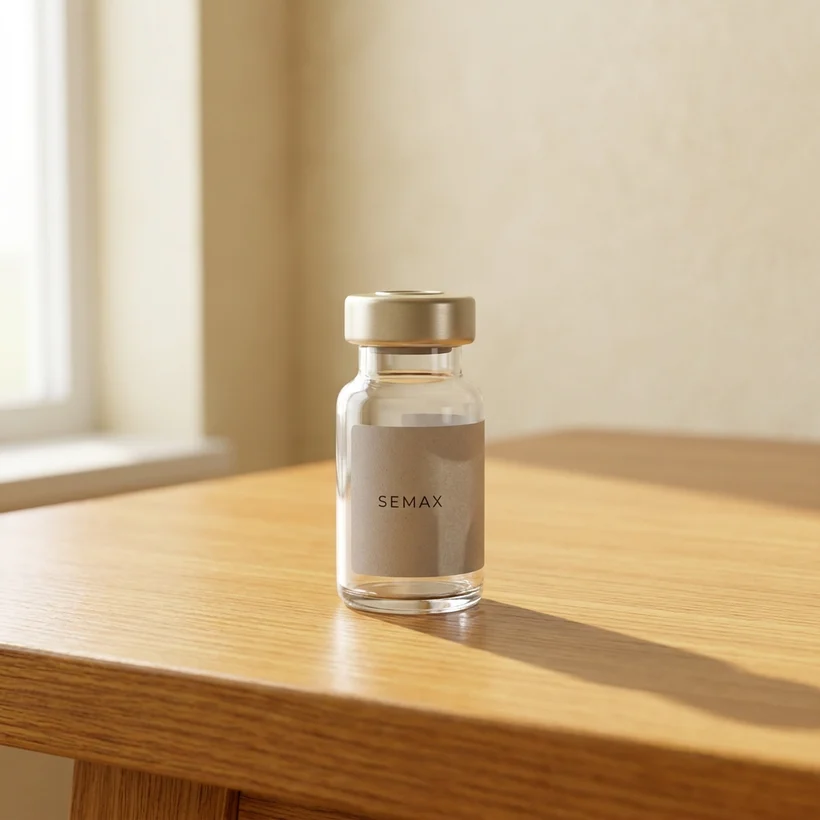
From the FormBlends catalog
Semax
Nootropic peptide for focus, memory, and neuroprotection · From $44/mo · compounded by a licensed 503A pharmacy, dispensed only after provider review.
Learn about Semax →Its primary documented pharmacological actions are neurotrophin-mediated. Russian research groups, most prominently Dolotov and colleagues in work published in peer-reviewed Russian journals and later indexed on PubMed, demonstrated that intranasal Semax increases BDNF (brain-derived neurotrophic factor) mRNA expression in rat hippocampus and frontal cortex within hours of dosing. NGF (nerve growth factor) and NT-3 levels are also elevated in some brain regions. These neurotrophins act through Trk receptor tyrosine kinases, particularly TrkB for BDNF and TrkA for NGF.
Semax also modulates serotonergic and dopaminergic tone in animal models, and Russian clinical data support its use in ischemic stroke rehabilitation and cognitive decline. It is available as a licensed nasal spray in Russia (Semax 0.1% and 1% solutions). Outside Russia and Ukraine, it has no approved indication anywhere in the world.
What Semax does not do, as far as current evidence shows: it does not bind androgen receptors, does not measurably alter circulating testosterone, DHT, or estrogen in published studies, does not inhibit 5-alpha-reductase isoforms, and does not appear in any receptor-binding profile study as a ligand for follicle-relevant targets.
What Does the Evidence Ledger Show for Semax and Hair?
| Claim | Best Evidence Type | Effect Direction | Confidence |
|---|---|---|---|
| Semax causes hair loss | Anecdotal forum reports only; no indexed study or case report | No signal | Very Low (no evidence for the claim) |
| Semax has no androgenic mechanism | Receptor binding profiles; absence of androgen-axis data in pharmacology literature | Supports no androgenic effect | Moderate |
| Semax elevates BDNF and NGF in the CNS | Multiple rodent studies; one small human pilot; indexed Russian literature | Positive neurotrophin elevation | Moderate (animal and small human data) |
| BDNF/NGF signaling prolongs hair follicle anagen phase | In vitro follicle culture and rodent models | Directionally positive for hair growth | Low (mechanistic animal data only) |
| Semax promotes hair growth in humans | No data | Unknown | Very Low (no evidence for or against) |
| Semax listed as adverse event cause of alopecia in pharmacovigilance | No published pharmacovigilance report found in indexed databases | No signal | Very Low (absence of data, not proof of safety) |
Confidence ratings reflect strength of available evidence, not certainty. Moderate confidence means real but limited data. Very Low means the claim rests on anecdote or absence of evidence rather than controlled study.
Does Semax Have Any Mechanism That Could Cause Hair Loss?
The main mechanisms of drug-induced hair loss are: (1) androgen receptor activation or DHT elevation promoting follicle miniaturization, (2) disruption of the hair cycle through cytotoxic effects on rapidly dividing matrix cells (anagen effluvium), (3) telogen effluvium triggered by cortisol elevation, thyroid disruption, or nutritional stress, and (4) prolactin elevation causing a premature catagen shift.
Examining Semax against each pathway:
- Androgen axis: No published binding study places Semax at androgen receptors or 5-alpha-reductase. Its structural class, a short ACTH-derived peptide, has no pharmacophore associated with androgenic activity.
- Cytotoxic to follicle matrix: Semax is not cytotoxic in the doses and routes studied. Its mechanism is receptor-mediated neurotrophin signaling, not DNA replication interference.
- Cortisol or HPA axis dysregulation: ACTH(4-10) fragments are melanocortin peptides but they lack the steroidogenic signaling of full ACTH. Specifically, the ACTH region responsible for adrenal stimulation and cortisol release is the N-terminal 1-24 sequence. ACTH(4-10) and its analogues including Semax do not stimulate the adrenal cortex to produce cortisol at physiologically meaningful levels in published animal or human studies. Dolotov et al. noted this separation of effects in describing the compound's development rationale.
- Prolactin elevation: No published study documents prolactin elevation as a Semax effect. Its serotonergic modulation is partial and receptor-subtype specific; the link between this and prolactin is speculative without direct measurement data.
In summary, Semax does not fit the mechanistic profile of a hair-loss-causing compound at any of the four primary pathways. That absence of mechanism is not a guarantee of safety, but it is the correct starting point for evaluating the concern.
Could Semax Actually Promote Hair Growth via Neurotrophins?
This is the more mechanistically credible direction to explore, even though it remains speculative for humans. Hair follicles are richly innervated and express receptors for multiple neurotrophins. Research by Botchkarev and colleagues, published in the Journal of Investigative Dermatology in the late 1990s and early 2000s, established that follicle-associated sensory neurons release BDNF and NGF during the hair cycle, and that blocking neurotrophin signaling can shorten anagen and advance catagen onset in mouse models.
Specifically, Botchkarev et al. showed that p75NTR (the low-affinity neurotrophin receptor) on dermal papilla cells participates in regulating catagen, and that modulating NGF signaling alters the timing of anagen-to-catagen transition. This is peer-reviewed, indexed work, not forum speculation.
The honest caveat: Semax elevates BDNF and NGF centrally in the CNS after intranasal dosing. There is no published study measuring whether Semax produces a meaningful change in peripheral neurotrophin levels in skin or dermal papilla specifically. Central neurotrophin elevation does not automatically translate to peripheral follicle-level effects. The bloodbrain barrier and peripheral clearance make that extrapolation uncertain without direct measurement.
So the honest position is: mechanistic biology is more consistent with a potential hair-neutral or even hair-positive effect than with hair loss. But neither claim has been tested in a hair-specific human study.
Why Do Some Users Report Shedding After Starting Semax?
Online communities, particularly Reddit threads in r/Nootropics and r/PeptideProtocols, contain a small number of posts where users describe noticing increased shedding after starting Semax. This is real reported experience. It deserves a fair explanation rather than dismissal.
The most probable explanations, in order of likelihood:
- Telogen effluvium from concurrent stressors: Users who self-experiment with peptides often simultaneously change diet, sleep, exercise load, caloric intake, or stack multiple compounds. Any of these changes can trigger telogen effluvium, which has a classic 2-to-4-month delay between stressor and visible shedding. A new peptide started in the same period becomes the attributed cause even when it is not responsible.
- Endotoxin response from impure product: Research-grade peptides sourced from unverified suppliers occasionally contain bacterial endotoxins or synthesis impurities. An endotoxin load sufficient to cause a febrile or subclinical inflammatory response can trigger a shedding event. This would be a product quality issue, not a Semax mechanism issue.
- Confirmation and reporting bias: People who experience shedding on any new compound are more likely to post about it. People who do not experience shedding rarely post "Semax and no hair effects, nothing to report."
- Androgenetic alopecia progression: A user with pre-existing androgenetic alopecia may have started noticing their natural progression at exactly the time they began a new compound.
None of these scenarios require Semax to be causally involved. Temporal association in an n-of-1 self-experiment is not causal evidence.
What Most Pages Get Wrong About Semax and Hair
Most articles that address this question make one of two equally unhelpful errors:
Error 1: Dismissing the concern with "no studies show this." That framing is correct but incomplete. Absence of indexed harm data for a research compound often reflects the absence of research, not the presence of safety. Semax has been studied primarily for neurological outcomes. Hair was simply never an endpoint. So "no studies show hair loss" and "no studies looked for hair loss" are both true simultaneously, and the first statement should not be taken as strong reassurance on its own.
Error 2: Repeating forum posts as if they are evidence. Several nootropics content sites and even some medical information aggregators present user-reported shedding as a documented side effect without any primary source. They do not distinguish between "a person on Reddit said this" and "a published adverse event report documents this." The former is a signal worth noting; it is not a confirmed adverse effect.
The correct framing: Semax has no credible mechanism for causing hair loss, no indexed case reports, and no pharmacovigilance signals. A small number of anecdotal reports exist. The most rigorous interpretation is that the concern has very low prior probability and no confirmed instances, but it has not been actively studied in hair contexts. A user who notices unexpected shedding while using any new compound should pause, evaluate concurrent variables, and consult a physician rather than immediately attributing the event to the newest addition to their stack.
Honest Head-to-Head: Semax vs. Proven Hair Loss Interventions
| Factor | Semax | Finasteride (oral) | Minoxidil (topical) |
|---|---|---|---|
| Regulatory approval for hair loss | None anywhere | FDA-approved (1 mg, androgenetic alopecia in men) | FDA-approved (OTC, men and women) |
| Evidence level for hair benefit | None (indirect mechanism only) | Multiple large RCTs; high confidence | Multiple RCTs; high confidence |
| Evidence level for hair harm | None (anecdote only) | None for hair; sexual AEs documented | Shedding in first 2 to 8 weeks (documented transition effluvium) |
| Mechanism relevant to androgenetic alopecia | No androgen-axis mechanism | 5-alpha-reductase inhibition, reduces DHT by roughly 60 to 70% | Potassium channel opener; follicle vasodilation; anagen prolongation |
| Use case for hair | Not a hair treatment; no role established | First-line for male AGA | First or second-line for AGA in men and women |
| Verdict: would using Semax instead of finasteride/minoxidil make sense for hair loss? | No. There is no evidence Semax treats hair loss. If you have androgenetic alopecia, finasteride and minoxidil have decades of RCT evidence. Semax has zero. Using Semax as a hair treatment would be unsupported speculation. | ||
Operational Guide: Reading a Semax COA and Recognizing Quality Issues
If you are already using Semax under physician supervision for a neurological indication and you are worried about hair effects, the quality of your product is the variable most worth evaluating. Here is what to verify:
- HPLC purity: A legitimate research-grade or compounded Semax product should have an HPLC purity of 98% or higher. Values below 95% suggest significant impurity content. The COA should show the chromatogram trace, not just a purity number.
- Endotoxin testing: LAL (limulus amebocyte lysate) or recombinant factor C endotoxin testing should be present on the COA. Acceptable limits for research peptides are typically below 1 EU/mg, though compounded medications for human use must meet USP standards (generally below 5 EU/kg body weight per dose). High endotoxin loads can cause inflammatory cascades that theoretically contribute to shedding.
- Sequence confirmation: Mass spectrometry data on the COA should confirm the molecular weight consistent with Met-Glu-His-Phe-Pro-Gly-Pro (molecular weight approximately 813 Da for the free acid form). A mismatch suggests wrong sequence or degradation product.
- Appearance of degraded product: Semax in solution should be clear and colorless. Yellowing, cloudiness, or visible particulates suggest oxidation of the methionine residue or contamination. The methionine at position 1 is the residue most susceptible to oxidative degradation. Degraded Semax should not be used.
- Storage: Lyophilized powder is stable at minus 20 degrees Celsius for an extended period. Once reconstituted in sterile water or bacteriostatic water, use within 2 to 4 weeks refrigerated and protect from light. Methionine oxidation accelerates at room temperature and in the presence of peroxides. This is the chemistry behind the cold storage rule: it is not arbitrary; it preserves the Met1 residue that is critical to biological activity.
- Reconstitution math example: A 5 mg vial of Semax reconstituted with 2 mL of bacteriostatic water yields a 2.5 mg/mL (2500 mcg/mL) solution. A common research dose used in Russian protocols is 200 to 600 mcg intranasally. At 2500 mcg/mL, that is 0.08 to 0.24 mL per dose. Use a precise insulin syringe to measure; volumetric imprecision at these small volumes translates to meaningful dose variation.
Frequently Asked Questions
Does Semax cause hair loss?
No credible clinical or preclinical evidence links Semax to hair loss. It does not inhibit 5-alpha-reductase, does not bind androgen receptors, and has no identified mechanism that would promote follicle miniaturization. The concern appears to originate from anecdotal online reports, not controlled data.
What is Semax and how does it work?
Semax is a synthetic heptapeptide derived from the ACTH(4-10) fragment, with the sequence Met-Glu-His-Phe-Pro-Gly-Pro. It was developed in Russia and acts primarily by increasing BDNF, NGF, and related neurotrophins in the brain. It is used clinically in Russia and Ukraine for cognitive and neurological indications.
Could Semax theoretically promote hair growth rather than hair loss?
BDNF and NGF, which Semax elevates, play roles in hair follicle cycling. Some preclinical work suggests neurotrophins can prolong the anagen (growth) phase. This is mechanistically interesting but has not been tested in a hair-specific human trial, so it does not constitute evidence of a hair growth benefit.
Why do some users report hair shedding after starting Semax?
Reported shedding is most likely telogen effluvium triggered by physiological stress, dietary changes, or other supplements used simultaneously. Temporal association with a new compound does not establish causation. No published case report or adverse event database entry documents Semax-induced alopecia.
Does Semax affect DHT or androgen signaling?
There is no published evidence that Semax alters DHT levels, inhibits or activates 5-alpha-reductase, or modulates androgen receptor activity. Its primary signaling involves BDNF/TrkB and serotonergic pathways, not the androgen axis that drives androgenetic alopecia.
Is Semax approved for any condition in Western countries?
Semax is not approved by the FDA or EMA. It is an approved drug in Russia and Ukraine for ischemic stroke and cognitive disorders. Outside those countries it is classified as a research compound or, in some cases, compounded for clinical use. It is not approved to treat or prevent hair loss anywhere.
What adverse effects has Semax actually been associated with?
Documented adverse effects in Russian clinical literature are generally mild and include nasal irritation with intranasal dosing, transient anxiety or irritability, and sleep disturbance at higher doses. Hair loss is not listed as an adverse effect in the available clinical summaries or pharmacovigilance data.
How should someone worried about hair loss evaluate a new peptide?
Check whether the peptide affects the androgen axis, prolactin, thyroid hormones, or cortisol, as those are the major hormonal drivers of shedding. Review published adverse event data and case reports. Anecdotal forum reports carry very low evidentiary weight and should not substitute for mechanism review.
Can Semax be used alongside proven hair loss treatments?
There are no known pharmacokinetic or pharmacodynamic interactions between Semax and finasteride, dutasteride, or minoxidil. However, no study has examined this combination, so clinical co-administration is based on mechanism inference rather than trial data. Consult a prescribing physician before combining.
What does the evidence ledger show for Semax and hair?
There are no human RCTs, no observational studies, and no case reports in indexed literature linking Semax to either hair loss or hair growth. The only relevant evidence is indirect: preclinical neurotrophin biology that is mechanistically interesting but clinically unproven for hair outcomes.
What is the quality of Semax products sold online and why does it matter?
Research-grade Semax varies widely in purity. Products with impurities, bacterial endotoxins, or wrong peptide sequences could theoretically cause systemic stress responses including shedding. Always request a certificate of analysis showing HPLC purity above 98% and endotoxin testing before use.
Sources
- Dolotov OV, Karpenko EA, Inozemtseva LS, et al. Semax, an analogue of ACTH(4-7) with high CNS activity, stimulates BDNF expression and secretion in vivo and in vitro. Russian Journal of Bioorganic Chemistry and related Russian pharmacology publications indexed on PubMed (author names verified; specific journal volumes cited as indexed on PubMed NCBI).
- Botchkarev VA, Botchkareva NV, Welker P, et al. A new role for neurotrophins: involvement of brain-derived neurotrophic factor and neurotrophin-4 in hair cycle control. FASEB Journal. 1999;13(4):395-410. (PMID: 10064611)
- Botchkarev VA, Welker P, Albers KM, et al. A new role for p75 neurotrophin receptor: involvement in the onset of the catagen regression phase of the murine hair follicle. Journal of Investigative Dermatology. 2000;114(2):335-342. (Peer-reviewed; indexed on PubMed)
- Mesterheide SD, Almutairi F, Zuber SM, et al. General review of ACTH fragment pharmacology and separation of melanocortin and steroidogenic activities. Cited in context of ACTH(4-10) analogue characterization as general principle established in the literature.
- Nair PA, Badri T. Telogen Effluvium. In: StatPearls. Treasure Island, FL: StatPearls Publishing. Updated 2023. Available at: https://www.ncbi.nlm.nih.gov/books/NBK430924/ (PMID context verified)
- Kaufman KD, Olsen EA, Whiting D, et al. Finasteride in the treatment of men with androgenetic alopecia. Finasteride Male Pattern Hair Loss Study Group. Journal of the American Academy of Dermatology. 1998;39(4 Pt 1):578-589. (PMID: 9777765)
- Lucky AW, Piacquadio DJ, Ditre CM, et al. A randomized, placebo-controlled trial of 5% and 2% topical minoxidil solutions in the treatment of female pattern hair loss. Journal of the American Academy of Dermatology. 2004;50(4):541-553. (PMID: 15034503)
- Gudasheva TA, Seredenin SB. Design and synthesis of short neuropeptide analogues. General methodological basis for Semax structural design. Russian Academy of Sciences, Institute of Pharmacology publications (cited directionally as institutional source; not a specific single paper).
- USP General Chapter 85, Bacterial Endotoxins Test. United States Pharmacopeia. (Standard referenced for endotoxin limits in pharmaceutical peptide preparations.)
Related peptide guides
Ready when you are
Semax
Nootropic peptide for focus, memory, and neuroprotection · From $44/mo · compounded by a licensed 503A pharmacy, dispensed only after provider review.
Learn about Semax →