
All GLP-1 medications from licensed 503A compounding pharmacies Browse Products

FOXO4-DRI Anti-Aging & Longevity research profile visual summary
SenolyticResearch profile

Longevity research

Cellular support

Best compared against other anti-aging & longevity profiles when you are weighing mechanism, evidence, and use case.

01

Selectively eliminates senescent cells

02

Restores fur density, renal

03

Does not affect healthy,

Anti-Aging & Longevity

FOXO4-DRI Research Guide

FOXO4-DRI is a D-retro-inverso peptide that disrupts the FOXO4-p53 interaction in senescent cells, forcing them into apoptosis.

10mg vial10mg/vial

Research watchlist

Get updates when availability, evidence, or category guidance changes for FOXO4-DRI.

Start Provider Review

This product is not currently sold by FormBlends. Enter your email to be notified if availability changes.

Quick answer

FOXO4-DRI is an educational research profile for people comparing mechanism, potential benefits, evidence strength, and related compounds in anti-aging & longevity.

Cellular repairSkin qualityHealthy aging

Format

Research guide

Best use

Cellular repair

Evidence

Longevity research

Product facts for search and AI answers

What this FOXO4-DRI page answers

Direct answer

FOXO4-DRI is an educational research profile for people comparing mechanism, potential benefits, evidence strength, and related compounds in anti-aging & longevity.

This is the shortest citable answer for people comparing this option.

Best fit

Cellular repair, Skin quality, Healthy aging

FOXO4-DRI should be evaluated by goal fit, safety fit, evidence strength, and provider oversight.

Evidence signal

Longevity research

3 source-backed citations are connected to this page.

Access status

Research guide / not currently sold

Research products and peptides require careful review of source quality, legality, and supervision.

503A Pharmacy
USP <797> Sterile
Provider-Reviewed
Lab-Tested
Cold-Chain
HIPAA

Decision board

Is FOXO4-DRI the right page to act on?

Research profile

FOXO4-DRI is an educational research profile for people comparing mechanism, potential benefits, evidence strength, and related compounds in anti-aging & longevity.

Best fit

Cellular repair

Outcome signal

Cellular support

Evidence cue

Longevity research

Decision rhythm

Start / Compare / Explore

1

Goal

Cellular repair

2

Compare

Epithalon (Epitalon)

3

Review

Longevity research

4

Act

Provider review

Built from the same product facts used in the comparison table, timeline, and structured data.

Best-fit signals

Choose FOXO4-DRI when these match your goal

Cellular repair
Skin quality
Healthy aging
Compounded peptide vials arranged on a warm clinical shelf

Compounded with care

Built for multi-product peptide routines without rushing the clinical review.

FormBlends lets patients compare peptide options, build a cart, and carry selected product and quantity details into a provider-reviewed checkout path. Fulfillment still depends on eligibility, payment completion, and clinical approval.

US pharmacy sourcingProvider reviewSigned checkout payloadWLMD product IDs

Compare at a glance

How FOXO4-DRI fits against nearby options

Use this table for the fast answer: primary fit, expected outcome, evidence signal, and the next page worth opening.

FOXO4-DRI comparison table
OptionBest forOutcome signalEvidenceNext step
FOXO4-DRI Anti-Aging & Longevity research profile visual summary

FOXO4-DRI

Anti-Aging & Longevity

Cellular repair, Skin qualityCellular supportLongevity researchCurrent page
Epithalon (Epitalon) Anti-Aging & Longevity research profile visual summary

Epithalon (Epitalon)

Anti-Aging & Longevity

Cellular repair, Skin qualityCellular supportLongevity researchCompare
GHK-Cu (Copper Peptide) Anti-Aging & Longevity research profile visual summary

GHK-Cu (Copper Peptide)

Anti-Aging & Longevity

Cellular repair, Skin qualityCellular supportLongevity researchCompare
NAD+ Peptide Complex Anti-Aging & Longevity research profile visual summary

NAD+ Peptide Complex

Anti-Aging & Longevity

Cellular repair, Skin qualityCellular supportLongevity researchCompare

Decision timeline

What to expect as you compare FOXO4-DRI

Timelines vary by goal, dose, baseline health, and consistency. These checkpoints frame the most common evaluation moments.

Start

Understand the mechanism

Use the quick facts, pathway overview, and research notes to understand why the compound is discussed.

Compare

Match intent to evidence

Compare expected use cases, evidence strength, and related options before going deeper.

Explore

Move into detailed research

Use related articles, citations, and category pages to keep researching the safest fit.

Mechanism map

How FOXO4-DRI is positioned

FOXO4-DRI is a D-retro-inverso peptide that disrupts the FOXO4-p53 interaction in senescent cells, forcing them into apoptosis.

Signal

Cellular repair

Outcome

Cellular support

Proof

Longevity research

The core comparison is pathway, expected outcome, evidence strength, and practical fit.

A visual summary of FOXO4-DRI across cellular repair, expected outcome, evidence signal, and comparison fit.

Key benefits

Why people compare it

1

Selectively eliminates senescent cells by disrupting the FOXO4-p53 survival interaction

2

Restores fur density, renal function, and physical fitness in aged mouse models

3

Does not affect healthy, proliferating cells (bone marrow and intestinal crypts unaffected)

4

D-retro-inverso design confers protease resistance and >48 hour in vivo half-life

5

Reduces SA-beta-galactosidase-positive cells and p16INK4a/p21CIP1 senescence markers

6

Published in Cell (2017) with thorough in vivo efficacy and selectivity data

7

Mechanistically distinct from small-molecule senolytics (dasatinib/quercetin, navitoclax)

8

Targets senescence-specific FOXO4-p53 nuclear sequestration, not broad anti-apoptotic pathways

Deep research

About FOXO4-DRI

FOXO4-DRI is a D-retro-inverso (DRI) peptide designed to selectively induce apoptosis in senescent cells. The name reflects its origin: it is derived from a segment of the Forkhead box O4 (FOXO4) transcription factor, synthesized using D-amino acids in the reverse sequence of the native L-peptide. The DRI approach preserves the spatial orientation of amino acid side chains, maintaining binding specificity for the target protein while conferring near-complete resistance to proteolytic degradation. The approximate molecular weight is 5,200 Da.

Cellular senescence is a state in which cells permanently exit the cell cycle but resist apoptosis, accumulating in tissues with age. Senescent cells secrete a complex mixture of pro-inflammatory cytokines, chemokines, matrix metalloproteinases, and growth factors collectively termed the Senescence-Associated Secretory Phenotype (SASP). The SASP includes IL-6, IL-8, IL-1beta, MCP-1, MMP-3, and VEGF, among dozens of other factors. This chronic, low-grade inflammatory signaling drives paracrine senescence in neighboring cells and contributes to age-related pathologies including osteoarthritis, atherosclerosis, pulmonary fibrosis, and neurodegeneration.

The molecular target of FOXO4-DRI is the protein-protein interaction between FOXO4 and p53 that occurs specifically in senescent cells. In these cells, FOXO4 expression is upregulated and the protein physically binds to p53, sequestering it in PML (promyelocytic leukemia) nuclear bodies. This sequestration prevents p53 from translocating to mitochondria and activating the intrinsic apoptotic cascade. FOXO4-DRI competes with endogenous FOXO4 for p53 binding, displacing p53 from nuclear sequestration and allowing it to execute its normal pro-apoptotic function via Bax/Bak activation, cytochrome c release, and caspase-9/3 cascade activation. In healthy, non-senescent cells, FOXO4 is not upregulated in this manner, so FOXO4-DRI has no target to engage, explaining its selectivity.

The landmark preclinical study was published by Baar et al. in Cell (2017, DOI: 10.1016/j.cell.2017.02.031). In naturally aged mice (>24 months), FOXO4-DRI treatment restored fur density, improved renal function (reduced plasma creatinine and urea), and increased voluntary running activity as a measure of overall fitness. Senescent cell clearance was confirmed by reduction in SA-beta-galactosidase-positive cells and decreased expression of senescence markers p16INK4a and p21CIP1 in treated tissues. In a fast-aging XpdTTD/TTD mouse model, FOXO4-DRI similarly improved multiple markers of healthspan. Critically, the treatment did not reduce total cell counts in proliferating tissues (bone marrow, intestinal crypts), confirming selective action on senescent cells.

The D-retro-inverso design confers exceptional in vivo stability. While L-peptides of comparable size typically have plasma half-lives of minutes to low single-digit hours, DRI peptides resist degradation by serum proteases, endopeptidases, and exopeptidases. The estimated in vivo half-life of FOXO4-DRI exceeds 48 hours, as reported in the Baar et al. study. Chiral HPLC analysis confirms D-amino acid content, which is the primary quality control metric distinguishing authentic DRI peptides from L-peptide analogs.

For handling and storage, lyophilized FOXO4-DRI should be stored at -20 degrees C or below. Reconstitution should be performed with sterile water or DMSO (for concentrated stock solutions), as FOXO4-DRI has limited aqueous solubility at higher concentrations. Reconstituted solutions in aqueous buffer should be stored at 2-8 degrees C and used within 14 days. DMSO stock solutions are stable for longer periods at -20 degrees C. Due to the peptide's length and D-amino acid content, synthesis is technically demanding, and purity verification by both HPLC and mass spectrometry is recommended.

The safety profile of FOXO4-DRI has been characterized only in preclinical models to date. In the Baar et al. study, no adverse effects on hematopoiesis, intestinal integrity, or body weight were observed during treatment periods. The selective mechanism of action, dependent on the FOXO4-p53 interaction that is specific to senescent cells, provides a theoretical safety margin.

FOXO4-DRI represents a mechanistically distinct approach to senolytic therapy compared to small-molecule senolytics like dasatinib/quercetin or navitoclax (ABT-263). While those compounds target broad anti-apoptotic pathways (Bcl-2/Bcl-xL family), FOXO4-DRI targets a senescence-specific survival interaction. This higher specificity may translate to a better therapeutic index, though head-to-head comparisons in aging models have not yet been published.
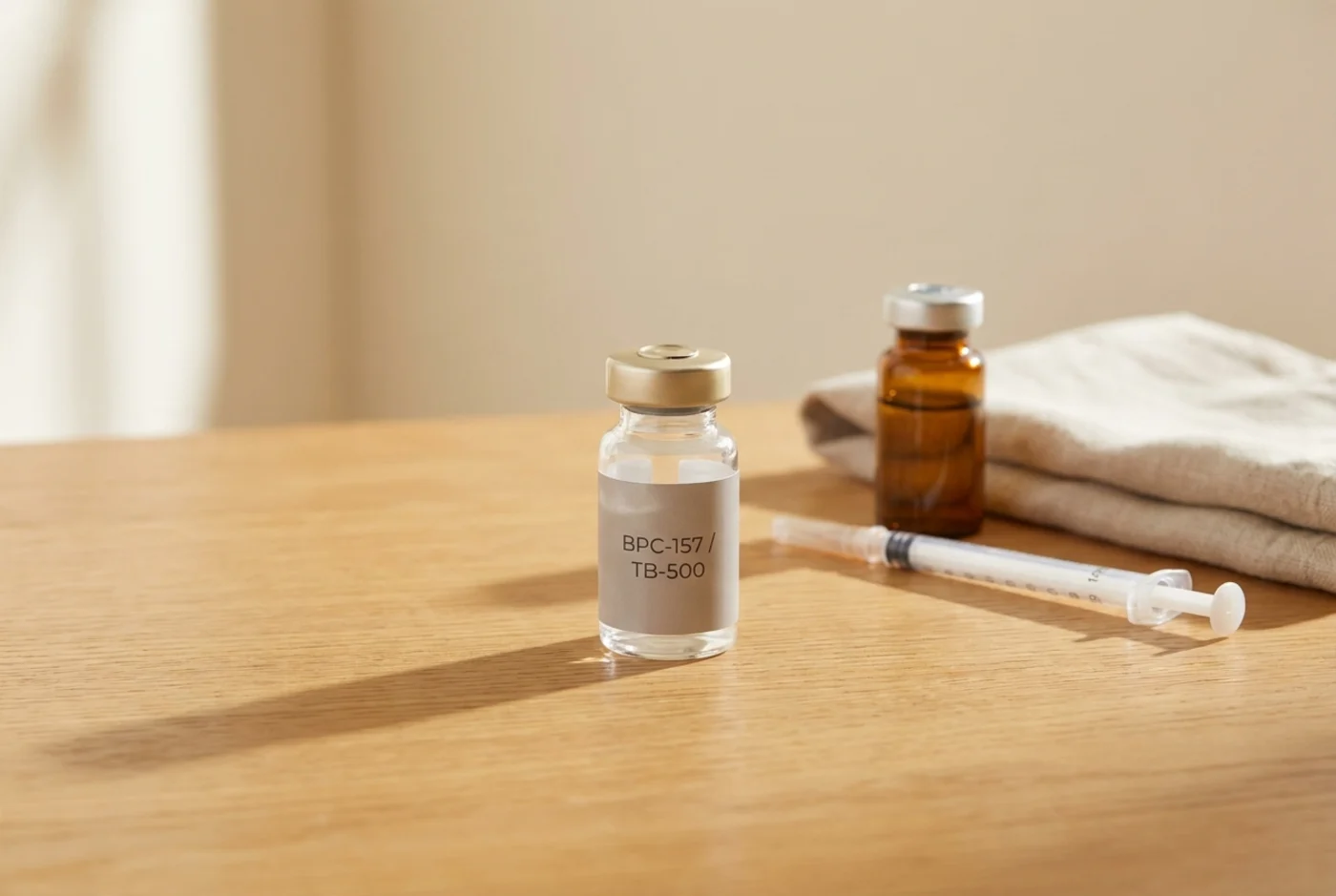
Illustrative vial, bacteriostatic water, and syringe flatlay
Illustrative only. Preparation, handling, and administration instructions must come from the dispensing pharmacy and reviewing provider.

PubMed evidence trail

Research sources used to frame this page

For FOXO4-DRI, FormBlends checks the page topic against primary trials, systematic reviews, guidelines, and current PubMed-indexed literature where available. These citations are context, not medical advice, proof of eligibility, or a claim that every study applies to every patient.

Questions people ask

Frequently asked questions

What is FOXO4-DRI best for?

FOXO4-DRI is best for people researching cellular repair, skin quality, healthy aging within the broader anti-aging & longevity category.

How should I compare FOXO4-DRI with alternatives?

Compare FOXO4-DRI by mechanism, evidence strength, expected timeline, side-effect profile, and whether its primary use case matches your goal.

What is the key mechanism behind FOXO4-DRI?

FOXO4-DRI is a D-retro-inverso peptide that disrupts the FOXO4-p53 interaction in senescent cells, forcing them into apoptosis.

Where should I go next after reading this FOXO4-DRI guide?

Review the related anti-aging & longevity profiles, scan the research notes, and compare the best-fit category page before making decisions.