The short answer
For most women, 1,600 calories produces a modest deficit and around 0.5 to 1 lb of weekly weight loss. It works well for a sedentary 130 lb woman (mild deficit) and an active 160 lb woman (more aggressive deficit). It's too low for active women over 180 lb and too high for some shorter, sedentary women.
Table of contents
- The 30-second answer
- Calculate your real maintenance calories
- The Mifflin-St Jeor equation, plain English
- Activity multipliers, with examples
- Where 1,600 calories actually lands for you
- The deficit math (and what to expect on the scale)
- When 1,600 is too low
- When 1,600 is too high
- What 1,600 calories looks like as actual food
- 1,600 calories on a GLP-1 medication
- FAQ
- Footer disclaimers
Calculate your real maintenance calories
Before you ask whether 1,600 calories is enough, you need to know what your body burns at rest and what it burns with movement. The starting point is BMR (basal metabolic rate), which is the calories your body uses if you lay in bed all day. The most accurate prediction equation for healthy adults is Mifflin-St Jeor, validated repeatedly since its 1990 publication and confirmed in the 2005 American Dietetic Association systematic review on RMR equations.
Check your GLP-1 eligibility
Use our free BMI Calculator to see if you may qualify for provider-reviewed GLP-1 therapy.
Try the BMI Calculator →For women: BMR = (10 × weight in kg) + (6.25 × height in cm) − (5 × age in years) − 161
For men: BMR = (10 × weight in kg) + (6.25 × height in cm) − (5 × age in years) + 5
Then multiply BMR by an activity factor (covered in the next section) to get total daily energy expenditure (TDEE), which is your real maintenance number.
The Mifflin-St Jeor equation, plain English
If math equations make your eyes glaze, here are three worked examples for women.
Example 1: 130 lb, 5'4", 35 years old, sedentary.
- Weight: 130 lb = 59 kg
- Height: 5'4" = 162 cm
- BMR = (10 × 59) + (6.25 × 162) − (5 × 35) − 161 = 590 + 1,012 − 175 − 161 = 1,266 calories at rest
- TDEE (sedentary, multiplier 1.2) = 1,266 × 1.2 = 1,520 calories/day
For this woman, 1,600 calories is above maintenance. She would not lose weight. She'd gain about 0.2 lbs per week.
Example 2: 160 lb, 5'5", 35 years old, lightly active (walks daily, lifts twice a week).
- Weight: 160 lb = 73 kg
- Height: 5'5" = 165 cm
- BMR = (10 × 73) + (6.25 × 165) − (5 × 35) − 161 = 730 + 1,031 − 175 − 161 = 1,425 calories at rest
- TDEE (lightly active, multiplier 1.375) = 1,425 × 1.375 = 1,960 calories/day
For this woman, 1,600 calories creates a 360-calorie deficit. She'd lose about 0.7 lbs per week.
Example 3: 195 lb, 5'7", 35 years old, moderately active.
- Weight: 195 lb = 88 kg
- Height: 5'7" = 170 cm
- BMR = (10 × 88) + (6.25 × 170) − (5 × 35) − 161 = 880 + 1,063 − 175 − 161 = 1,607 calories at rest
- TDEE (moderately active, multiplier 1.55) = 1,607 × 1.55 = 2,491 calories/day
For this woman, 1,600 calories creates an 891-calorie deficit. She'd lose about 1.8 lbs per week, which is on the aggressive end of the recommended range.
The same target (1,600) produces three completely different outcomes for three women in their mid-30s. That's the whole answer to "is 1,600 calories enough." It depends on which one of those women you are.
Activity multipliers, with examples
Pick the multiplier that honestly describes your week. Most people overestimate this. Be ruthless.
| Activity level | Multiplier | What this actually looks like |
|---|---|---|
| Sedentary | 1.2 | Desk job, no formal exercise, fewer than 5,000 steps/day |
| Lightly active | 1.375 | Desk job, 1 to 3 walks or workouts/week, 6,000 to 8,000 steps/day |
| Moderately active | 1.55 | Active job (teacher, nurse) or 4 to 5 workouts/week, 10,000+ steps/day |
| Very active | 1.725 | Physically demanding job + workouts, or 6+ intense workouts/week |
| Extremely active | 1.9 | Athletic training, 2x daily workouts, or labor-intensive job + sport |
The honest gut-check: if you walked your dog twice today and went to a yoga class on Tuesday, you're "lightly active," not "moderately active." Most people who self-report as moderately active are actually lightly active.
Where 1,600 calories actually lands for you
Here's a fast lookup table for women, assuming 35 years old. Adjust slightly down if older, slightly up if younger.
| Body weight | Sedentary TDEE | Lightly active TDEE | Moderately active TDEE | 1,600 cal effect |
|---|---|---|---|---|
| 120 lb / 5'2" | ~1,440 | ~1,650 | ~1,860 | Sedentary: gain. Light: 0.1 lb/wk loss. Moderate: 0.5 lb/wk loss. |
| 130 lb / 5'4" | ~1,520 | ~1,740 | ~1,960 | Sedentary: gain. Light: 0.3 lb/wk loss. Moderate: 0.7 lb/wk loss. |
| 140 lb / 5'5" | ~1,580 | ~1,810 | ~2,040 | Sedentary: minimal. Light: 0.4 lb/wk loss. Moderate: 0.9 lb/wk loss. |
| 150 lb / 5'6" | ~1,640 | ~1,880 | ~2,120 | Sedentary: minimal loss. Light: 0.6 lb/wk. Moderate: 1.0 lb/wk. |
| 160 lb / 5'5" | ~1,710 | ~1,960 | ~2,210 | Sedentary: 0.2 lb/wk. Light: 0.7 lb/wk. Moderate: 1.2 lb/wk. |
| 180 lb / 5'7" | ~1,830 | ~2,100 | ~2,360 | Sedentary: 0.5 lb/wk. Light: 1.0 lb/wk. Moderate: 1.5 lb/wk. |
| 200 lb / 5'7" | ~1,950 | ~2,240 | ~2,520 | Sedentary: 0.7 lb/wk. Light: 1.3 lb/wk. Moderate: 1.8 lb/wk. |
| 220 lb / 5'8" | ~2,080 | ~2,390 | ~2,690 | Sedentary: 1.0 lb/wk. Light: 1.6 lb/wk. Moderate: 2.2 lb/wk. |
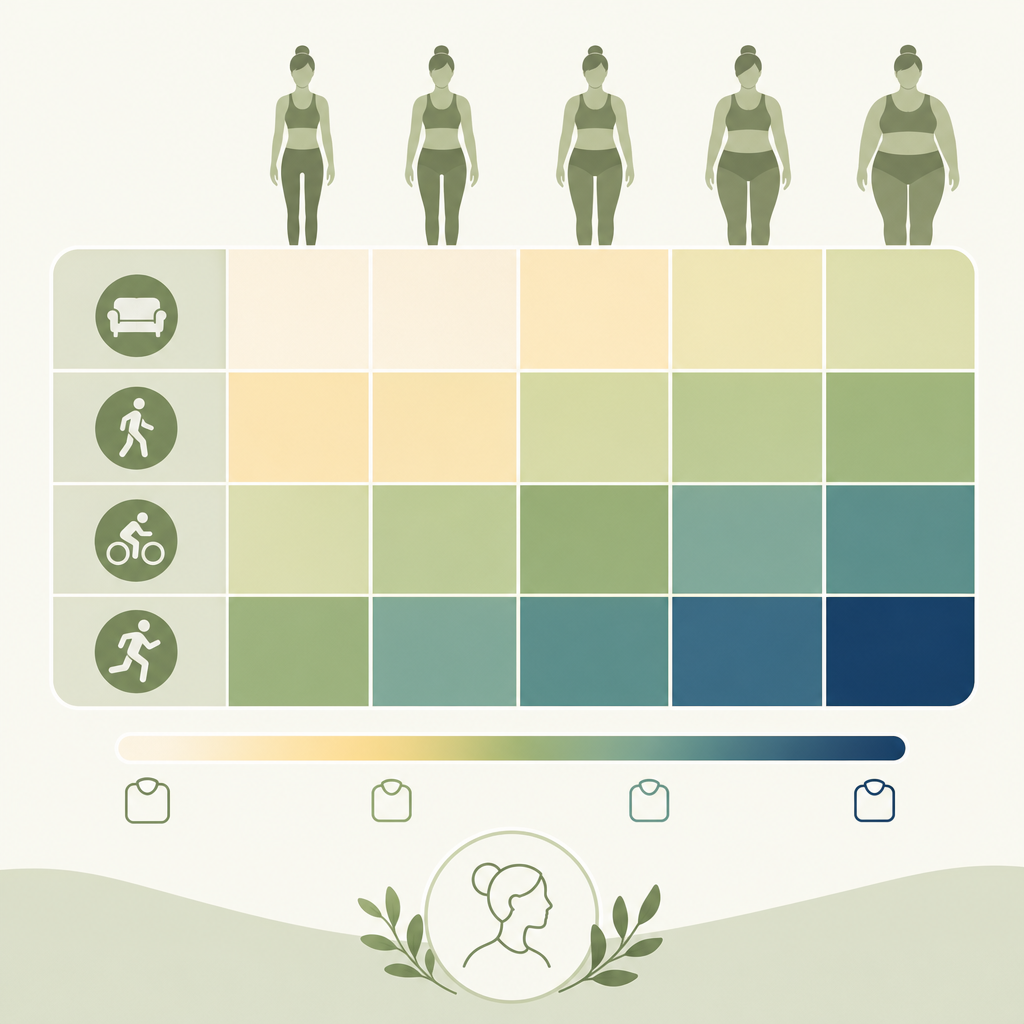
The clinical short read: 1,600 calories is a sweet-spot deficit for women in the 150 to 200 lb range with light to moderate activity. It's too restrictive for many women under 130 lb who are sedentary (because it puts them above maintenance, so they don't lose at all, ironically), and too restrictive for women over 200 lb who are very active (because the deficit gets aggressive enough to drive muscle loss).
The deficit math (and what to expect on the scale)
The traditional rule is that 3,500 calories equals one pound of fat. The more recent literature (Hall et al., Lancet, 2011, on the dynamics of weight change) shows the math is more complex. As you lose weight, your TDEE drops too, which is why deficits stop producing the same loss rate after a few weeks.
A practical rule:
- A 250 to 500 calorie/day deficit is the conservative, sustainable range. Expected loss: 0.5 to 1.0 lb/week.
- A 500 to 750 calorie/day deficit is moderate. Expected loss: 1.0 to 1.5 lb/week. Doable but harder to sustain.
- A deficit over 750 calories/day is aggressive. Often produces 1.5 to 2+ lb/week initially, but adherence drops sharply and muscle loss becomes a real risk.
For most women, 1,600 calories lands in the conservative-to-moderate range, which is exactly where weight-loss programs aim. The Academy of Nutrition and Dietetics' position paper recommends a deficit of 500 to 1,000 calories/day for adults with overweight or obesity, with weekly loss between 0.5 and 2 lbs.
What to expect week to week:
- Week 1: Loss is usually 2 to 4 lbs. Most of this is water and glycogen, not fat. Don't read too much into the first-week scale drop.
- Weeks 2 to 4: Loss settles into the steady range your math predicted (typically 0.5 to 1.5 lbs per week).
- Weeks 5 to 8: First plateau. Often a 7 to 14 day stall as the body adjusts to the new TDEE. Don't panic.
- Weeks 9+: Continued loss requires a recalculation. Your TDEE has dropped 80 to 150 calories from the starting number, so the same 1,600 produces a smaller deficit.
When 1,600 is too low
Three patterns where 1,600 calories will hurt rather than help.
Sedentary women under 5'2" weighing under 120 lb. TDEE often runs around 1,300 to 1,400 calories. A 1,600 target is above maintenance, so weight will hold or rise. The fix is to either add activity (which raises TDEE) or set a lower target (around 1,200 to 1,400, ideally with provider input).
Women already in a long-running aggressive deficit. If you've been eating 1,200 to 1,400 calories for 6+ months, your TDEE has adapted downward. Jumping to 1,600 will not feel like progress. The right move is usually a structured "diet break" at maintenance for 2 to 4 weeks, then a fresh deficit set.
Women with a history of disordered eating. Tracking calories at a fixed target can re-trigger restrictive patterns. The clinical alternative is structured meal patterns (3 meals + 1 to 2 snacks, with target protein per meal) without explicit calorie counting. Talk to a clinician.
When 1,600 is too high
Two scenarios where the 1,600 target won't move the scale.
Truly sedentary lifestyle. Working from home, no daily walk, fewer than 4,000 steps/day. A 130 lb woman in this pattern has a TDEE around 1,400 to 1,500. The fix is usually adding 5,000 to 7,000 daily steps, which raises TDEE by 200 to 300 calories and makes 1,600 a real deficit.
Older women with reduced muscle mass. Postmenopausal women in their 60s and 70s often have TDEE values 200 to 400 calories lower than the equation predicts because of sarcopenia (age-related muscle loss). Resistance training is the most effective intervention because it raises BMR and changes the equation's predictive accuracy.
What 1,600 calories looks like as actual food
The number itself is meaningless without the structure. A 1,600-calorie day built well looks satiating and varied. A 1,600-calorie day built poorly leaves you hungry and frustrated. Here's a sample structure that works for most women:
Sample 1,600-calorie day:
| Meal | Foods | Cal | Protein |
|---|---|---|---|
| Breakfast | 2 eggs scrambled + 1/2 cup oatmeal + 1/2 cup berries | 360 | 18 g |
| Mid-morning snack | 5 oz plain Greek yogurt + 1 tbsp almonds | 180 | 18 g |
| Lunch | 4 oz grilled chicken + 1 cup quinoa + 2 cups salad with 1 tbsp olive oil | 530 | 35 g |
| Afternoon snack | 1 medium apple + 1 tbsp peanut butter | 190 | 4 g |
| Dinner | 5 oz salmon + 1 cup roasted vegetables + 1/2 cup brown rice | 480 | 35 g |
| Total | 1,740 | 110 g |
The slight over-shoot (1,740 vs 1,600) shows why most "1,600 calorie" plans actually run 1,500 to 1,700 in real life. Adjust portions to dial in. The protein number (110 g) is the more important variable for most women trying to preserve muscle during weight loss.
The 2020 Journal of the International Society of Sports Nutrition position stand recommends 1.6 to 2.4 g of protein per kg of body weight during a calorie deficit. For a 160 lb woman, that's 116 to 175 g of protein per day. Most 1,600-calorie meal plans designed by influencers undershoot protein badly. Build the day around protein, fill in the rest.
1,600 calories on a GLP-1 medication
Patients on compounded semaglutide or tirzepatide often find that 1,600 calories is more than they can eat during dose-escalation weeks. The food-noise reduction and gastric slowing combine to make 1,200 to 1,400 the natural intake during titration.
This creates a real risk if not handled correctly: muscle loss. The 2022 SURMOUNT-1 trial of tirzepatide showed average weight loss of around 21% at the highest dose, but participants who didn't deliberately maintain protein intake lost a higher percentage of lean mass.
Practical guidance for GLP-1 patients:
- Set a protein floor, not a calorie floor. Aim for 1.2 to 1.6 g of protein per kg of body weight, even if total calories drop. For a 180 lb woman, that's 98 to 130 g of protein. Hit that first, regardless of calorie total.
- Don't push to hit 1,600 if your appetite says 1,300. Forced eating during titration tends to trigger nausea and reflux. (More on this in our piece on why GLP-1s can cause acid reflux.)
- Re-evaluate at 90 days. Once you're settled at a stable dose, intake usually rises back into the 1,400 to 1,700 range. That's the time to revisit the 1,600 target.
- Strength train. The single most effective intervention for preserving lean muscle on a GLP-1 medication is resistance training 2 to 3 times per week. Cardio doesn't substitute.
FAQ
Will I lose weight on 1,600 calories a day?
Probably, if your TDEE is above 1,600. For most women between 140 and 200 lbs with light to moderate activity, 1,600 produces a 250 to 700 calorie daily deficit and weekly loss of 0.5 to 1.5 lbs. For sedentary women under 130 lbs, 1,600 may be at or above maintenance.
How much weight will I lose on 1,600 calories per week?
Anywhere from 0 to 2 lbs depending on your TDEE. Use the Mifflin-St Jeor equation and activity multiplier to find your TDEE, subtract 1,600, then divide by 500 to get pounds per week. Real-world results often track 70 to 90% of the predicted number due to metabolic adaptation.
Is 1,600 calories too low for a woman?
For most women in the 150 to 220 lb range, no. It's a sustainable moderate deficit. For shorter, lighter, or much older women, 1,600 may not produce loss at all. For taller or very active women over 200 lbs, 1,600 can be aggressive and may risk muscle loss without enough protein.
How do I calculate my own daily calorie target?
Use the Mifflin-St Jeor equation: BMR = (10 × kg weight) + (6.25 × cm height) − (5 × age) − 161 for women. Multiply by activity (1.2 sedentary, 1.375 lightly active, 1.55 moderately active). Subtract 250 to 500 from that TDEE for a sustainable deficit.
Can I eat 1,600 calories and not lose weight?
Yes, if 1,600 is at or above your TDEE. Sedentary women under 130 lbs often hit this scenario. Adding 5,000 to 7,000 daily steps raises TDEE by 200 to 300 calories and turns 1,600 into a real deficit.
How much protein should I eat on 1,600 calories?
For weight loss with muscle preservation, aim for 1.2 to 1.6 g of protein per kg of body weight. A 160 lb woman should target 87 to 116 g of protein daily. Most 1,600-calorie meal plans run too low on protein (60 to 80 g), which drives muscle loss and increased hunger.
What's the lowest calorie a woman should eat?
The American College of Sports Medicine recommends not going below 1,200 calories per day without medical supervision. Below that, micronutrient gaps become difficult to avoid and metabolic adaptation accelerates. 1,600 is well above the floor for almost all adult women.
Does 1,600 calories work for older women?
Often yes, with caveats. Postmenopausal women in their 60s and beyond may have TDEE 200 to 400 calories lower than the equation predicts due to muscle loss. Adding strength training 2 to 3 times per week is the best intervention to keep 1,600 effective.
Will I be hungry on 1,600 calories a day?
That depends on the food choices, not the calorie number. A high-protein, high-fiber 1,600-calorie day with adequate volume rarely produces real hunger. A low-protein, low-fiber 1,600-calorie day (a few cookies, a smoothie, takeout) leaves most women hungry by mid-afternoon.
Can I lose weight faster than 1 lb per week on 1,600 calories?
For larger women (over 200 lbs) or very active women, yes. The faster loss usually slows after the first 6 to 8 weeks as TDEE adapts. For smaller, less-active women, 1,600 produces a slower 0.3 to 0.7 lb/week pace, which is still sustainable.
How long can I stay on 1,600 calories?
Indefinitely, if the macronutrient mix is right and the deficit is sustainable. Most women plateau every 8 to 12 weeks and need a brief diet break (2 to 4 weeks at maintenance) to reset. The plateau isn't failure. It's a normal physiological adaptation.
Is 1,600 calories realistic on a GLP-1 medication?
During dose escalation, often it's more than appetite allows. Many patients eat 1,200 to 1,400 calories during the first 90 days. Set a protein floor (1.2 to 1.6 g/kg) rather than a calorie floor, and don't force food when nausea is present.
Author / review note
Reviewed by the FormBlends Medical Team. This article was last reviewed and updated on April 29, 2026. References cited include Mifflin et al., American Journal of Clinical Nutrition, 1990 (resting energy expenditure equation); Frankenfield et al., Journal of the American Dietetic Association, 2005 (REE prediction systematic review); Hall et al., Lancet, 2011 (quantitative model of human weight change); Jastreboff et al., New England Journal of Medicine, 2022 (SURMOUNT-1 tirzepatide trial); and the Academy of Nutrition and Dietetics 2016 position on weight management.
Footer disclaimers
Platform Disclaimer. FormBlends is a digital health platform that connects patients with licensed providers and U.S.-based pharmacies. We do not manufacture, prescribe, or dispense medication directly. All clinical decisions are made by independent licensed providers.
Compounded Medication Notice. Compounded semaglutide and tirzepatide are not FDA-approved. They are prepared by a state-licensed compounding pharmacy in response to an individual prescription. Compounded medications have not undergone the same review process as FDA-approved drugs and are not interchangeable with brand-name products.
Results Disclaimer. Individual results vary. Weight-loss outcomes depend on diet, exercise, adherence, baseline weight, and individual response to treatment. Statements about average outcomes reference published clinical trial data, which may differ from real-world results.
Trademark Notice. All brand names referenced are the property of their respective owners. FormBlends is not affiliated with, endorsed by, or sponsored by any brand-name pharmaceutical manufacturer.
Related guides
- Is Burning 600 Calories a Day Enough to Lose Weight? An Honest Look at the Math, the Body's Response, and What Actually Works
- Will Burning 600 Calories a Day Help You Lose Weight? The Math, the Caveats, and the Honest Answer
- Is 1700 Calories Enough to Lose Weight? How to Find Your Personal Deficit
- Is Burning 100 Calories a Day Enough to Lose Weight? The Real Math
- Is 1,100 Calories Enough to Lose Weight? Why the Number Alone Doesn't Tell You
- Will You Lose Weight on 1700 Calories a Day? An Honest Look at the Math
See your options in about 2 minutes
Take the free quiz and see what fits you. Quick, private, and no commitment to continue.
See my options →