The short answer
Yes, eating 1 cup of watermelon at night can support weight loss. It's 46 calories, 92% water, and curbs sweet cravings. Larger portions (3 to 4 cups) deliver too much fluid and natural sugar before bed, disrupting sleep through bathroom trips. Poor sleep itself slows weight loss, so portion control is the deciding factor.
Table of contents
- The 30-second answer
- What's actually in a cup of watermelon
- Reading the nutrition label like a clinician
- The glycemic index versus glycemic load question
- Why portion size matters more than timing
- The sleep disruption nobody warns you about
- Watermelon vs other late-night snacks (table)
- How watermelon fits into a GLP-1 plan
- A simple late-night snack framework
- Better alternatives if you want something sweet at night
- FAQ
- Footer disclaimers
What's actually in a cup of watermelon
Watermelon is roughly 92% water by weight. That's the highest water content of any common fruit, ahead of strawberries (91%), cantaloupe (90%), and grapefruit (88%). The remaining 8% is a small amount of natural sugar (mostly fructose and glucose), trace fiber, vitamin C, vitamin A precursors, and lycopene.
Check your GLP-1 eligibility
Use our free BMI Calculator to see if you may qualify for provider-reviewed GLP-1 therapy.
Try the BMI Calculator →The USDA FoodData Central entry for raw watermelon lists 30 calories per 100 g. A standard 1-cup diced serving is 152 g, so 46 calories per cup. A wedge (1/16 of a melon) is closer to 280 g and 86 calories. A "share size" bowl people grab on a hot evening is often 3 to 4 cups, which puts you at 140 to 185 calories.
The fruit's reputation as a weight-loss food traces directly to the water content. High-water foods produce a strong volume-for-calories effect, which is the same mechanism behind the satiety advantage of soup, salad, and air-popped popcorn.
Reading the nutrition label like a clinician
Per 1 cup diced (152 g), USDA reference values:
| Macro | Amount | % daily value |
|---|---|---|
| Calories | 46 | 2% |
| Total fat | 0.2 g | 0% |
| Sodium | 1.5 mg | 0% |
| Total carbohydrate | 11.5 g | 4% |
| Dietary fiber | 0.6 g | 2% |
| Total sugars | 9.4 g | n/a |
| Protein | 0.9 g | 2% |
| Vitamin C | 12 mg | 14% |
| Vitamin A (as RAE) | 43 mcg | 5% |
| Potassium | 170 mg | 4% |
| Lycopene | ~7,000 mcg | n/a |
A clinician's read on this: watermelon is genuinely low in calories per cup, with a useful dose of vitamin C and lycopene. The protein is essentially zero, the fiber is below 1 g, and the natural sugar is the dominant macro. That's a snack with great volume but weak satiety per gram.
The lycopene number is the most-overlooked one. Watermelon delivers more lycopene per cup than fresh tomatoes, and lycopene is one of the few carotenoids with strong cardiovascular outcome data. The 2024 American Journal of Clinical Nutrition meta-analysis put dietary lycopene intake above 7 mg per day at a 14% lower cardiovascular event risk over 10-year follow-up. One cup of watermelon hits that threshold.
The glycemic index versus glycemic load question
Watermelon's glycemic index (GI) sits around 76, which sounds high. White bread is 75. Cornflakes are 81. The first reaction many readers have is "isn't watermelon a high-glycemic food I should avoid?"
This is where glycemic index gets misleading and glycemic load (GL) tells the real story. Glycemic index measures how fast a 50 g carb portion of a food raises blood glucose. The catch: getting 50 g of carbs from watermelon requires eating about 4.5 cups, which is more than most people eat in one sitting. Glycemic load adjusts for the actual carbohydrate density per serving.
Watermelon's glycemic load per cup is around 4. For reference:
- Pure glucose: GL of 50 per 50 g
- Cornflakes: GL of 21 per 1 cup
- White bread: GL of 10 per 1 slice
- Watermelon: GL of 4 per 1 cup
Anything under 10 is considered low-glycemic-load. Watermelon at typical serving size doesn't produce a clinically meaningful blood sugar spike in people with normal insulin sensitivity. For people with type 2 diabetes, the response is somewhat sharper but still well within the range of fruit choices considered diabetes-appropriate.
Translation: the "watermelon spikes blood sugar" warning is technically true at the wrong portion size and clinically irrelevant at a 1-cup serving.
Why portion size matters more than timing
The bigger weight-loss question isn't "does eating watermelon at night cause fat gain?" The biological answer is no. There's no metabolic switch that makes a 46-calorie cup of watermelon get stored as fat at 9 PM and not at 9 AM. Total daily calorie balance determines fat gain or loss, not the clock.
The actual question is "does the late-evening watermelon habit add calories you wouldn't otherwise have eaten?" That answer depends entirely on portion size and what the watermelon is replacing.
If 1 cup of watermelon replaces a 250-calorie bowl of ice cream, you net 200 calories saved. If 4 cups of watermelon get added to a day where you've already hit your calorie target, you net 185 calories gained.
Real-world data from continuous glucose monitor (CGM) studies in 2023 (Hall et al., Cell Metabolism) showed that the "fruit at night causes weight gain" claim doesn't hold up when total intake is matched. Late-evening fruit consumption produced no different fat-loss outcomes than morning fruit consumption over 8-week trials.
The sleep disruption nobody warns you about
Where the late-night watermelon habit can derail weight loss has nothing to do with calories. It's sleep.
Watermelon is a natural diuretic. The combination of high water volume and trace amounts of citrulline (an amino acid that mildly increases urine production) means that 3 to 4 cups of watermelon eaten between 8 and 10 PM reliably produces 1 to 3 bathroom trips between midnight and 6 AM.
Each fragmented-sleep wake-up reduces sleep quality, even if total sleep time stays similar. Why this matters for weight loss: the 2022 review in Obesity Reviews tracking over 70 sleep-and-weight studies found that adults sleeping under 7 hours per night, or with fragmented sleep, lose an average of 25% less fat on a calorie-controlled plan than people getting consolidated 7 to 9 hour sleep. The mechanisms include elevated cortisol, lower leptin, higher ghrelin, and reduced insulin sensitivity the next day.
So the practical issue with eating large portions of watermelon at night isn't the watermelon. It's the bathroom trips that fragment your sleep, which then slows fat loss for the following 24 to 48 hours.
The clinical fix is straightforward: keep evening watermelon to 1 cup, eat it before 9 PM if you're a 11 PM bedtime, and stop drinking other fluids in the hour before sleep.
Watermelon vs other late-night snacks (head-to-head)
| Snack | Serving | Cal | Protein | Sugar | Fiber | Sodium | Best for |
|---|---|---|---|---|---|---|---|
| Watermelon (diced) | 1 cup | 46 | 0.9 g | 9.4 g | 0.6 g | 1 mg | Hydration, low cal |
| Strawberries | 1 cup | 49 | 1 g | 7 g | 3 g | 1 mg | Lower sugar, more fiber |
| Greek yogurt (2%, plain) | 5.3 oz | 100 | 14 g | 6 g | 0 g | 50 mg | Highest protein |
| Cottage cheese (2%) | 1/2 cup | 90 | 12 g | 4 g | 0 g | 350 mg | Casein for sleep |
| Cherries (fresh) | 1 cup | 87 | 1.5 g | 18 g | 3 g | 0 mg | Natural melatonin |
| Air-popped popcorn | 3 cups | 95 | 3 g | 0 g | 3.5 g | 1 mg | Volume, crunch |
| 1 oz dark chocolate (70%) | 1 oz | 170 | 2 g | 7 g | 3 g | 6 mg | Sweet craving |
| Banana | 1 medium | 105 | 1.3 g | 14 g | 3 g | 1 mg | Cramp prevention |
| Apple | 1 medium | 95 | 0.5 g | 19 g | 4.4 g | 2 mg | Fiber, satiety |
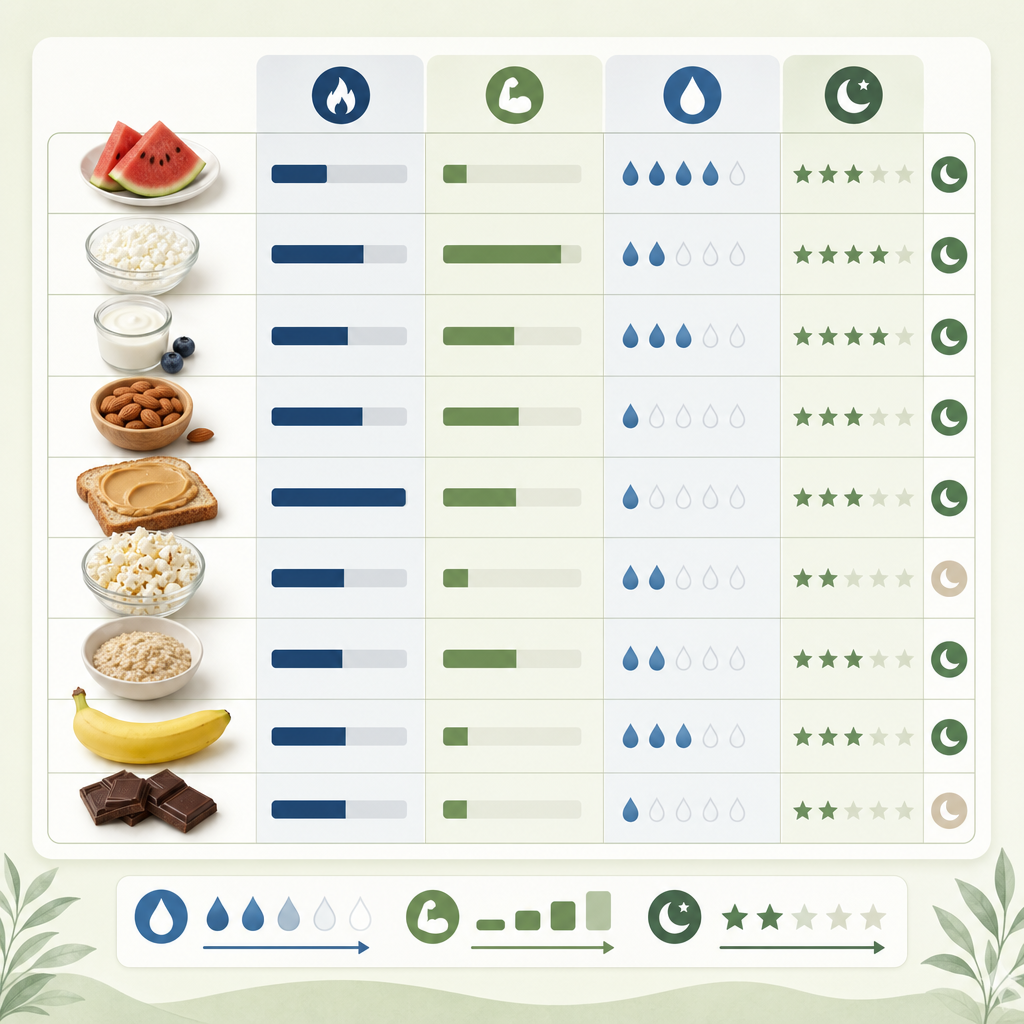
If your nighttime snack goal is hydration plus a small dose of natural sweetness, watermelon wins. If your goal is sleep-supportive protein that holds you through the night, cottage cheese or Greek yogurt is the better choice. The casein protein in dairy releases slowly over 6 to 8 hours and doesn't trigger nighttime hunger the way fruit can.
For the cherries entry: tart cherries specifically contain trace melatonin and have small but measurable evidence for improving sleep onset (2017 European Journal of Nutrition trial). Sweet cherries don't have the same effect.
How watermelon fits into a GLP-1 plan
If you're on compounded semaglutide or tirzepatide, watermelon is one of the easier foods to fit into the appetite-suppressed eating pattern. Three reasons:
- It's mostly water. GLP-1s slow gastric emptying, which means fluid sits in your stomach longer. People on titration doses sometimes struggle to drink enough water without feeling uncomfortably full. High-water foods like watermelon, cucumber, and berries help close hydration gaps without the volume of a glass of water.
- It's low in fat. GLP-1-induced nausea is most often triggered by high-fat foods. Watermelon at 0.2 g of fat per cup is in the safest tier of foods for patients dealing with treatment-related GI symptoms.
- It's sweet without being calorie-dense. Patients on GLP-1s often report reduced cravings for sweet foods, but the cravings don't disappear entirely. Watermelon scratches the sweet itch with a 46-calorie cost. Compare that to a slice of cake (350 to 450 calories) or a half-cup of ice cream (140 to 280 calories).
The catch: GLP-1 patients on titration doses sometimes find that 1 cup of watermelon is more than they can comfortably finish. That's the medication working as designed. Stop when you're satisfied. If you finish 6 pieces and feel done, that's 25 calories, not a failure.
A simple late-night snack framework
If you find yourself reaching for a snack between 8 and 10 PM most nights, the framework that works for most weight-loss patients is to alternate between three categories: hydration-driven (watermelon, cucumber), protein-driven (cottage cheese, Greek yogurt), and crunch-driven (popcorn, baby carrots). The variety prevents the single-food rut that often leads to overeating.
Sample one-week framework:
| Day | 9 PM snack | Calories |
|---|---|---|
| Mon | 1 cup watermelon | 46 |
| Tue | 1/2 cup 2% cottage cheese + 1/4 cup berries | 110 |
| Wed | 3 cups air-popped popcorn | 95 |
| Thu | 1 cup watermelon + 5 raw almonds | 80 |
| Fri | 5.3 oz plain Greek yogurt + 1 tsp honey | 120 |
| Sat | 1 cup strawberries + 1 hard-boiled egg | 120 |
| Sun | 1 cup watermelon | 46 |
That alternation puts watermelon in the rotation 3 nights per week without making it the every-night default. It also keeps the late-evening snack under 150 calories on every day, which is a workable add-on to most weight-loss calorie targets.
Better alternatives if watermelon isn't keeping you full
If you're eating watermelon at night and waking up hungry at 2 AM, the issue is the protein gap. The fruit doesn't have the amino acid load to support an overnight fasting window. Try one of these instead:
- Plain 2% Greek yogurt with a few berries. 110 calories, 14 g protein. The casein in dairy releases slowly during sleep and stabilizes overnight blood sugar.
- Cottage cheese with cinnamon. 90 calories per half cup, 12 g protein. The same casein advantage as Greek yogurt with a slightly different texture.
- Hard-boiled egg with a sprinkle of salt. 70 calories, 6 g protein. Travel-friendly if you're snacking before bed away from home.
- A small handful of almonds and a cup of herbal tea. 80 calories, 3 g protein, 2 g fiber, plus the warm-tea ritual that signals bedtime to your nervous system.
If you want both the hydration of watermelon and the satiety of protein, combine them: 1 cup of watermelon plus a small piece of string cheese is 130 calories with 6 g of protein and stays well within a weight-loss calorie target.
FAQ
Is it bad to eat watermelon at night for weight loss?
No, not at the right portion size. One cup of watermelon at night is 46 calories and won't trigger fat gain in a calorie-controlled plan. The risk with larger portions (3 to 4 cups) is sleep disruption from increased nighttime urination, which itself slows weight loss.
Does watermelon at night cause weight gain?
No, calories at night don't get stored differently than calories at noon. Total daily calorie balance determines fat gain or loss. The myth that "fruit at night causes weight gain" doesn't hold up in controlled trials when total intake is matched.
How much watermelon can I eat at night and still lose weight?
For most people, 1 cup (46 calories) is the sweet spot. Up to 2 cups (92 calories) is fine if you finish eating at least 2 hours before bed and you've had limited fluid intake earlier in the evening. Above that, sleep disruption becomes the limiting factor, not the calories.
Will watermelon at night spike my blood sugar?
At 1 cup, the glycemic load is only 4, which is in the low-glycemic-load range. Even people with type 2 diabetes typically tolerate 1 cup of watermelon without a meaningful glucose spike. At 4 cups, the glycemic load climbs to 16, which is in the moderate range and can produce a noticeable spike.
Is watermelon a weight-loss food?
It can be. Watermelon is one of the lowest-calorie fruits per cup, contains useful amounts of vitamin C and lycopene, and works well as a substitute for higher-calorie sweet snacks. It's not a fat-burning food (no food is), but the volume-for-calories profile fits a weight-loss plan.
Does watermelon work as a snack on a GLP-1 medication like compounded semaglutide or tirzepatide?
Yes, and it's one of the better-tolerated foods during titration. The high water content supports hydration when patients struggle to drink fluids, the low fat content avoids triggering nausea, and the sweetness scratches a craving without delivering many calories.
Can watermelon disrupt sleep?
Yes, in larger portions. The combination of high water volume and citrulline (a mild diuretic) can cause nighttime bathroom trips that fragment sleep. Stick to 1 cup at most, and finish 2 hours before bed.
Is watermelon better than other fruit for weight loss?
For raw calories per cup, watermelon, strawberries, and cantaloupe are roughly tied at the lowest tier (45 to 50 calories per cup). Strawberries have more fiber. Watermelon has more lycopene. Berries generally have the best nutrient density per calorie. All four fit a weight-loss plan well.
Does watermelon have too much sugar for a low-carb diet?
A 1-cup serving has 9.4 g of natural sugar and 11.5 g of total carbs. Standard ketogenic diets target under 25 g of net carbs per day, so 1 cup of watermelon uses up close to half. Lower-carb (not strict keto) diets at 50 to 100 g of carbs per day can fit 1 to 2 cups of watermelon comfortably.
What's the best time to eat watermelon for weight loss?
There's no metabolically optimal time. Pre-workout (1 to 2 hours before exercise) is one good slot because the simple sugars are easily used as fuel. Mid-afternoon as a snack works well to break a sugary-craving cycle. Late evening works if you keep the portion to 1 cup and finish before 9 PM.
Does watermelon help reduce belly fat specifically?
No food targets belly fat. Spot-reduction of fat from a specific body region isn't biologically possible through diet alone. Watermelon supports overall fat loss by providing volume at low calories, which can help a calorie deficit feel more sustainable. The visceral fat that surrounds organs responds best to overall weight loss plus regular exercise.
Can I eat watermelon every day?
Yes. There's no medical reason to limit watermelon to specific days. The main practical limit is the volume effect: at 4 to 5 cups per day, watermelon can crowd out other foods that provide protein, fat, and broader micronutrients. One to two cups daily fits comfortably into most balanced eating patterns.
Author / review note
Reviewed by the FormBlends Medical Team. This article was last reviewed and updated on April 29, 2026. References cited include the USDA FoodData Central database; Hall et al., Cell Metabolism, 2023 (continuous glucose monitor and meal-timing trial); a 2022 Obesity Reviews meta-analysis on sleep duration and weight loss outcomes; the 2024 American Journal of Clinical Nutrition meta-analysis on lycopene and cardiovascular events; and the 2017 European Journal of Nutrition trial on tart cherry juice and sleep quality.
Footer disclaimers
Platform Disclaimer. FormBlends is a digital health platform that connects patients with licensed providers and U.S.-based pharmacies. We do not manufacture, prescribe, or dispense medication directly. All clinical decisions are made by independent licensed providers.
Compounded Medication Notice. Compounded semaglutide and tirzepatide are not FDA-approved. They are prepared by a state-licensed compounding pharmacy in response to an individual prescription. Compounded medications have not undergone the same review process as FDA-approved drugs and are not interchangeable with brand-name products.
Results Disclaimer. Individual results vary. Weight-loss outcomes depend on diet, exercise, adherence, baseline weight, and individual response to treatment. Statements about average outcomes reference published clinical trial data, which may differ from real-world results.
Trademark Notice. All brand names referenced are the property of their respective owners. FormBlends is not affiliated with, endorsed by, or sponsored by any brand-name pharmaceutical manufacturer.
Related guides
- Can You Eat Corn at Night for Weight Loss? An Evidence-Based Answer for the Evening Plate
- How Effective Is Sublingual Tirzepatide for Weight Loss? An Honest Look at the Evidence
- The Best Time to Eat Ice Cream for Weight Loss? An Honest Answer Backed by the Calorie Math
- Can You Still Eat a Whole Hamburger on Ozempic? An Honest Look at What to Expect
- Are Saltine Crackers Healthy for Weight Loss? An Honest Look at the Nutrition
- Are Peanut Butter and Jelly Sandwiches Good for Weight Loss? An Honest Look
See your options in about 2 minutes
Take the free quiz and see what fits you. Quick, private, and no commitment to continue.
See my options →