The short answer
For most adult women under 50, 1700 calories produces a 200 to 500 calorie daily deficit, which usually drives weight loss of 0.5 to 1 lb per week. For sedentary smaller women, 1700 may already be at maintenance. For most adult men, 1700 calories is a steep 700 to 900 calorie deficit and often loses fat fast.
Table of contents
- The 30-second answer
- How a calorie deficit actually works
- Estimating your maintenance number (TDEE) without a lab
- Is 1700 a deficit for you? Three example profiles
- Why the scale lies during the first three weeks
- The protein floor that protects your metabolism
- Plateaus at 1700 calories and how to break them
- How GLP-1 medications change the picture
- A sample 1700-calorie day that hits 130 g of protein
- FAQ
- Footer disclaimers
How a calorie deficit actually works
Body weight is governed by energy balance. If the food you eat delivers fewer calories than your body burns over a long enough window, the body has to make up the difference from stored fuel, mostly fat and a small amount of lean tissue.
Check your GLP-1 eligibility
Use our free BMI Calculator to see if you may qualify for provider-reviewed GLP-1 therapy.
Try the BMI Calculator →The widely cited number is that 3,500 calories below maintenance equals one pound of fat lost. That figure has been refined since the original Wishnofsky 1958 paper. Newer modeling from Hall et al. (NIDDK, 2011) shows the real ratio drifts higher as you lose weight, because a smaller body burns fewer calories at rest. The 3,500 rule is close enough for the first 10 to 15 lbs of loss, and it gets sloppier after that.
If 1700 calories per day is 500 below your maintenance level, that's a 3,500 calorie weekly deficit. On paper, that's one pound of fat per week. In practice, it shows up as 0.7 to 0.9 lbs per week once you account for normal water swings, glycogen shifts, and gut content.
If 1700 calories happens to be at or above your maintenance, no amount of consistency will produce weight loss. The number itself is meaningless without your maintenance figure to compare against.
Estimating your maintenance number (TDEE) without a lab
Total daily energy expenditure has four moving parts: basal metabolic rate (BMR), thermic effect of food, exercise, and non-exercise activity (fidgeting, walking, posture).
The most accurate at-home estimate uses the Mifflin-St Jeor equation for BMR, then multiplies by an activity factor.
Mifflin-St Jeor BMR:
- Women: (10 x weight in kg) + (6.25 x height in cm) - (5 x age) - 161
- Men: (10 x weight in kg) + (6.25 x height in cm) - (5 x age) + 5
Activity factor:
- Sedentary (desk job, no exercise): BMR x 1.2
- Lightly active (1 to 3 walks per week): BMR x 1.375
- Moderately active (3 to 5 sessions per week): BMR x 1.55
- Very active (6 to 7 sessions per week): BMR x 1.725
- Athletic / physical job: BMR x 1.9
Worked example. A 38-year-old woman, 5'5" (165 cm), 175 lbs (79.4 kg), works at a desk and walks her dog three times a week. BMR = (10 x 79.4) + (6.25 x 165) - (5 x 38) - 161 = 794 + 1031 - 190 - 161 = 1474. TDEE = 1474 x 1.375 = roughly 2,030 calories.
For her, 1700 calories produces a 330 calorie daily deficit. That's a sustainable 0.6 lb per week loss rate. Not dramatic. Slow and durable.
A second example. A 45-year-old man, 5'11" (180 cm), 220 lbs (100 kg), construction job, walks 6,000 steps daily. BMR = (10 x 100) + (6.25 x 180) - (5 x 45) + 5 = 1000 + 1125 - 225 + 5 = 1905. TDEE = 1905 x 1.725 = 3,286 calories.
For him, 1700 calories is a 1,586 calorie daily deficit. That's 11,100 calories per week, or theoretically 3 lbs per week. Loss that fast almost always comes with muscle loss, fatigue, and a poor adherence rate. He'd be better served at 2,300 to 2,500 calories.
Is 1700 a deficit for you? Three example profiles
| Profile | Maintenance estimate | 1700 cal deficit | Expected weekly loss |
|---|---|---|---|
| 5'2", 135 lbs, 60 yrs, sedentary woman | 1,580 cal | None (1700 is a surplus) | Likely no loss or slow gain |
| 5'5", 175 lbs, 38 yrs, lightly active woman | 2,030 cal | 330 cal/day | 0.5 to 0.7 lb/wk |
| 5'8", 200 lbs, 32 yrs, lightly active woman | 2,200 cal | 500 cal/day | 0.8 to 1.0 lb/wk |
| 5'10", 185 lbs, 40 yrs, lightly active man | 2,580 cal | 880 cal/day | 1.5 to 1.8 lb/wk |
| 5'11", 220 lbs, 45 yrs, very active man | 3,290 cal | 1,590 cal/day | 2.5 to 3 lb/wk (not recommended) |
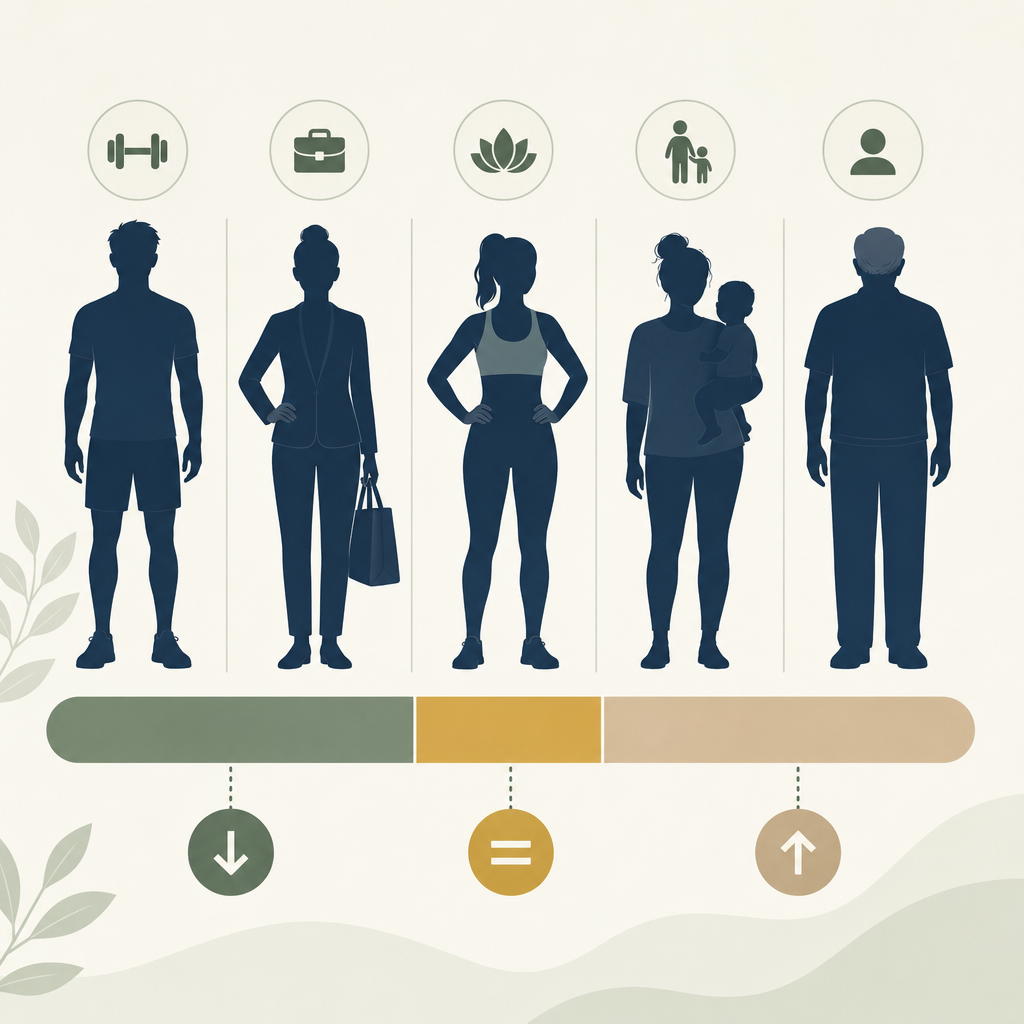
The takeaway from this table is uncomfortable. The "1700 calorie diet" is talked about as a single thing, but it produces wildly different results depending on whose body it lands in. A 60-year-old retiree gains weight on it. A 30-something man on a building site loses muscle mass on it. The number is not magic. The deficit relative to your TDEE is what matters.
Why the scale lies during the first three weeks
Patients who switch to a 1700 calorie target often see the scale drop 4 to 6 lbs in the first week, then plateau or even climb in week two. They assume the diet stopped working. It didn't.
What's happening: each gram of stored carbohydrate (glycogen) holds about 3 grams of water. A typical adult carries 400 to 500 g of glycogen. When you cut calories and carbs together, glycogen depletes fast and the water it was holding flushes out within 5 to 7 days. That's 3 to 5 lbs of water weight, not fat.
By week two, your body has restocked some glycogen as it adapts. Sodium balance can also shift. The scale climbs even though fat is still being lost in the background. By week three, the noise smooths out and the trend becomes readable again.
The clinical fix: weigh daily, but only track the 7-day rolling average. Daily numbers are noisy. The 7-day average is signal.
The protein floor that protects your metabolism
When you cut calories, the body has a choice about where to pull energy from. With low protein and no resistance stimulus, around 25 to 30% of the lost weight will come from lean tissue. With adequate protein and 2 weekly resistance sessions, that drops to under 10%.
That's not a small difference. Lean tissue is the engine that burns calories at rest. A 165 lb woman who loses 30 lbs of "weight" with 25% lean tissue loss has a TDEE about 80 calories per day lower than a woman who lost the same weight with 8% lean loss. That gap is what turns into the post-diet rebound.
The evidence base here is strong. Pasiakos et al. (FASEB Journal, 2013) ran a controlled crossover trial showing that 1.6 to 2.4 g/kg of protein during a calorie deficit preserved nearly twice as much lean mass compared to 0.8 g/kg. Longland et al. (American Journal of Clinical Nutrition, 2016) replicated the result during a 4-week aggressive deficit, finding subjects on 2.4 g/kg gained lean mass while losing fat.
The simple rule: at 1700 calories, eat 0.8 to 1.0 g of protein per pound of goal body weight. For a woman targeting 140 lbs, that's 112 to 140 g of protein daily, or roughly 30 to 40% of her calories.
Plateaus at 1700 calories and how to break them
Three to six weeks into a 1700 calorie plan, weight loss often slows or stalls. The four most common causes:
1. The number stopped being a deficit. As you lose weight, your maintenance calorie need drops. A 200 lb woman with a 2,200 TDEE who loses 25 lbs ends up with a TDEE around 2,000. The 500-calorie deficit she had at the start is now 300. To restore the original deficit, she'd cut another 200 calories or add activity.
2. Tracking has gotten loose. Most people underestimate intake by 15 to 20% after a few months on a diet, partly through bite-and-lick eating, partly through portion drift. A "tablespoon" of olive oil being measured by eye routinely lands at 1.5 to 2 tablespoons. That's 100 to 200 hidden calories per day on its own.
3. Sleep has dropped. Less than 6 hours of sleep increases ghrelin (the hunger hormone) and decreases leptin. The same calorie target feels harder, hunger trends up, and adherence falls. Fix the sleep before adjusting calories.
4. Adaptive thermogenesis. After 4 to 6 weeks of restriction, the body reduces non-exercise activity and downregulates BMR slightly. The Biggest Loser study (Fothergill et al., Obesity, 2016) documented BMR drops of 200 to 500 calories below predicted in extreme cases. For typical 1700 calorie dieters, the drop is 5 to 10% of BMR, or 60 to 90 calories.
The break: a one-week diet break at maintenance every 8 to 10 weeks. Patients who took planned breaks (Byrne et al., International Journal of Obesity, 2018, the MATADOR trial) lost more total fat over 16 weeks than continuous-deficit dieters, and kept it off longer.
How GLP-1 medications change the picture
If you're on compounded semaglutide or tirzepatide and you're targeting 1700 calories, the experience is different. The hunger that usually fights against a deficit is muted. What I see in clinic notes:
- Patients on semaglutide commonly report 1700 to 1900 calories feels effortless once they're past the 0.5 mg titration step.
- Patients on tirzepatide often drift below 1500 calories without trying. That's actually a problem, not a win, because protein intake and total food volume can drop too low to support lean tissue.
If you're medicated and find 1700 easy to hit, the priorities shift. Protein becomes more important, not less, because the appetite suppression makes it tempting to skip meals. Fluid intake matters because GLP-1 patients commonly under-drink. And resistance training is non-negotiable for protecting lean mass during faster-than-typical loss rates.
For the dosing math behind compounded GLP-1 plans, see our tirzepatide units and milligrams chart and the 60 units of tirzepatide guide.
A sample 1700-calorie day that hits 130 g of protein
Hitting both calories and protein at 1700 takes some structure. Here's a plate-by-plate example.
| Meal | Items | Calories | Protein |
|---|---|---|---|
| Breakfast | 3 eggs, 1 oz feta, spinach, 1 slice sourdough | 360 | 26 g |
| Snack | 1 cup 2% Greek yogurt + 1 cup berries | 200 | 22 g |
| Lunch | 5 oz grilled chicken, 1 cup quinoa, mixed greens, 1 tbsp olive oil + lemon | 480 | 42 g |
| Snack | 1 oz almonds + 1 medium apple | 245 | 7 g |
| Dinner | 5 oz salmon, 1 cup roasted veg, 1/2 cup white rice | 415 | 36 g |
| Total | 1,700 | 133 g |
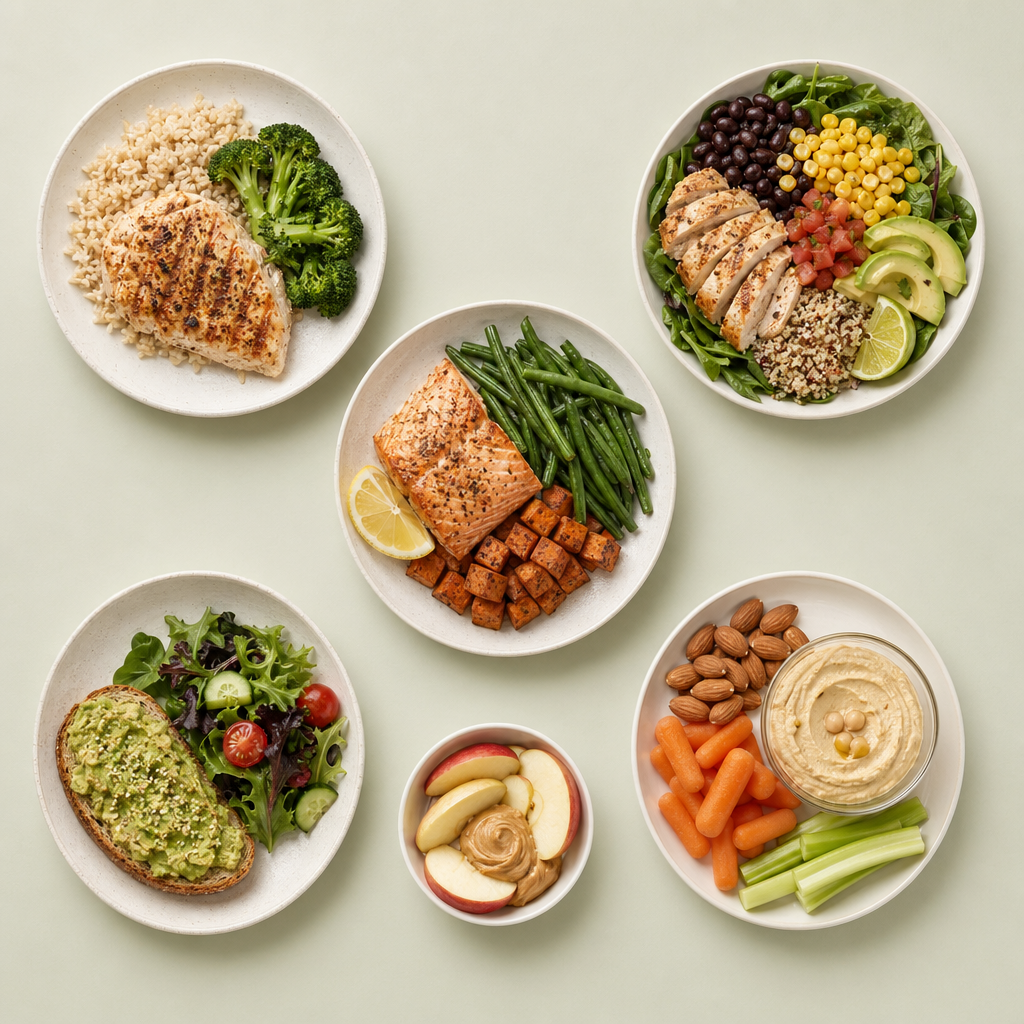
This pattern hits 31% protein, 38% carbs, 31% fat. Fiber lands around 30 g. It's a sustainable hit-the-numbers day for someone who cooks. If your week is busier, swap in a protein shake at the second snack and a pre-cooked grain bowl at lunch.
FAQ
Will I actually lose weight on 1700 calories a day?
You'll lose weight if 1700 is below your maintenance level. For most women under 60 who aren't extremely small, it usually is. For most men, 1700 is a deeper deficit than recommended and may cause unwanted lean tissue loss. Calculate your TDEE before committing to a number.
Is 1700 calories a deficit for a woman?
For an average-height moderately active adult woman, yes. Maintenance for that profile sits around 2,000 to 2,300 calories. 1700 produces a 300 to 600 calorie deficit, which translates to 0.6 to 1.2 lbs per week of loss.
Is 1700 calories a deficit for a man?
Usually, yes, and often a large one. Most men sit at 2,400 to 3,000 calories of maintenance. 1700 calories often creates a 700 to 1,300 calorie deficit, which is faster than most clinicians recommend. Men typically do better on 2,000 to 2,300.
How much weight will I lose on 1700 calories per week?
At a 500 calorie daily deficit, expect about 1 lb per week of fat loss after the initial water-weight drop. Smaller deficits, smaller losses. Larger deficits don't always produce proportionally larger losses, because the body adapts.
What happens if I'm not losing weight on 1700 calories?
Most likely your maintenance is at or below 1700. The other common reason is undercounting (eyeball portions of nuts, oils, dressings, sauces). Track everything for 7 days using a scale, recheck the math, and consider activity-side adjustments.
Should I exercise if I'm eating 1700 calories?
Yes. Two resistance sessions per week protect your lean mass. Walking 7,000 to 10,000 steps adds 100 to 300 calories of expenditure without spiking hunger the way intense cardio does. Avoid stacking heavy cardio plus a heavy deficit. That combination drives fatigue and adherence drop.
Can I drink alcohol on 1700 calories?
Alcohol counts. A 5 oz glass of wine is about 125 calories. Two glasses is a meal. The bigger problem is that alcohol disinhibits eating decisions, so the actual calorie hit is usually 50 to 100% above the drink itself. Alcohol also suppresses fat oxidation for 8 to 12 hours.
Will 1700 calories slow my metabolism?
Mild adaptive thermogenesis is normal during any deficit. It's typically 5 to 10% of BMR. It mostly reverses when you return to maintenance. Severe metabolic slowdown is rare outside extreme cases (very long restriction, very low protein, no resistance training).
How do I know if 1700 is too low?
Signs to watch for: persistent fatigue past week three, hair shedding, libido drop, mood drops, frequent illness, periods becoming irregular. If two or more show up, raise calories by 200 to 300, prioritize protein, and check in with your provider.
Is 1700 calories sustainable long term?
For most people, yes, if it's not lower than your eventual maintenance. Once you reach your goal weight, your maintenance might land at or near 1700, in which case the number stays. If your goal-weight maintenance is higher (say 2,000), keep the deficit period to 12 to 20 weeks and then transition.
Does 1700 calories work with intermittent fasting?
The fasting window doesn't change the calorie math. If you eat 1700 calories in two meals between noon and 8 PM, you'll lose the same amount as if you ate the same 1700 across four meals. Pick the eating pattern that helps you hit 1700 consistently.
Does the type of food at 1700 calories matter for weight loss?
For weight loss specifically, total calories drive the result. For body composition, hunger management, and energy, food quality matters a lot. 1700 calories of protein, vegetables, and whole grains keeps you full and protects muscle. 1700 calories of cookies and white pasta does not, even if the scale moves.
Author / review note
Reviewed by the FormBlends Medical Team. References include Hall KD et al., The Lancet, 2011 (quantification of the effect of energy imbalance on bodyweight); Pasiakos SM et al., FASEB Journal, 2013 (protein and lean mass during energy deficit); Longland TM et al., American Journal of Clinical Nutrition, 2016 (high-protein deficit trial); Fothergill E et al., Obesity, 2016 (Biggest Loser metabolic adaptation); Byrne NM et al., International Journal of Obesity, 2018 (MATADOR trial on intermittent dieting); and the Mifflin-St Jeor BMR equation as adopted by the Academy of Nutrition and Dietetics.
Footer disclaimers
Platform Disclaimer. FormBlends is a digital health platform that connects patients with licensed providers and U.S.-based pharmacies. We do not manufacture, prescribe, or dispense medication directly. All clinical decisions are made by independent licensed providers.
Compounded Medication Notice. Compounded semaglutide and tirzepatide are not FDA-approved. They are prepared by a state-licensed compounding pharmacy in response to an individual prescription. Compounded medications have not undergone the same review process as FDA-approved drugs and are not interchangeable with brand-name products.
Results Disclaimer. Individual results vary. Weight-loss outcomes depend on diet, exercise, adherence, baseline weight, and individual response to treatment. Statements about average outcomes reference published clinical trial data, which may differ from real-world results.
Trademark Notice. Brand names referenced in this article are the property of their respective owners. FormBlends is not affiliated with, endorsed by, or sponsored by any brand-name pharmaceutical manufacturer.
Related guides
- Will Burning 600 Calories a Day Help You Lose Weight? The Math, the Caveats, and the Honest Answer
- Is Burning 600 Calories a Day Enough to Lose Weight? An Honest Look at the Math, the Body's Response, and What Actually Works
- Is Burning 100 Calories a Day Enough to Lose Weight? The Real Math
- Is 1700 Calories Enough to Lose Weight? How to Find Your Personal Deficit
- Is Tajin Good for Weight Loss? An Honest Look at the Calories, Sodium, and Capsaicin Math
- Is Burning 200 Calories a Day Good for Weight Loss? The Math, the Catch, and What 200 Calories Actually Looks Like
See your options in about 2 minutes
Take the free quiz and see what fits you. Quick, private, and no commitment to continue.
See my options →