The short answer
30 units on a U-100 insulin syringe equals 0.30 mL of liquid. The milligram amount depends on your vial's concentration: 1.5 mg at 5 mg/mL, 3 mg at 10 mg/mL, 4.5 mg at 15 mg/mL, and 6 mg at 20 mg/mL. Read the concentration on your specific vial label before drawing.
Table of contents
- The 30-second answer
- The math: how units, mL, and mg connect
- Conversion table for 30 units of tirzepatide at every common concentration
- Where 30 units fits on the standard tirzepatide dosing ladder
- How to find your vial's concentration
- Drawing 30 units accurately on a U-100 syringe
- Common errors when converting units to mg
- Storage and stability considerations
- When 30 units is not the right dose
- FAQ
- Footer disclaimers
The math: how units, mL, and mg connect
The U-100 insulin syringe is the standard tool for compounded tirzepatide. The "U-100" designation means the syringe is calibrated to deliver 100 units per milliliter for standard insulin. For tirzepatide, the unit markings are repurposed as volume markings only:
Check your GLP-1 eligibility
Use our free BMI Calculator to see if you may qualify for provider-reviewed GLP-1 therapy.
Try the BMI Calculator →- 1 unit = 0.01 mL
- 30 units = 0.30 mL
- 100 units = 1.00 mL
This is volume, not drug weight. To get the drug weight in milligrams, multiply the volume by the concentration:
volume (mL) × concentration (mg/mL) = dose (mg)
So 30 units of a 10 mg/mL vial = 0.30 mL × 10 mg/mL = 3 mg.
That formula works for every concentration, every vial, every dose. Once you know the concentration on your specific vial, you can calculate the mg dose for any number of units, and vice versa.
Conversion table for 30 units of tirzepatide at every common concentration
The four concentrations U.S. compounding pharmacies most often use:
| Concentration | 30 units = volume | 30 units = mg dose |
|---|---|---|
| 5 mg/mL | 0.30 mL | 1.5 mg |
| 10 mg/mL | 0.30 mL | 3 mg |
| 15 mg/mL | 0.30 mL | 4.5 mg |
| 20 mg/mL | 0.30 mL | 6 mg |
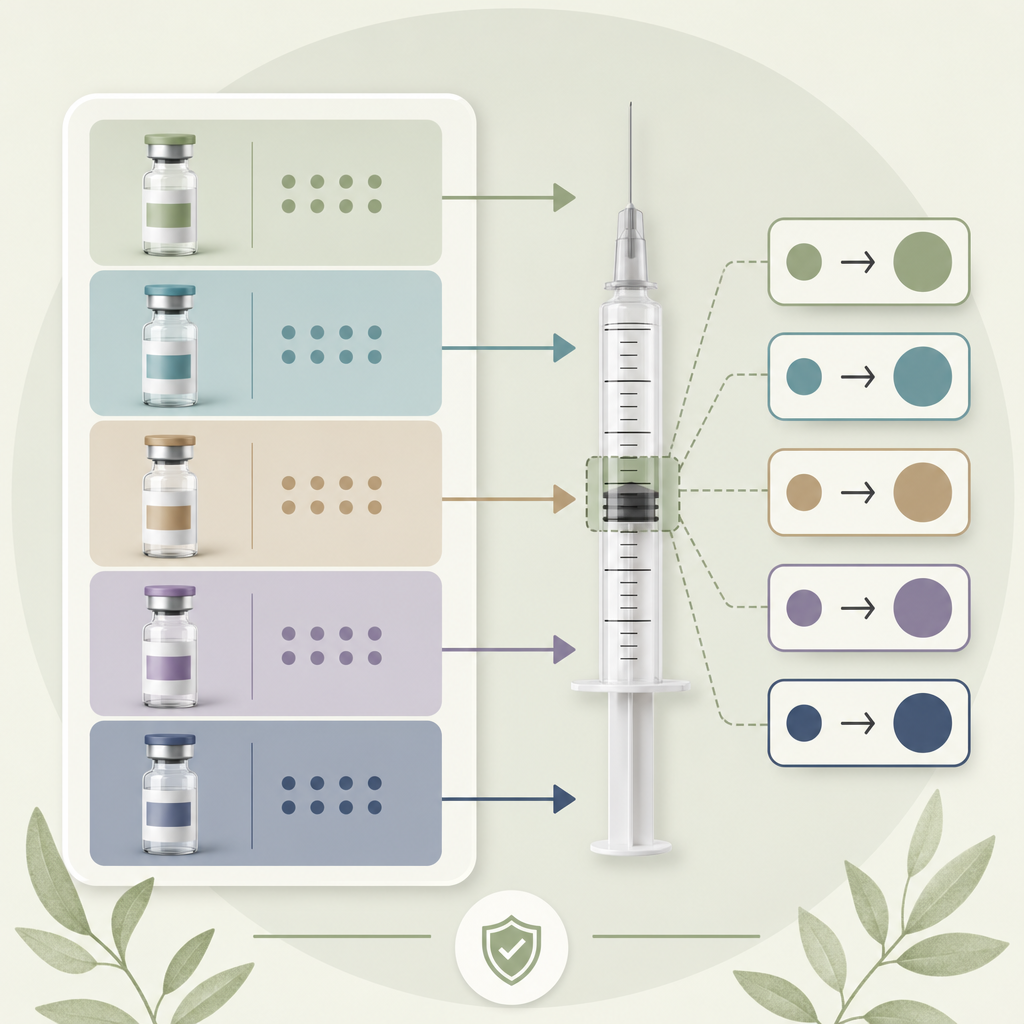
The volume is the same (0.30 mL) for all concentrations. What changes is how much active drug is in that 0.30 mL. A 5 mg/mL vial has half the drug per unit of a 10 mg/mL vial, which is why the mg dose changes even though the syringe markings don't.
For a quick mental check: at 10 mg/mL, the unit number divided by 10 gives you the mg dose. So 30 units at 10 mg/mL is 3 mg. 25 units is 2.5 mg. 50 units is 5 mg. The math is intentionally clean at this concentration, which is why 10 mg/mL is the most common compounding standard.
Where 30 units fits on the standard tirzepatide dosing ladder
The FDA-approved tirzepatide dosing ladder for Mounjaro and Zepbound goes:
- 2.5 mg weekly (starting dose, weeks 1 to 4)
- 5 mg weekly (weeks 5 to 8)
- 7.5 mg weekly (weeks 9 to 12)
- 10 mg weekly (weeks 13 to 16)
- 12.5 mg weekly
- 15 mg weekly (maximum maintenance dose)
At 10 mg/mL, 30 units equals 3 mg, which is between the standard 2.5 mg starting dose and the 5 mg week-5 dose. Some compounding protocols use 30-unit increments as part of a slower titration to reduce side effects, particularly for patients who don't tolerate the standard 2.5 mg to 5 mg jump.
If your prescription says "draw 30 units weekly" without naming a milligram dose, the concentration on the vial is what tells you whether you're at 1.5, 3, 4.5, or 6 mg per week. That's why every dosing instruction sheet should include both the unit count and the mg dose. If yours doesn't, call the pharmacy to confirm.
How to find your vial's concentration
The concentration is printed on the vial label in one of three formats:
- Direct concentration: "Tirzepatide 10 mg/mL"
- Total / volume format: "Tirzepatide 100 mg / 10 mL." Divide 100 by 10 to get 10 mg/mL.
- For powder-only vials (rare for tirzepatide): the concentration is set when you reconstitute. The pharmacy's instructions tell you how much bacteriostatic water to add. (See our reconstitution guide for the full process.)
Common concentrations you might see on a U.S. compounding pharmacy label:
- 5 mg/mL (lower concentration, larger draw volume)
- 10 mg/mL (most common)
- 15 mg/mL (occasional, used for smaller-volume vials)
- 20 mg/mL (highest, used for high-dose patients)
If your label shows only the total milligrams (e.g., "30 mg vial") without a volume, the concentration is in the pharmacy's accompanying instructions or patient handout. Don't assume. The same "30 mg" on a label could be 0.3 mL (100 mg/mL, never used for compounded tirzepatide) or 3 mL (10 mg/mL, common). Read the supporting paperwork.
Drawing 30 units accurately on a U-100 syringe
Standard process for self-administering compounded tirzepatide:
Materials:
- Pre-mixed compounded tirzepatide vial
- U-100 insulin syringe (0.3 mL or 0.5 mL barrel, 31-gauge needle, 5/16 inch length is typical)
- Two alcohol swabs
- Sharps container
Steps:
- Wash hands with soap and water for 20 seconds.
- Inspect the vial. The solution should be clear and colorless to faint straw-yellow. Some compounded versions are pink or orange-red because of added vitamin B12. Don't use if cloudy or particulate.
- Wipe the vial top with an alcohol swab. Let it air-dry.
- Pull back the plunger to draw 30 units of air into the syringe.
- Insert the needle through the rubber stopper and push the air in.
- Invert the vial. Pull the plunger back to draw 30 units of liquid.
- Check for air bubbles at eye level. Tap the syringe to dislodge any bubbles, push them back into the vial, then re-draw to confirm 30 units of liquid.
- Confirm the plunger's leading edge sits on the 30-unit line.
- Remove the needle. Don't recap.
- Choose an injection site (abdomen avoiding 2 inches around the navel, front or outer thigh, or back of the upper arm). Rotate sites weekly.
- Wipe the site with the second alcohol swab. Let it dry.
- Pinch a fold of skin. Insert the needle at 90 degrees (or 45 degrees if you have very little subcutaneous fat). Push the plunger in steadily.
- Withdraw the needle. Apply gentle pressure with a tissue if there's any bleeding.
- Dispose of the syringe in a sharps container.
The full process takes about 90 seconds once you've done it a few times. Time of day doesn't matter much for tirzepatide. Most patients pick a specific day of the week and stick to it.
Common errors when converting units to mg
The 2024 FDA Adverse Event Reporting System data on compounded GLP-1 dosing identified four recurring conversion mistakes.
Error 1: Assuming a "universal" mg-per-unit ratio.
There isn't one. The mg per unit depends entirely on the concentration on your vial. A patient who learned that "30 units = 3 mg" at one pharmacy might keep that mental shortcut after switching to a pharmacy that ships at 5 mg/mL, where 30 units is actually 1.5 mg. The dose is now half what was intended.
The fix: re-check the concentration every time you receive a new vial.
Error 2: Confusing total vial volume with concentration.
A vial labeled "30 mg / 3 mL" is 10 mg/mL. A vial labeled "30 mg / 1.5 mL" is 20 mg/mL. Some patients see "30 mg" and assume they should draw 30 units, which would deliver only 3 mg in the first case and 6 mg in the second. The vial total isn't your dose. The concentration plus your prescribed dose determines the unit count.
Error 3: Reading the syringe markings incorrectly.
U-100 syringes come in three barrel sizes: 0.3 mL (30 units max), 0.5 mL (50 units max), and 1.0 mL (100 units max). On a 0.3 mL barrel, every line is one unit. On a 0.5 mL or 1.0 mL barrel, the spacing differs. Always read the printed numbers, not "marks past zero."
Error 4: Drawing an air bubble and counting it as drug volume.
If you draw 30 units of liquid plus a 5-unit air bubble, your actual drug volume is 25 units. The fix is the eye-level inspection step, plus tapping out bubbles before confirming the dose.
A 2024 paper in Annals of Pharmacotherapy (Patel et al.) found that 7.2% of self-administering compounded GLP-1 patients reported at least one suspected dosing error in the first 90 days. Most errors were over-doses (drawing more than intended) and most were associated with not re-checking concentration after a pharmacy change.
Storage and stability considerations
Refrigeration. Unopened compounded tirzepatide vials store at 36 to 46°F (2 to 8°C). Don't freeze. Frozen and thawed peptide may aggregate, reducing potency.
After first puncture. The vial is good for 28 days when refrigerated, per most U.S. compounding pharmacy guidelines. Some pharmacies stamp 21 days. Mark the date of first puncture on the vial label.
Travel. Use an insulated bag with a frozen gel pack between an insulator and the vial. Direct contact with ice or gel packs can freeze the solution. Most pharmacies will provide a travel kit on request.
Color. Clear and colorless to faint straw-yellow is normal. Pink or orange-red is acceptable only if your formulation includes vitamin B12 (some compounding pharmacies add cyanocobalamin). If your vial changes color over its lifespan, contact the pharmacy.
Cloudiness, particles, or settling. Don't use the vial. These signs indicate peptide aggregation, contamination, or temperature excursion.
When 30 units is not the right dose
Some scenarios where the 30-unit prescription needs review:
- Persistent severe nausea or vomiting beyond the first 2 weeks. Dose may be too aggressive. Speak with your provider about a smaller increment.
- No weight loss after 12 weeks at 30 units. Dose may be too small for your physiology. Provider should consider escalation.
- A pharmacy switch. New vial may be a different concentration. Recalculate units before drawing.
- An unfamiliar concentration on the vial. Don't draw 30 units by default. Confirm with the pharmacy what unit count delivers your prescribed mg dose.
- You're new to tirzepatide. The standard starting dose is 2.5 mg weekly, which at 10 mg/mL is 25 units, not 30. Verify with the prescription.
The 30-unit number isn't magic. It's a volume, and what matters is the milligram dose that volume delivers. A patient at 10 mg/mL drawing 30 units is on a 3 mg dose, which is a non-standard but reasonable interim step. A patient at 20 mg/mL drawing 30 units is on a 6 mg dose, which is between the standard 5 mg and 7.5 mg steps.
FAQ
How many mg is 30 units of tirzepatide?
30 units is 0.30 mL on a U-100 insulin syringe. The milligram dose depends on your vial's concentration: 1.5 mg at 5 mg/mL, 3 mg at 10 mg/mL, 4.5 mg at 15 mg/mL, or 6 mg at 20 mg/mL.
What's the most common concentration for compounded tirzepatide?
10 mg/mL is by far the most common. The math is clean: dose in mg equals unit count divided by 10. So 30 units = 3 mg, 50 units = 5 mg, 25 units = 2.5 mg.
Is 30 units a standard tirzepatide dose?
30 units isn't one of the FDA-approved fixed doses (2.5, 5, 7.5, 10, 12.5, 15 mg), but at 10 mg/mL it delivers 3 mg, which some compounding protocols use as an intermediate step between 2.5 and 5 mg. Confirm with your provider's prescription.
Why does the mg dose change between pharmacies even at 30 units?
Because each pharmacy uses its own concentration. A 30-unit draw delivers different mg amounts at 5 mg/mL vs 10 mg/mL vs 20 mg/mL. Always re-check the concentration when you get a new vial.
Where do I find the concentration on my vial?
On the vial label, in one of two formats: "10 mg/mL" or "100 mg / 10 mL." If only the total mg is shown without a volume, check the pharmacy's accompanying instructions or call the pharmacy.
What happens if I draw the wrong number of units?
Small errors (within 1 to 2 units) are clinically irrelevant for tirzepatide. Larger errors (drawing 50 units instead of 30, for example) can cause amplified GI side effects. If you injected an over-dose, monitor for nausea and vomiting and call your provider if symptoms are severe or last more than 24 hours.
What size syringe should I use for 30 units?
A 0.3 mL or 0.5 mL U-100 insulin syringe with a 31-gauge, 5/16-inch needle is standard. The 0.3 mL barrel only goes up to 30 units, so it fills exactly to the top for a 30-unit draw, which makes the count easy to verify.
Can I split a 30-unit dose into two smaller injections?
Tirzepatide has a half-life around 5 days and is designed for once-weekly dosing. Splitting a single weekly dose into two smaller injections is not standard practice and isn't supported by clinical data. Discuss with your provider if you have a reason to consider it.
Is 30 units the same dose as 30 units of insulin?
No. The "unit" on the syringe is a volume marking. 30 units of insulin and 30 units of tirzepatide are both 0.30 mL, but the drug is different and the dosing math is different. Don't conflate insulin units with tirzepatide units.
What if I miss a 30-unit weekly dose?
If less than 4 days late, take the missed dose and resume your normal schedule. If more than 4 days late, skip the missed dose and resume on your next scheduled day. Don't double up.
Why does my vial say 30 mg total but I only need 3 mg per week?
A 30 mg vial at 10 mg/mL is 3 mL of solution, which contains 10 weekly 3 mg doses. Each weekly dose draws 0.30 mL (30 units) and the rest of the vial stays for future weeks.
Can I use a U-40 or U-500 syringe for tirzepatide?
No. Use U-100 syringes only. U-40 and U-500 syringes have different unit calibrations and would deliver wrong volumes.
Author / review note
Reviewed by the FormBlends Medical Team. References include the U.S. Pharmacopeia guidance on insulin syringes (USP General Chapter on injection devices), Patel et al., Annals of Pharmacotherapy, 2024 (compounded GLP-1 dosing errors), and the FDA prescribing information for Mounjaro and Zepbound (Eli Lilly), accessed Q1 2026.
Footer disclaimers
Platform Disclaimer. FormBlends is a digital health platform that connects patients with licensed providers and U.S.-based pharmacies. We do not manufacture, prescribe, or dispense medication directly. All clinical decisions are made by independent licensed providers.
Compounded Medication Notice. Compounded semaglutide and tirzepatide are not FDA-approved. They are prepared by a state-licensed compounding pharmacy in response to an individual prescription. Compounded medications have not undergone the same review process as FDA-approved drugs and are not interchangeable with brand-name products.
Results Disclaimer. Individual results vary. Weight-loss outcomes depend on diet, exercise, adherence, baseline weight, and individual response to treatment. Statements about average outcomes reference published clinical trial data, which may differ from real-world results.
Trademark Notice. Mounjaro and Zepbound are registered trademarks of Eli Lilly and Company. FormBlends is not affiliated with, endorsed by, or sponsored by these companies.
Related guides
- How Many Units Is 2.5 mg of Tirzepatide? A Conversion Chart for Every Compounded Concentration
- How Many Units Is 5 mg of Tirzepatide? A Conversion Chart for Every Compounded Concentration
- How Many Mg Is 40 Units of Tirzepatide? A Clear Conversion by Vial Concentration
- How Many Units Is 15 mg of Tirzepatide? The Conversion Chart for Every Compounded Concentration
- How Many Units Is 0.25 mg of Semaglutide? A Conversion Chart for Every Compounded Concentration
- How Many mg Is 50 Units of Semaglutide? The Conversion Chart for Every Compounded Concentration
- Tool: dosage calculator
See your options in about 2 minutes
Take the free quiz and see what fits you. Quick, private, and no commitment to continue.
See my options →