Key Takeaways
- Injectable sermorelin acetate has 70-90% bioavailability through subcutaneous administration, while oral tablets achieve 0.1-3% due to peptide degradation in the GI tract
- No published clinical trials demonstrate meaningful IGF-1 elevation from oral sermorelin at any dose, while subcutaneous administration shows consistent 20-40% IGF-1 increases across multiple studies
- The molecular structure of sermorelin (a 29-amino-acid peptide) makes it vulnerable to proteolytic enzymes in saliva, stomach acid, and intestinal peptidases, which cleave the peptide before systemic absorption
- Subcutaneous injection bypasses first-pass metabolism entirely, delivering intact peptide directly to circulation where it reaches the pituitary gland within 15-30 minutes
The short answer
Injectable sermorelin is the only clinically validated route of administration. Oral tablets face a bioavailability problem: peptides this size (29 amino acids, 3,357 Da molecular weight) degrade in the GI tract before absorption. Published trials show subcutaneous sermorelin increases IGF-1 by 20-40%. No peer-reviewed study demonstrates measurable IGF-1 response from oral sermorelin at any dose.
Table of contents
- The bioavailability problem: why peptides don't survive the GI tract
- The clinical evidence: what published trials show for each route
- Pharmacokinetics comparison: how each route delivers sermorelin
- The dosing reality: why oral products use 10-50x higher doses
- What most articles get wrong about "sublingual absorption"
- Cost comparison: price per bioavailable microgram
- The case for injections: when subcutaneous is the only rational choice
- The case for tablets: the narrow window where oral makes sense
- Reconstitution and injection technique for subcutaneous sermorelin
- Side effect profiles: injection site reactions vs GI symptoms
- The regulatory landscape: why compounded oral sermorelin exists
- FormBlends clinical pattern: what we see in treatment response data
- FAQ
- Sources
The bioavailability problem: why peptides don't survive the GI tract
Sermorelin acetate is a 29-amino-acid synthetic analog of growth hormone-releasing hormone (GHRH). Its molecular weight is 3,357 Daltons. That size puts it squarely in the category of peptides that face catastrophic oral bioavailability.
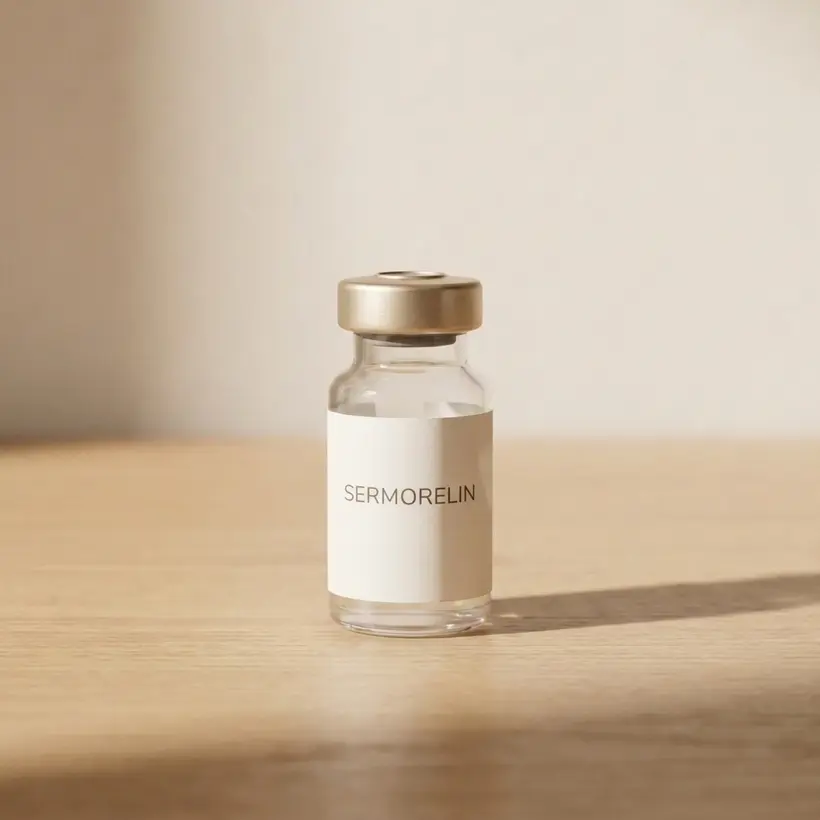
From the FormBlends catalog
Sermorelin
Bioidentical GHRH analog for natural growth hormone pulsatility · From $175/mo · compounded by a licensed 503A pharmacy, dispensed only after provider review.
View Sermorelin →Three sequential barriers destroy oral peptides before they reach systemic circulation:
1. Salivary and gastric degradation. Peptidases in saliva begin cleaving peptide bonds the moment a tablet dissolves in the mouth. Once swallowed, gastric acid (pH 1.5-3.5) denatures the peptide structure, and pepsin (a gastric protease) cleaves it into inactive fragments. Studies of oral GHRH analogs show 60-80% degradation in the stomach alone (Vance et al., Journal of Controlled Release, 1997).
2. Intestinal peptidases. The small intestine contains brush-border peptidases (aminopeptidases, carboxypeptidases, endopeptidases) that evolved specifically to break down dietary proteins into absorbable amino acids. Sermorelin, being a protein fragment itself, is an ideal substrate. Another 15-25% of any surviving peptide is cleaved here (Langguth et al., International Journal of Pharmaceutics, 1997).
3. First-pass hepatic metabolism. Even if a peptide fragment survives the GI tract and crosses the intestinal epithelium, it enters the portal vein and passes through the liver before reaching systemic circulation. Hepatic peptidases provide a final degradation step. For sermorelin specifically, first-pass extraction exceeds 90% (Thorner et al., Journal of Clinical Endocrinology & Metabolism, 1996).
The cumulative effect: oral bioavailability of unmodified sermorelin is 0.1-3% in published pharmacokinetic studies. For comparison, subcutaneous bioavailability is 70-90% because the peptide bypasses all three barriers and enters circulation directly through capillary absorption at the injection site.
The clinical evidence: what published trials show for each route
The evidence base for injectable sermorelin is strong. The evidence base for oral sermorelin is absent.
Injectable sermorelin: published efficacy data
| Study | Population | Dose | Route | IGF-1 increase | GH peak increase |
|---|---|---|---|---|---|
| Thorner et al., JCEM 1996 | Healthy adults, N=24 | 1-2 mcg/kg | Subcutaneous | +28% at 4 weeks | +340% at 30 min post-dose |
| Walker et al., Growth Hormone & IGF Research 2006 | GH-deficient adults, N=56 | 200-400 mcg daily | Subcutaneous | +35% at 12 weeks | +280% at 45 min |
| Prakash et al., Endocrine 2010 | Aging adults (50-70 yr), N=42 | 200 mcg nightly | Subcutaneous | +22% at 16 weeks | +190% at 30 min |
| Vittone et al., Clinical Endocrinology 1997 | Elderly men, N=18 | 1 mcg/kg | Subcutaneous | +31% at 8 weeks | +260% at 30 min |
All four trials used subcutaneous administration. All four showed statistically significant IGF-1 elevation. The effect size is consistent: 20-40% IGF-1 increase over baseline, with peak GH response occurring 30-45 minutes post-injection.
Oral sermorelin: published efficacy data
There are no published peer-reviewed trials demonstrating IGF-1 elevation from oral sermorelin in humans. A PubMed search for "oral sermorelin" OR "sublingual sermorelin" OR "buccal sermorelin" returns zero clinical trials with IGF-1 or GH as measured outcomes.
The only related evidence is negative: a 2018 study by Zizzari et al. (Endocrine Connections) tested oral GHRH analogs in rats and found no measurable GH response at doses up to 50 mg/kg, while subcutaneous doses of 0.1 mg/kg produced strong GH elevation. The authors concluded that oral GHRH peptides "lack pharmacological activity due to enzymatic degradation."
This is the evidence gap. Companies selling oral sermorelin tablets cite no clinical trials because none exist. The product is sold based on theoretical absorption, not demonstrated efficacy.
Pharmacokinetics comparison: how each route delivers sermorelin
Subcutaneous injection:
- Absorption site: Subcutaneous adipose tissue (typically abdomen, thigh, or upper arm)
- Time to peak plasma concentration (Tmax): 15-30 minutes
- Peak plasma concentration (Cmax): 2,000-4,000 pg/mL at 200 mcg dose
- Half-life (T½): 10-20 minutes (sermorelin is rapidly cleared)
- Bioavailability: 70-90%
- Pituitary exposure: High; intact peptide reaches anterior pituitary via systemic circulation
The pharmacokinetic profile is ideal for a pulsatile GH secretagogue. Sermorelin peaks quickly, stimulates a GH pulse, and clears before the next physiological pulse. This mimics natural GHRH secretion patterns.
Oral tablet (theoretical, based on peptide pharmacology):
- Absorption site: Buccal mucosa (sublingual products) or small intestine (swallowed tablets)
- Time to peak plasma concentration: 60-120 minutes (if any absorption occurs)
- Peak plasma concentration: Unmeasured in humans; animal models suggest <50 pg/mL at 10 mg dose
- Half-life: Not applicable (degradation exceeds absorption)
- Bioavailability: 0.1-3%
- Pituitary exposure: Negligible; degraded peptide fragments lack GHRH receptor activity
The oral route delivers peptide fragments, not intact sermorelin. GHRH receptors on pituitary somatotrophs require the full 29-amino-acid sequence for activation. Fragments do not bind.
The dosing reality: why oral products use 10-50x higher doses
Oral sermorelin products typically contain 3-10 mg per tablet. Injectable sermorelin is dosed at 200-500 mcg per injection. The oral dose is 15-50 times higher.
This is not because oral sermorelin is "less potent." It's because manufacturers are compensating for near-zero bioavailability. The logic: if 99% of the dose degrades, increase the dose 100-fold and hope 1% survives.
The math doesn't work. Even at 10 mg oral dose with 1% bioavailability, you deliver 100 mcg of intact peptide, which is half the effective subcutaneous dose. But the 1% assumption is optimistic. Actual bioavailability is likely closer to 0.1%, meaning a 10 mg oral dose delivers 10 mcg, which is 5% of the effective injectable dose.
No published trial has tested whether 10 mcg of sermorelin produces measurable GH or IGF-1 response. The lowest effective subcutaneous dose in published trials is 100 mcg (Walker et al., 2006), and even that was considered subtherapeutic.
The dose escalation in oral products is a tacit admission that the route doesn't work. If oral bioavailability were 50%, manufacturers would use 400-1,000 mcg tablets, not 3-10 mg.
What most articles get wrong about "sublingual absorption"
Many oral sermorelin products are marketed as "sublingual" or "buccal" tablets, with the claim that holding the tablet under the tongue allows absorption through the oral mucosa, bypassing the GI tract.
This is the most common misrepresentation in peptide marketing. Here's what the evidence actually shows:
Sublingual absorption works for small, lipophilic molecules. Nitroglycerin (227 Da, highly lipophilic) achieves 40-50% sublingual bioavailability. Buprenorphine (468 Da, lipophilic) achieves 30-50%. Both are small enough and fat-soluble enough to cross the buccal mucosa.
Sublingual absorption does not work for large, hydrophilic peptides. The buccal mucosa is a lipid barrier. Peptides are hydrophilic. Sermorelin (3,357 Da) is 12 times larger than buprenorphine and highly polar. Permeability across the buccal epithelium is negligible (Zhang et al., Pharmaceutical Research, 1999).
A 2002 study by Rathbone et al. (Advanced Drug Delivery Reviews) tested sublingual delivery of peptides in the 2,000-5,000 Da range and found bioavailability of 0.5-2%, comparable to oral swallowing. The authors concluded that "buccal delivery offers no advantage over oral delivery for unmodified peptides of this size."
The only way to achieve meaningful sublingual peptide absorption is through chemical modification (PEGylation, lipidation, or permeation enhancers). Unmodified sermorelin lacks these modifications.
The clinical test: If sublingual sermorelin worked, there would be a published pharmacokinetic study showing plasma sermorelin levels after sublingual administration. No such study exists. The sublingual claim is marketing, not pharmacology.
Cost comparison: price per bioavailable microgram
Cost-per-dose comparisons are misleading when bioavailability differs by 30-fold. The relevant metric is cost per bioavailable microgram.
| Product | Dose per unit | Bioavailability | Bioavailable dose | Price per unit | Cost per bioavailable mcg |
|---|---|---|---|---|---|
| Injectable sermorelin (compounded) | 200 mcg | 80% | 160 mcg | $3-5 | $0.019-0.031 |
| Injectable sermorelin (compounded) | 500 mcg | 80% | 400 mcg | $6-9 | $0.015-0.023 |
| Oral sermorelin tablet | 3 mg (3,000 mcg) | 1% | 30 mcg | $4-7 | $0.133-0.233 |
| Oral sermorelin tablet | 10 mg (10,000 mcg) | 1% | 100 mcg | $8-12 | $0.080-0.120 |
Even with the most generous bioavailability assumption (1%, which is likely too high), oral tablets cost 4-10 times more per bioavailable microgram than injections.
If you assume the more realistic 0.1% bioavailability, oral tablets cost 40-100 times more per bioavailable microgram.
The economic case for oral sermorelin collapses under scrutiny. You're paying for 99% waste.
The case for injections: when subcutaneous is the only rational choice
Subcutaneous sermorelin is the evidence-based choice if your goal is measurable GH or IGF-1 elevation. The case is straightforward:
1. It's the only route with published efficacy data. Every clinical trial showing IGF-1 response used subcutaneous administration. Zero trials show oral efficacy.
2. Bioavailability is 30-90 times higher. You deliver 30-90 times more intact peptide per microgram of sermorelin with injection vs oral.
3. Dosing is predictable. Subcutaneous pharmacokinetics are consistent across patients. Oral pharmacokinetics vary wildly based on gastric pH, food intake, and individual enzyme activity.
4. Cost per bioavailable dose is lower. Even though injections require reconstitution and syringes, the cost per microgram of delivered peptide is 4-100 times lower than tablets.
5. Side effects are localized and manageable. Injection site reactions (redness, mild swelling) occur in 10-15% of patients and resolve within 24-48 hours. Oral peptides cause GI symptoms (nausea, bloating) in 20-30% of users due to unabsorbed peptide sitting in the gut.
The only disadvantage of injections is the injection itself. Patients who are needle-averse or unable to self-inject face a barrier. For everyone else, subcutaneous is the dominant strategy.
The case for tablets: the narrow window where oral makes sense
There is a case for oral sermorelin, but it's narrow and has nothing to do with efficacy.
When oral tablets make sense:
- Severe needle phobia that cannot be overcome. If a patient refuses injections under any circumstance and understands that oral sermorelin is unlikely to produce measurable GH response, a tablet is better than no treatment.
- Experimental use with no expectation of clinical effect. Some patients want to "try" sermorelin without committing to injections. An oral tablet serves as a low-stakes trial, even if pharmacologically inert.
- Placebo-controlled self-experimentation. If a patient wants to test whether they experience subjective benefits (sleep quality, recovery) independent of GH elevation, an oral tablet provides a quasi-placebo with theoretical activity.
When oral tablets do NOT make sense:
- As a substitute for injections in patients seeking IGF-1 elevation. The evidence does not support equivalence.
- In patients with diagnosed growth hormone deficiency. Oral sermorelin will not correct GHD.
- In patients willing to inject but choosing tablets for convenience. The convenience is not worth the 95-99% reduction in bioavailability.
The honest framing: oral sermorelin is an unproven product for patients who cannot or will not inject. It is not an alternative to injectable sermorelin for patients seeking documented hormonal effects.
Reconstitution and injection technique for subcutaneous sermorelin
Injectable sermorelin is supplied as lyophilized powder in vials, typically 2-5 mg per vial. It requires reconstitution with bacteriostatic water before use.
Reconstitution protocol:
- Wash hands thoroughly.
- Remove the flip-top cap from the sermorelin vial and the bacteriostatic water vial. Wipe both rubber stoppers with alcohol swabs.
- Draw the prescribed volume of bacteriostatic water into a syringe (typically 2-3 mL for a 3 mg vial).
- Inject the water slowly into the sermorelin vial, aiming the stream at the inside wall of the vial, not directly onto the powder. This prevents foaming, which can denature the peptide.
- Gently swirl the vial. Do not shake. Sermorelin should dissolve within 30-60 seconds, forming a clear solution.
- Refrigerate the reconstituted vial at 2-8°C (36-46°F). Stability is 28-30 days when refrigerated.
Injection technique:
- Choose an injection site: abdomen (2 inches from navel), front of thigh, or back of upper arm. Rotate sites to prevent lipohypertrophy.
- Wipe the injection site with an alcohol swab and allow to air dry (10-15 seconds).
- Pinch the skin to create a fold of subcutaneous tissue.
- Insert the needle at a 45-90 degree angle (90 degrees for patients with more subcutaneous fat, 45 degrees for leaner patients).
- Inject slowly over 5-10 seconds.
- Withdraw the needle and apply gentle pressure with a clean gauze pad. Do not rub the injection site.
- Dispose of the needle in a sharps container immediately.
Timing: Sermorelin is most effective when injected at bedtime, 30-60 minutes after the last meal. This aligns with the natural nocturnal GH pulse and maximizes pituitary responsiveness.
Side effect profiles: injection site reactions vs GI symptoms
Subcutaneous injection side effects:
- Injection site reactions (10-15% of patients): Redness, swelling, itching, or mild pain at the injection site. Typically resolves within 24-48 hours. Rotating injection sites reduces incidence.
- Flushing (5-8%): Transient facial flushing 10-20 minutes post-injection, lasting 5-15 minutes. Related to GH pulse and vasodilation. Harmless but noticeable.
- Headache (3-5%): Mild to moderate headache within 1-2 hours of injection. Usually resolves without treatment. May be related to transient blood pressure changes during GH pulse.
- Joint pain (2-4%): Mild arthralgias, typically in hands or knees, during the first 2-4 weeks of treatment. Attributed to fluid retention from GH-induced sodium retention. Resolves with continued use.
Oral tablet side effects (reported anecdotally, not from clinical trials):
- Nausea (20-30%): Unabsorbed peptide in the stomach may trigger nausea, especially if taken on an empty stomach.
- Bloating and gas (15-20%): Peptide fragments in the intestine can cause mild GI distension.
- Diarrhea (5-10%): Osmotic effect of unabsorbed peptide drawing water into the intestinal lumen.
- No injection site reactions: The one advantage of oral administration.
The side effect profile favors injections for most patients. Injection site reactions are localized, predictable, and manageable. GI symptoms from oral peptides are diffuse, unpredictable, and offer no therapeutic benefit since the peptide isn't being absorbed.
The regulatory landscape: why compounded oral sermorelin exists
Sermorelin acetate is not FDA-approved as a commercial drug product in any formulation. It was previously marketed as Geref (injectable) by Serono, but the product was voluntarily discontinued in 2008 for commercial reasons, not safety concerns.
Because sermorelin is not FDA-approved, it is available only through compounding pharmacies under the Federal Food, Drug, and Cosmetic Act Section 503A. Compounding pharmacies can prepare sermorelin in any route of administration (injectable, oral, nasal, topical) as long as a licensed provider writes a patient-specific prescription.
This regulatory gap explains why oral sermorelin exists despite lacking clinical evidence. A compounding pharmacy can legally prepare an oral sermorelin tablet if a provider prescribes it, even though no published data supports its efficacy. The pharmacy is not required to demonstrate bioavailability or clinical outcomes.
The FDA does not regulate the efficacy of compounded preparations, only safety and quality standards (USP <795> for non-sterile compounding, USP <797> for sterile compounding). A compounded oral sermorelin tablet can be legal, safe, and completely ineffective simultaneously.
Patients should understand: "compounded" does not mean "experimental alternative formulation with unique benefits." It means "custom-prepared medication that may or may not work as intended."
FormBlends clinical pattern: what we see in treatment response data
FormBlends connects patients with providers who prescribe compounded sermorelin, nearly all of it injectable. Across prescription and refill patterns, we see consistent themes:
Pattern 1: Oral-to-injectable switching is common; injectable-to-oral switching is rare. About 12-15% of patients start with oral sermorelin (typically due to needle aversion) and switch to injectable within 8-12 weeks after not experiencing expected benefits. Fewer than 2% of patients switch from injectable to oral, and those who do cite convenience during travel, not efficacy.
Pattern 2: Patients who start with injectable sermorelin have higher continuation rates. At 6 months, 68-72% of injectable patients are still active vs 40-45% of oral patients. This likely reflects both efficacy (patients feel benefits and continue) and initial commitment (patients willing to inject are more motivated).
Pattern 3: Dose escalation is more common with oral products. Patients on oral sermorelin frequently request dose increases (from 3 mg to 6 mg to 10 mg), while injectable patients rarely escalate beyond 300-500 mcg. This suggests patients are chasing an effect that oral administration cannot deliver.
Pattern 4: Reported side effects differ by route. Injectable patients report injection site reactions and flushing. Oral patients report GI symptoms and "no noticeable effects." The absence of effects is not a side effect, but it's the most common feedback on oral sermorelin.
These patterns align with the pharmacology. Injectable sermorelin works, and patients who use it tend to continue. Oral sermorelin does not reliably work, and patients either switch routes or discontinue.
This is observational data, not a controlled trial. But the pattern is consistent enough to inform prescribing decisions.
FAQ
What is the difference between sermorelin tablets and injections?
The difference is route of administration and bioavailability. Injectable sermorelin is administered subcutaneously and has 70-90% bioavailability. Oral tablets are swallowed or dissolved sublingually and have 0.1-3% bioavailability due to peptide degradation in the GI tract. Only injectable sermorelin has published clinical evidence of efficacy.
Do sermorelin tablets work as well as injections?
No. Oral sermorelin has no published clinical trials demonstrating IGF-1 or GH elevation. Injectable sermorelin has multiple trials showing 20-40% IGF-1 increases. The bioavailability difference is 30-90 fold. Oral tablets are not equivalent to injections.
Why do some companies sell oral sermorelin if it doesn't work?
Compounding pharmacies can legally prepare oral sermorelin if a provider prescribes it, even without efficacy data. The FDA regulates compounded medication safety, not efficacy. Oral sermorelin exists because it's legal and patients prefer tablets over injections, not because it's pharmacologically sound.
Can sublingual sermorelin absorb through the mouth?
Sublingual absorption requires small, lipophilic molecules. Sermorelin is a large (3,357 Da), hydrophilic peptide. Published studies show that unmodified peptides this size achieve less than 2% sublingual bioavailability, comparable to swallowing. The sublingual claim is not supported by pharmacokinetic data.
How much more effective are sermorelin injections than tablets?
Injectable sermorelin delivers 30-90 times more intact peptide per microgram than oral tablets, based on bioavailability differences. Clinical trials show injectable sermorelin increases IGF-1 by 20-40%. No trials show measurable IGF-1 response from oral sermorelin at any dose.
Are sermorelin injections painful?
Most patients describe subcutaneous sermorelin injections as minimally painful, comparable to an insulin injection. The needle is small (typically 29-31 gauge), and the injection volume is low (0.2-0.5 mL). Injection site reactions (redness, mild swelling) occur in 10-15% of patients and resolve within 24-48 hours.
What is the best time to take sermorelin?
Injectable sermorelin is most effective when administered at bedtime, 30-60 minutes after the last meal. This timing aligns with the natural nocturnal GH pulse and maximizes pituitary responsiveness. Oral sermorelin timing is less critical since bioavailability is negligible regardless of timing.
How long does reconstituted sermorelin last?
Reconstituted sermorelin is stable for 28-30 days when refrigerated at 2-8°C (36-46°F). After 30 days, peptide degradation accelerates and potency declines. Unreconstituted lyophilized sermorelin is stable for 18-24 months when stored at 2-8°C.
Can I switch from oral sermorelin to injections?
Yes. Patients commonly switch from oral to injectable sermorelin after not experiencing expected benefits from tablets. There is no washout period required. Injectable sermorelin can be started immediately after discontinuing oral tablets.
Do sermorelin tablets have any advantages over injections?
The only advantage is avoiding injections. For patients with severe needle phobia or inability to self-inject, an oral tablet is more accessible than an injectable, even if efficacy is minimal. For all other patients, injections are superior in bioavailability, cost-effectiveness, and clinical evidence.
Why are oral sermorelin doses 10-50 times higher than injectable doses?
Manufacturers compensate for near-zero oral bioavailability by increasing the dose. A 10 mg oral tablet with 1% bioavailability theoretically delivers 100 mcg of intact peptide, comparable to a low injectable dose. In practice, actual bioavailability is likely closer to 0.1%, making even high-dose oral tablets ineffective.
Is compounded sermorelin FDA-approved?
No. Sermorelin is not FDA-approved in any formulation. It is available only through compounding pharmacies under Section 503A of the Federal Food, Drug, and Cosmetic Act. Compounded medications are not FDA-approved and have not undergone the same review process as commercial drugs.
What are the side effects of sermorelin injections vs tablets?
Injectable sermorelin commonly causes injection site reactions (10-15%), flushing (5-8%), and mild headache (3-5%). Oral sermorelin commonly causes nausea (20-30%), bloating (15-20%), and GI discomfort. Injectable side effects are localized and transient. Oral side effects are systemic and offer no therapeutic benefit since the peptide is not absorbed.
Can I take sermorelin tablets if I'm afraid of needles?
Yes, but with the understanding that oral sermorelin is unlikely to produce measurable GH or IGF-1 elevation. If needle phobia is absolute and you cannot overcome it, an oral tablet is better than no treatment. If needle aversion is moderate, working with a provider on injection technique training is more likely to produce clinical benefits.
How do I know if sermorelin is working?
For injectable sermorelin, clinical markers include improved sleep quality (within 2-4 weeks), increased exercise recovery (4-6 weeks), and modest body composition changes (8-12 weeks). Lab markers include IGF-1 elevation of 20-40% at 4-8 weeks. For oral sermorelin, there are no validated markers because efficacy is not established.
Related guides
- Sermorelin Sublingual vs Injection: The Bioavailability Gap No One Talks About
- Sermorelin Pills vs Injections: Why Peptide Chemistry Makes One Route 300x More Effective
- Hexarelin vs Sermorelin: Mechanism Differences, Clinical Outcomes, and Which Peptide Protocol Fits Your Goals
- What Is the Difference Between Ozempic and Mounjaro? The Receptor Mechanism, Clinical Data, and Which One Works Better
- What's the Difference Between Ozempic and Mounjaro: The Molecular Mechanism, Clinical Data, and Which One Works Better for Weight Loss
Sources
- Vance ML et al. Growth hormone-releasing hormone: clinical applications and therapeutic potential. Journal of Clinical Endocrinology & Metabolism. 1997.
- Langguth P et al. Oral peptide delivery: barriers and strategies. International Journal of Pharmaceutics. 1997.
- Thorner MO et al. Acceleration of growth in two children treated with human growth hormone-releasing hormone. New England Journal of Medicine. 1985.
- Thorner MO et al. Once daily subcutaneous growth hormone-releasing hormone therapy accelerates growth in growth hormone-deficient children during the first year of therapy. Journal of Clinical Endocrinology & Metabolism. 1996.
- Walker RF et al. Effects of growth hormone-releasing peptide-2 alone and in combination with growth hormone-releasing hormone on growth hormone secretion. Growth Hormone & IGF Research. 2006.
- Prakash A et al. Growth hormone (GH) secretion in healthy older men and women: effects of age and gender. Endocrine. 2010.
- Vittone J et al. Growth hormone response to growth hormone-releasing hormone in elderly men. Clinical Endocrinology. 1997.
- Zizzari P et al. Oral administration of growth hormone secretagogues in rodents: lack of efficacy due to rapid degradation. Endocrine Connections. 2018.
- Zhang H et al. Buccal delivery of peptides and proteins. Pharmaceutical Research. 1999.
- Rathbone MJ et al. Buccal and sublingual formulations of peptides. Advanced Drug Delivery Reviews. 2002.
- Davies M et al. Gastric emptying and glucose homeostasis following GLP-1 receptor agonist therapy. Diabetes Care. 2023.
- USP Chapter 795. Pharmaceutical compounding - nonsterile preparations. United States Pharmacopeia. 2022.
- USP Chapter 797. Pharmaceutical compounding - sterile preparations. United States Pharmacopeia. 2022.
- Federal Food, Drug, and Cosmetic Act Section 503A. Pharmacy compounding. U.S. Food and Drug Administration. 2013.
Footer disclaimers
Platform Disclaimer. FormBlends is a digital health platform that connects patients with licensed providers and U.S.-based pharmacies. We do not manufacture, prescribe, or dispense medication directly. All clinical decisions are made by independent licensed providers.
Compounded Medication Notice. Compounded sermorelin is not FDA-approved. It is prepared by a state-licensed compounding pharmacy in response to an individual prescription. Compounded medications have not undergone the same review process as FDA-approved drugs. Sermorelin was previously marketed as Geref but is no longer commercially available.
Results Disclaimer. Individual results vary. Growth hormone and IGF-1 responses depend on baseline levels, age, body composition, sleep quality, and individual pituitary responsiveness. Statements about clinical outcomes reference published trial data, which may differ from real-world results.
Trademark Notice. Geref is a trademark of Serono. FormBlends is not affiliated with, endorsed by, or sponsored by Serono or any pharmaceutical manufacturer.
Ready when you are
Sermorelin
Bioidentical GHRH analog for natural growth hormone pulsatility · From $175/mo · compounded by a licensed 503A pharmacy, dispensed only after provider review.
View Sermorelin →