Key Takeaways
- The Mounjaro Savings Card from Eli Lilly reduces copays for eligible commercial-insurance patients who have type 2 diabetes.
- Eligible patients can pay as little as $25 for up to a three-month fill, with savings capped at $150, $300 or $450 depending on fill length.
- The card does not cover Mounjaro for off-label weight loss and is unavailable to Medicare, Medicaid, and other government-program patients.
- Mounjaro is Eli Lilly's brand-name tirzepatide approved for type 2 diabetes.
- The Mounjaro Savings Card is the manufacturer's copay-assistance program.
The short answer
The Mounjaro Savings Card from Eli Lilly reduces copays for eligible commercial-insurance patients who have type 2 diabetes. Eligible patients can pay as little as $25 for up to a three-month fill, with savings capped at $150, $300 or $450 depending on fill length. The card does not cover Mounjaro for off-label weight loss and is unavailable to Medicare, Medicaid, and other government-program patients.
Table of contents
- The 30-second answer
- The Mounjaro Savings Card in plain English
- Eligibility: who qualifies, who doesn't
- Real out-of-pocket scenarios
- How to get and apply the coupon
- Why your coupon may not work at the pharmacy
- Mounjaro cash price by dose
- Lilly's patient assistance program (LillyCares) for low-income patients
- Mounjaro vs Ozempic vs Zepbound coupons compared
- The compounded tirzepatide alternative
- Exact 2026 card limits
- Getting a 3-month fill at $25
- The $500 coupon search
- Medicare options
- Corrected cash prices
- FAQ
- Footer disclaimers
The Mounjaro Savings Card in plain English
Mounjaro is Eli Lilly's brand-name tirzepatide approved for type 2 diabetes. The Mounjaro Savings Card is the manufacturer's copay-assistance program. It works as secondary payment after your insurance pays its share. The card has three components patients should understand:
See transparent compounded pricing
Review compounded GLP-1 pricing and what provider-reviewed care includes, with no surprises at checkout.
Try the Cost Calculator →- Lower copay floor. Eligible patients can pay as little as $25 per month.
- Maximum savings per fill. The card pays up to $150 on a one-month fill, $300 on a two-month fill and $450 on a three-month fill, with a $1,950 cap per calendar year and a limit of 13 fills. If your plan's coinsurance leaves you owing more than that, you'll still owe the difference.
- Annual benefit cap. The card has an aggregate annual savings limit. High-cost patients can exhaust the cap mid-year and pay full copay for the rest of the year.
The card is structured so the manufacturer absorbs most of the gap between your full copay and the $25 floor, but only up to the per-fill maximum and the annual cap. Most patients with a moderate copay see consistent $25 fills. Patients with very high copays may still pay $100 to $200 even with the card.
Eligibility: who qualifies, who doesn't
You qualify if:
- You have commercial (private or employer-sponsored) insurance
- Your insurance plan covers Mounjaro for type 2 diabetes
- You have a valid Mounjaro prescription written for type 2 diabetes
- You are a U.S. resident
- You are not enrolled in Medicare, Medicaid, TRICARE, VA, or any other government-funded plan
- You meet any state-specific requirements (some states restrict copay coupons)
You don't qualify if:
- You're on Medicare or Medicaid (federal anti-kickback rules)
- You're on TRICARE or VA
- Your prescription is written off-label (Mounjaro for weight loss instead of for diabetes)
- Your insurance plan doesn't cover Mounjaro at all
- You're a resident of a state with copay-coupon restrictions, depending on plan type
The off-label weight-loss exclusion is the most common eligibility surprise. Lilly markets Zepbound (also tirzepatide) for obesity and Mounjaro for diabetes. The Savings Card for Mounjaro is reserved for the diabetes indication. If your provider wrote a Mounjaro prescription for weight loss because Zepbound wasn't covered, the Savings Card may not apply. The diagnosis code on the prescription matters.
Real out-of-pocket scenarios
Scenario 1: Type 2 diabetes patient, employer plan covers Mounjaro on Tier 2. BlueCross BlueShield through a Fortune 500 employer. Tier 2 copay: $50. Savings Card brings copay to $25. Monthly cost: $25.
Scenario 2: Type 2 diabetes patient, marketplace silver plan, Mounjaro on Tier 3. Healthcare.gov silver plan. 30% coinsurance after $4,000 deductible. Negotiated Mounjaro price: $1,000. Pre-deductible: full price. Post-deductible coinsurance: $300. Savings Card maximum: $150 on a one-month fill. Monthly cost post-deductible after card: as low as $25.
Scenario 3: Type 2 diabetes patient, high-deductible HSA plan, deductible not met. Plan covers Mounjaro but deductible is $5,000 and patient has spent $0. Pre-deductible cost: $1,050 negotiated rate. Savings Card max: $150 on a one-month fill. Monthly cost until deductible met: approximately $650. After deductible met, copay drops and card brings it to $25.
Scenario 4: Off-label use for weight loss. Patient is using Mounjaro for weight loss without insurance coverage for the indication. Savings Card does not apply. Cash price: $1,000 to $1,400 per fill at major retail pharmacies.
Scenario 5: Medicare patient with type 2 diabetes. Medicare Part D plan covers Mounjaro at specialty tier. Copay: $250 to $500 per month depending on plan. Savings Card not allowed. Monthly cost: $250 to $500.
The headline "$25 with a coupon" is the best-case scenario. Most type 2 diabetes patients with strong commercial coverage do hit that floor. Patients with high-deductible plans, off-label prescriptions, or government coverage land elsewhere.
How to get and apply the coupon
Step 1: Confirm eligibility. Make sure you have commercial insurance, a Mounjaro prescription for type 2 diabetes, and U.S. residency. If you're on Medicare or Medicaid, stop here.
Step 2: Verify coverage. Log into your insurance portal. Search for "tirzepatide" or "Mounjaro." Confirm the formulary tier and whether prior authorization is required.
Step 3: Enroll in the Savings Card. Visit the official Mounjaro savings page on the Lilly website. Complete the enrollment form. The card arrives electronically (download or save to your phone).
Step 4: Bring the card to the pharmacy. Provide both your insurance card and the Savings Card to the pharmacist. Ask the pharmacist to run insurance first, then apply the savings card as secondary payment.
Step 5: Verify on the receipt. The receipt should show your copay and a separate line item for the Savings Card discount. If the price didn't drop as expected, ask the pharmacist to re-run the claim.
Step 6: Track annual usage. The card has an annual cap. The Lilly enrollment portal usually displays usage to date. High-cost patients should plan around mid-year cap exhaustion.
Step 7: Re-enroll annually. Cards typically expire each calendar year. Re-enrollment is straightforward through the same portal.
Why your coupon may not work at the pharmacy
The most common reasons a Mounjaro coupon fails at the counter:
- Off-label diagnosis. Mounjaro is approved for diabetes; if your prescription is for weight loss only, the card doesn't apply.
- Government insurance. Medicare, Medicaid, TRICARE, and VA all exclude the card by federal rule.
- Prior authorization not in place. Many plans require PA. Without approval, the claim is denied and the card has nothing to discount.
- Plan doesn't cover Mounjaro. Some employer plans exclude GLP-1 medications entirely. The card needs an active claim to apply against.
- Annual cap exhausted. High-cost patients can use up the cap mid-year and pay full copay until the next reset.
- State law restrictions. California, Massachusetts, and other states have varying rules on copay assistance for marketplace plans.
- Pharmacy system issue. Independent pharmacies sometimes can't process the card; ask before transferring your prescription.
- Wrong card. Patients sometimes confuse the Mounjaro card with the Zepbound card. They are separate programs.
If a fill fails, the pharmacist can usually identify the reason within a minute. Don't pay full price without understanding what failed.
Mounjaro cash price by dose
Cash prices apply to patients without coverage for Mounjaro and to patients with coverage who haven't met their deductible.
| Mounjaro dose | Walmart cash | CVS cash | Costco (members) | Walgreens cash |
|---|---|---|---|---|
| 2.5 mg pen (1 month) | $1,030 to $1,120 | $1,070 to $1,210 | $960 to $1,050 | $1,070 to $1,180 |
| 5 mg pen (1 month) | $1,060 to $1,150 | $1,090 to $1,240 | $980 to $1,080 | $1,090 to $1,210 |
| 7.5 mg pen (1 month) | $1,070 to $1,180 | $1,100 to $1,260 | $1,000 to $1,100 | $1,110 to $1,230 |
| 10 mg pen (1 month) | $1,080 to $1,200 | $1,110 to $1,280 | $1,010 to $1,120 | $1,120 to $1,250 |
| 12.5 mg pen (1 month) | $1,090 to $1,220 | $1,120 to $1,300 | $1,020 to $1,140 | $1,140 to $1,280 |
| 15 mg pen (1 month) | $1,100 to $1,260 | $1,140 to $1,320 | $1,040 to $1,160 | $1,160 to $1,310 |
GoodRx and other discount cards typically lower these prices by $80 to $200. They cannot be combined with the Lilly Savings Card.
Lilly's patient assistance program (LillyCares) for low-income patients
LillyCares is the manufacturer's patient assistance program for patients who can't afford their medications and don't qualify for the Savings Card.
Eligibility (2026):
- U.S. resident
- Income at or below 400% of the federal poverty level (about $60,240 for an individual, $124,800 for a family of 4)
- No prescription drug insurance, or coverage that doesn't cover Mounjaro
- Valid Mounjaro prescription for type 2 diabetes
- Cannot be receiving the medication through any other source
What it provides:
- Free Mounjaro for qualified patients, typically in 90-day supplies
- Renewable annually
- Shipped to provider's office or to patient depending on local pharmacy participation
How to apply:
- Application forms available through LillyCares
- Provider completes the medical necessity portion
- Approval typically takes 2 to 4 weeks
- Income documentation (pay stubs, tax return) is usually required
LillyCares is the most under-utilized assistance route. Many patients qualify but don't apply because the paperwork sits with the provider's office. If you think you qualify, ask your provider's office to submit the application on your behalf.
Mounjaro vs Ozempic vs Zepbound coupons compared
A side-by-side comparison of the three major GLP-1 manufacturer coupons.
| Feature | Mounjaro Savings Card (Lilly) | Ozempic Savings Card (Novo Nordisk) | Zepbound Savings Card (Lilly) |
|---|---|---|---|
| Approved indication | Type 2 diabetes | Type 2 diabetes | Obesity, sleep apnea |
| Floor copay | $25 | $25 | $25 |
| Max per fill | ~$400 | ~$150 | ~$150 to $300 |
| Eligibility | Commercial insurance | Commercial insurance | Commercial insurance |
| Government plan exclusion | Yes | Yes | Yes |
| Off-label use covered | No | No | No |
| Self-pay vial alternative | No | No | Yes (Zepbound Self Pay) |
| Patient assistance program | LillyCares | NovoCare PAP | LillyCares |
The Lilly Mounjaro and Zepbound cards work similarly but on different products. The Ozempic card is from a different manufacturer and applies only to Ozempic. A patient switching between brands needs to enroll in the new card separately.
The compounded tirzepatide alternative
For patients who can't get a workable Mounjaro coupon (off-label use, government insurance, plan denial), compounded tirzepatide is the most common alternative.
Pricing:
- FormBlends compounded tirzepatide: $279 to $449 per month (no insurance)
- Other licensed telehealth platforms: $299 to $549 per month
- Local 503A compounding pharmacies: $250 to $499 per month
Differences from brand-name Mounjaro:
- Compounded tirzepatide is not FDA-approved
- It's prepared by a state-licensed compounding pharmacy in response to an individual prescription
- It's typically supplied as a multi-dose vial drawn with a U-100 insulin syringe rather than a pre-filled pen
- It's not interchangeable with Mounjaro
When compounded makes sense:
- Your insurance doesn't cover Mounjaro
- You're using tirzepatide off-label for weight loss without coverage
- You don't qualify for the Savings Card or LillyCares
- You want predictable monthly pricing without insurance paperwork
When brand-name Mounjaro makes more sense:
- You qualify for the $25 copay through the Savings Card
- You qualify for free Mounjaro through LillyCares
- You strongly prefer FDA-approved medications
- You need the convenience of the auto-injector pen
A licensed clinician should walk through the trade-offs before either option starts. The decision is patient-specific.
The exact 2026 Mounjaro Savings Card limits
Lilly's own page says "as little as $25" and leaves the ceilings to the fine print. Here they are, as reported by GoodRx () and Noom (May 12, 2026) from the card terms, with the program running through December 31, 2026.
| Term | Amount |
|---|---|
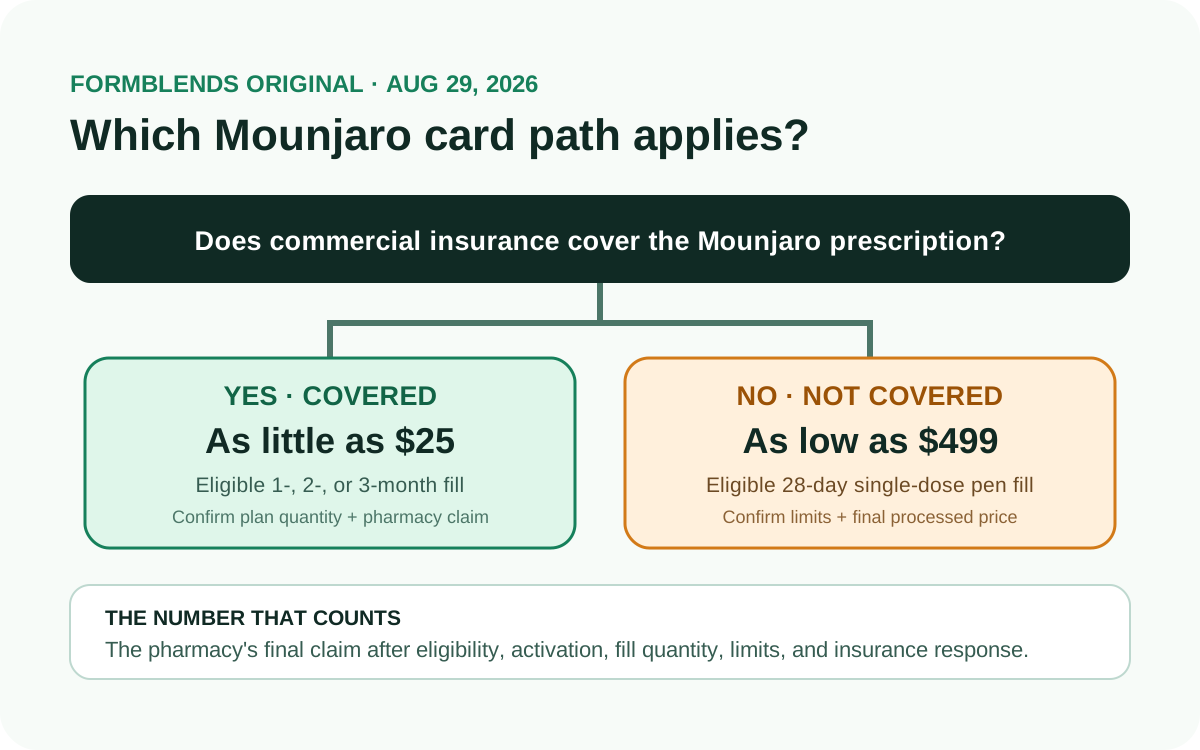
| Your price with commercial coverage of Mounjaro | As little as $25 for a one, two or three-month fill |
| Maximum savings per one-month fill (28 days, up to 4 pens) | $150 |
| Maximum savings per two-month fill | $300 |
| Maximum savings per three-month fill (84 days, up to 12 pens) | $450 |
| Maximum savings per calendar year | $1,950 across up to 13 fills |
| Your price when your commercial plan does not cover Mounjaro | As low as $499 a month; the card pays up to $647 a month and $8,411 a year |
| Who is excluded | Medicare, Medicaid, TRICARE and other government program enrollees; the uninsured |
| Program end | December 31, 2026 |
The practical consequence of the $150 cap: if your plan covers Mounjaro but leaves you with a large coinsurance amount, the card reduces it by $150, not to $25. The $25 figure is reached only when your plan's copay is $175 or less.
Lilly's five-step script for a three-month fill at $25
The single biggest saving most patients miss is the three-month fill: one $25 payment for 84 days and up to 12 pens, against three separate $25 payments. Lilly publishes a script for it on the savings page. In practice it goes like this.
- Ask your prescriber to write the prescription for a three-month supply.
- Confirm your plan allows 90-day fills at retail or by mail; many do, some only by mail order.
- At the pharmacy, ask directly: "Will you fill my three-month prescription of Mounjaro?" Some counters default to one month.
- If the pharmacy cannot fill three months, ask to transfer to an in-network pharmacy that can.
- If none can, fall back to the one-month fill at $25 and try again next cycle; a pharmacy may simply not have 12 pens in stock.
"Mounjaro coupon $500": what that search actually finds
People searching for a $500 Mounjaro coupon are usually seeing the second tier of the same card. If you have commercial insurance that does not cover Mounjaro, the card brings the price down to as low as $499 a month, paying a maximum of $647 a month and $8,411 a year. It is not a $500 discount for the uninsured; without commercial insurance you are not eligible for either tier. The uninsured routes are the retail price (about $1,330 by dose on GoodRx in June 2026), the same molecule sold as Zepbound at $299 to $449 self-pay through LillyDirect if you meet its criteria, or compounded tirzepatide. Lilly Cares, the company's assistance program, is worth checking, but several 2026 sources report that Mounjaro is not on its medication list, so confirm before you count on it.
Medicare patients: the payment plan, the $2,100 cap and the Zepbound Bridge
Medicare enrollees cannot use the card. Three things still help. The Medicare Prescription Payment Plan spreads Part D costs across the year with no interest. The Part D out-of-pocket cap is $2,100 for 2026, after which covered drugs cost nothing. And the Medicare GLP-1 Bridge, running July 1, 2026 to December 31, 2027, prices the Zepbound KwikPen at no more than $50 a month with prior authorization. Mounjaro itself is not listed in the Bridge, so a Medicare patient using tirzepatide for weight rather than diabetes should ask about Zepbound.
Mounjaro cash prices in September 2026, corrected
The dose-by-pharmacy ranges earlier in this article predate the current retail listings. As of GoodRx's June 9, 2026 update the retail price is flat across doses: $1,333.96 (2.5 mg), $1,333.92 (5 mg), $1,332.02 (7.5 mg), $1,333.46 (10 mg), $1,329.12 (12.5 mg) and $1,332.19 (15 mg), against a list price of $1,112.16. There is no manufacturer self-pay program for Mounjaro. The same molecule under the Zepbound label costs $299, $399 or $449 a month self-pay through LillyDirect, and the FormBlends price index put the median month-to-month price of compounded tirzepatide at $299 on September 3, 2026.
FAQ
What is the Mounjaro coupon?
The Mounjaro Savings Card is Eli Lilly's manufacturer copay assistance program. It reduces copays for eligible patients with commercial insurance whose plans cover Mounjaro for type 2 diabetes. Eligible patients can pay as little as $25 per month.
How much does Mounjaro cost with the coupon?
Eligible commercial-insurance patients with type 2 diabetes can pay as little as $25 per month. Patients with very high coinsurance may still owe $50 to $200 even with the card because of the per-fill cap.
Can I use the Mounjaro coupon for weight loss?
No. The Savings Card requires a Mounjaro prescription written for type 2 diabetes. Patients using Mounjaro off-label for weight loss are not eligible. Lilly's separate Zepbound program covers tirzepatide for the obesity indication.
Can I use the Mounjaro coupon with Medicare?
No. Medicare, Medicaid, TRICARE, and VA patients are excluded by federal anti-kickback rules. The card automatically rejects claims paid through any government plan.
How do I get the Mounjaro coupon?
Visit the official Mounjaro Savings Card page on the Lilly website. Complete the brief enrollment form. The card arrives electronically and is presented at the pharmacy alongside your insurance card.
Can I use the Mounjaro coupon at any pharmacy?
Most major pharmacy chains (Walmart, CVS, Costco, Walgreens, Sam's Club) accept the card directly through their pharmacy claims system. Independent pharmacies usually accept it but may require additional steps.
Is the Mounjaro coupon the same as the Zepbound coupon?
No. Mounjaro is Lilly's tirzepatide for type 2 diabetes; Zepbound is Lilly's tirzepatide for obesity and sleep apnea. The two have separate Savings Card programs with separate enrollment, separate caps, and separate eligibility criteria.
Can I get free Mounjaro through Lilly?
Possibly. LillyCares is Lilly's Patient Assistance Program. It provides free Mounjaro to patients with income below 400% of the federal poverty level and no drug coverage for Mounjaro. Your provider must submit the application.
Why is my Mounjaro copay still high with the coupon?
The most common reasons: your deductible isn't met, your plan covers Mounjaro at high coinsurance and the card's per-fill cap is reached, prior authorization isn't in place, or your annual benefit cap is exhausted. Ask the pharmacist to break down the math.
What if my insurance won't cover Mounjaro?
Three options: appeal the denial through your provider with additional clinical documentation, switch to Mounjaro cash purchase at retail prices ($1,000 to $1,260 per fill), or consider compounded tirzepatide through a licensed telehealth platform ($279 to $449 per month).
Is GoodRx cheaper than the Mounjaro coupon?
Usually no. The Mounjaro Savings Card brings the copay to $25 for eligible patients, which is cheaper than any GoodRx-style discount on cash price. For patients without insurance coverage of Mounjaro, GoodRx may bring cash price down to $850 to $1,000, which is still far higher than $25.
Will Mounjaro be covered by my insurance after January 2026 changes?
Coverage rules continue to evolve. Some employer plans expanded GLP-1 coverage in 2026, while some marketplace plans tightened restrictions. Check your specific plan's 2026 formulary and prior authorization rules; they're not transferrable from previous years.
Can I switch from Mounjaro to Zepbound and use the same coupon?
No. The two products have separate Savings Cards. If your provider transitions you from Mounjaro (diabetes indication) to Zepbound (obesity indication), enroll in the Zepbound Savings Card separately.
Can I use the Mounjaro coupon without insurance?
No. Both tiers of the Lilly savings card require commercial insurance. Uninsured patients should look at the LillyDirect Zepbound self-pay price of $299 to $449 if they qualify, or compounded tirzepatide, and confirm on lillycares.com whether Mounjaro is currently on the Lilly Cares medication list before applying.
Can I use the Mounjaro coupon without diabetes?
The card is written for patients with a type 2 diabetes prescription, and plans that cover Mounjaro almost always require that diagnosis. For weight management, the tirzepatide product with its own savings card and self-pay program is Zepbound.
How many times can you use the Mounjaro coupon?
Up to 13 fills per calendar year, with total savings capped at $1,950 a year, through December 31, 2026.
How long does the Mounjaro coupon last?
The current program runs through December 31, 2026. Lilly has renewed it annually; check the savings page in December for the 2027 terms.
Author / review note
References include the official Mounjaro prescribing information (revised 2024), the Lilly Savings Card terms and conditions effective 2026, the LillyCares Patient Assistance Program eligibility documentation, the SURPASS trial program publications (Frias et al., New England Journal of Medicine, 2021; Del Prato et al., Lancet, 2021), and the FDA prescribing information for tirzepatide.
Related guides
- Zepbound Coupon 2026: How the Lilly Savings Card Works, Who Qualifies, and What You'll Actually Pay
- The Eli Lilly Mounjaro Coupon (Savings Card) in 2026: Who Qualifies, What It Saves, and What to Do If You Don't Qualify
- Mounjaro Savings Card: Who Qualifies in 2026, What You Pay, and the Catches Lilly Doesn't Mention
- Wegovy Coupon in 2026: How the Savings Card Works, Who Qualifies, and What You'll Pay
- Ozempic Coupon in 2026: How the Savings Card Works, Who Qualifies, and What You'll Pay
- Zepbound Coupon 2025: How the Savings Card Works, Who Qualifies, and What You'll Actually Pay
- Tool: cost calculator
Sources
- The official Mounjaro prescribing information (revised 2024).
- The Lilly Savings Card terms and conditions effective 2026.
- The LillyCares Patient Assistance Program eligibility documentation.
- The SURPASS trial program publications (Frias et al., New England Journal of Medicine, 2021; Del Prato et al., Lancet, 2021).
- The FDA prescribing information for tirzepatide.
- Eli Lilly. Mounjaro savings and coverage, August 2026. https://mounjaro.lilly.com/savings-coverage
- GoodRx. How to save on Mounjaro, https://www.goodrx.com/mounjaro/how-to-save-on-mounjaro
- GoodRx. How much is Mounjaro without insurance, updated June 9, 2026. https://www.goodrx.com/mounjaro/how-much-is-mounjaro-without-insurance
- Noom. Does insurance cover Mounjaro, last updated May 12, 2026. https://www.noom.com/blog/weight-management/does-insurance-cover-mounjaro/
- Eli Lilly. Zepbound coverage and savings, August 2026. https://zepbound.lilly.com/coverage-savings
- Eli Lilly. LillyDirect Zepbound self-pay pricing, August 2026. https://www.lilly.com/lillydirect/zepbound
- FormBlends Research. Compounded GLP-1 Price Index, as of September 3, 2026. https://formblends.com/feeds/glp1-prices.json
Footer disclaimers (all 4 verbatim)
Platform Disclaimer. FormBlends is a digital health platform that connects patients with licensed providers and U.S.-based pharmacies. We do not manufacture, prescribe, or dispense medication directly. All clinical decisions are made by independent licensed providers.
Compounded Medication Notice. Compounded semaglutide and tirzepatide are not FDA-approved. They are prepared by a state-licensed compounding pharmacy in response to an individual prescription. Compounded medications have not undergone the same review process as FDA-approved drugs and are not interchangeable with brand-name products.
Results Disclaimer. Individual results vary. Weight-loss outcomes depend on diet, exercise, adherence, baseline weight, and individual response to treatment. Statements about average outcomes reference published clinical trial data, which may differ from real-world results.
Trademark Notice. Mounjaro and Zepbound are registered trademarks of Eli Lilly and Company. Ozempic, Wegovy, and Rybelsus are registered trademarks of Novo Nordisk A/S. LillyCares is a program of Eli Lilly and Company. Walmart, CVS, Costco, Walgreens, Sam's Club, and GoodRx are trademarks of their respective owners. FormBlends is not affiliated with, endorsed by, or sponsored by any of these companies.
See your options in about 2 minutes
Take the free quiz and see what fits you. Quick, private, and no commitment to continue.
See my options →