Key Takeaways
- The Eli Lilly Zepbound Savings Card reduces eligible commercial-insurance copays to as little as $25 per fill, with a maximum savings of $100 per 1-month fill ($200 per 2-month, $300 per 3-month) and $1,300 per calendar year (Eli Lilly Zepbound Savings Card terms read September 4, 2026; the card expires December 31, 2026).
- Patients without Zepbound coverage on their commercial plan can use the card to pay as low as $499 a month for the single-dose pen, up to 13 fills a year.
- Eli Lilly also sells Zepbound self-pay through LillyDirect and GoodRx-listed pharmacies: KwikPen or single-dose vial at $299 (2.5 mg), $399 (5 mg) and $449 (7.5 to 15 mg when refilled within 45 days; otherwise $499 or $699).
- Medicare, Medicaid, TRICARE, and VA patients are excluded from the manufacturer savings card by federal anti-kickback rules.
- The current card expires December 31, 2026; the covered tier is capped at $1,300 a year and the not-covered tier at 13 fills a year. Medicare Part D patients can get the KwikPen for $50 a month through the Medicare GLP-1 Bridge instead.
The short answer
The Zepbound manufacturer coupon, called the Zepbound Savings Card, reduces commercial-insurance copays to as little as $25 per fill (maximum savings $100 a month, $1,300 a year). Patients with commercial insurance that does not cover Zepbound pay as low as $499 monthly with the card, up to 13 fills a year. Medicare, Medicaid, and government-program patients aren't eligible. Apply at zepbound.lilly.com.
Table of contents
- The 30-second answer
- What the Zepbound Savings Card actually pays
- Who qualifies and who's excluded
- How to apply for and download the card
- Using the card at the pharmacy: step by step
- Zepbound Savings Card vs LillyDirect self-pay vials
- What happens when the card expires or hits its annual limit
- Stacking with other discounts (GoodRx, FSA, HSA)
- The compounded tirzepatide alternative for patients who don't qualify
- Savings card terms table
- Copay examples with the $100 cap
- Self-pay prices by dose
- Medicare GLP-1 Bridge
- Pharmacies honoring $299 self-pay
- FAQ
- Sources
- Footer disclaimers
What the Zepbound Savings Card actually pays
Eli Lilly's Zepbound Savings Card has two tiers, depending on your insurance coverage status.
See transparent compounded pricing
Review compounded GLP-1 pricing and what provider-reviewed care includes, with no surprises at checkout.
Try the Cost Calculator →Tier 1: Commercial insurance covers Zepbound. You pay as little as $25 for a 1-, 2- or 3-month fill. Maximum savings of $100 per 1-month fill, $200 per 2-month fill, $300 per 3-month fill, and $1,300 per calendar year. The card pays the difference between your copay and $25, up to the cap.
Tier 2: Commercial insurance does not cover Zepbound. You pay as low as $499 for a one-month supply of the single-dose pen. The card covers the difference between the wholesale acquisition cost and $499, for up to 13 fills per calendar year.
For comparison, GoodRx lists an average retail price of $600 for the Zepbound KwikPen and shows Lilly's $299 self-pay offer at Walgreens, CVS, Walmart, Costco and other chains (September 2026). The savings card is a meaningful reduction for the covered group; for the not-covered group, Lilly's own $299 to $449 self-pay KwikPen price is usually lower than the $499 card tier.
The card is not a discount on the list price applied to everyone. It's two distinct programs with different eligibility paths and payment amounts.
Who qualifies and who's excluded
Qualifies (Tier 1, $25 copay):
- U.S. resident with commercial (private) insurance that covers Zepbound
- Prescription written by a licensed U.S. provider
- Adult age 18 or older (the savings card aligns with the FDA approval age)
- Not enrolled in Medicare, Medicaid, TRICARE, VA, or any government-funded prescription program
Qualifies (Tier 2, $499 not-covered price):
- U.S. resident with commercial insurance that does not cover Zepbound (e.g., the plan denied prior auth, the formulary excludes it, or the plan covers only diabetes drugs)
- Prescription written by a licensed U.S. provider
- Not enrolled in Medicare, Medicaid, TRICARE, VA
Excluded:
- Anyone enrolled in Medicare Part D, Medicare Advantage with drug coverage, Medicaid, TRICARE, VA, IHS, federal employee health plans (some), or any state-funded program
- Patients whose Zepbound costs are paid through an alternate funding program or vendor
- Anyone receiving Zepbound through a 340B program or hospital discount program
- Cash-paying patients without any insurance (use Lilly's self-pay KwikPen or vial price instead)
The Medicare exclusion catches many patients off-guard. Federal anti-kickback laws prohibit drug manufacturers from offering copay assistance to government program enrollees. There's no workaround through the Lilly card.
How to apply for and download the card
The application takes about 5 minutes online and doesn't require provider involvement.
Step 1. Go to zepbound.lilly.com (the Lilly Savings Card page).
Step 2. Enter your name, email, mailing address, and date of birth.
Step 3. Confirm you have commercial insurance and aren't enrolled in any government program.
Step 4. Print or save the digital card. The card has a Member ID, RxBin, RxPCN, and Group number, all of which the pharmacy needs.
Step 5. Bring the card (printed, saved on phone, or memorized member ID) to the pharmacy alongside your insurance card.
The card is reusable through its expiration date, currently December 31, 2026. You don't reapply each fill. Lilly has issued a new card each year so far; check the terms each January.
If you don't have commercial insurance, the same website routes you to the self-pay program instead. The Tier 2 ($499) path uses the same card; the pharmacy's rejected insurance claim is what triggers it.
Using the card at the pharmacy: step by step
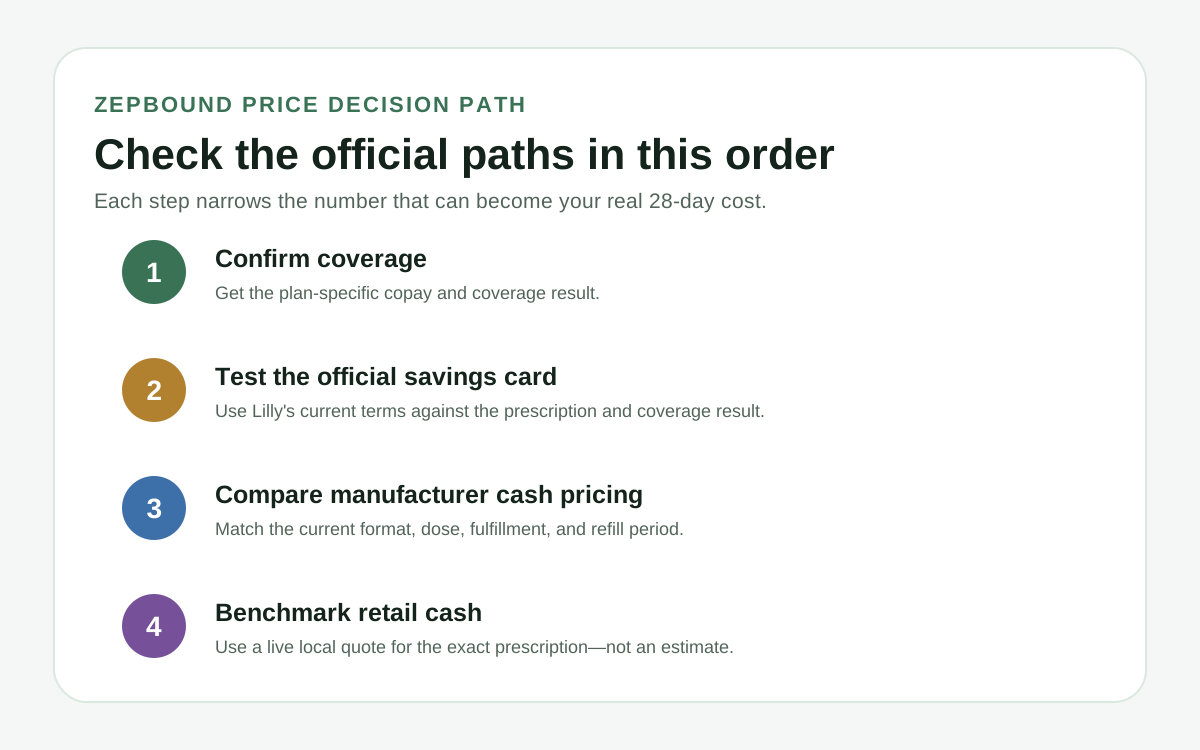
The pharmacist runs your prescription through three claims, in this order:
1. Insurance claim. The pharmacist runs your commercial insurance card first. The plan returns either an approved copay (e.g., $300) or a denial.
2. Savings card claim. The pharmacist then runs the Zepbound Savings Card claim. If your insurance approved Zepbound, the card pays the difference between the copay and $25, up to $100 for a 1-month fill. If your insurance denied Zepbound, the card processes the Tier 2 path at $499.
3. Final patient cost. You pay the remaining balance: $25 if Tier 1 worked cleanly, more if your copay exceeded $125, or $499 if Tier 2.
If something doesn't process correctly, the most common fixes are:
- Make sure the pharmacist enters all four codes from the savings card (Member ID, BIN, PCN, Group). Missing any one rejects the claim.
- Check that the prescription is for Zepbound specifically (not Mounjaro). The savings card is Zepbound-only.
- Verify the date. The current card expires December 31, 2026.
- Confirm you haven't hit the $1,300 annual cap (Tier 1) or the 13-fill limit (Tier 2).
The card processes electronically. You don't pay out of pocket and submit for reimbursement. The pharmacy collects the manufacturer's share at point of sale.
Zepbound Savings Card vs LillyDirect self-pay vials
Eli Lilly also sells Zepbound self-pay through LillyDirect, and the same self-pay price now appears at retail pharmacies through GoodRx. Self-pay covers the multi-dose KwikPen and the single-dose vial; the single-dose pen has no self-pay price and is insurance-only.
| Program | Eligibility | Price per month | Format |
|---|---|---|---|
| Zepbound Savings Card (Tier 1) | Commercial insurance covers Zepbound | $25 (up to $100 savings a month) | Pre-filled pen |
| Zepbound Savings Card (Tier 2) | Commercial insurance, Zepbound not covered | $499 | Pre-filled pen |
| Self-pay 2.5 mg | Anyone with a prescription | $299 | KwikPen or single-dose vial |
| Self-pay 5 mg | Anyone with a prescription | $399 | KwikPen or single-dose vial |
| Self-pay 7.5/10/12.5/15 mg | Anyone with a prescription | $449 with a refill within 45 days; otherwise $499 (7.5 mg) or $699 (10 to 15 mg) | KwikPen or single-dose vial |
| Medicare GLP-1 Bridge | Medicare Part D, CMS criteria, prior authorization | $50 (July 1, 2026 to December 31, 2027) | KwikPen only |
Self-pay requires no insurance and is the cheapest brand-name option for patients without commercial coverage. The KwikPen is a multi-dose pen; the vial requires drawing the dose with a syringe.
For Medicare Part D patients who meet CMS criteria, the GLP-1 Bridge at $50 a month beats every self-pay price; for Medicaid or uninsured patients, self-pay at $299 to $449 is the lowest brand-name price point available.
For more on cost comparisons, see our Zepbound cost guide.
What happens when the card expires or hits its annual limit
The Zepbound Savings Card has two reset triggers.
Card expiration. The current card expires December 31, 2026, and reimbursement claims must be submitted by March 31, 2027. Lilly has issued a new card each year so far, but the terms can change.
Annual limits. Tier 1 savings stop at $1,300 in a calendar year; Tier 2 stops at 13 fills. Beyond those, you pay your full insurance copay (Tier 1) or Lilly's self-pay price (Tier 2).
Monthly cap reached. If your insurance copay is $300 and the card pays its $100 maximum, you still owe $200. The card doesn't cap your out-of-pocket at $25 if your copay is above $125; in that case compare Lilly's $299 to $449 self-pay price.
Insurance change. If you switch from commercial insurance to Medicare during the year, you lose eligibility immediately. The card stops working at the next fill.
Eli Lilly program changes. Manufacturer programs aren't permanent. Lilly has the right to change terms, reduce maximum savings, or end the program. The current $25/$499/$100 figures were read from zepbound.lilly.com on September 4, 2026 and could change.
Stacking with other discounts (GoodRx, FSA, HSA)
The savings card has restrictions on stacking with other discounts.
GoodRx and other coupons. You can't stack the Zepbound Savings Card with GoodRx or other discount cards in the same transaction. Pick one. For most patients with commercial insurance, the savings card produces a lower out-of-pocket than GoodRx alone.
FSA and HSA accounts. You can pay your $25 copay (or the residual after card application) using FSA or HSA dollars. The savings card itself isn't an FSA-eligible expense, but the medication you receive is.
Manufacturer + other manufacturer coupons. Not applicable. There's only one Zepbound manufacturer coupon.
Provider samples. Eli Lilly distributes free Zepbound samples to providers occasionally. Sample doses don't count against the 13-fill limit because they don't go through pharmacy claims.
If you're unsure whether a discount can stack, ask the pharmacist before they process the claim. Pharmacy software flags incompatible combinations automatically.
The compounded tirzepatide alternative for patients who don't qualify
For patients who don't qualify for the Zepbound Savings Card (Medicare, Medicaid, no insurance, or cost still too high), compounded tirzepatide is a common alternative.
Pricing comparison:
| Option | Monthly cost | Format | FDA approval |
|---|---|---|---|
| Zepbound + savings card (Tier 1) | $25 | Pen | Yes |
| Zepbound + savings card (Tier 2) | $499 | Pen | Yes |
| Zepbound self-pay (LillyDirect or a GoodRx pharmacy) | $299-$449 | KwikPen or vial | Yes |
| Compounded tirzepatide via FormBlends | See product page and price index (market median $299, September 2026) | Vial | No (compounded) |
The compounded option matters most for:
- Medicare and Medicaid patients excluded from the manufacturer card
- Patients whose plan denied prior authorization
- Patients who reach the annual card limit and need ongoing therapy
- Patients in states where compounding access is straightforward
The compounded medication is not the same as Zepbound. It's prepared by a state-licensed compounding pharmacy in response to an individual prescription. For more on the differences, see our compounded tirzepatide guide.
How long the savings card stays in effect
The current program runs through December 31, 2026, per Eli Lilly's published terms. Manufacturer copay programs typically renew year over year, but the terms can change.
Things that have shifted historically:
- Maximum savings amount (currently $100 a month and $1,300 a year for covered patients under the 2026 terms)
- Annual fill limit (13 fills for the not-covered tier under the 2026 terms)
- Not-covered price (as low as $499 under the 2026 terms)
- Self-pay pricing (currently $299, $399 and $449 by dose, with a 45-day refill rule on the $449 tier)
If you've been using the card for a year or more, check the Lilly website each January for updated terms before assuming the same prices apply.
Zepbound Savings Card terms in one table (card expires December 31, 2026)
Read from zepbound.lilly.com/savings (CMAT-26402, August 2026) on September 4, 2026. Earlier versions of this article used older figures ($469 cap, $650 tier); these are the current ones.
| Term | Commercial plan covers Zepbound | Commercial plan does not cover Zepbound |
|---|---|---|
| What you pay | As little as $25 for a 1-, 2- or 3-month fill | As low as $499 for a 1-month fill of the single-dose pen |
| Maximum monthly savings | $100 (1-month), $200 (2-month), $300 (3-month) | Wholesale acquisition cost minus $499 |
| Annual limit | $1,300 per calendar year | 13 fills per calendar year |
| Device | Single-dose pen | Single-dose pen |
| Excluded | Government program beneficiaries (Medicare, Medicaid, TRICARE, VA); patients paid through alternate funding vendors | |
| Expiration | Card expires and savings end December 31, 2026; reimbursement claims due by March 31, 2027 | |
Copay examples with the $100 cap: when the card wins and when self-pay wins
The $100 monthly cap is the number that decides whether the card or Lilly's self-pay price is your better route.
| Your copay per month | Card pays | You pay with the card | Lilly self-pay comparison |
|---|---|---|---|
| $75 | $50 | $25 | Card wins |
| $125 | $100 | $25 | Card wins |
| $150 | $100 | $50 | Card wins |
| $300 | $100 | $200 | Card wins at 2.5 mg ($299 self-pay) but only just |
| $450 (coinsurance) | $100 | $350 | Self-pay wins at 2.5 mg ($299); tie at 5 mg ($399) and above ($449) |
| $600 (coinsurance) | $100 | $500 | Self-pay wins at every dose ($299 to $449) |
| 3-month fill, $450 copay | $300 | $150 ($50 a month) | Card wins |
Twelve monthly fills at the $100 cap use $1,200 of the $1,300 annual limit, so the annual cap rarely binds for monthly fills. Remember that self-pay purchases file no insurance claim and do not count toward your deductible.
Self-pay KwikPen and vial prices by dose, and the 45-day refill rule
Lilly's self-pay pricing applies to the multi-dose KwikPen and the single-dose vial, bought through LillyDirect or at a pharmacy that runs the offer (GoodRx lists Walgreens, CVS, Walmart, Costco, HEB and Sam's Club). It does not apply to the single-dose pen. Read on lilly.com/lillydirect/zepbound and zepbound.lilly.com/savings on September 4, 2026.
| Dose | Self-pay price per month (28 days) | Regular price without the offer | Condition |
|---|---|---|---|
| 2.5 mg | $299 | $299 | None |
| 5 mg | $399 | $399 | None |
| 7.5 mg | $449 | $499 | Refill within 45 days of the prior fill |
| 10 mg, 12.5 mg, 15 mg | $449 | $699 | Refill within 45 days of the prior fill |
The 45-day rule matters most at 10 mg and above, where missing the window costs $250. The $449 purchase offer is applied automatically on the first purchase of 7.5 mg or higher, according to Lilly's terms.
Medicare: $50 a month through the GLP-1 Bridge (July 1, 2026 to December 31, 2027)
The savings card excludes Medicare, but Medicare Part D patients now have a better route. Through the Medicare GLP-1 Bridge, a CMS Innovation Center model, eligible beneficiaries get the Zepbound KwikPen (not the single-dose pen or vial), Wegovy (pen and pill) or Foundayo for a $50 monthly copay from July 1, 2026 through December 31, 2027. The Part D deductible does not apply, the $50 does not count toward the beneficiary's out-of-pocket total (the 2026 Part D cap is $2,100), and there is no low-income subsidy on it. Prior authorization goes through a single central processor. CMS criteria: age 18 or older with a BMI of 35 or higher; or a BMI of 30 or higher with heart failure, uncontrolled hypertension despite two antihypertensive medications, or chronic kidney disease stage 3a or above; or a BMI of 27 or higher with pre-diabetes, a previous heart attack, a previous stroke, or symptomatic peripheral artery disease, with BMI judged at the time GLP-1 therapy was started. Beneficiaries who already qualify for a GLP-1 through their Part D plan, for diabetes for example, use that coverage instead. Lilly's access page summarizes it as Zepbound for no more than $50 a month.
Which pharmacies honor the $299 self-pay price
As of September 4, 2026, GoodRx's Zepbound page shows Lilly's self-pay KwikPen offer at $299 (2.5 mg) at Walgreens, CVS, Walmart, Costco, HEB and Sam's Club, against an average retail price it lists as $600. You do not need a GoodRx coupon for this; it is Lilly's price. LillyDirect ships the same KwikPen or vial at the same price. If a pharmacy quotes a higher cash price, ask it to run Lilly's self-pay program rather than a discount card.
FAQ
What is the Zepbound manufacturer coupon?
The Zepbound Savings Card from Eli Lilly. It reduces commercial-insurance copays to as little as $25 per fill (maximum savings $100 a month, $1,300 a year; the card expires December 31, 2026). For patients with commercial insurance that doesn't cover Zepbound, the card sets the price at $499 per month for up to 13 fills a year.
How much does Zepbound cost with the manufacturer coupon?
$25 per month if your commercial insurance covers Zepbound and your copay is $125 or less. $499 per month if you have commercial insurance but Zepbound isn't covered. The $25 figure is the lowest possible price; some patients with high copays pay more because the card has a per-fill maximum benefit.
Who is eligible for the Zepbound Savings Card?
U.S. residents with commercial (private) insurance, age 18 or older, with a valid Zepbound prescription. Excluded: Medicare, Medicaid, TRICARE, VA and other government programs, and patients whose costs are paid through an alternate funding vendor.
How do I get the Zepbound coupon?
Visit zepbound.lilly.com and complete the savings card application. Print or save the digital card with your Member ID, BIN, PCN, and Group number. Bring it to the pharmacy alongside your insurance card. The pharmacist runs both claims at checkout.
Can Medicare patients use the Zepbound coupon?
No. Federal anti-kickback laws prohibit manufacturer copay coupons for Medicare and other government-program patients. Since July 1, 2026, Medicare Part D patients who meet CMS criteria can get the Zepbound KwikPen for no more than $50 a month through the Medicare GLP-1 Bridge; otherwise they can use Lilly self-pay at $299 to $449 per month or look at compounded alternatives.
Does the Zepbound coupon work for the weight-loss indication?
Yes. The savings card applies to Zepbound prescriptions for the FDA-approved indications, which include chronic weight management. Some commercial plans don't cover Zepbound for weight loss; in that case, the Tier 2 path at $499 per month applies.
How many times can I use the Zepbound Savings Card?
For covered patients, until savings reach $1,300 in the calendar year; for the not-covered tier, up to 13 fills. The current card expires December 31, 2026.
Is there a difference between the Zepbound coupon and LillyDirect?
Yes. The Zepbound Savings Card requires commercial insurance. LillyDirect is a self-pay channel for anyone with a prescription, offering the KwikPen or single-dose vial at $299 to $449 per month by dose. Different products, different prices, different eligibility.
Can I use GoodRx with the Zepbound Savings Card?
No. The savings card and GoodRx can't stack in the same transaction. If you have commercial insurance, the savings card almost always produces a lower price than GoodRx. If you have no insurance, GoodRx now lists Lilly's own $299 self-pay KwikPen offer at major chains, so the price is the same either way.
What if my Zepbound copay is higher than $25 even with the card?
The savings card pays a maximum of $100 per 1-month fill toward your copay. If your copay is $300, you'd pay $200 ($300 minus $100), which is why Lilly's $299 to $449 self-pay price can be the better deal. Plans with high specialty copays leave you owing more than $25 even with the card.
Does the card work for compounded tirzepatide?
No. The card is brand-name Zepbound only. Compounded tirzepatide is a separate product made by compounding pharmacies and isn't covered by the Lilly program.
Will the Zepbound Savings Card cover prior authorization?
The card doesn't influence whether your insurance approves the prescription. If your plan denies prior authorization, you can't get the Tier 1 ($25) benefit. You can use the Tier 2 ($499) path if you have commercial insurance but no coverage for Zepbound.
Is there a manufacturer coupon for Zepbound in 2026?
Yes. Eli Lilly's Zepbound Savings Card, read on zepbound.lilly.com on September 4, 2026, lets commercially insured patients with coverage pay as little as $25 (maximum savings $100 a month, $1,300 a year) and prices the single-dose pen at $499 for commercially insured patients without coverage (13 fills a year). It expires December 31, 2026. There is no coupon for the uninsured; Lilly's self-pay price of $299 to $449 is the cash route.
Can I stack the Zepbound coupon with other discounts?
No. The savings card cannot be combined with GoodRx or another discount card in the same transaction, and it cannot be used alongside Lilly's self-pay price. You can pay the remaining copay with HSA or FSA funds. If your copay minus the $100 card benefit is higher than Lilly's self-pay price for your dose ($299 to $449), skip the card and pay self-pay.
Can you use the Zepbound coupon with no insurance?
No. Both tiers of the card require commercial insurance: $25 if the plan covers Zepbound, $499 if it does not. Uninsured patients use Lilly's self-pay program instead, which is open to anyone with a prescription at $299 (2.5 mg), $399 (5 mg) or $449 (7.5 to 15 mg with a refill within 45 days) through LillyDirect or a pharmacy listed on GoodRx.
Is Zepbound covered by Medicare?
Not under the standard Part D benefit, which excludes weight-loss drugs, and the savings card excludes Medicare. But from July 1, 2026 through December 31, 2027 the Medicare GLP-1 Bridge covers the Zepbound KwikPen for no more than $50 a month for Part D beneficiaries who meet CMS criteria (BMI of 35 or higher, or 30 with certain conditions, or 27 with pre-diabetes or prior heart attack, stroke or peripheral artery disease), with prior authorization.
Related guides
- Ozempic Manufacturer Coupon in 2026: Who Qualifies, How Much You Save, and What to Do If You Don't
- Novo Nordisk Wegovy Coupon in 2026: Who Qualifies, How Much You'll Actually Save, and What to Do When Denied
- The Wegovy Manufacturer Coupon in 2026: How It Works, Who Qualifies, and Real Savings
- Zepbound Coupon 2026: How the Lilly Savings Card Works, Who Qualifies, and What You'll Actually Pay
- Zepbound Coupon 2025: How the Savings Card Works, Who Qualifies, and What You'll Actually Pay
- Wegovy Coupon in 2026: How the Savings Card Works, Who Qualifies, and What You'll Pay
- Tool: dosage calculator
Sources
- Jastreboff AM, Aronne LJ, Ahmad NN, et al. Tirzepatide once weekly for the treatment of obesity (SURMOUNT-1). N Engl J Med. 2022;387:205-216.
- Zepbound (tirzepatide) prescribing information. Eli Lilly and Company. Revised 2024.
- Eli Lilly Zepbound Savings Card terms and conditions. zepbound.lilly.com. Accessed Q1 2026.
- Eli Lilly LillyDirect self-pay program terms. lillydirect.lilly.com. Accessed Q1 2026.
- CMS Office of Inspector General. Special advisory bulletin: pharmaceutical manufacturer copayment coupons. 2014.
- Massachusetts General Laws Chapter 175H, Section 3 (manufacturer coupon restrictions). 2012.
- American Society of Health-System Pharmacists. Manufacturer copay assistance programs guidance. ASHP Foundation, 2023.
- Garvey WT, Frias JP, Jastreboff AM, et al. Tirzepatide once weekly for chronic weight management (SURMOUNT-2). Lancet. 2023;402:613-626.
- Aronne LJ, Sattar N, Horn DB, et al. Tirzepatide for chronic weight management (SURMOUNT-3, lifestyle-induced). JAMA. 2024;331:38-48.
- Eli Lilly. Zepbound savings card terms and self-pay pricing, CMAT-26402, August 2026. https://zepbound.lilly.com/savings
- Eli Lilly. Zepbound coverage and savings, read September 4, 2026. https://zepbound.lilly.com/coverage-savings
- Eli Lilly. Zepbound access and coverage, including the Medicare GLP-1 Bridge, read September 4, 2026. https://zepbound.lilly.com/access-coverage
- Eli Lilly. LillyDirect Zepbound self-pay pricing, read September 4, 2026. https://www.lilly.com/lillydirect/zepbound
- GoodRx. Zepbound prices and self-pay KwikPen offer, read September 4, 2026. https://www.goodrx.com/zepbound
- Centers for Medicare and Medicaid Services. Medicare GLP-1 Bridge model overview, read September 4, 2026. https://www.cms.gov/priorities/innovation/innovation-models/medicare-glp-1-bridge
- Centers for Medicare and Medicaid Services. Medicare GLP-1 Bridge: information for providers, page last modified August 6, 2026. https://www.cms.gov/medicare/coverage/prescription-drug-coverage/medicare-glp-1-bridge/information-providers
- healthinsurance.org (Louise Norris). Does health insurance cover GLP-1 medications for weight loss?, updated August 20, 2026. https://www.healthinsurance.org/faqs/does-health-insurance-cover-drugs-used-for-weight-loss-such-as-ozempic-wegovy-mounjaro-and-zepbound/
- FormBlends Research. Compounded GLP-1 Price Index, as of September 3, 2026. https://formblends.com/feeds/glp1-prices.json
Footer disclaimers
Platform Disclaimer. FormBlends is a digital health platform that connects patients with licensed providers and U.S.-based pharmacies. We do not manufacture, prescribe, or dispense medication directly. All clinical decisions are made by independent licensed providers.
Compounded Medication Notice. Compounded semaglutide and tirzepatide are not FDA-approved. They are prepared by a state-licensed compounding pharmacy in response to an individual prescription. Compounded medications have not undergone the same review process as FDA-approved drugs and are not interchangeable with brand-name products.
Results Disclaimer. Individual results vary. Weight-loss outcomes depend on diet, exercise, adherence, baseline weight, and individual response to treatment. Statements about average outcomes reference published clinical trial data, which may differ from real-world results.
Trademark Notice. Zepbound and Mounjaro are registered trademarks of Eli Lilly and Company. LillyDirect is a service of Eli Lilly. GoodRx is a trademark of GoodRx Holdings. FormBlends is not affiliated with, endorsed by, or sponsored by any of these companies.
See your options in about 2 minutes
Take the free quiz and see what fits you. Quick, private, and no commitment to continue.
See my options →