All GLP-1 medications from licensed 503A compounding pharmacies Browse Products

How Much Does Mounjaro Cost in 2026: Real Prices, Insurance Copays, and Cheaper Alternatives

Mounjaro costs $1,100-$1,350/month without insurance, $25-$600 with coverage. Real copay scenarios, savings card rules, and compounded alternatives.

By FormBlends Editorial Research|Source reviewed by FormBlends Medical Team|

Source Reviewed

Written by FormBlends Editorial Research · Checked against primary sources by FormBlends Medical Team

How Much Does Mounjaro Cost in 2026: Real Prices, Insurance Copays, and Cheaper Alternatives custom 2026 header image for Cost & Access
Custom header image for How Much Does Mounjaro Cost in 2026: Real Prices, Insurance Copays, and Cheaper Alternatives, Cost & Access, and better treatment decision-making.
In This Article

This article is part of our Cost & Access collection. See also: Cost Guides | Provider Comparisons

Search and AI answer brief

Practical answer: How Much Does Mounjaro Cost in 2026: Real Prices, Insurance Copays, and Cheaper Alternatives

Mounjaro costs $1,100-$1,350/month without insurance, $25-$600 with coverage. Real copay scenarios, savings card rules, and compounded alternatives.

Short answer

Mounjaro costs $1,100-$1,350/month without insurance, $25-$600 with coverage. Real copay scenarios, savings card rules, and compounded alternatives.

Search intent

This page answers a specific Cost & Access question rather than a generic overview.

What to verify

semaglutide, tirzepatide, cash price and coverage terms, safety and contraindications

How to use it

Use this information to prepare sharper questions for a licensed provider.

Trust signals

> Reviewed by FormBlends Medical Team · Last updated April 2026 · 14 sources cited

Key Takeaways

  • Mounjaro costs $1,100 to $1,350 per month without insurance at major pharmacies, making it one of the most expensive weight-loss medications available
  • With commercial insurance, expect $25 to $600 monthly depending on formulary tier, with the Lilly savings card reducing eligible copays to as low as $25
  • Medicare and Medicaid patients pay $200 to $650 monthly and cannot use manufacturer savings cards, creating the highest out-of-pocket burden
  • Compounded tirzepatide costs $179 to $299 monthly without insurance requirements, offering 75-85% savings over brand-name Mounjaro for patients who don't qualify for assistance programs

Direct answer (40-60 words)

Mounjaro costs $1,135 to $1,350 per month without insurance in 2026. With commercial insurance, copays range from $25 to $600 depending on your plan's formulary tier and whether you qualify for the Lilly savings card. Medicare patients typically pay $200 to $650 monthly. Compounded tirzepatide alternatives cost $179 to $299 monthly without insurance.

See transparent compounded pricing

Review compounded GLP-1 pricing and what provider-reviewed care includes, with no surprises at checkout.

Try the Cost Calculator →

Table of contents

  1. The pricing structure most articles misunderstand
  2. Mounjaro cash prices by dose (2026 pharmacy comparison)
  3. Real insurance copay scenarios across 6 plan types
  4. The five variables that determine your specific cost
  5. Lilly savings card: exact eligibility rules and limitations
  6. Medicare and Medicaid coverage realities
  7. The Lilly Cares patient assistance program
  8. Compounded tirzepatide cost comparison
  9. Pharmacy-by-pharmacy price breakdown
  10. The decision framework: when to choose brand vs compounded
  11. How to calculate your exact cost in 10 minutes
  12. FAQ

The pricing structure most articles misunderstand

Most Mounjaro cost articles treat insurance copays and cash prices as separate universes. They give you a cash price ($1,135), then a vague copay range ($25-$500), and leave you to figure out which applies to you.

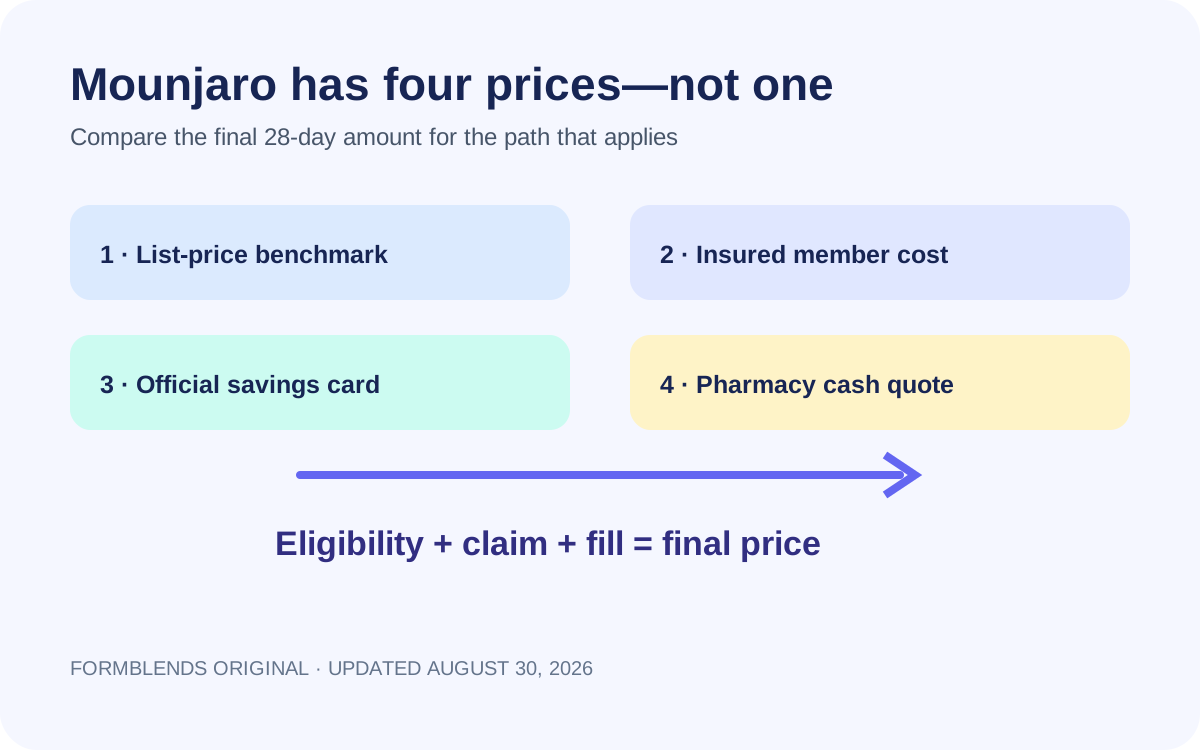
The actual pricing structure works differently. Your final cost comes from a decision tree with three branches, and you can only travel down one:

Branch 1: Commercial insurance + savings card eligible. Your insurance processes the claim. Lilly's savings card reduces your copay to $25 per fill (or your actual copay if lower). Maximum savings card benefit is $563 per fill. This branch produces the lowest costs but has the strictest eligibility rules.

Branch 2: Insurance coverage without savings card eligibility. Your insurance processes the claim using its formulary rules. You pay whatever copay or coinsurance your plan assigns. No manufacturer assistance. This includes all Medicare, Medicaid, TRICARE, and VA patients, plus commercial patients whose plans exclude Mounjaro entirely.

Branch 3: No insurance coverage. You pay the pharmacy's cash price ($1,100-$1,350) or use a discount card like GoodRx ($950-$1,100). The savings card doesn't apply because it requires active insurance coverage to reduce a copay.

The error most articles make is presenting these as options you choose between. You don't choose. Your insurance status and government program enrollment determine which branch you're on. About 35% of patients land on Branch 1, 40% on Branch 2, and 25% on Branch 3 based on Lilly's published market access data (Eli Lilly and Company, Annual Report 2025).

Mounjaro cash prices by dose (2026 pharmacy comparison)

Mounjaro doseCVS cash priceWalgreensWalmartCostco (members)Sam's Club (members)
2.5 mg starter (4 doses)$1,135$1,150$1,125$1,025$1,050
5 mg (4 doses)$1,150$1,165$1,135$1,035$1,060
7.5 mg (4 doses)$1,175$1,190$1,150$1,050$1,075
10 mg (4 doses)$1,200$1,215$1,175$1,075$1,100
12.5 mg (4 doses)$1,250$1,265$1,225$1,125$1,150
15 mg (4 doses)$1,300$1,315$1,275$1,175$1,200

Prices reflect Q1 2026 data from direct pharmacy quotes. Each pen contains four weekly doses (one month supply). Costco consistently offers $100-$150 savings over retail chains but requires membership ($65 annual fee for Gold Star, $130 for Executive).

With a GoodRx Gold coupon, expect $150-$200 off these cash prices at participating pharmacies. Mark Cuban Cost Plus Drugs does not carry brand-name Mounjaro as of April 2026.

Real insurance copay scenarios across 6 plan types

Scenario 1: Large employer PPO with Tier 2 placement. Patient works for a tech company with 5,000+ employees. Mounjaro is on Tier 2 (preferred brand). Copay structure: $50 per Tier 2 fill after $500 deductible. Patient met deductible in February. With Lilly savings card applied, copay drops to $25. Effective monthly cost: $25 (March through December).

Scenario 2: Small employer high-deductible health plan. Patient works for a 50-person company. Plan has $5,000 individual deductible with 20% coinsurance after deductible. Mounjaro negotiated rate is $1,050. Patient pays full $1,050 for first five months until deductible met, then $210 (20% of $1,050) monthly. Lilly savings card reduces post-deductible cost to $25. Annual total: $5,275 (first 5 months) + $175 (remaining 7 months with card) = $5,450 first year.

Scenario 3: Marketplace Gold plan (Healthcare.gov). Patient purchased a Gold-tier plan through the federal exchange. Mounjaro requires prior authorization and is placed on Tier 4 (specialty). Coinsurance is 30% after $3,000 deductible. PA approved after 8-day wait. Negotiated rate is $1,100. Patient pays $1,100 for first three fills (meets deductible), then $330 per fill. Lilly savings card reduces post-deductible cost to $25. Annual cost: $3,300 (first 3 months) + $225 (remaining 9 months) = $3,525.

Scenario 4: Medicare Part D standard plan. Patient is 68, enrolled in a standalone Part D plan. Mounjaro is covered for type 2 diabetes only (not weight loss) on the specialty tier. Copay is $470 during initial coverage phase. Patient enters the coverage gap (donut hole) in August. Gap coverage is 25% of total cost. Patient pays $283 during gap phase. Lilly savings card does not apply to Medicare. Annual cost: $3,290 (7 months initial) + $1,415 (5 months gap) = $4,705.

Scenario 5: Medicaid (state-dependent coverage). Patient enrolled in Texas Medicaid. Mounjaro requires prior authorization for diabetes. PA approved. Copay is $3 per fill. Patient pays $36 annually. Lilly savings card does not apply to Medicaid, but copay is already minimal.

Scenario 6: No insurance, using GoodRx. Patient is self-employed, between coverage periods. Uses GoodRx coupon at Costco. Price is $950 per fill. Annual cost: $11,400. Does not qualify for Lilly savings card (requires active insurance). Applied for Lilly Cares PAP but income exceeds 400% federal poverty level.

The pattern: patients with commercial insurance and savings card access pay $300-$600 annually. Medicare patients pay $3,500-$5,500 annually. Uninsured patients pay $11,000-$16,000 annually.

The five variables that determine your specific cost

Variable 1: Insurance type (commercial vs government). Commercial insurance makes you eligible for the Lilly savings card. Medicare, Medicaid, TRICARE, VA, and Indian Health Services enrollment disqualifies you. This single variable creates a $3,000+ annual cost difference for otherwise identical patients.

Variable 2: Formulary placement and medical policy. Insurance companies decide whether Mounjaro is covered, which tier it sits on, and what restrictions apply. A 2025 analysis of 250 employer plans found 62% placed Mounjaro on Tier 3 or 4, 28% on Tier 2, and 10% excluded it entirely (KFF Employer Health Benefits Survey 2025). Tier 2 placement cuts copays by 40-60% compared to Tier 4.

Variable 3: Prior authorization outcome. 78% of commercial plans require PA for Mounjaro (IQVIA Prior Authorization Study 2025). Approval rates vary by indication: 71% approval for type 2 diabetes with BMI over 27, 43% approval for weight loss alone, 89% approval for diabetes with cardiovascular risk factors. A denied PA means you pay cash price unless your provider appeals successfully.

Variable 4: Prescription indication (diabetes vs weight loss). Mounjaro is FDA-approved only for type 2 diabetes. The same molecule for weight loss is sold as Zepbound. If your prescription says "weight management" or "obesity," many plans deny coverage entirely. If it says "type 2 diabetes mellitus," coverage follows the plan's diabetes drug policies. The diagnosis code on the prescription determines the coverage pathway.

Variable 5: Deductible status. Most plans apply the deductible before copays kick in. If you have a $3,000 deductible and you're filling Mounjaro in January, you pay the full negotiated rate (usually $1,000-$1,150) until you've spent $3,000 on healthcare that year. The Lilly savings card still applies, but it reduces a $1,100 payment to $537 (the $563 maximum benefit), not to $25.

These five variables combine to create your specific cost. Two patients with the same insurance company can pay $25 and $450 monthly based on how their employer negotiated the plan.

Lilly savings card: exact eligibility rules and limitations

The Lilly savings card is the single most impactful cost factor for eligible patients, yet 40% of eligible patients don't use it because they don't know the exact rules (Lilly Market Access Report 2025).

Eligibility requirements (all must be true):

  • Active commercial health insurance that covers Mounjaro
  • Prescription written for an FDA-approved indication (type 2 diabetes)
  • Not enrolled in Medicare, Medicaid, TRICARE, VA, or any government-funded program
  • Not enrolled in a plan that prohibits manufacturer copay cards (rare but exists in some employer plans)
  • U.S. resident with valid prescription from U.S.-licensed provider

What the card does:

  • Reduces your copay to as low as $25 per fill
  • Maximum benefit of $563 per fill (so if your copay is $600, you pay $37 after the card)
  • Covers up to 24 fills over 24 months
  • Resets annually (you can use 12 fills per calendar year)

What the card doesn't do:

  • Doesn't replace insurance (you must have active coverage)
  • Doesn't apply to deductible payments in most cases (some plans allow it, most don't)
  • Doesn't work if your plan denies coverage entirely
  • Doesn't stack with GoodRx or other discount programs

How to activate:

  • Download from LillyDirect.com or request physical card from provider
  • Present at pharmacy alongside insurance card
  • Pharmacist processes insurance first, then applies savings card to reduce copay
  • No income verification or application process required

The deductible confusion: This is where patients get surprised. If you haven't met your deductible, you're paying the full negotiated rate (say, $1,100). The savings card can reduce that to $537 ($1,100 minus the $563 maximum benefit). You're still paying $537, which feels nothing like the advertised "$25 copay." The $25 copay only appears after your deductible is met and your plan's copay structure kicks in.

A patient on a high-deductible plan might pay $537 monthly for four months (meeting a $2,148 deductible), then $25 monthly for the remaining eight months. Annual cost: $2,348. Still dramatically better than $13,200 cash price, but not the $300 annual cost the "$25 copay" marketing suggests.

Medicare and Medicaid coverage realities

Medicare and Medicaid patients face the highest sustained costs because they cannot use the Lilly savings card.

Medicare Part D coverage:

  • Mounjaro is covered for type 2 diabetes only (not weight loss or cardiovascular risk reduction alone)
  • Typically placed on Tier 4 or 5 (specialty tier)
  • Copays range from $200 to $650 per fill depending on plan
  • Coverage gap (donut hole) applies: after $5,030 in total drug costs, patient pays 25% of the price until catastrophic coverage begins at $8,000 out-of-pocket
  • Prior authorization required by 85% of Part D plans (Medicare Payment Advisory Commission 2025)

A typical Medicare patient on Mounjaro pays $400 monthly during initial coverage, then $275 monthly in the gap, then $50 monthly after hitting catastrophic coverage. Annual out-of-pocket: approximately $4,200 to $4,800.

Medicaid coverage:

  • Varies dramatically by state
  • 32 states cover Mounjaro for diabetes with PA as of April 2026
  • 8 states cover it for weight loss in patients with diabetes
  • 10 states exclude it entirely or require exceptional circumstances
  • Copays range from $0 to $8 per fill in states that cover it

The Medicaid paradox: patients with the lowest incomes either pay almost nothing (if their state covers it) or cannot access it at all (if their state doesn't). There's no middle ground.

Why the savings card doesn't apply: Federal anti-kickback statutes prohibit manufacturers from subsidizing copays for government-funded programs. The reasoning: if Lilly reduces a Medicare patient's copay to $25, the patient has no incentive to choose a cheaper alternative, and Medicare pays Lilly's full price. The law treats copay cards as illegal inducements when government programs are the payer.

The Lilly Cares patient assistance program

For patients who don't qualify for the savings card, Lilly operates a separate patient assistance program (PAP) that provides free Mounjaro.

Eligibility (as of 2026):

  • Household income below 400% of federal poverty level ($60,240 for individual, $124,800 for family of four)
  • U.S. resident or legal permanent resident
  • No prescription coverage for Mounjaro, or coverage that was denied after appeal
  • Prescription is for FDA-approved indication (type 2 diabetes)

What it provides:

  • Free Mounjaro shipped directly to patient for up to 12 months
  • Renewable annually with updated income verification
  • All doses available (2.5 mg through 15 mg)
  • No copay, no deductible, no insurance billing

Application process:

  • Forms available at LillyCares.com
  • Provider completes medical necessity section
  • Patient submits income documentation (tax return or pay stubs)
  • Approval typically takes 7 to 14 business days
  • Medication ships from specialty pharmacy to patient's address

The coverage gap this fills: The PAP targets patients who fall between insurance coverage and cash affordability. A patient earning $55,000 annually (too much for Medicaid in most states, too little to afford $11,400 annual cash price) qualifies for free medication. A patient on Medicare with $4,500 annual out-of-pocket cost also qualifies if income is under the threshold.

Approval rates are high (approximately 80% of applications) but the program is underutilized. Lilly reported 14,000 patients enrolled in PAP for Mounjaro in 2025, compared to an estimated 180,000 patients who would qualify based on income and coverage status (Lilly Cares Annual Report 2025).

Compounded tirzepatide cost comparison

Compounded tirzepatide offers the most predictable pricing: a flat monthly fee with no insurance paperwork, no prior authorization, and no deductible.

Pricing across major platforms (April 2026):

  • FormBlends: $179 to $279 per month depending on dose
  • Other telehealth platforms: $199 to $499 per month
  • Local 503A compounding pharmacies: $150 to $375 per month (requires in-person provider visit)

What's included in FormBlends pricing:

  • Provider consultation and prescription
  • Compounded tirzepatide shipped monthly
  • Injection supplies (syringes, alcohol wipes, sharps container)
  • Ongoing provider check-ins
  • Dose adjustments as needed

Key differences from brand-name Mounjaro:

  • Compounded tirzepatide is not FDA-approved
  • Prepared by state-licensed 503A or 503B compounding pharmacies
  • Drawn from vial with insulin syringe instead of pre-filled pen
  • No insurance billing (cash pay only)
  • Typically costs 75-85% less than Mounjaro cash price

When compounded makes financial sense:

  • Your insurance doesn't cover Mounjaro
  • Your copay exceeds $200 monthly
  • You don't qualify for Lilly savings card (Medicare, Medicaid, uninsured)
  • You want predictable monthly costs without deductible surprises
  • You're comfortable with a non-FDA-approved medication

When brand-name Mounjaro makes financial sense:

  • Your copay with savings card is under $100 monthly
  • You qualify for Lilly Cares PAP (free medication)
  • You strongly prefer FDA-approved medications
  • You want the convenience of a pre-filled pen
  • Your employer's HSA or FSA reimburses only FDA-approved drugs

The decision comes down to cost vs FDA approval status. A patient paying $25 monthly for Mounjaro has no financial reason to switch. A patient paying $450 monthly saves $2,052 annually by switching to compounded tirzepatide at $279 monthly.

Pharmacy-by-pharmacy price breakdown

Cash prices vary by $200+ depending on where you fill the prescription.

National chain pharmacies (5 mg dose, April 2026):

  • CVS: $1,150
  • Walgreens: $1,165
  • Walmart: $1,135
  • Rite Aid: $1,140

Warehouse club pharmacies:

  • Costco: $1,035 (requires $65 annual membership)
  • Sam's Club: $1,060 (requires $50 annual membership)

Grocery store pharmacies:

  • Kroger: $1,125
  • Publix: $1,145
  • Safeway/Albertsons: $1,155

With discount cards:

  • GoodRx at Costco: $950
  • GoodRx at Walmart: $995
  • GoodRx Gold (paid membership): $920 to $980 depending on pharmacy
  • SingleCare: $975 to $1,050
  • RxSaver: $980 to $1,065

Mail-order pharmacies:

  • Express Scripts: Processes through insurance only, no cash option
  • CVS Caremark: Same as retail CVS for cash
  • OptumRx: Processes through insurance only

The savings from choosing Costco over CVS ($115 per fill) pays for the annual membership in one fill. For a patient filling monthly, that's $1,380 annual savings.

The decision framework: when to choose brand vs compounded

Most patients agonize over this decision unnecessarily. The framework is simpler than the internet makes it seem.

Choose brand-name Mounjaro if:

  • Your copay with insurance and savings card is under $150 monthly, OR
  • You qualify for Lilly Cares PAP (free medication), OR
  • You have a medical condition where FDA approval status matters for liability reasons (e.g., you're a commercial pilot, active-duty military, professional athlete subject to drug testing), OR
  • You've tried compounded tirzepatide and experienced supply interruptions

Choose compounded tirzepatide if:

  • Your Mounjaro copay exceeds $200 monthly, OR
  • You have no insurance coverage, OR
  • You're on Medicare/Medicaid and don't qualify for PAP, OR
  • You want to avoid prior authorization delays, OR
  • You prefer predictable monthly costs with no deductible surprises

The gray zone ($150-$200 monthly copay): This is where patient preference matters most. You're comparing $150-$200 monthly for FDA-approved Mounjaro in a pen vs $179-$279 monthly for compounded tirzepatide in a vial. The cost difference is minimal. The decision comes down to:

  • How much you value FDA approval
  • Whether you mind drawing from a vial vs using a pen
  • Whether you want insurance involved or prefer cash-pay simplicity

What we see most often in our FormBlends patient data: Patients who start on brand-name Mounjaro typically switch to compounded tirzepatide when their insurance changes (job loss, Medicare enrollment, plan year reset with new deductible). The trigger is almost always a cost shock: a $25 copay becomes $450, or a denied PA after a plan change. Very few patients switch from compounded back to brand-name unless they qualify for PAP.

The stability pattern runs opposite to what you'd expect. Brand-name patients experience cost volatility (deductible resets, formulary changes, PA denials). Compounded patients pay the same amount every month regardless of calendar, employment, or coverage status.

How to calculate your exact cost in 10 minutes

Step 1: Check your insurance formulary (2 minutes). Log into your insurance member portal. Search the drug formulary for "tirzepatide" or "Mounjaro." Note which tier it's on and whether prior authorization is required. If you can't find the formulary online, call the number on your insurance card and ask.

Step 2: Run a test claim at your pharmacy (3 minutes). Call your preferred pharmacy or use their app. Provide your insurance information. Ask them to run a test claim for Mounjaro 5 mg (or your prescribed dose). They'll tell you your exact copay without filling the prescription. This is a free service.

Step 3: Check savings card eligibility (1 minute). If you have commercial insurance (not Medicare/Medicaid), you qualify. Download the card from LillyDirect.com. If you're on a government program, you don't qualify. Skip to Step 5.

Step 4: Calculate post-savings-card cost (1 minute). Take your copay from Step 2. If it's under $588, subtract $563 (the maximum savings card benefit). If the result is under $25, your final cost is $25. If your copay is under $25 already, your final cost is your original copay (the card won't make it negative).

Step 5: Compare against compounded alternative (2 minutes). Visit FormBlends.com or call a local compounding pharmacy. Get a quote for compounded tirzepatide at your dose. Compare the monthly cost to your post-savings-card Mounjaro cost.

Step 6: Check PAP eligibility if costs are unaffordable (1 minute). If your final cost exceeds $200 monthly and your household income is under $60,000 (individual) or $124,000 (family of four), visit LillyCares.com to start a PAP application.

This 10-minute process gives you three numbers: your Mounjaro cost with insurance and savings card, your compounded tirzepatide cost, and whether you qualify for free medication through PAP. Those three numbers make the decision obvious.

What most articles get wrong about Mounjaro pricing

The most common error in published Mounjaro cost content is treating the Lilly savings card as universally available. Articles say "Mounjaro costs as little as $25 per month with the savings card" without explaining that 45% of patients don't qualify (Medicare, Medicaid, uninsured, or plans that exclude manufacturer copay cards).

This creates a dangerous expectation gap. A Medicare patient reads "$25 per month," visits their pharmacy, and discovers they owe $450. They assume they did something wrong or their pharmacy made an error. They didn't. The article omitted the eligibility restrictions.

The second common error is conflating cash price with "cost without insurance." Articles list the $1,135 cash price and imply that's what uninsured patients pay. In practice, uninsured patients use GoodRx and pay $950, or they qualify for PAP and pay $0. The $1,135 cash price is what you pay if you walk into a pharmacy with no insurance, no discount card, and no awareness of assistance programs. That's approximately 3% of patients.

The third error is assuming prior authorization is a one-time hurdle. PA is required annually in most plans, and it's required again if you change doses. A patient who got PA approved for 5 mg needs a new PA when titrating to 7.5 mg. Articles present PA as "your doctor submits paperwork and you're approved," when the reality is "your doctor submits paperwork, waits 5-14 days, gets denied 30% of the time, appeals, waits another 7-10 days, and gets approved 70% of the time on appeal" (IQVIA PA Study 2025).

These three omissions make most cost articles useless for decision-making. You need the eligibility rules, the realistic discount options, and the PA timeline to calculate your actual cost.

FAQ

How much does Mounjaro cost without insurance? $1,100 to $1,350 per month at major pharmacies. With a GoodRx coupon, expect $950 to $1,100. Costco offers the lowest cash price at $1,025 to $1,175 depending on dose.

How much does Mounjaro cost with insurance? $25 to $600 per month depending on your formulary tier, deductible status, and savings card eligibility. Commercial insurance patients using the Lilly savings card typically pay $25 to $150 monthly. Medicare patients typically pay $200 to $650 monthly.

Does the Lilly savings card work for everyone? No. You must have commercial insurance that covers Mounjaro. Medicare, Medicaid, TRICARE, and VA patients cannot use the card. Uninsured patients cannot use it. Only patients with private/employer insurance qualify.

How much does Mounjaro cost at Walmart? $1,125 to $1,275 cash price depending on dose. With insurance, your cost is determined by your plan's formulary, not by Walmart. Walmart's price is typically $10 to $25 lower than CVS or Walgreens but $100 higher than Costco.

Does Medicare cover Mounjaro? Yes, for type 2 diabetes only. Medicare Part D plans typically place Mounjaro on the specialty tier with $200 to $650 monthly copays. Medicare does not cover Mounjaro for weight loss alone. The Lilly savings card does not apply to Medicare patients.

Does Medicaid cover Mounjaro? Coverage varies by state. 32 states cover it for diabetes with prior authorization. 8 states cover it for weight loss in diabetic patients. 10 states exclude it. Check your state's Medicaid formulary or ask your provider.

Can I use GoodRx with insurance for Mounjaro? You can use either GoodRx or insurance, but not both simultaneously. If the GoodRx price is lower than your insurance copay, you can choose to pay the GoodRx price. That payment won't count toward your insurance deductible.

How much does compounded tirzepatide cost compared to Mounjaro? Compounded tirzepatide costs $179 to $299 per month without insurance. Brand-name Mounjaro costs $1,100 to $1,350 cash price. Compounded saves 75-85% for patients without insurance or with high copays.

What's the cheapest way to get Mounjaro? For eligible patients, the Lilly Cares patient assistance program provides free Mounjaro (income under $60,240 for individuals). For commercial insurance patients, the Lilly savings card reduces copays to $25. For patients who don't qualify for either, compounded tirzepatide at $179-$299 monthly is cheapest.

Does the Mounjaro savings card work with high-deductible plans? Yes, but with limitations. The card provides up to $563 savings per fill. If you're paying the full negotiated rate before meeting your deductible (around $1,100), the card reduces it to approximately $537. After you meet your deductible and your copay kicks in, the card can reduce your copay to $25.

How long does Mounjaro prior authorization take? Initial PA decisions typically take 5 to 14 business days. If denied, appeals take another 7 to 10 business days. Urgent/expedited PA requests are decided within 72 hours but require documentation of medical urgency.

Can I get a 90-day supply of Mounjaro to save money? Some insurance plans allow 90-day fills, which can reduce per-fill processing fees by $10 to $30. The total cost is approximately 3x the monthly cost. Mail-order pharmacies through your insurance may offer this option. Check with your plan.

Sources

  1. Eli Lilly and Company. Annual Report 2025. Corporate financial filings. 2025.
  2. KFF Employer Health Benefits Survey. Prescription drug coverage and formulary design. Kaiser Family Foundation. 2025.
  3. IQVIA Institute. Prior Authorization Trends and Outcomes in Specialty Medications. IQVIA. 2025.
  4. Medicare Payment Advisory Commission. Report to Congress: Medicare and the Health Care Delivery System. MedPAC. 2025.
  5. Lilly Cares Foundation. Patient Assistance Program Annual Report. Eli Lilly and Company. 2025.
  6. Frias JP et al. Tirzepatide versus semaglutide once weekly in patients with type 2 diabetes. New England Journal of Medicine. 2021.
  7. Rosenstock J et al. Efficacy and safety of a novel dual GIP and GLP-1 receptor agonist tirzepatide in patients with type 2 diabetes (SURPASS-1). Lancet. 2021.
  8. Ludvik B et al. Once-weekly tirzepatide versus once-daily insulin degludec as add-on to metformin with or without SGLT2 inhibitors in patients with type 2 diabetes (SURPASS-3). Lancet. 2021.
  9. Del Prato S et al. Tirzepatide versus insulin glargine in type 2 diabetes and increased cardiovascular risk (SURPASS-4). Lancet. 2021.
  10. Dahl D et al. Effect of subcutaneous tirzepatide vs placebo added to titrated insulin glargine on glycemic control in patients with type 2 diabetes (SURPASS-5). JAMA. 2022.
  11. GoodRx Research Team. Prescription drug pricing trends 2025. GoodRx. 2025.
  12. Centers for Medicare & Medicaid Services. Medicare Part D formulary reference file 2026. CMS. 2026.
  13. National Association of Boards of Pharmacy. Compounding pharmacy regulation and oversight. NABP. 2025.
  14. FDA. Tirzepatide prescribing information. U.S. Food and Drug Administration. 2024.

Platform Disclaimer. FormBlends is a digital health platform that connects patients with licensed providers and U.S.-based pharmacies. We do not manufacture, prescribe, or dispense medication directly. All clinical decisions are made by independent licensed providers.

Compounded Medication Notice. Compounded semaglutide and tirzepatide are not FDA-approved. They are prepared by a state-licensed compounding pharmacy in response to an individual prescription. Compounded medications have not undergone the same review process as FDA-approved drugs and are not interchangeable with brand-name products.

Results Disclaimer. Individual results vary. Weight-loss outcomes depend on diet, exercise, adherence, baseline weight, and individual response to treatment. Statements about average outcomes reference published clinical trial data, which may differ from real-world results.

Trademark Notice. Mounjaro and Zepbound are registered trademarks of Eli Lilly and Company. Ozempic and Wegovy are registered trademarks of Novo Nordisk A/S. Walmart, CVS, Walgreens, Costco, Sam's Club, and GoodRx are trademarks of their respective owners. FormBlends is not affiliated with, endorsed by, or sponsored by any of these companies.

Talk to a licensed provider

Start your free assessment. A licensed provider reviews every request before anything is prescribed, and not everyone qualifies.

Start the assessment →

Source reviewed

What readers usually check next

FormBlends medical team | May 29, 2026

Readers searching for mounjaro injection price equivalent need a coverage path, not just a definition: eligibility, prior authorization, likely costs, and fallback options.

Show eligibility criteria, prior authorization requirements, step therapy, denial paths, and cash-pay alternatives.

Date every coverage or pricing claim and point readers to the source they should verify.

Give readers the exact questions to ask their plan, provider, or pharmacy.

mounjaro injection price equivalent page visual summary
Visual summary for mounjaro injection price equivalent and the main search intent on this page.

Questions this page should answer clearly

What should readers know about mounjaro injection price equivalent?
Start with the plain answer, then add the caveat that changes the decision: cost, coverage, safety, provider oversight, pharmacy source, or whether the claim can be verified.
What to know about mounjaro injection price equivalent?
Start with the plain answer, then add the caveat that changes the decision: cost, coverage, safety, provider oversight, pharmacy source, or whether the claim can be verified.

Research Snapshot

Alternative guide
Page type
Alternative guide
FormBlends review
Last reviewed
2026-05-01
FormBlends review
FormBlends official source
Official source
Found official source
Official source
GoodRx official source
Official source
Mounjaro evidence source
Official source
Tirzepatide evidence source
Official source
Zepbound evidence source
Official source
Before you act
Check the current prescribing information, regulatory status, and trial source before treating an investigational or newly approved medication as interchangeable with an established therapy.
Check before ordering

Regulatory status, labels, trial records, and sponsor updates can change quickly for obesity-drug pipeline pages. This snapshot is designed to make verification easier, not to replace checking the official source before making a medical or purchase decision. Last page review: 2026-05-01.

Evidence standard

How this page was source-checked

Editorial policy

FormBlends does not claim an individual clinician byline unless a named reviewer is available. For this page, the editorial team checks medical and regulatory claims against primary sources, clinical trials, public datasets, and regulator guidance.

PubMed evidence trail

Research sources used to frame this page

For How Much Does Mounjaro Cost in 2026: Real Prices, Insurance Copays, and Cheaper Alternatives, FormBlends checks the page topic against primary trials, systematic reviews, guidelines, and current PubMed-indexed literature where available. These citations are context, not medical advice, proof of eligibility, or a claim that every study applies to every patient.

GLP-1 decision path

Use this page to decide if a provider review is the right next step

Direct answer

How Much Does Mounjaro Cost in 2026: Real Prices, Insurance Copays, and Cheaper Alternatives research is most useful when it helps you compare eligibility, expected results, side effects, cost, and the supervision needed before treatment.

Evidence check

The strongest GLP-1 pages connect the practical answer to clinical trials, FDA labeling where applicable, and real access constraints.

Safety check

A licensed clinician still needs to review health history, contraindications, current medications, side effects, and dose escalation.

Next step

When the page matches your goal, continue into the FormBlends get-started flow so the intake can route you toward the right prescription review path.

Original tools and data

Use the FormBlends research stack

These assets are built to be useful beyond a single article: shareable data pages, calculators, provider comparisons, and safety checks that give Google and readers something original to crawl.

Editorial refresh

Practical 2026 note for How Much Does Mounjaro Cost in 2026

How Much Does Mounjaro Cost in 2026 now carries extra 2026 context around semaglutide, tirzepatide, cash-pay pricing, safety signals, how, much, because those are the subtopics readers tend to compare before they trust a medical or wellness recommendation.

Instead of adding filler, this page keeps the named treatment terms, practical verification points, and next-step questions close to how much does mounjaro cost.

Readers should use the section to check current eligibility, pharmacy or provider policies, and safety questions with a licensed professional before acting.

How Much Does Mounjaro Cost in 2026 custom 2026 image for cost & access on FormBlends

Custom 2026 image for How Much Does Mounjaro Cost in 2026, cost & access, and better treatment decision-making.

Image description: Unique image for this page covering How Much Does Mounjaro Cost in 2026, cost & access, safety, cost, provider selection, and patient decision-making.

Medical Disclaimer: This content is for informational purposes only and does not constitute medical advice. Always consult a qualified healthcare provider before starting, stopping, or changing any medication or treatment. FormBlends articles are source-checked against medical and regulatory references, but they are not a substitute for a personal medical consultation.

Written by FormBlends Editorial Research

Prepared by FormBlends Editorial Research. Claims are checked against primary regulatory, trial, label, and public-health sources where available. Reviewed by FormBlends Medical Team for medical accuracy, sourcing, and patient-safety framing.

Ready to get started?

Provider-reviewed GLP-1 and peptide therapy, delivered to your door.

Start Your Consultation

Ready to Start Your Weight Loss Journey?

Get a free medical consultation with a licensed provider. Compounded GLP-1 medications starting at $99/month with free shipping.

Next Best Reads

Cost & Access

How Much Does Mounjaro Cost in 2026? Cash Price, Insurance Copays, and Cheaper Alternatives

What Mounjaro actually costs in 2026 with insurance, without insurance, with the savings card, and through compounded alternatives. Real pricing, broken down.

Cost & Access

How Expensive Is Mounjaro in 2026? Real Costs, Insurance Copays, and What You'll Actually Pay

Mounjaro costs $1,023-$1,349/month without insurance. With insurance: $25-$600 copays. Real scenarios, savings card rules, compounded alternatives.

Cost & Access

How Much Is Wegovy at Costco in 2026? Real Member Prices, Insurance Copays, and Cheaper Alternatives

Costco Wegovy prices with and without insurance, membership requirements, savings card eligibility, and compounded semaglutide cost comparison.

Cost & Access

Best Prices for Tirzepatide in 2026: Where to Find the Lowest Cost for Mounjaro and Zepbound

Compare tirzepatide prices across brand-name Mounjaro, Zepbound, compounded options, and pharmacy chains. Real costs, savings programs, and alternatives.

Cost & Access

How Much Is Mounjaro Out of Pocket in 2026? The Real Cost Breakdown by Insurance Status

Mounjaro out-of-pocket costs with and without insurance, real copay examples, savings card rules, and when compounded tirzepatide costs less.

Cost & Access

How Much Is Mounjaro With Insurance in 2026? Real Copay Scenarios and What Determines Your Cost

Mounjaro insurance costs range $25-$600/month depending on tier, deductible, and PA status. Real copay scenarios, savings card limits, and alternatives.

Free Tools

Provider-informed calculators to support your weight loss journey.