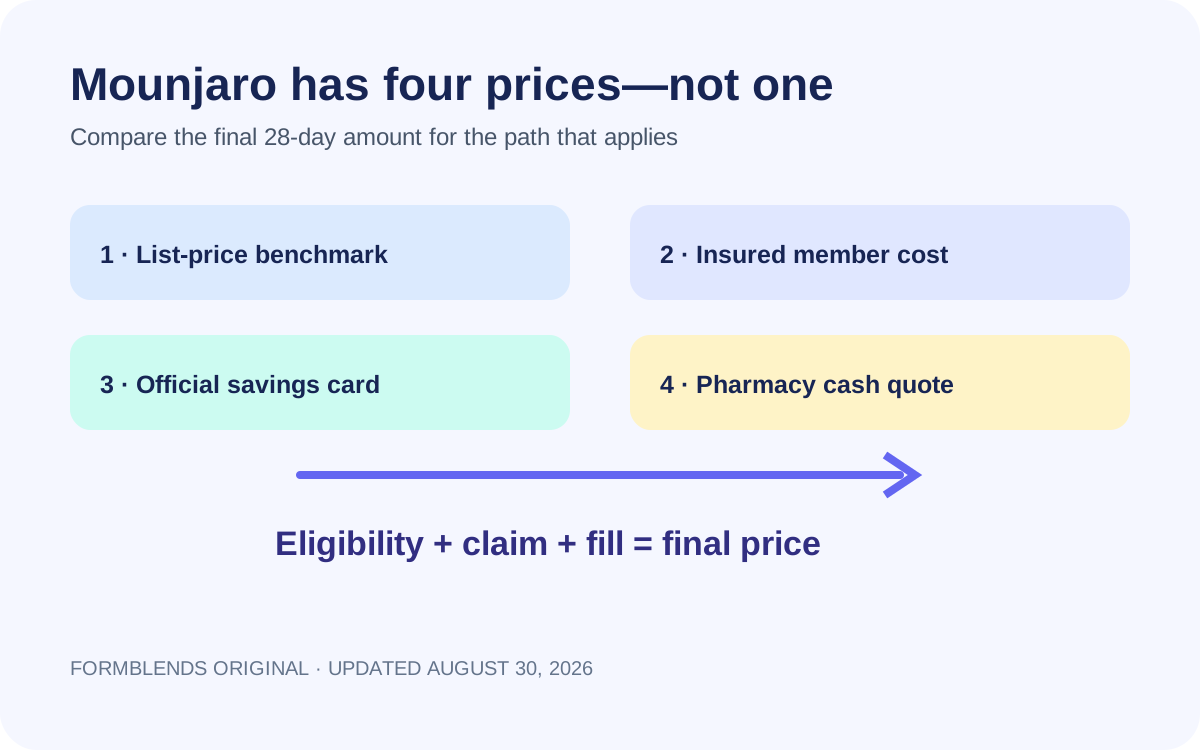
Short answer: Lilly lists Mounjaro at $1,112.16 for a 28-day supply before insurance or discounts. Actual cost depends on coverage. Eligible commercially insured patients may pay as little as $25 when covered or $499 when their commercial plan does not cover it, subject to the 2026 Savings Card limits and approved-use rules.
Commercial terms and coverage information were checked September 4, 2026 and can change. This article is educational and is not medical advice.
2026 Mounjaro cost map
| Situation | Possible cost | Important condition |
|---|---|---|
| No insurance | Retail price; Lilly list price is $1,112.16 per 28 days and GoodRx puts average retail at about $1,348 (September 2026) | Lilly has no self-pay program for Mounjaro; the same molecule sold as Zepbound is $299 to $449 self-pay. |
| Commercial insurance covers Mounjaro | Plan copay; eligible card users may pay as little as $25 | Prescription must be for an FDA-approved use; savings capped at $150 per 1-month fill ($300 and $450 for 2- and 3-month fills), $1,950 a year, 13 fills. |
| Commercial insurance does not cover it | Eligible card users may pay as low as $499 | Lilly pays up to $647 a month and $8,411 a year; the card expires December 31, 2026; approved-use requirement applies. |
| Medicare/Medicaid/VA/TRICARE | Plan-specific; Part D covers Mounjaro for type 2 diabetes with prior authorization, with a 2026 out-of-pocket cap of $2,100 | Manufacturer card excludes government beneficiaries; the Medicare GLP-1 Bridge does not include Mounjaro. |
Why quotes differ
The list price is not the same as the amount billed after a plan's negotiated rate. Deductibles, formulary tier, prior authorization, quantity, pharmacy network, and benefit phase can all change the final amount. Mounjaro is FDA approved for type 2 diabetes; using it solely for weight loss can affect coverage and Savings Card eligibility.
How to get the real number before filling
- Ask the prescriber which diagnosis and indication support the prescription.
- Check Mounjaro in the plan formulary and note prior authorization or step therapy.
- Ask the insurer for the 28-day in-network estimate at your pharmacy.
- Check Lilly's live Savings Card terms, not an old screenshot.
- Have the pharmacy run insurance first and then the card if eligible.
Safety and substitution
Mounjaro and Zepbound contain tirzepatide but have different FDA-approved indications and coverage pathways. Do not switch products or doses based only on price. Compounded tirzepatide is not FDA approved; FDA has reported dosing and quality concerns with unapproved GLP-1 products.
See transparent compounded pricing
Review compounded GLP-1 pricing and what provider-reviewed care includes, with no surprises at checkout.
Try the Cost Calculator →Mounjaro list price, retail price and the number that matters (September 2026)
Four different dollar figures get called the "price of Mounjaro." As of September 4, 2026 they are:
| Figure | Amount | Source and date |
|---|---|---|
| List price (wholesale acquisition cost), one fill of four pens | $1,112.16 | Lilly, as reported by GoodRx, January 2026 |
| Average retail price | About $1,348 | GoodRx, September 2026 |
| Lowest GoodRx-listed price | $1,086.78 | GoodRx, September 2026 |
| Lilly self-pay program | None for Mounjaro | mounjaro.lilly.com, September 2026 |
| Same molecule as Zepbound, Lilly self-pay | $299 (2.5 mg), $399 (5 mg), $449 (7.5 to 15 mg with a refill within 45 days) | lilly.com/lillydirect/zepbound, September 2026 |
The number that matters for most readers is not on that list: it is the copay your plan returns for a type 2 diabetes prescription, which the savings card then reduces. For an uninsured patient, the striking fact is that Lilly sells tirzepatide as Zepbound for $299 to $449 self-pay while offering no self-pay price for Mounjaro at all. Zepbound is approved for chronic weight management and obstructive sleep apnea, not for type 2 diabetes, so whether it is appropriate for you is a clinical question for your prescriber, not a pricing question.
Mounjaro Savings Card caps table (13 fills, $1,950 a year) and the $499 not-covered path
Read on mounjaro.lilly.com/savings-coverage on September 4, 2026. The card expires December 31, 2026 and excludes governmental beneficiaries.
| Term | Commercial plan covers Mounjaro | Commercial plan does not cover Mounjaro |
|---|---|---|
| What you pay | As little as $25 for a 1-, 2- or 3-month prescription | As low as $499 for a 1-month supply of single-dose pens |
| Maximum savings per fill | $150 (1-month), $300 (2-month), $450 (3-month) | $647 per month |
| Annual maximum | $1,950 per calendar year | $8,411 per calendar year |
| Fills | Up to 13 per year | Up to 13 per year |
| Indication | Prescription must be for an FDA-approved use (type 2 diabetes) | |
Worked examples: a $100 copay becomes $25; a $175 copay becomes $25; a $250 copay becomes $100 (the $150 cap binds); a 3-month fill with a $600 copay becomes $150. A patient who uses the full $150 every month exhausts the $1,950 annual cap on the 13th fill. GoodRx's answer to "can you get Mounjaro for $25 without insurance" is the right one: no, because both tiers of the card require commercial insurance.
Lilly Cares and Mounjaro: confirm before you apply
Many cost articles send uninsured, low-income patients to Lilly Cares, the company's patient assistance foundation, for free Mounjaro. Whether Mounjaro is on the 2026 Lilly Cares medication list is contested: Healthline's March 2026 review of the program reports that it is not, other sources say it is, and lillycares.com does not make the list easy to read. Do not count on it until you have confirmed it on lillycares.com or by phone. What the foundation does publish: income limits by medication group at 300, 400 or 500 percent of the 2026 federal poverty level (400 percent is $63,840 for one person and $132,000 for a family of four under the HHS guidelines), exclusion of patients enrolled in Medicaid, the full Medicare low-income subsidy or VA benefits, eligibility for Medicare Part D patients within the limits, and enrollment for about 12 months. If Mounjaro is not on the list, the routes that remain are the savings card's $499 not-covered tier (commercially insured only), Medicare Part D for type 2 diabetes with the $2,100 cap, Zepbound self-pay at $299 to $449 if your prescriber decides it is appropriate, and compounded tirzepatide at a September 2026 median of $299 in the Compounded GLP-1 Price Index.
Medicare and Mounjaro in 2026: the $2,100 cap and what the Bridge does not cover
Medicare Part D plans cover Mounjaro for type 2 diabetes, with prior authorization on most plans. Two 2026 facts change the math. First, Part D out-of-pocket spending is capped at $2,100 for 2026 (CMS), and the Medicare Prescription Payment Plan can spread that across the year, so a Part D patient's worst case for all covered drugs combined is about $175 a month averaged over twelve months. Second, the Medicare GLP-1 Bridge, which runs July 1, 2026 to December 31, 2027, prices Wegovy, the Zepbound KwikPen and Foundayo at $50 a month for beneficiaries with obesity who meet CMS criteria; Mounjaro is not on that list, and a beneficiary who already qualifies for a GLP-1 through Part D for diabetes uses that coverage rather than the Bridge. The Mounjaro savings card excludes Medicare entirely. For most Medicare patients with type 2 diabetes, then, brand Mounjaro under Part D is now cheaper over a year than compounded tirzepatide at $299 a month.
What a BCBS-type prior authorization requires for Mounjaro
Plans publish their criteria, and they are shorter than most articles suggest. Blue Cross Blue Shield of Michigan's prior authorization and step therapy guideline (September 2026) requires, for Mounjaro: treatment of type 2 diabetes, or a trial of one generic or preferred medication for type 2 diabetes; no use in combination with another GLP-1 agonist product; initial approval for one year. Blue Cross Blue Shield of Massachusetts states that Ozempic, Mounjaro and Trulicity continue to require prior authorization including a documented type 2 diabetes diagnosis, even as it excluded the weight-loss brands from standard coverage on renewals from January 1, 2026. The 2026 FEP Blue formulary places Mounjaro on Tier 2 across all three options. What gets a first submission denied is almost always a missing diagnosis code or a missing record of the prior diabetes drug, not the BMI.
Frequently asked questions
What is the Mounjaro list price?
Lilly lists $1,112.16 for a 28-day supply, before insurance, discounts, taxes, or fees.
How much is Mounjaro with commercial insurance?
It depends on the plan. Eligible patients with coverage may pay as little as $25 under the 2026 Lilly Savings Card terms, which cap savings at $150 per month and $1,950 per year across 13 fills; a $250 copay therefore becomes $100.
Can the card help if commercial insurance does not cover Mounjaro?
Lilly says eligible commercially insured patients without coverage may pay as low as $499 for a 28-day fill, subject to terms and limits.
Can Medicare patients use the Mounjaro Savings Card?
No. Lilly excludes Medicare and other government-funded health programs from the manufacturer card. Part D does cover Mounjaro for type 2 diabetes with prior authorization, and 2026 out-of-pocket drug spending is capped at $2,100. The $50 Medicare GLP-1 Bridge covers Wegovy, the Zepbound KwikPen and Foundayo, not Mounjaro.
Is Mounjaro approved for weight loss?
Mounjaro is approved for type 2 diabetes. Zepbound is the tirzepatide brand approved for chronic weight management in eligible patients.
Can I get Mounjaro for $25 without insurance?
No. Both tiers of the Lilly Mounjaro Savings Card require commercial insurance: as little as $25 when the plan covers Mounjaro, and as low as $499 when it does not (terms read September 4, 2026; card expires December 31, 2026). Lilly publishes no self-pay price for Mounjaro. GoodRx's lowest listed price was $1,086.78 against an average retail of about $1,348.
Is there a generic version of Mounjaro?
No. Tirzepatide is available only as Lilly's Mounjaro and Zepbound as of September 2026. Compounded tirzepatide is not a generic: it is not FDA-approved, and since the FDA shortage ended (December 19, 2024, upheld by the Fifth Circuit on August 27, 2026) it can be dispensed only as a patient-specific 503A prescription. Its September 2026 median price was $299 a month in the FormBlends price index.
Can you get Mounjaro for free?
Only through a patient assistance program, and whether Lilly Cares lists Mounjaro in 2026 is contested (Healthline, March 2026, says it does not). Confirm on lillycares.com before applying. Income limits use the 2026 poverty guidelines: 400 percent is $63,840 for one person and $132,000 for a family of four. Medicaid, full low-income-subsidy and VA enrollees are not eligible.
How much does Mounjaro cost per month with Medicare?
Your Part D plan's copay or coinsurance for a type 2 diabetes prescription, with prior authorization, up to the 2026 out-of-pocket cap of $2,100 for all covered drugs; the Medicare Prescription Payment Plan can spread that into roughly $175 monthly installments. The savings card excludes Medicare, and the $50 Medicare GLP-1 Bridge covers Wegovy, the Zepbound KwikPen and Foundayo, not Mounjaro.
Sources
- Lilly Mounjaro FAQ: list price, coverage, and patient-cost context.
- Lilly: 2026 Savings Card eligibility, caps, and expiration.
- Mounjaro Prescribing Information: approved use and safety information.
- FDA: concerns with unapproved GLP-1 products.
- GoodRx. How much is Mounjaro without insurance, updated June 9, 2026. https://www.goodrx.com/mounjaro/how-much-is-mounjaro-without-insurance
- GoodRx. Mounjaro prices, read September 4, 2026. https://www.goodrx.com/mounjaro
- Eli Lilly. Mounjaro savings and coverage, card expiring December 31, 2026, read September 4, 2026. https://mounjaro.lilly.com/savings-coverage
- Eli Lilly. LillyDirect Zepbound self-pay pricing, read September 4, 2026. https://www.lilly.com/lillydirect/zepbound
- Eli Lilly. Zepbound savings card terms and self-pay pricing, CMAT-26402, August 2026. https://zepbound.lilly.com/savings
- Lilly Cares Foundation. How to apply, 2026 income guidelines, read September 4, 2026 (site is script-walled; confirm the medication list directly). https://www.lillycares.com/how-to-apply
- U.S. Department of Health and Human Services, ASPE. 2026 poverty guidelines. https://aspe.hhs.gov/poverty-guidelines
- Centers for Medicare and Medicaid Services. Final CY 2026 Part D redesign program instructions fact sheet, March 2026. https://www.cms.gov/newsroom/fact-sheets/final-cy-2026-part-d-redesign-program-instructions
- Centers for Medicare and Medicaid Services. Medicare GLP-1 Bridge: information for providers, page last modified August 6, 2026. https://www.cms.gov/medicare/coverage/prescription-drug-coverage/medicare-glp-1-bridge/information-providers
- Blue Cross Blue Shield of Michigan and Blue Care Network. Prior authorization and step therapy guidelines, September 2026. https://www.bcbsm.com/amslibs/content/dam/public/consumer/forms-documents/pharmacy/prior-authorization-and-step-therapy-guidelines.pdf
- Blue Cross Blue Shield of Massachusetts. Account and broker GLP-1 FAQs, last updated May 1, 2025. https://www.bluecrossma.org/sites/g/files/csphws1866/files/acquiadam-assets/99-003442450_Account-Broker_GLP-1_FAQs.pdf
- Blue Cross Blue Shield Federal Employee Program. 2026 abbreviated formulary book. https://www.fepblue.org/-/media/FEPBlue-Sitecore-10-Media/PDFs/Brochures/2026/FEP2026AbbrevFormularyBook-R60-WCAG.pdf
- U.S. Food and Drug Administration. Declaration that the tirzepatide shortage is resolved, December 19, 2024. https://www.fda.gov/media/185577/download
- FormBlends Research. Compounded GLP-1 Price Index, as of September 3, 2026. https://formblends.com/feeds/glp1-prices.json
Editorial method: FormBlends Editorial Standards Team reviewed official program pages, regulatory material, prescribing information, and primary research where applicable. No clinician or patient review is claimed.
See your options in about 2 minutes
Take the free quiz and see what fits you. Quick, private, and no commitment to continue.
See my options →