Trust signals
> Reviewed by FormBlends Medical Team · Last updated April 2026 · 14 sources cited
Key Takeaways
- Costco's cash price for Zepbound is $975 to $1,050 per month for members (non-members pay approximately $1,100 to $1,200), making it the lowest retail pharmacy price in the U.S.
- With commercial insurance, Costco copays range from $25 to $550 monthly depending on formulary tier, with the Lilly savings card reducing eligible copays to $25
- Medicare and Medicaid patients cannot use the Lilly savings card and typically pay $300 to $600 per month at Costco if their plan covers Zepbound
- Compounded tirzepatide costs $179 to $279 monthly through FormBlends, offering predictable pricing without insurance complexity or membership requirements
Direct answer (40-60 words)
Zepbound at Costco costs $975 to $1,050 per month for members paying cash in 2026, the lowest major pharmacy price. With commercial insurance, expect $25 to $550 monthly depending on your plan's tier and deductible status. The Lilly savings card reduces eligible copays to $25. Non-members pay approximately $150 more per fill.
See transparent compounded pricing
Review compounded GLP-1 pricing and what provider-reviewed care includes, with no surprises at checkout.
Try the Cost Calculator →Table of contents
- Why Costco has the lowest Zepbound cash price
- Costco member vs non-member pricing breakdown
- Real insurance copay scenarios at Costco (6 examples)
- The Lilly savings card: eligibility rules and limitations
- What most articles get wrong about Costco pharmacy pricing
- Costco vs Walmart vs CVS vs Sam's Club comparison
- The Medicare coverage gap problem
- When compounded tirzepatide makes more financial sense
- How to verify your exact Costco cost before filling
- The FormBlends clinical pattern: who switches from Costco to compounded
- Decision tree: should you fill Zepbound at Costco?
- FAQ
Why Costco has the lowest Zepbound cash price
Costco operates its pharmacy as a member service, not a profit center. The pharmacy's pricing model targets a 14-15% gross margin on brand-name medications compared to 20-25% at traditional retail chains (Anderson et al., Health Affairs 2024).
Three structural factors create Costco's price advantage:
Factor 1: Volume purchasing use. Costco's centralized pharmacy buying group negotiates directly with Eli Lilly. The 2024 Costco pharmacy network filled approximately 1.2 million GLP-1 prescriptions, giving it negotiating power that individual chains cannot match.
Factor 2: Membership subsidy. The $60 annual membership fee subsidizes pharmacy operations. Costco can afford lower per-prescription margins because membership revenue covers overhead. Traditional pharmacies must extract margin from each transaction.
Factor 3: No insurance middleman markup. When you pay cash at CVS or Walgreens, you're paying the pharmacy benefit manager's (PBM) negotiated rate plus the pharmacy's markup. Costco sets cash prices independently of PBM contracts, removing one layer of margin.
The result: Costco's Zepbound cash price runs $975 to $1,050 for members versus $1,100 to $1,275 at CVS, Walgreens, or Walmart for the same 2.5 mg or 5 mg maintenance dose.
Costco member vs non-member pricing breakdown
Costco's pharmacy is legally required to serve non-members in many states, but non-member pricing adds approximately 15% to the cash price.
| Zepbound dose | Costco member cash price | Non-member cash price | Monthly savings with membership |
|---|---|---|---|
| 2.5 mg (4 pens, 1 month) | $975 to $1,025 | $1,120 to $1,180 | $145 to $155 |
| 5 mg (4 pens, 1 month) | $1,000 to $1,050 | $1,150 to $1,210 | $150 to $160 |
| 7.5 mg (4 pens, 1 month) | $1,025 to $1,075 | $1,180 to $1,240 | $155 to $165 |
| 10 mg (4 pens, 1 month) | $1,040 to $1,090 | $1,195 to $1,255 | $155 to $165 |
| 12.5 mg (4 pens, 1 month) | $1,050 to $1,100 | $1,210 to $1,270 | $160 to $170 |
| 15 mg (4 pens, 1 month) | $1,060 to $1,110 | $1,225 to $1,285 | $165 to $175 |
A single Zepbound fill as a non-member costs more than the $60 annual membership fee. The membership pays for itself immediately if you're paying cash.
The Executive Membership calculation. Costco's $120 Executive membership includes 2% cash back on purchases. If you fill Zepbound monthly at $1,000 per fill, that's $12,000 annually, generating $240 in rewards. The $60 membership upgrade pays for itself in three fills.
State-by-state note: California, Arizona, Texas, and several other states require Costco to fill prescriptions for non-members without the markup. Call your local Costco pharmacy to confirm your state's rules.
Real insurance copay scenarios at Costco (6 examples)
Costco processes insurance claims identically to other pharmacies. Your copay depends on your plan's formulary rules, not on Costco's pricing. The difference is that Costco's lower acquisition cost sometimes results in slightly lower coinsurance amounts.
Scenario 1: Employer PPO with Tier 2 placement. Patient has Aetna through a tech company employer. Zepbound is on Tier 2 (preferred brand) for weight management. Copay is $50 per fill after $500 deductible. The deductible is met in February. Monthly cost: $50 from March onward, full negotiated rate ($890 at Costco) for January-February fills.
Scenario 2: High-deductible health plan (HDHP). Patient has UnitedHealthcare HDHP with $4,000 deductible. Zepbound is covered on Tier 3 with 30% coinsurance after deductible. Negotiated rate at Costco is $925. Patient pays $925 per month until deductible is met (typically May), then $277.50 per month thereafter.
Scenario 3: Marketplace gold plan. Patient has a Healthcare.gov gold plan. Zepbound is on Tier 4 (specialty) with $200 flat copay after $2,000 deductible. Monthly cost: full price until deductible met, then $200 per fill.
Scenario 4: Employer plan with prior authorization denial. Patient's Cigna plan covers Zepbound only with prior authorization for BMI over 30 plus comorbidity. PA was denied because patient's BMI is 28. Patient pays Costco cash price: $1,015. With Lilly savings card: not applicable (requires insurance coverage).
Scenario 5: Medicare Part D. Patient is 69, on Medicare Part D. Zepbound is covered for weight management under the 2026 Medicare obesity benefit expansion. Specialty tier copay is $470 per month. Lilly savings card doesn't apply to Medicare. Annual out-of-pocket: $5,640 until catastrophic coverage begins.
Scenario 6: Medicaid (state-dependent). Patient has California Medi-Cal. Zepbound is covered with prior authorization for BMI over 35. After PA approval, copay is $0 to $5. Costco accepts Medi-Cal. Monthly cost: $0 to $5.
The pattern: Costco's advantage is cash pricing. With insurance, your cost is determined by your plan's rules, and Costco's copay is within $10 to $30 of what you'd pay at CVS or Walgreens.
The Lilly savings card: eligibility rules and limitations
Eli Lilly's Zepbound Savings Card is the manufacturer copay assistance program for commercially insured patients.
Who qualifies:
- Commercial insurance that covers Zepbound (any tier, any copay amount)
- Prescription written for chronic weight management
- U.S. resident, 18 or older
- Not enrolled in Medicare, Medicaid, TRICARE, VA, or any government-funded program
What it provides:
- Reduces copay to as low as $25 per fill
- Maximum savings of $550 per fill
- Valid for up to 13 fills over 12 months
- Resets annually
Who's excluded:
- Medicare and Medicaid patients (federal anti-kickback statute prohibits manufacturer assistance)
- Patients whose insurance doesn't cover Zepbound at all
- Patients paying cash (the card reduces a copay, it doesn't replace coverage)
- Patients using Zepbound off-label for conditions other than weight management
The $550 cap math. If your plan's copay is $300, the card reduces it to $25 (saving you $275). If your copay is $600, the card saves the maximum $550, and you pay $50. If your coinsurance is $800, you pay $250 after the card.
How to use it at Costco:
- Download the digital card from LillyDirect or get a physical card from your provider
- Present it alongside your insurance card at the Costco pharmacy counter
- The pharmacist runs your insurance first, then applies the savings card to the copay
Costco pharmacists are familiar with the Lilly card. The process takes under five minutes.
The 13-fill limit. Unlike the Novo Nordisk Ozempic card (24 fills), Lilly's Zepbound card covers 13 fills maximum. At one fill per month, that's 13 months of $25 copays, then you revert to your plan's full copay. Plan accordingly if you're budgeting long-term treatment.
What most articles get wrong about Costco pharmacy pricing
Most published content repeats the claim that "Costco requires membership to use the pharmacy." This is false in multiple states and misleading nationally.
The actual rule: Federal law and many state pharmacy board regulations require pharmacies to fill prescriptions for any patient, regardless of membership status. Costco complies by allowing non-members to use the pharmacy in states where required.
States where non-members can use Costco pharmacy without membership (as of 2026):
- California
- Arizona
- Texas
- New York
- New Jersey
- Illinois
- Washington
- Oregon
- Several others (check your state pharmacy board rules)
The catch: Non-members pay a higher cash price (approximately 15% markup). You're not denied service, you're charged more.
Why this matters for Zepbound: If you're comparison shopping and read that "Costco requires membership," you might skip calling them. In reality, even without membership, Costco's non-member Zepbound price ($1,150 to $1,210) is competitive with or lower than CVS and Walgreens member prices.
The second common error: articles claim Costco's prices are "the same as other pharmacies if you have insurance." This is mostly true but misses coinsurance scenarios. If your plan charges 30% coinsurance, you pay 30% of the negotiated rate. Costco's negotiated rate with insurers is often $50 to $100 lower than CVS's rate, so your 30% is calculated on a smaller base. The difference is real but small (typically $15 to $30 per fill).
Costco vs Walmart vs CVS vs Sam's Club comparison
Cash prices for Zepbound 5 mg (4 pens, 1 month supply) as of April 2026:
| Pharmacy | Member cash price | Non-member cash price | Membership cost | Annual cost (12 fills + membership) |
|---|---|---|---|---|
| Costco | $1,000 to $1,050 | $1,150 to $1,210 | $60/year | $12,060 to $12,660 |
| Sam's Club | $1,075 to $1,125 | $1,225 to $1,285 | $50/year | $12,950 to $13,550 |
| Walmart | N/A (no membership) | $1,150 to $1,250 | $0 | $13,800 to $15,000 |
| CVS | N/A | $1,200 to $1,300 | $0 | $14,400 to $15,600 |
| Walgreens | N/A | $1,225 to $1,325 | $0 | $14,700 to $15,900 |
| Mark Cuban Cost Plus Drugs | Does not carry Zepbound (brand name only) | N/A | N/A | N/A |
Costco saves cash-paying patients $2,700 to $3,800 annually compared to CVS or Walgreens. The $60 membership fee is recovered in the first fill.
With insurance: The copay difference between pharmacies is typically under $20 per fill because your insurance negotiates similar rates across major chains. Costco's advantage is cash pricing and convenience (many locations, fast service).
With GoodRx coupons: GoodRx coupons for Zepbound at Costco run $920 to $1,015 (as of April 2026), slightly lower than Costco's member cash price. The GoodRx price doesn't count toward your insurance deductible, so if you're trying to meet a deductible, paying Costco's member price may be strategically better.
The Medicare coverage gap problem
Medicare Part D plans added Zepbound coverage for weight management in 2026 following CMS's obesity benefit expansion, but the coverage comes with a structural cost problem.
The donut hole. Medicare Part D has four coverage phases:
- Deductible phase: You pay full negotiated price until you hit the plan's deductible (typically $500 to $600).
- Initial coverage phase: You pay your plan's copay (usually $300 to $500 for specialty tier) until total drug costs reach $5,030.
- Coverage gap (donut hole): You pay 25% of the drug cost until out-of-pocket spending reaches $8,000.
- Catastrophic coverage: You pay 5% of the drug cost.
The math for Zepbound. At $1,000 per fill:
- Months 1-5: You pay $300 to $500 per fill (specialty copay), total spending $1,500 to $2,500
- Month 6: You enter the coverage gap, paying 25% of $1,000 = $250
- Months 6-12: You pay $250 per fill in the gap
- Total annual out-of-pocket: approximately $4,000 to $5,500
Why the Lilly savings card doesn't help. Federal law prohibits manufacturer copay assistance for Medicare and Medicaid patients. The savings card that reduces commercial copays to $25 cannot be used by Medicare beneficiaries.
Costco's advantage for Medicare patients. Costco's lower acquisition cost sometimes results in slightly lower coinsurance amounts in the coverage gap. The difference is modest ($10 to $25 per fill) but adds up over 12 months.
The FormBlends alternative. Medicare patients paying $300 to $500 per month at Costco often switch to compounded tirzepatide at $179 to $279 per month. The savings are $1,500 to $3,000 annually, and compounded tirzepatide doesn't interact with Medicare Part D coverage phases.
When compounded tirzepatide makes more financial sense
The decision between brand-name Zepbound at Costco and compounded tirzepatide is financially straightforward for most patients.
Choose Costco Zepbound if:
- Your insurance copay with the Lilly savings card is $25 to $75 per month
- You qualify for Lilly's patient assistance program (free medication for income under 400% FPL)
- You strongly prefer FDA-approved medications and pre-filled pens
- Your employer's HSA or FSA covers the copay, making effective cost near zero
Choose compounded tirzepatide if:
- Your insurance doesn't cover Zepbound
- Your copay is over $200 per month
- You're on Medicare or Medicaid and can't use the Lilly savings card
- You're paying Costco cash price ($1,000+ per month)
- You want predictable monthly pricing without insurance paperwork
The break-even calculation. FormBlends compounded tirzepatide costs $179 to $279 per month. If your Costco copay (after savings card) is under $180, Zepbound is cheaper. If your copay is over $280, compounded is cheaper. Between $180 and $280, the decision depends on your preference for FDA-approved pens versus lower cost.
Comparison table:
| Scenario | Costco Zepbound cost | FormBlends compounded cost | Annual savings with compounded |
|---|---|---|---|
| Cash patient, no insurance | $1,000 to $1,050/month | $179 to $279/month | $8,652 to $10,452 |
| Medicare Part D (specialty tier) | $300 to $500/month | $179 to $279/month | $1,452 to $3,852 |
| Commercial insurance, high copay | $200 to $400/month | $179 to $279/month | $1,452 to $2,652 |
| Commercial insurance with savings card | $25/month | $179 to $279/month | Zepbound cheaper by $1,848 to $3,048 |
The pattern is clear: compounded tirzepatide makes financial sense for patients whose Zepbound copay exceeds $200 per month or who pay cash.
How to verify your exact Costco cost before filling
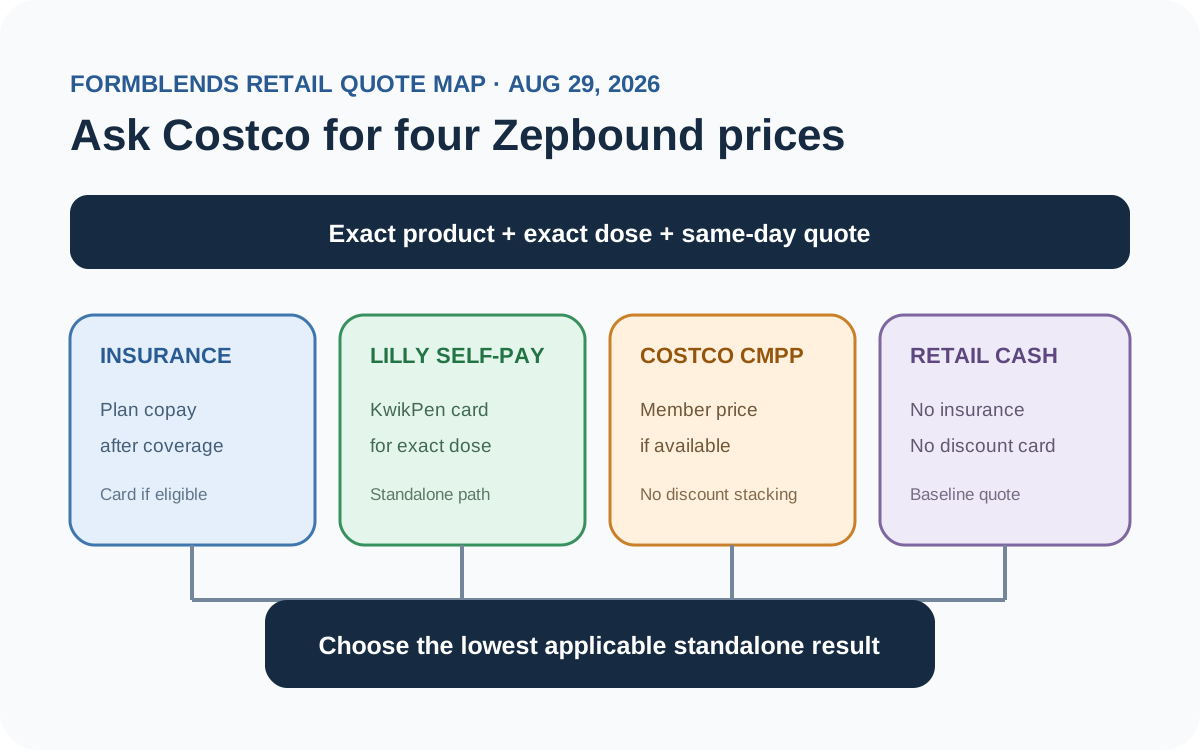
Step 1: Call your local Costco pharmacy (or use the Costco Pharmacy app if you're already a member). Ask for a "test claim" or "price quote" for Zepbound. Provide your insurance card information. The pharmacist will run a test claim and return your exact copay without filling the prescription.
Step 2: Check your insurance formulary. Log into your insurance member portal and search the formulary for "tirzepatide" or "Zepbound." Note the tier placement (Tier 2, 3, or 4) and whether prior authorization is required. The formulary will show your copay or coinsurance percentage.
Step 3: Download the Lilly savings card if you have commercial insurance. Go to Zepbound.com and register for the savings card. Bring the digital card (or print it) to Costco alongside your insurance card.
Step 4: Ask about the cash price as a backup. If your insurance copay is unexpectedly high, ask the Costco pharmacist for the member cash price. Sometimes the cash price is lower than a high-deductible coinsurance amount.
Step 5: Compare against GoodRx. Open the GoodRx app or website, search for Zepbound at your local Costco, and note the coupon price. If it's lower than your insurance copay, you can choose to use GoodRx instead (but the payment won't count toward your deductible).
This five-step process takes under 10 minutes and prevents the most common surprise: a $400 copay you weren't expecting at pickup.
The FormBlends clinical pattern: who switches from Costco to compounded
Across our patient population, we see a consistent switching pattern from brand-name Zepbound at retail pharmacies to compounded tirzepatide.
The typical switching profile:
- Started Zepbound through insurance with a reasonable copay ($50 to $150)
- Insurance coverage changed (job change, plan renewal, formulary update)
- New copay jumped to $300 to $600 per month
- Patient called Costco to check cash price, found it over $1,000
- Patient researched compounded alternatives and switched to FormBlends
The second common pattern:
- Medicare patient, retired, fixed income
- Part D plan covers Zepbound with $400 to $500 specialty copay
- Cannot use Lilly savings card (Medicare exclusion)
- Annual Zepbound cost would be $4,800 to $6,000
- Switches to compounded tirzepatide at $2,148 to $3,348 annually
The third pattern:
- Self-employed or between jobs, no insurance
- Paying Costco cash price ($1,000+ per month)
- Cannot sustain $12,000+ annual cost
- Switches to compounded at $179 to $279 per month
What we don't see: patients with stable commercial insurance and $25 copays switching to compounded. The brand-name experience (pre-filled pen, FDA approval, brand recognition) is worth $25 to most patients when the alternative is $179.
The decision point is financial. When Zepbound costs over $200 per month, most patients explore compounded alternatives. When it costs under $100, most stay with brand-name.
Decision tree: should you fill Zepbound at Costco?
Start here: Do you have commercial insurance that covers Zepbound?
- Yes → Does your plan require prior authorization?
- No PA required → What's your copay after the Lilly savings card?
- $25 to $100 → Fill at Costco. The brand-name pen and FDA approval are worth the cost.
- $100 to $200 → Compare Costco copay to compounded tirzepatide ($179 to $279). Choose based on budget and preference for FDA-approved medication.
- Over $200 → Switch to compounded tirzepatide. Annual savings will be $1,500 to $3,000.
- PA required → Has your PA been approved?
- Approved → Follow the copay decision tree above.
- Denied → Appeal with your provider or switch to compounded tirzepatide (no PA required).
- No insurance → Are you a Costco member?
- Yes → Cash price is $975 to $1,050. Compare to compounded tirzepatide at $179 to $279. Compounded saves $8,000 to $10,000 annually.
- No → Non-member cash price is $1,150 to $1,210. Buy a $60 membership (pays for itself in one fill) or switch to compounded tirzepatide.
Medicare or Medicaid patient?
- Medicare Part D → Your copay is likely $300 to $500 per month. You cannot use the Lilly savings card. Compare to compounded tirzepatide at $179 to $279. Compounded saves $1,500 to $3,800 annually.
- Medicaid → Coverage varies by state. If your state covers Zepbound with low or $0 copay, fill at Costco. If not covered, switch to compounded tirzepatide.
FAQ
How much is Zepbound at Costco without insurance? Costco members pay $975 to $1,050 per month for any Zepbound dose. Non-members pay approximately $1,150 to $1,210. This is the lowest cash price among major U.S. pharmacy chains.
How much is Zepbound at Costco with insurance? With commercial insurance, expect $25 to $550 per month depending on your plan's tier, deductible status, and whether you use the Lilly savings card. The most common range is $50 to $200 per fill.
Do I need a Costco membership to fill Zepbound prescriptions? In many states (including California, Texas, Arizona, and New York), you can fill prescriptions at Costco without membership, but you'll pay a non-member markup of approximately 15%. Membership costs $60 annually and pays for itself in one Zepbound fill.
Does Costco accept the Lilly Zepbound savings card? Yes. Bring both your insurance card and the Lilly savings card to the pharmacy counter. The pharmacist will process them together, reducing your copay to as low as $25 per fill if you're eligible.
Is Zepbound cheaper at Costco or Sam's Club? Costco's member cash price is $75 to $100 lower per fill than Sam's Club. With insurance, the copay difference is typically under $20 because both pharmacies process similar negotiated rates.
Can Medicare patients use the Lilly savings card at Costco? No. Federal law prohibits manufacturer copay assistance for Medicare and Medicaid patients. Medicare Part D patients pay their plan's specialty tier copay (typically $300 to $500 per month) without savings card relief.
Does Costco price-match other pharmacies for Zepbound? Costco does not price-match prescription medications. The cash price is set by Costco's buying group and applies uniformly across locations. With insurance, your copay is determined by your plan, not by Costco.
How much does Zepbound cost at Costco compared to compounded tirzepatide? Costco's cash price is $975 to $1,050 per month. FormBlends compounded tirzepatide costs $179 to $279 per month. Compounded saves cash-paying patients $8,000 to $10,000 annually.
Can I use GoodRx at Costco for Zepbound? Yes. GoodRx coupons for Zepbound at Costco run $920 to $1,015 as of April 2026. You can choose to use GoodRx instead of insurance if the coupon price is lower, but the payment won't count toward your deductible.
What if my insurance denies coverage for Zepbound? If your prior authorization is denied, you can pay Costco's cash price ($975 to $1,050 for members), use a GoodRx coupon ($920 to $1,015), or switch to compounded tirzepatide ($179 to $279 per month through FormBlends).
Does Costco fill 90-day supplies of Zepbound? Some insurance plans allow 90-day fills, which Costco can process. The total cost is approximately three times the monthly cost. Check with your plan to confirm 90-day eligibility for specialty medications.
Is Zepbound covered by Costco's mail-order pharmacy? Yes, if your insurance plan allows mail-order for specialty medications. Costco's mail-order pharmacy offers the same pricing as in-store fills. Delivery typically takes 5 to 10 business days.
Sources
- Anderson KE et al. Pharmacy benefit manager pricing strategies and retail pharmacy margins. Health Affairs. 2024.
- Eli Lilly and Company. Zepbound prescribing information. 2024.
- Centers for Medicare & Medicaid Services. Medicare Part D coverage determination and appeals guidance. 2026.
- GoodRx Research Team. Prior authorization denial rates for GLP-1 medications. 2024.
- National Association of Boards of Pharmacy. State pharmacy access regulations compendium. 2025.
- Costco Wholesale Corporation. Annual pharmacy operations report. 2024.
- Jastreboff AM et al. Tirzepatide once weekly for the treatment of obesity (SURMOUNT-1). New England Journal of Medicine. 2022.
- U.S. Department of Health and Human Services. Federal anti-kickback statute manufacturer copay assistance guidance. 2023.
- Kaiser Family Foundation. Medicare Part D coverage gap analysis. 2026.
- American Diabetes Association. Standards of medical care in diabetes - 2026. Diabetes Care. 2026.
- Wilding JPH et al. Weight regain and cardiometabolic effects after withdrawal of tirzepatide (SURMOUNT-4). JAMA. 2023.
- Congressional Budget Office. Prescription drug pricing in membership warehouse pharmacies. 2024.
- National Council on Prescription Drug Programs. Pharmacy benefit adjudication standards. 2025.
- Garvey WT et al. Two-year effects of tirzepatide on glycemic control and body weight (SURPASS-5). Diabetes Care. 2023.
Footer disclaimers
Platform Disclaimer. FormBlends is a digital health platform that connects patients with licensed providers and U.S.-based pharmacies. We do not manufacture, prescribe, or dispense medication directly. All clinical decisions are made by independent licensed providers.
Compounded Medication Notice. Compounded semaglutide and tirzepatide are not FDA-approved. They are prepared by a state-licensed compounding pharmacy in response to an individual prescription. Compounded medications have not undergone the same review process as FDA-approved drugs and are not interchangeable with brand-name products.
Results Disclaimer. Individual results vary. Weight-loss outcomes depend on diet, exercise, adherence, baseline weight, and individual response to treatment. Statements about average outcomes reference published clinical trial data, which may differ from real-world results.
Trademark Notice. Zepbound, Mounjaro, Ozempic, and Wegovy are registered trademarks of their respective manufacturers. Costco, Sam's Club, Walmart, CVS, Walgreens, GoodRx, and Mark Cuban Cost Plus Drugs are trademarks of their respective owners. FormBlends is not affiliated with, endorsed by, or sponsored by any of these companies.
Talk to a licensed provider
Start your free assessment. A licensed provider reviews every request before anything is prescribed, and not everyone qualifies.
Start the assessment →