Key Takeaway
Switching between dose levels or starting a new tirzepatide prescription? Getting the tirzepatide dose conversion right is critical for safe, effective treatment. If you're stepping up from 2.
Switching between dose levels or starting a new tirzepatide prescription? Getting the tirzepatide dose conversion right is critical for safe, effective treatment. If you're stepping up from 2.5 mg to 5 mg or trying to figure out how many syringe units equal your prescribed dose, this guide and conversion chart have you covered.
Key Takeaways: - The Standard Tirzepatide Titration Schedule - Learn how to convert tirzepatide mg to syringe units - Tips for Accurate Tirzepatide Dosing - When to Talk to Your Provider About Dose Changes
Below you'll find the standard tirzepatide titration schedule, a step-by-step conversion process, and a reference chart you can bookmark or print.
The Standard Tirzepatide Titration Schedule
Like semaglutide, tirzepatide follows a gradual dose increase. You start low and step up over time. This reduces side effects and helps your body adjust to the medication's dual-action mechanism) tirzepatide activates both GIP and GLP-1 receptors.
The standard schedule looks like this:
- Weeks 1-4: 2.5 mg once weekly
- Weeks 5-8: 5 mg once weekly
- Weeks 9-12: 7.5 mg once weekly
- Weeks 13-16: 10 mg once weekly
- Weeks 17-20: 12.5 mg once weekly
- Week 21 onward: 15 mg once weekly
"What makes tirzepatide particularly interesting is the dual GIP/GLP-1 mechanism. We're seeing that GIP receptor activation appears to amplify the metabolic effects in ways we didn't fully anticipate from the preclinical data.", Dr. Ania Jastreboff, MD, PhD, Yale School of Medicine, lead author of SURMOUNT-1[1]
Not everyone reaches 15 mg. Your provider determines your target dose based on your response, tolerance, and goals. Many people achieve meaningful results at 5 mg or 10 mg.
Clinical trials showed that tirzepatide at the 15 mg dose led to average weight loss of approximately 22% of body weight over 72 weeks. But the 5 mg dose also showed significant results (approximately 15% average weight loss. More isn't always necessary.
How to Convert Tirzepatide mg to Syringe Units
If you're using compounded tirzepatide from a licensed 503A pharmacy, your medication comes in a vial at a specific concentration. Here's how to do the conversion. Check out our see real Zepbound results for detailed data.
View data table
| Category | Mean Body Weight Loss (%) | Detail |
|---|---|---|
| Tirzepatide | 22 | ~22% body weight at 72 wks |
| Semaglutide | 15 | ~15% body weight at 68 wks |
| Liraglutide | 8 | ~8% body weight at 56 wks |
| Retatrutide | 24 | ~24% in Phase 2 trial |
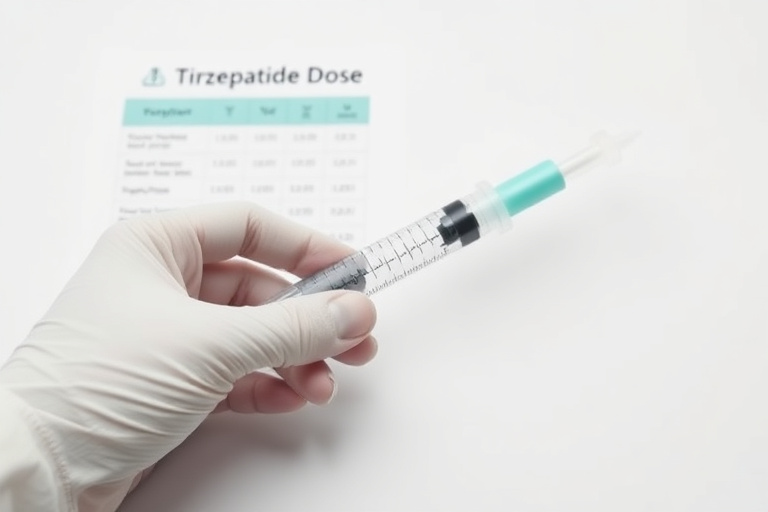
The formula: Prescribed dose (mg) divided by vial concentration (mg/mL) = injection volume (mL)
Then multiply the mL by 100 to get units on a U-100 insulin syringe.
Free Download: Universal Peptide Dose Conversion Table A printable chart with pre-calculated conversions for tirzepatide and other peptides at common concentrations. Tape it to your fridge for quick reference. Get yours free) we'll email it to you instantly.
[Download CTA Button]
Example with a 10 mg/mL concentration:
| Prescribed Dose | Volume (mL) | Syringe Units (U-100) |
|---|---|---|
| 2.5 mg | 0.25 mL | 25 units |
| 5 mg | 0.50 mL | 50 units |
| 7.5 mg | 0.75 mL | 75 units |
| 10 mg | 1.00 mL | 100 units |
Example with a 20 mg/mL concentration:
| Prescribed Dose | Volume (mL) | Syringe Units (U-100) |
|---|---|---|
| 2.5 mg | 0.125 mL | 12.5 units |
| 5 mg | 0.25 mL | 25 units |
| 7.5 mg | 0.375 mL | 37.5 units |
| 10 mg | 0.50 mL | 50 units |
| 12.5 mg | 0.625 mL | 62.5 units |
| 15 mg | 0.75 mL | 75 units |
Notice how a higher concentration means smaller injection volumes. This is one reason pharmacies compound at different concentrations (a smaller injection can be more comfortable.
Always check your vial label before drawing your dose. If the concentration doesn't match what you expected, contact your provider or pharmacy before injecting.
You can also use the to run these numbers instantly.
Tips for Accurate Tirzepatide Dosing
Accuracy matters at every step of the process. Here are practical tips to make sure you're getting your full prescribed dose.
Check your GLP-1 eligibility
Use our free BMI Calculator to see if you may qualify for provider-reviewed GLP-1 therapy.
Try the BMI Calculator →Use the right syringe. For smaller volumes (under 0.3 mL), a 0.3 mL insulin syringe gives you finer markings and better accuracy. For larger volumes, a 1 mL syringe works well. Match your syringe to your injection volume.
Draw slowly. Pull the plunger back slowly and steadily. Rushing can introduce air bubbles, which take up space where medication should be.
Remove air bubbles. After drawing your dose, hold the syringe needle-up and tap the barrel gently. Any bubbles will rise to the top. Push the plunger slightly to expel the air, then verify your dose volume is still correct.
Be consistent with injection day and time. Tirzepatide is a once-weekly medication. Pick the same day each week. The can send you reminders so you never miss a dose.
Log every injection. Record your dose, injection site, and any side effects after each injection. This data helps your provider make informed decisions about dose adjustments. The make this simple.
When to Talk to Your Provider About Dose Changes
Dose adjustments should always come from your provider. But knowing when to bring it up can help you advocate for yourself.
You should reach out if you've been at your current dose for the recommended period with no significant side effects and want to discuss stepping up. Your provider may approve the increase or recommend staying put based on your progress.
You should also reach out if you're experiencing persistent side effects that haven't improved after 2-3 weeks at a new dose. Common side effects include nausea, constipation, and decreased appetite. Most are mild and temporary, but your provider can offer strategies to manage them. Check our for more detail.
Never adjust your dose on your own. Even if you have leftover medication at a different concentration, don't try to calculate a new dose yourself. Changes to your dosing should always go through your prescribing provider.
If you're exploring tirzepatide options, learn more about to understand which medication your provider might recommend.
Frequently Asked Questions
Can I split a tirzepatide dose across two injections?
This isn't standard practice. Tirzepatide is designed as a once-weekly single injection. If your injection volume feels too large, talk to your provider about whether a higher concentration formulation might be available to reduce the volume.
What happens if I miss a tirzepatide dose?
If you miss a dose and it's been less than 4 days (96 hours), take it as soon as you remember. If it's been more than 4 days, skip the missed dose and take your next dose on the regular day. Don't double up.
Why is my tirzepatide a different concentration than what I've seen online?
Compounding pharmacies prepare tirzepatide at various concentrations. Your pharmacy and provider chose a concentration that works for your prescribed dose and preferred injection volume. The actual medication is the same) the concentration just changes how many units you draw.
Do I need to reconstitute compounded tirzepatide?
It depends on the formulation. Some compounded tirzepatide comes pre-mixed and ready to inject. Others come as lyophilized powder that requires reconstitution calculator. Check with your pharmacy and follow the instructions provided with your medication.
Start your path Today
Every transformation starts with a single step. Talk to a licensed FormBlends provider about whether this approach is right for you, consultations are free and confidential.
Medical References
- Jastreboff AM, Aronne LJ, Ahmad NN, et al. Tirzepatide Once Weekly for the Treatment of Obesity. N Engl J Med. 2022;387(3):205-216. [PubMed | ClinicalTrials.gov | DOI]
- Davies M, Færch L, Jeppesen OK, et al. Semaglutide 2.4 mg once a week in adults with overweight or obesity, and type 2 diabetes (STEP 2). Lancet. 2021;397(10278):971-984. [PubMed | ClinicalTrials.gov | DOI]
- Wadden TA, Bailey TS, Billings LK, et al. Effect of Subcutaneous Semaglutide vs Placebo as an Adjunct to Intensive Behavioral Therapy on Body Weight in Adults With Overweight or Obesity (STEP 3). JAMA. 2021;325(14):1403-1413. [PubMed | ClinicalTrials.gov | DOI]
- Garvey WT, Batterham RL, Bhatt DL, et al. Two-year effects of semaglutide in adults with overweight or obesity (STEP 5). Nat Med. 2022;28(10):2083-2091. [PubMed | ClinicalTrials.gov | DOI]
Sources &. References
- Stierman B, Afful J, Carroll MD, et al. National Health and Nutrition Examination Survey 2017-March 2020 Prepandemic Data Files. NCHS Data Brief. No. 492. CDC/NCHS. 2023.
- Sumithran P, Prendergast LA, Delbridge E, et al. Long-Term Persistence of Hormonal Adaptations to Weight Loss. N Engl J Med. 2011;365(17):1597-1604. Doi:10.1056/NEJMoa1105816
- Wilding JPH, Batterham RL, Calanna S, et al. Once-Weekly Semaglutide in Adults with Overweight or Obesity. N Engl J Med. 2021;384(11):989-1002. Doi:10.1056/NEJMoa2032183
- Davies M, Færch L, Jeppesen OK, et al. Semaglutide 2.4 mg once a week in adults with overweight or obesity, and type 2 diabetes (STEP 2 (Davies et al., Lancet, 2021)). Lancet. 2021;397(10278):971-984. Doi:10.1016/S0140-6736(21)00213-0
- Wadden TA, Bailey TS, Billings LK, et al. Effect of Subcutaneous Semaglutide vs Placebo as an Adjunct to Intensive Behavioral Therapy on Body Weight in Adults With Overweight or Obesity (STEP 3 (Wadden et al., JAMA, 2021)). JAMA. 2021;325(14):1403-1413. Doi:10.1001/jama.2021.1831
- Garvey WT, Batterham RL, Bhatt DL, et al. Two-Year Effects of Semaglutide in Adults with Overweight or Obesity (STEP 5 (Garvey et al., Nat Med, 2022)). Nat Med. 2022;28:2083-2091. Doi:10.1038/s41591-022-02026-4
- Lincoff AM, Brown-Frandsen K, Colhoun HM, et al. Semaglutide and Cardiovascular Outcomes in Obesity without Diabetes. N Engl J Med. 2023;389(24):2221-2232. Doi:10.1056/NEJMoa2307563
The information in this article is intended for educational use only and shouldn't be considered medical advice. Consult a qualified healthcare provider before making any changes to your medication or supplement regimen. FormBlends helps with connections with licensed providers for personalized medical guidance.
Last updated: 2026-03-24
See your options in about 2 minutes
Take the free quiz and see what fits you. Quick, private, and no commitment to continue.
See my options →