Last spring, a 42-year-old marketing director named Derek in Scottsdale told his prescriber he wanted "the fat loss part of growth hormone without the side effects." He'd been quoted $1,200 a month for HGH at performance doses, had read about joint swelling and blood sugar issues, and figured there had to be a shortcut. His prescriber put him on AOD 9604 at 300 mcg daily. After eight weeks, Derek had dropped about four pounds. "It's doing something," he said, "but it's not doing what I thought HGH would do."
That experience captures the entire AOD 9604 vs HGH comparison in miniature. AOD 9604 is, quite literally, a piece of the growth hormone molecule. Amino acids 176 through 191 of the C-terminal region, plus a stabilizing tyrosine tacked onto the N-terminus. Sixteen amino acids out of 191. The fragment keeps the fat-mobilizing signal. It drops everything else. Whether that tradeoff makes sense depends entirely on what you're after and what you're willing to risk.
What You're Actually Comparing: A Fragment vs. the Whole Molecule
Full-length HGH is a 191 amino acid polypeptide with a complex three-dimensional fold. Its growth-promoting activity, the stuff that drives muscle protein synthesis, IGF-1 production, and the side effects people worry about, lives primarily in the N-terminal region. The lipolytic activity is concentrated at the C-terminal end.
AOD 9604 is that C-terminal slice, isolated and stabilized. Think of it like extracting the caffeine from coffee but leaving behind the dozens of other bioactive compounds. You get one specific effect, stripped of the broader pharmacological package.
This matters because people frequently talk about these two compounds as if they sit on the same spectrum (low-dose HGH on one end, AOD 9604 somewhere nearby). They don't. They work through different receptor pathways entirely. The confusion is understandable. Both share the word "growth hormone" in their descriptions. Both are peptides administered subcutaneously. Both show up in the same online forums and clinic menus. But functionally, comparing AOD 9604 to HGH is closer to comparing a single guitar string to the whole instrument. Same material, fundamentally different output.
How They Work: Two Completely Different Signaling Paths
HGH binds the growth hormone receptor across multiple tissue types. That single binding event triggers a cascade: the liver ramps up IGF-1 production, protein synthesis increases systemically, glucose handling shifts (sometimes unfavorably), fluid balance changes, and yes, fat cells release stored lipids. Lipolysis is baked into the broader endocrine response, not separable from it.
When HGH binds its receptor on the hepatocyte surface, the JAK2-STAT5 intracellular signaling pathway fires. This pathway is directly responsible for the transcription of IGF-1 and a host of other downstream gene products. The metabolic effects most people associate with growth hormone, from connective tissue synthesis to the upregulation of fatty acid oxidation, cascade from this single receptor interaction. That is a lot of biology hitched to one binding event, which is exactly why the side effect profile is so tangled up with the benefits.
AOD 9604 doesn't bind the growth hormone receptor at any meaningful affinity. The current evidence points to beta-3 adrenergic receptor activation on adipocytes as the primary mechanism. Early animal work by Ng and Borstein (published in Journal of Molecular Endocrinology, 2000) demonstrated that the fragment stimulated lipolysis in fat tissue explants without triggering the anti-insulin or growth-promoting activity associated with the intact molecule. It's a targeted lipolytic signal that sidesteps the GH receptor entirely.
Here's the thing: that's both the appeal and the limitation. You avoid GH receptor-mediated side effects. You also miss GH receptor-mediated benefits. There is no partial credit here. The fragment either binds the GH receptor or it doesn't, and the research consistently shows it doesn't.
What Each One Actually Does to Your Body
HGH at supraphysiologic doses produces a constellation of effects. Increased lean body mass. Fat loss. Higher IGF-1. Water retention (sometimes dramatic, with patients gaining three to six pounds of fluid in the first two weeks). Altered glucose handling that can push toward insulin resistance. A review published in The Journal of Clinical Endocrinology & Metabolism (2001) by Liu and colleagues examined GH administration in healthy elderly adults and found increases in lean mass and reductions in fat mass, but also elevated rates of soft tissue edema, arthralgias, and glucose intolerance. At replacement doses in genuinely GH-deficient patients, the profile is milder and more favorable. At performance doses, the body composition changes are real but they come with baggage.
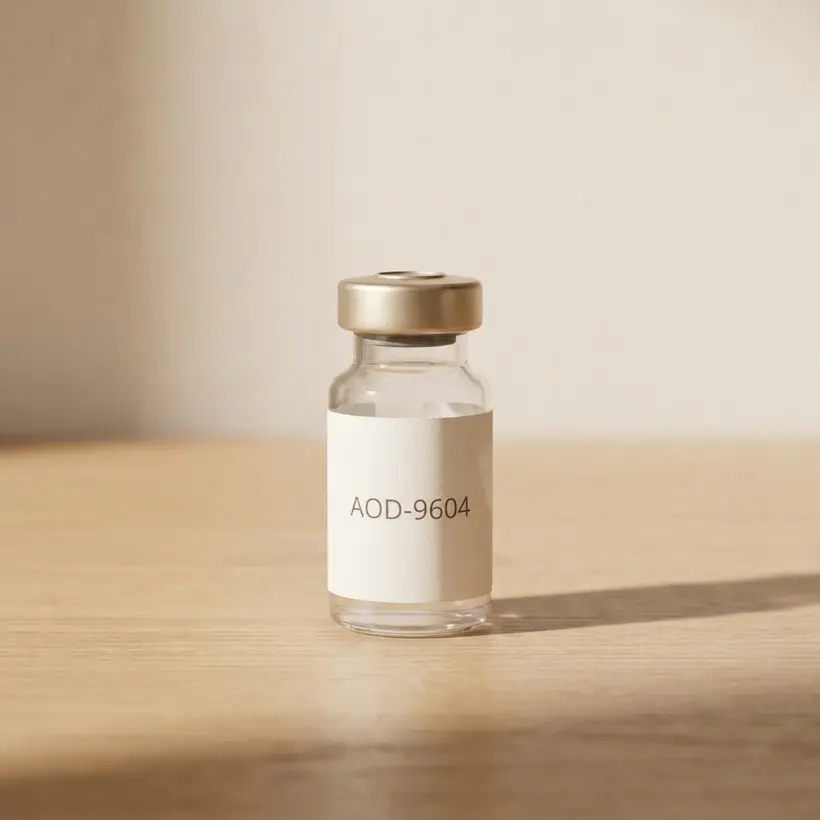
From the FormBlends catalog
AOD-9604
Fat-targeting fragment without growth hormone side effects · From $199/mo · compounded by a licensed 503A pharmacy, dispensed only after provider review.
View AOD-9604 →There is also a dose-duration calculus with HGH that complicates straightforward comparison. At 1 to 2 IU per day (a common anti-aging protocol), the side effect burden is lower but the body composition changes are more modest. At 4 to 6 IU per day (performance territory), fat loss and lean mass gains become more dramatic, but so does everything else: carpal tunnel, jaw ache, morning stiffness, fasting glucose creeping upward. Patients who use HGH at performance doses typically require regular lab monitoring, including fasting insulin, IGF-1, and hemoglobin A1c, to catch metabolic drift early.
AOD 9604 produces fat-mobilizing signaling without the lean mass increase, fluid retention, or insulin effects. The Phase 2b clinical trial (Stier et al., Obesity Research, 2004) measured IGF-1 directly and found no significant change versus placebo. Fasting glucose and insulin levels also remained stable across treatment groups. That's the key safety selling point, but it also means you're not getting the anabolic component.
And the magnitude difference is significant. The Phase 2b trial showed a statistically significant but modest weight loss signal over 12 weeks, on the order of a few pounds separating the active group from placebo. Compared to what supraphysiologic HGH delivers in the same timeframe, AOD 9604's effect size is substantially smaller. People who expect HGH-caliber body composition changes from AOD 9604 are consistently disappointed. If someone is already carrying significant adiposity and has poor dietary habits, AOD 9604 at 300 mcg daily is not going to override a 500-calorie surplus. It is an assist, not a primary driver.
The Safety Tradeoff, Honestly
Supraphysiologic HGH use carries a real side effect burden: joint pain, carpal tunnel symptoms, facial and extremity edema, fasting glucose elevation, insulin resistance. There are longer-term theoretical concerns around sustained IGF-1 elevation, including cardiovascular and oncologic questions, though quantifying that risk depends heavily on dose, duration, and individual baseline factors.
The insulin resistance piece deserves specific attention. GH is inherently counter-regulatory to insulin. It promotes hepatic glucose output and reduces peripheral glucose uptake. At replacement doses in deficient patients, this is a manageable and often clinically irrelevant shift. At supraphysiologic doses in metabolically healthy adults, it can push a borderline fasting glucose into prediabetic territory within months. Patients with existing metabolic syndrome or family histories of type 2 diabetes are at particular risk, and responsible prescribers screen for these factors before initiating HGH at any dose.
AOD 9604's Phase 2b trial reported a tolerability profile comparable to placebo, with injection-site reactions as the main differentiator. No IGF-1 bump. No glucose or insulin disruption. The absence of GH receptor engagement is what makes this possible.
The honest caveat: multi-year continuous-use safety data for AOD 9604 in Western populations simply doesn't exist. The trial data we have covers weeks, not years. That's not a reason to panic, but it's a gap worth acknowledging plainly rather than glossing over. We also lack head-to-head comparisons between AOD 9604 and HGH in matched populations, which means much of the comparative safety framing relies on mechanistic reasoning rather than randomized trial data. Mechanistic reasoning is useful but not infallible.
When Each One Makes Sense (and When Neither Does)
HGH has FDA approval for confirmed growth hormone deficiency (pediatric and adult), specific genetic growth disorders, and HIV-associated wasting. Off-label use for body composition and anti-aging is widespread but unsupported by regulatory approval, and it requires careful prescriber oversight given the dose-dependent side effect profile.
AOD 9604 occupies a narrower lane. It's researched as a targeted lipolytic compound for people who want modest fat-loss support without broad endocrine disruption. There's also a secondary research line around cartilage and joint health based on preliminary animal data (Metabolic Pharmaceuticals Ltd. reported preclinical findings suggesting AOD 9604 may stimulate proteoglycan synthesis in cartilage explants), though that evidence is early and has not been replicated in human trials at the time of writing. AOD 9604 is not FDA-approved as a drug. It holds GRAS status for certain oral dietary applications, which is a food-safety classification, not drug approval. It can be prepared by licensed 503A or 503B compounding pharmacies with a valid prescription.
Combining AOD 9604 with GH-releasing peptides like Sermorelin or Tesamorelin is a common clinical strategy. The rationale: the secretagogue stimulates your own pulsatile GH release for broader metabolic benefits, while AOD 9604 layers on additional lipolytic signaling. This approach aims to approximate some of the breadth of HGH therapy without administering the exogenous molecule itself. The secretagogue preserves the hypothalamic-pituitary feedback loop, meaning the body still regulates how much GH is actually released, whereas exogenous HGH overrides that feedback mechanism entirely. Stacking AOD 9604 with exogenous HGH, on the other hand, is unusual and somewhat redundant, since the full-length molecule already contains the lipolytic activity that AOD 9604 isolates.
There are also people for whom neither compound is the right starting point. Someone with untreated sleep apnea, chronic sleep deprivation, a sedentary lifestyle, or a diet dominated by ultra-processed food is going to get a better return on investment from addressing those variables first. Peptides sit on top of fundamentals. They do not replace them.
The Boring Truth About Cost and Expectations
HGH at performance doses is expensive. Easily $800 to $1,500 or more per month depending on sourcing, and the ongoing monitoring (IGF-1 levels, glucose, insulin) adds cost. Pharmaceutical-grade HGH from brand manufacturers (Norditropin, Genotropin, Humatrope) sits at the top of that range. Compounded somatropin can be less expensive, but the regulatory landscape around compounded HGH is complex, and sourcing matters enormously for both purity and consistency.
AOD 9604 is cheaper per day, typically falling in the $150 to $400 per month range depending on the compounding pharmacy, dosage, and whether it is sourced as a subcutaneous injectable or a sublingual formulation. But cost-per-result is a different calculation. If you're paying less for a substantially smaller effect, the value proposition isn't automatically better.
My honest take: AOD 9604 makes the most sense for people who have a specific, limited goal (modest fat loss support), who are already doing the fundamentals well (nutrition, training, sleep), and who either can't tolerate or don't want the systemic effects of HGH. A patient with well-controlled metabolic markers who has hit a legitimate plateau and wants a low-risk addition to their protocol is the ideal candidate. If someone expects AOD 9604 to replace HGH, they will be disappointed. It was never designed to do that. It was designed to do one piece of what HGH does, and it does that one piece with a cleaner safety profile and a smaller magnitude of effect.
It is also worth noting that expectations around AOD 9604 have been inflated by social media and clinic marketing. The peptide has real mechanistic support for fat mobilization. It does not have clinical data showing dramatic weight loss or physique transformation. Managing that expectation gap is part of responsible prescribing.
Frequently Asked Questions
Is AOD 9604 the same as HGH?
No. AOD 9604 is a 16 amino acid fragment of HGH (amino acids 176-191, plus a stabilizing tyrosine). Full-length HGH is 191 amino acids. The fragment retains lipolytic signaling but does not bind the GH receptor at meaningful affinity, so it lacks the growth-promoting, IGF-1-raising, and metabolic effects of the whole molecule.
Will AOD 9604 give me HGH-like results?
No. The body composition effects are substantially smaller than what HGH produces at supraphysiologic doses. AOD 9604 provides a targeted fat-mobilizing signal without the lean mass gains, water retention, or broader endocrine shifts. In practical terms, patients using AOD 9604 alone typically report modest reductions in stubborn fat areas over eight to twelve weeks, not the noticeable recomposition effect associated with HGH at performance doses.
Does AOD 9604 affect IGF-1?
The Phase 2b clinical trial showed no significant IGF-1 elevation in AOD 9604-treated participants compared to placebo. This is consistent with the fragment's lack of GH receptor binding. For patients who are concerned about sustained IGF-1 elevation (for example, those with a family history of certain cancers where elevated IGF-1 is a theoretical risk factor), this distinction is clinically relevant.
Is AOD 9604 safer than HGH?
The mechanistic profile suggests AOD 9604 avoids GH receptor-mediated effects like insulin resistance, fluid retention, and IGF-1 elevation. Available human data supports this. However, long-term data covering multi-year continuous exposure does not yet exist, and the total number of humans studied in controlled trials remains small relative to the decades of clinical experience with recombinant HGH.
Can I take both AOD 9604 and HGH?
It's uncommon and generally considered redundant, since HGH itself provides the lipolytic activity AOD 9604 is designed to isolate. Adding AOD 9604 to an existing HGH protocol would duplicate the C-terminal lipolytic signal that the full-length molecule already delivers. This is ultimately a prescriber decision based on individual clinical context, but most clinicians would not see a physiological rationale for the combination.
Is AOD 9604 FDA-approved?
No. AOD 9604 holds GRAS status for certain oral dietary uses, which is a food-safety designation, not drug approval. It is not approved as a drug for any indication. When used as a subcutaneous injectable, it is prepared by licensed compounding pharmacies under a valid prescription as part of a patient-specific compounding framework.
Can AOD 9604 be combined with Sermorelin or other secretagogues?
Yes, this is a common clinical combination. The secretagogue stimulates physiological GH release for broader metabolic support, while AOD 9604 provides additional targeted lipolytic signaling. The advantage of this approach over exogenous HGH is that the secretagogue works within the body's existing feedback loops rather than overriding them, which generally results in a milder side effect profile while still broadening the metabolic benefit beyond what AOD 9604 alone provides. Prescriber oversight is required, and baseline labs (including IGF-1, fasting glucose, and a metabolic panel) should be established before initiating any combination peptide protocol.
Related Reading
- AOD 9604 Hub
- AOD 9604 Benefits and Research
- AOD 9604 Dosage Protocols
- AOD 9604 versus Tesamorelin for Fat Loss
- Sermorelin Hub
- Tesamorelin Hub
Compliance Footer
AOD 9604 is not approved by the FDA for the prevention, mitigation, treatment, or cure of any disease. Compounded AOD 9604 is prepared by licensed compounding pharmacies for individual patients under a valid prescription from a licensed prescriber. Information on this page is educational and is not medical advice. Individual results vary.
Ready when you are
AOD-9604
Fat-targeting fragment without growth hormone side effects · From $199/mo · compounded by a licensed 503A pharmacy, dispensed only after provider review.
View AOD-9604 →