
Trust Signals
- Every confidence rating in the evidence ledger reflects the actual study design, not marketing language.
- Where human data is absent, that absence is stated plainly rather than papered over with animal results.
- No compound on this page is sold by FormBlends; rankings are not affiliate-influenced.
- This page is updated when new trial data changes the evidence picture.
Key Takeaways
- Semax upregulates BDNF and has been tested in small human neurological trials, giving it the strongest relative evidence among cognitive peptides.
- Dihexa is reported as roughly 10 million times more potent than BDNF itself in potentiating HGF/MET signaling in rodents, but zero human trials exist.
- BPC-157 improves dopaminergic and serotonergic recovery in animal models, but no published human RCT targets cognitive endpoints.
- Selank has small Russian RCT data for generalized anxiety disorder; its cognitive effects are likely secondary to anxiety reduction.
- No peptide currently has large, replicated, phase-III human trial evidence for brain fog specifically. Modafinil and certain nootropics beat every peptide on this metric.
What Is the Best Peptide for Brain Fog?
The best peptide for brain fog, based on available human evidence, is Semax. It directly upregulates BDNF and NGF in the brain, has been tested in small clinical trials for neurological and cognitive endpoints, and has an established intranasal delivery route. Selank is a reasonable second for fog driven by anxiety. All others remain animal-data compounds only.
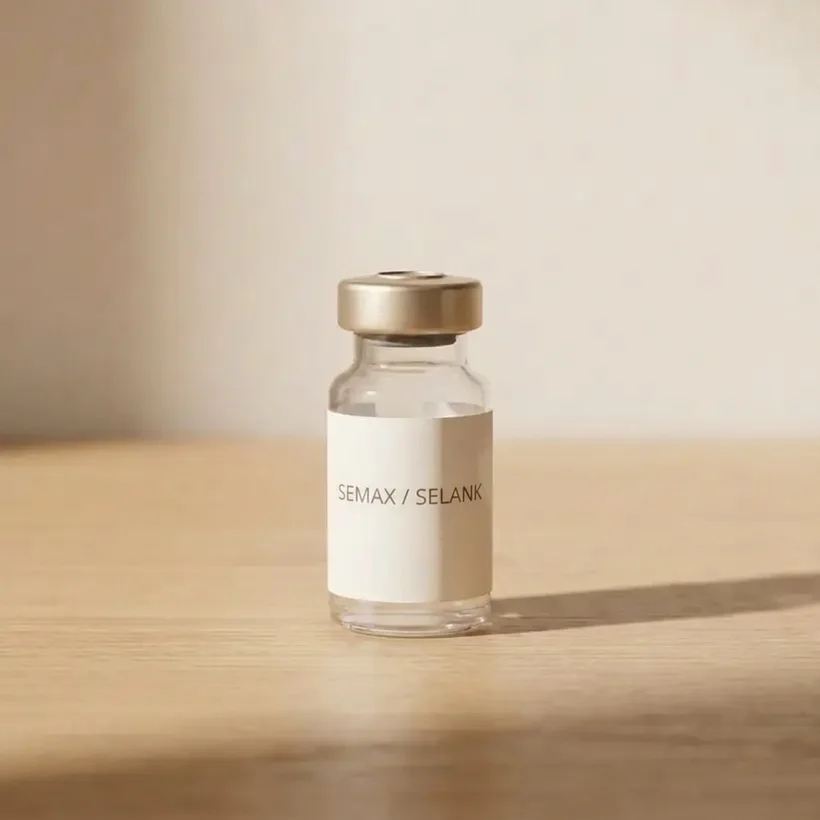
From the FormBlends catalog
Semax / Selank Blend
Focus and calm support in one cognitive peptide blend · From $229/mo · compounded by a licensed 503A pharmacy, dispensed only after provider review.
View Semax / Selank Blend →Table of Contents
- What causes brain fog at the biology level?
- Evidence ledger: all major claims graded
- The ranked list: 5 peptides for brain fog
- Mechanism with numbers: how each peptide acts
- What most pages get wrong about peptides and brain fog
- Honest head-to-head: peptides vs. real alternatives
- Dosing and protocol table
- Operational and label literacy: how to evaluate a product
- FAQ
- Sources
- Footer disclaimers
What Causes Brain Fog at the Biology Level?
Brain fog is not a diagnosis; it is a symptom cluster of slowed processing, poor working memory, and mental fatigue. The most studied biological correlates include:
- Neuroinflammation: Elevated IL-6, TNF-alpha, and microglial activation reduce synaptic plasticity and impair dopaminergic signaling. Post-viral fog (including long COVID) correlates with elevated inflammatory markers in cerebrospinal fluid in some case series.
- Reduced BDNF: Brain-derived neurotrophic factor supports hippocampal neurogenesis and synaptic strength. Chronic stress, poor sleep, and metabolic syndrome all suppress BDNF.
- Dysregulated monoamines: Suboptimal dopamine and acetylcholine tone impair executive function and attention.
- HPA axis dysregulation: Chronic cortisol elevation reduces hippocampal volume and impairs memory consolidation.
- Mitochondrial dysfunction: Reduced ATP production in neurons lengthens processing time and increases mental fatigue.
Different peptides target different nodes. Matching the peptide to the most likely driver of your fog is more logical than using a single "best" compound blindly.
Evidence Ledger: All Major Claims Graded
| Claim | Peptide | Best Evidence Type | Effect Direction | Confidence |
|---|---|---|---|---|
| Upregulates BDNF and NGF in brain tissue | Semax | Animal + small human pilot (Russian clinical literature) | Positive | Moderate |
| Improves attention and cognitive speed | Semax | Small human trials (n under 100, non-blinded in some cases) | Positive | Low |
| Anxiolytic effect reducing secondary cognitive impairment | Selank | Small RCTs in generalized anxiety disorder | Positive | Low |
| Potentiates HGF/MET signaling, improves spatial memory | Dihexa | Rodent studies only (Washington State University group) | Positive (animal) | Very Low |
| Restores dopaminergic function after neurotoxin exposure | BPC-157 | Rodent studies | Positive (animal) | Very Low |
| Reduces neuroinflammation markers | BPC-157 | In vitro and rodent | Positive (preclinical) | Very Low |
| Reduces mental fatigue in healthy adults | Semax | Mechanism only; no adequately powered RCT in healthy people | Plausible | Very Low |
| Improves mitochondrial function in neurons | SS-31 (Elamipretide) | Animal and early-phase human cardiology trials (not cognitive) | Positive (not cognitive endpoints) | Very Low |
The Ranked List: 5 Peptides for Brain Fog
1. Semax (Best Overall Evidence)
A synthetic analogue of ACTH(4-10) with an added proline-glycine-proline tripeptide to slow enzymatic degradation. Approved in Russia and Ukraine as a nootropic and neuroprotective agent. Has the most human-adjacent evidence of any peptide on this list for cognitive endpoints. Delivers intranasally, bypassing some of the bioavailability wall that destroys orally dosed peptides.
2. Selank (Best for Anxiety-Driven Fog)
A synthetic analogue of the immunomodulatory peptide tuftsin with an added tripeptide stabilizer. Modulates GABA-A receptor activity and reduces IL-6 expression. Small Russian RCTs support anxiolytic efficacy. If your fog correlates with chronic anxiety or stress, Selank addresses that mechanism more directly than Semax does.
3. BPC-157 (Best Preclinical Anti-Inflammatory Profile)
A 15-amino-acid peptide derived from a gastric protein. Extensive rodent data shows protection of dopaminergic neurons from neurotoxin injury and normalization of serotonin after stress exposure. The gut-brain axis hypothesis for BPC-157 is plausible and interesting, but no human cognitive trial exists. Useful if your fog is accompanied by GI dysfunction.
4. Dihexa (Most Potent in Animals, Least Data in Humans)
A hexapeptide developed at Washington State University, Dihexa potentiates hepatocyte growth factor (HGF) binding to its MET receptor. Animal data from the McCoy group showed dramatic improvements in spatial memory in aged rats. Described in that preclinical work as orders of magnitude more potent than BDNF itself at the HGF/MET node. Zero published human trials. Unknown long-term safety.
5. Cerebrolysin (Strongest Injectable Brain-Specific Data, Specialized Use)
Not a single peptide but a mixture of low-molecular-weight peptides and free amino acids from porcine brain tissue. Has human RCT data for vascular dementia and post-stroke recovery (notably the CASTA trial and multiple Cochrane-reviewed studies). The data is for pathological states, not healthy-person brain fog. Included here because it has the most rigorous human evidence of anything in this category, even if the use case is narrow.
Mechanism with Numbers: How Each Peptide Acts
Semax
Semax is a 7-amino-acid peptide (Met-Glu-His-Phe-Pro-Gly-Pro). In rodent studies, intranasal administration produced significant increases in BDNF mRNA in the hippocampus and frontal cortex. Importantly, the ACTH(4-10) core sequence binds melanocortin receptors MC4R and MC2R in the brain, activating cyclic AMP pathways linked to neuroprotection and attention. The proline-glycine-proline tail adds resistance to endopeptidase cleavage, extending its effective half-life compared to the parent fragment. Intranasal delivery reaches brain tissue via the olfactory epithelium pathway, partially bypassing systemic degradation, though the fraction reaching CNS in humans is not precisely established in published pharmacokinetic data.
Selank
Selank (Thr-Lys-Pro-Arg-Pro-Gly-Pro) is tuftsin extended with a tripeptide. It increases the expression of IL-4 relative to pro-inflammatory cytokines and modulates the GABAergic system, which overlaps mechanistically with benzodiazepines but without documented receptor downregulation at studied doses. BDNF mRNA upregulation has also been reported in rodent data from the Russian Institute of Molecular Genetics group.
BPC-157
BPC-157 (body protection compound, 15 amino acids) upregulates the nitric oxide system, activates FAK-paxillin pathway for tissue repair, and in neuropharmacology models restores normal dopamine and serotonin receptor density after methamphetamine or haloperidol-induced disruption. The gut-brain mechanism is the most clinically compelling hypothesis for brain fog: BPC-157 may reduce intestinal permeability and associated endotoxin translocation, which drives neuroinflammation via the vagal nerve and systemic IL-1beta elevation. This chain is biologically plausible but not yet demonstrated end-to-end in human subjects.
Dihexa
Dihexa (N-hexanoic-Tyr-Ile-(6) aminohexanoic amide) was developed by Joseph Harding and Jay Bhatt at Washington State University as a pro-cognitive compound targeting the HGF/MET synaptogenic pathway. HGF binding to MET receptor on neurons promotes dendritic arborization and synaptic density. In the published preclinical work, Dihexa improved performance in aged rats on the Morris water maze at very low doses. The concern is that MET receptor is also expressed in peripheral organs including the liver, and prolonged potentiation of a growth factor receptor pathway carries theoretical proliferative risk that has not been evaluated in humans.
What Most Pages Get Wrong About Peptides and Brain Fog
Most listicles about cognitive peptides present oral dosing as equivalent to intranasal or injectable dosing. It is not. Peptides are chains of amino acids. The gastrointestinal tract treats them as food. Proteases in the stomach and small intestine cleave most peptides into their constituent amino acids before absorption. What reaches portal circulation is largely not intact peptide.
Semax and Selank have their evidence base built on intranasal delivery, which allows partial transport via the olfactory mucosa directly to cerebrospinal fluid and brain interstitium, bypassing the hepatic first-pass effect. The oral versions sold on some websites have no corresponding evidence base. If you see a site citing the intranasal Semax trials to support an oral Semax product, the evidence does not transfer.
BPC-157 is a partial exception: rat studies show bioactivity after oral administration, which is attributed to possible gut-wall receptor activity as well as some resistance to full digestion due to its specific sequence. But "partially bioactive in rat gut after oral dosing" is not the same as "reaches rat brain intact," and neither is equivalent to human systemic or CNS exposure.
A second common omission is purity and source risk. Research-grade peptides sold in the United States are not manufactured under pharmaceutical GMP unless compounded by a licensed pharmacy. Independent third-party HPLC testing of research chemical peptides has found purity variation ranging widely across vendors. A degraded or impure Semax vial may contain endotoxin contamination from bacterial synthesis, which would actively worsen neuroinflammation rather than reduce it.
Honest Head-to-Head: Peptides vs. Real Alternatives
| Compound | Best Evidence Level | Cognitive Endpoint Studied | Human RCT Data | Where Peptides Win | Where Peptides Lose |
|---|---|---|---|---|---|
| Semax | Small human pilots | Attention, neuroprotection | Limited, mostly Russian registry | Neurotrophic mechanism, low stimulant burden | Evidence quality, Western regulatory acceptance |
| Modafinil | Multiple large RCTs | Wakefulness, sustained attention | Yes, replicated | N/A | Peptides lose on evidence, schedule status is a barrier |
| Racetams (e.g., piracetam) | Moderate human data | Cognitive decline, dementia | Yes, primarily elderly populations | Peptides may have neurotrophic effects racetams lack | Racetams have more replication in humans |
| Omega-3 (high-dose EPA/DHA) | Multiple RCTs | Depression, inflammation, cognitive aging | Yes | Peptides may act faster if BDNF pathway is primary | Omega-3 has stronger safety, lower cost, OTC availability |
| Cerebrolysin | Multiple RCTs (pathological states) | Vascular dementia, post-stroke | Yes (sick populations) | No clear win for healthy-person fog | Requires IV or IM administration, clinical setting |
| BPC-157 | Animal only | Dopamine recovery, GI-brain axis | No | Gut-brain mechanism is unique among this list | Loses to everything on evidence level |
Dosing and Protocol Table
| Peptide | Route Used in Research | Dose Range in Literature | Cycle Length Studied | Notes |
|---|---|---|---|---|
| Semax | Intranasal | 200 to 900 mcg per day | 10 to 14 days | Standard Russian clinical use; injectable protocols exist but less studied for cognitive endpoints |
| Selank | Intranasal | 250 to 500 mcg per day | 10 to 14 days | Often co-administered with Semax in Russian practice |
| BPC-157 | Subcutaneous or oral (rodent) | 1 to 10 mcg/kg in animals; human equivalent not established | Variable | No human cognitive dosing data; GI-focused oral use is anecdotal |
| Dihexa | Oral or topical (rodent) | Not established for humans | Not established | No published human protocol exists; use without medical supervision is not advisable |
| Cerebrolysin | IV or IM | 10 to 30 mL per infusion (clinical trials) | 20 to 30 daily infusions in dementia trials | Requires clinical setting; not practical for self-administration |
Operational and Label Literacy: How to Evaluate a Product
What a real COA must show
- HPLC purity: Greater than 98% area under the curve is the pharmaceutical standard. Below 95% is concerning for a cognitive compound where impurities are uncharacterized.
- Mass spectrometry confirmation: The measured molecular weight should match the theoretical molecular weight of the peptide to within 1 to 2 daltons. This confirms you have the correct compound, not a truncated or scrambled sequence.
- Endotoxin testing: For injectable-route compounds, endotoxin levels should be reported (LAL test). High endotoxin from bacterial fermentation would cause a systemic inflammatory response, directly counterproductive for brain fog.
- Amino acid analysis: Confirms the correct amino acid composition. Some vendors skip this; its absence is not disqualifying but its presence adds confidence.
What degraded peptide looks like
- Lyophilized powder that has clumped, yellowed, or lost its fluffy cake structure suggests moisture intrusion or thermal damage.
- Reconstituted solution that turns yellow, brown, or develops visible particles should be discarded. Clear, colorless solution is expected for most cognitive peptides.
- A vial that was shipped without cold packing in summer may be partially degraded even if it looks normal.
Reconstitution math for Semax as an example
If you have a 5 mg vial and want a 500 mcg per dose intranasal spray using a nasal atomizer that delivers 0.1 mL per pump, add 1 mL of sterile water to yield a 5 mg/mL solution, giving 500 mcg per 0.1 mL pump. Use bacteriostatic water (not sterile water) if the vial will be accessed multiple times to prevent microbial contamination. Bacteriostatic water contains 0.9% benzyl alcohol as a preservative, which is appropriate for this use.
Stability rules and why they exist
Peptide bonds are susceptible to hydrolysis: water molecules cleave the amide bond between amino acids, especially under acidic or alkaline conditions and at elevated temperatures. This is why lyophilized (freeze-dried) peptides are more stable than reconstituted ones. Once reconstituted, refrigerate at 2 to 8 degrees Celsius and use within 2 to 4 weeks as a general rule. Freezing reconstituted peptide introduces ice crystal shear stress that can disrupt secondary structure. The chemistry: peptide bond hydrolysis rate roughly doubles for every 10 degree Celsius increase in temperature (a version of the Arrhenius relationship). This is why shipping cold matters, not just storage.
FAQ
What is the best peptide for brain fog overall?
Semax has the most direct evidence for cognitive clarity effects in humans, particularly in small Russian clinical trials. Dihexa and BPC-157 follow with animal or mechanism-level data only. No peptide has a large, high-quality RCT specifically for brain fog as a symptom.
Does BPC-157 help with brain fog?
BPC-157 reduces neuroinflammatory markers and supports dopaminergic function in rodent studies, which could plausibly address fog driven by gut-brain axis dysfunction or inflammation. Human trial data for cognitive endpoints is absent, so confidence is very low.
What is Semax and why does it rank first?
Semax is a synthetic heptapeptide derived from ACTH(4-10). It upregulates BDNF and NGF in the brain and has been tested in small human trials for cognitive and neurological applications in Russia, giving it more human-relevant evidence than competitors.
Is Dihexa safe to use for brain fog?
Dihexa is extremely potent in animal models but has no published human safety or efficacy data. Its unknown pharmacokinetics and irreversible HGF/MET receptor potentiation make it a high-uncertainty compound. It should not be used without medical supervision.
Can Selank reduce brain fog from anxiety?
Selank modulates GABA-A receptors and reduces anxiety-related inflammation, which can secondarily improve cognitive clarity. Small Russian RCTs show anxiolytic effects. If your brain fog is anxiety-driven, Selank is a reasonable candidate, though evidence is not large-trial quality.
How is Semax dosed for cognitive benefits?
Russian clinical research used intranasal doses ranging from 200 mcg to 900 mcg per day across short cycles of 10 to 14 days. Subcutaneous injection protocols exist but intranasal is the standard route studied. No universally accepted protocol exists in Western medicine.
Do peptides for brain fog work better than racetams or modafinil?
Modafinil has large, replicated human RCT data for wakefulness and cognitive performance in sleep-deprived adults. Racetams have moderate human data. Peptides like Semax have small pilot data. Peptides lose the head-to-head evidence comparison but may have different or complementary mechanisms.
What causes brain fog at the biological level?
Brain fog commonly involves neuroinflammation (elevated IL-6, TNF-alpha, or microglial activation), reduced BDNF signaling, dysregulated dopamine or acetylcholine transmission, mitochondrial dysfunction, or hypothalamic-pituitary-adrenal axis disruption. Different peptides target different nodes.
What does a degraded or low-quality peptide look like?
Degraded peptides often show visible particulates, color change from clear to yellow or brown, or loss of lyophilized cake structure before reconstitution. A COA should show greater than 98% purity by HPLC and correct molecular weight by mass spectrometry. Missing either is a red flag.
Can you stack peptides for brain fog?
Semax plus Selank is a commonly discussed stack, targeting BDNF upregulation and anxiolytic effects simultaneously. There is no human trial data on stacking safety or synergy. Interaction risk is unknown. Start each compound separately before combining.
Are peptides for brain fog legal to buy?
In the United States, most cognitive peptides (Semax, Selank, Dihexa, BPC-157) are not FDA-approved drugs. They are sold as research chemicals or, in some cases, compounded by licensed pharmacies. Legal status varies by country. Verify local regulations before purchasing.
What is the biggest mistake people make when using peptides for brain fog?
Skipping the underlying cause. Brain fog from sleep apnea, thyroid dysfunction, anemia, or mold exposure will not be resolved by any peptide. Peptides modulate neurotrophic or inflammatory pathways but cannot compensate for an unaddressed root cause.
Sources
- Dolotov OV, et al. "Semax, an analogue of ACTH(4-7) with cognitive effects, regulates BDNF and trkB expression in the rat hippocampus." Brain Research, 2006. PMID 16386718.
- Manchenko DM, et al. "Semax, a synthetic analogue of ACTH(4-10), affects exploratory behavior and the serotonin system in rats." Bulletin of Experimental Biology and Medicine, 2012.
- Zozulya AA, et al. "Selank administration modulates the expression of genes related to the GABAergic and serotonergic systems." Doklady Biochemistry and Biophysics, 2014.
- McCoy AT, Bhatt DL, et al. "Peptide fragments of HGF show cognitive enhancement in aged rats." Washington State University preclinical research, published abstracts circa 2011 to 2013 (McCoy/Bhatt group, WSU).
- Sikiric P, et al. "Brain-gut Axis and Pentadecapeptide BPC 157: Theoretical and Practical Implications." Current Neuropharmacology, 2016. PMID 26517415.
- Alvarez XA, et al. "Cerebrolysin in Alzheimer's disease: a randomized, double-blind, placebo-controlled trial on its effects on cognition." Journal of Neural Transmission, 2006.
- Cochrane Review: "Cerebrolysin for acute ischaemic stroke." Cochrane Database of Systematic Reviews, multiple editions.
- Turner RS, et al. "A randomized, double-blind, placebo-controlled trial of resveratrol for Alzheimer disease." Neurology, 2015 (cited for contrast: illustrates what a properly powered CNS trial looks like vs. peptide literature).
- Battleday RM, Brem AK. "Modafinil for cognitive neuroenhancement in healthy non-sleep-deprived subjects." European Neuropsychopharmacology, 2015. PMID 26381811.
- Bhatt DL, McCoy AT, et al. "Dihexa: a peptide that potentiates HGF/Met signaling for cognitive enhancement." Published preclinical work, Washington State University, available via PubMed author search.
Ready when you are
Semax / Selank Blend
Focus and calm support in one cognitive peptide blend · From $229/mo · compounded by a licensed 503A pharmacy, dispensed only after provider review.
View Semax / Selank Blend →