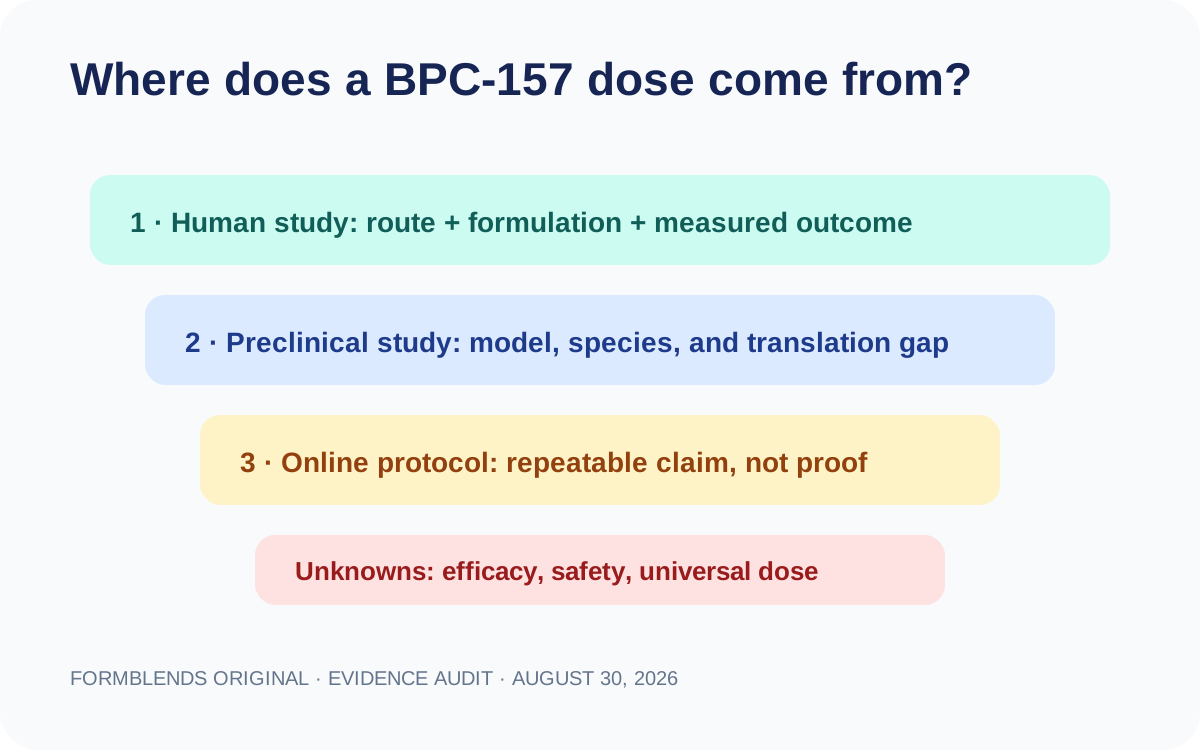
Correction, September 2026: an earlier version of this page opened with a "research dose range" of 200 to 800 mcg per day and a "most common starting protocol." Those figures came from peptide-vendor blogs, not from clinical research, and have been removed. As of September 5, 2026 there is no published human dose-finding study of BPC-157 by any route. The FDA's July 2026 advisory committee briefing found only five clinical studies in the medical literature, all using rectal administration for ulcerative colitis, and "no human pharmacokinetic data for BPC-157 after oral, SC, nasal, or transdermal administration." BPC-157 is not FDA approved, it has sat in the FDA's Category 2 list of compounding substances with "significant safety risks" since September 29, 2023, and this page is educational only. FormBlends does not sell BPC-157.
Quick answer: What is the standard BPC-157 dose? There is none. No human dose-finding, dose-response or pharmacokinetic study has been published for oral or injected BPC-157 (FDA advisory committee briefing, July 2026). Doses circulating online are extrapolated from rodent experiments and vendor marketing. BPC-157 is a research peptide, is not FDA approved, and the FDA proposed in July 2026 that it not be added to the list of substances pharmacies may compound.
What is BPC-157?
BPC-157 (Body Protection Compound-157) is a synthetic 15-amino-acid peptide derived from a protein found in human gastric juice. It has been studied in many preclinical experiments for tissue repair and gut injury, and a 2026 review in Pharmaceutics describes it as an investigational peptide facing unresolved formulation and translational barriers. Human evidence is limited to a handful of small studies of rectal preparations for inflammatory bowel disease conducted by a Croatian manufacturer (Pliva) and summarized in a 2006 review; none established a dose for the uses discussed online.
What is the standard BPC-157 dosage?
Correction, September 2026: this section previously contained a table of daily doses, frequencies, routes and durations by goal (general wellness, injury recovery, gut health, tendon). No trial supports any cell of that table, and it has been removed. There is no standard BPC-157 dosage because no human dose-finding study exists. The FDA's July 2026 briefing document, prepared for its Pharmacy Compounding Advisory Committee, evaluated BPC-157 only for ulcerative colitis, found five clinical studies (all rectal enema or similar), and noted that in the studies with blood sampling the drug was not detected in plasma. "Physician-supervised peptide therapy" with BPC-157 means compounding a substance the FDA has classified since September 29, 2023 as carrying significant safety risks.
How does BPC-157 dosing work in research?
In the preclinical literature, BPC-157 doses are reported in micrograms per kilogram of body weight in rodents. Animal doses do not translate directly to humans. Using the body-surface-area method described by Nair and Jacob (2016), a 10 mcg/kg rat dose corresponds to roughly 1.6 mcg/kg in a human. That arithmetic is shown only to illustrate why rodent figures cannot be read as human doses; it is not a recommendation. Correction, September 2026: an earlier version added that "most practitioners use higher doses based on clinical experience." That claim had no source and has been removed.

From the FormBlends catalog
BPC-157
The body protection compound for accelerated healing · From $169/mo · compounded by a licensed 503A pharmacy, dispensed only after provider review.
View BPC-157 →A dose-by-effect table that used to appear here summarized rodent models without citations and has been removed.
How do you dose BPC-157 by body weight?
Correction, September 2026: a body-weight dosing table (140, 180 and 220 pounds at "low," "standard" and "high" doses) has been removed. It was an invented human protocol built on rodent numbers. No published study has dosed BPC-157 by body weight in humans.
What are the tissue-specific dosing protocols?
Correction, September 2026: tissue-specific protocols for tendon, muscle, gut, joint and nerve (with doses, routes and durations) have been removed. None exists in the published literature. The FDA found no human pharmacokinetic data after oral or subcutaneous administration, so statements about "acid stability" making oral use "viable" in humans are also unsupported.
How do you dose by administration route?
Correction, September 2026: a route-by-bioavailability table has been removed. Human bioavailability of BPC-157 by any route is unknown. The FDA's July 2026 briefing states: "We found no human pharmacokinetic data for BPC-157 after oral, SC, nasal, or transdermal administration," and reports that in the rectal-enema studies the peptide was not detected in plasma.
How do you reconstitute BPC-157?
Correction, September 2026: step-by-step reconstitution instructions, a concentration table and storage guidance have been removed. This page no longer provides preparation or dosing instructions for BPC-157, because there is no approved product, no human dose and no validated beyond-use dating for home-reconstituted vials. The FDA's briefing notes adverse event reports in its FAERS database involving compounded BPC-157 injections.
How long should a BPC-157 cycle last?
Correction, September 2026: cycle lengths by severity (4, 6 to 8 and 8 to 12 weeks) have been removed. No published human study has tested any BPC-157 cycle, and there is no research on long-term human use of any kind.
Safety considerations
Correction, September 2026: an earlier version described a "strong safety profile" with "no toxic dose identified." That is not how the FDA characterizes the evidence. On September 29, 2023 the agency placed BPC-157 in Category 2 of its interim list of bulk substances nominated for compounding, the category for substances that "raise significant safety concerns"; the FDA's category definition is that it "has identified significant safety risks." Its July 2026 briefing cites potential immunogenicity, impurity and characterization concerns and adverse event reports involving compounded injections. BPC-157 has been on the World Anti-Doping Agency Prohibited List as an S0 non-approved substance since January 1, 2022, so competing athletes cannot use it. There is no human safety database from which to say who should or should not take it.
A note on FormBlends and BPC-157
BPC-157 is not FDA approved. FormBlends does not sell it and does not provide dosing, reconstitution or protocol guidance for it. FormBlends provides compounded semaglutide and tirzepatide for weight management under clinician supervision.
Correction, September 2026: there is no human dose. What the FDA found in July 2026
This page previously presented dose tables, body-weight charts, route comparisons, reconstitution steps and cycle lengths for BPC-157. Every one of those numbers has been removed. Three of the five sources they rested on were peptide-vendor or affiliate blogs, and the fourth, a 2011 Current Pharmaceutical Design citation, could not be located in PubMed.
What the FDA's briefing document for the July 23 to 24, 2026 Pharmacy Compounding Advisory Committee meeting actually says: the agency evaluated BPC-157 for ulcerative colitis, the only use with any clinical data; its search of PubMed and Embase "yielded five clinical studies," all with rectal administration; in the studies that measured blood levels the peptide was not detected in plasma; and "we found no human pharmacokinetic data for BPC-157 after oral, SC, nasal, or transdermal administration." The FDA's proposal to the committee was that BPC-157 (free base and acetate) not be included on the 503A bulks list, alongside KPV, TB-500, MOTS-c, epitalon and Semax. A compounding-industry consultancy reported on August 17, 2026 that the committee's advisory vote on BPC-157 was 8 in favor, 6 against and 1 abstention; the FDA had not posted official minutes as of September 5, 2026, and any listing would still require notice-and-comment rulemaking.
Regulatory timeline (dated)
| Date | Event | Source |
|---|---|---|
| January 1, 2022 | BPC-157 named as an example of an S0 non-approved substance on the World Anti-Doping Agency Prohibited List | USADA athlete advisory, 2022 list |
| September 29, 2023 | FDA adds BPC-157 to Category 2 of its interim 503A bulk substances list (substances that raise significant safety concerns), alongside AOD-9604, CJC-1295 and LL-37 | FDA category update, mirrored by A4PC |
| May 14, 2026 | Current FDA 503A category list; Category 2 defined as substances for which "FDA has identified significant safety risks" | FDA 503A bulks page |
| July 23 to 24, 2026 | Pharmacy Compounding Advisory Committee reviews BPC-157; FDA proposes it not be listed | FDA briefing document and committee questions |
| August 17, 2026 | Advisory vote reported as 8 yes, 6 no, 1 abstain (secondary report; FDA minutes pending) | Restore Health Consulting |
| Pending | FDA final decision through rulemaking |
Seen September 5, 2026. Nothing in this timeline creates an approved product, a human dose, or a route of administration with known bioavailability.
Why animal doses do not translate
Most BPC-157 claims trace back to rodent experiments that report doses per kilogram of body weight. Small animals clear drugs faster relative to body size, so pharmacologists convert doses using body surface area rather than weight. In the standard conversion table published by Nair and Jacob in the Journal of Basic and Clinical Pharmacy (2016), a rat dose is divided by about 6.2 to estimate a human-equivalent dose, so 10 mcg/kg in a rat corresponds to roughly 1.6 mcg/kg in a person. That calculation is a starting point for designing a first-in-human trial, not a dose; it assumes the compound is absorbed by the route used, and for BPC-157 in humans that is unknown. The rodent figures also come from acute injury models that do not map onto chronic tendon pain, gut conditions or "wellness" in adults.
Frequently asked questions
What is the standard BPC-157 dosage?
There is none. No human dose-finding study exists, and the FDA's July 2026 briefing found no human pharmacokinetic data for oral or injected BPC-157. Figures quoted online are extrapolations from rodent studies and vendor marketing.
How often should I take BPC-157?
No frequency has been studied in humans. An earlier answer here gave once- or twice-daily schedules; those had no source and have been removed.
Can I take too much BPC-157?
Nobody knows, because there is no human toxicology data. The FDA has classified BPC-157 as a substance with significant safety risks (Category 2, September 29, 2023) and its 2026 briefing notes adverse event reports involving compounded injections.
Should I inject near the injury or in my stomach?
This page no longer gives injection-site or route guidance. Human absorption by any route is unknown; the FDA found no human pharmacokinetic data after oral, subcutaneous, nasal or transdermal administration.
How much bacteriostatic water do I add?
Reconstitution guidance has been removed from this page. There is no approved BPC-157 product, no human dose to prepare, and no validated stability data for home-mixed vials.
Does BPC-157 need refrigeration?
Storage and beyond-use guidance has been removed. The 28-day figure that used to appear here had no source. Stability data for reconstituted BPC-157 have not been published.
How long does BPC-157 take to work?
There is no human trial that sets a timeline. An earlier answer here relayed anecdotal timeframes (one to two weeks, four to eight weeks); they have been removed because they were not evidence of anything.
When is the best time to take BPC-157?
There is no evidence on timing because there is no human dosing study. This page does not provide a routine.
Can I stack BPC-157 with TB-500?
This page does not recommend combining research peptides. TB-500 is also on the FDA's Category 2 list, and in July 2026 the FDA proposed that TB-500, like BPC-157, not be added to the list of substances pharmacies may compound.
Is BPC-157 FDA-approved?
No. It is not FDA approved for any condition. On July 23 to 24, 2026 the FDA told its Pharmacy Compounding Advisory Committee that it proposes BPC-157 not be included on the list of bulk substances that may be compounded; a final decision requires rulemaking. FormBlends does not sell it.
Is BPC-157 legal to buy or use in the United States?
BPC-157 is not an approved drug and cannot be legally marketed for human use. Since September 29, 2023 the FDA has listed it in Category 2 of its compounding bulk substances list, the category for substances with identified significant safety risks, and in July 2026 the agency proposed that it not be added to the list pharmacies may compound. It is sold online as a research chemical; that labeling does not make it approved for people.
Is BPC-157 banned in sports?
Yes. The World Anti-Doping Agency's Prohibited List has named BPC-157 as an example of an S0 non-approved substance since January 1, 2022 (USADA athlete advisory on the 2022 list). S0 covers pharmacological substances with no current approval by any governmental regulatory health authority for human therapeutic use. Athletes subject to testing cannot use it in or out of competition.
What did the FDA advisory committee decide about BPC-157 in 2026?
The FDA's Pharmacy Compounding Advisory Committee reviewed BPC-157 on July 23 to 24, 2026. The FDA's own position in its briefing was that BPC-157 should not be included on the 503A bulks list, citing no human pharmacokinetic data and only five small rectal-administration studies. A compounding consultancy reported an advisory vote of 8 yes, 6 no and 1 abstain on August 17, 2026; official minutes were not posted as of September 5, 2026, and listing would still require rulemaking.
Sources
- Nair AB, Jacob S. Dose conversion between animals and human. J Basic Clin Pharm. 2016;7(2):27-31.
- U.S. Food and Drug Administration. Briefing document for the Pharmacy Compounding Advisory Committee meeting, July 23 to 24, 2026 (BPC-157 evaluation). https://www.fda.gov/media/193343/download
- U.S. Food and Drug Administration. Questions to the Pharmacy Compounding Advisory Committee, July 23 to 24, 2026 (FDA proposes BPC-157, TB-500 and others not be included on the 503A bulks list). https://www.fda.gov/media/193342/download
- U.S. Food and Drug Administration. Bulk drug substances nominated for use in compounding under section 503A, interim category list, updated May 14, 2026. https://www.fda.gov/media/94155/download
- U.S. Food and Drug Administration. Bulk Drug Substances Used in Compounding Under Section 503A of the FD&C Act, content current as of May 14, 2026 (Category 2 definition). https://www.fda.gov/drugs/human-drug-compounding/bulk-drug-substances-used-compounding-under-section-503a-fdc-act
- FDA 503A categories update, September 29, 2023 (BPC-157 added to Category 2), as mirrored by the Alliance for Pharmacy Compounding. https://join.a4pc.org/hubfs/PDFs/503A-Categories-Update-for-September-2023-FINAL.docx.pdf
- Restore Health Consulting. FDA's PCAC votes in favor of six peptides for potential inclusion on the 503A bulks list, August 17, 2026 (secondary report of the advisory vote). https://www.restorehealthconsulting.com/news/fdas-pcac-votes-in-favor-of-six-peptides-for-potential-inclusion-on-the-503a-bulks-list-what-compounders-need-to-know
- U.S. Anti-Doping Agency. Key changes to the 2022 Prohibited List (BPC-157 named under S0). https://www.usada.org/athlete-advisory/key-changes-2022-prohibited-list/
- Nair AB, Jacob S. A simple practice guide for dose conversion between animals and human. J Basic Clin Pharm 2016;7:27-31. https://europepmc.org/article/MED/27057123
- Mateescu DM et al. BPC-157 as an Investigational Peptide Therapeutic: Biopharmaceutical Challenges, Formulation Strategies, and Translational Development Barriers. Pharmaceutics 2026;18:625. https://europepmc.org/article/MED/42198317
- Sikiric P et al. Stable gastric pentadecapeptide BPC 157 in trials for inflammatory bowel disease (PL-10, PLD-116, PL 14736, Pliva, Croatia). Inflammopharmacology 2006;14:214-221. https://europepmc.org/article/MED/17186181
Ready when you are
BPC-157
The body protection compound for accelerated healing · From $169/mo · compounded by a licensed 503A pharmacy, dispensed only after provider review.
View BPC-157 →