
Key Takeaways
- Subcutaneous injection is the only sermorelin delivery route with published human pharmacokinetic and efficacy data, including the original FDA approval (Geref, now withdrawn).
- Intranasal peptide bioavailability for molecules in the 3,000 Da range is typically under 5 percent without a penetration enhancer, based on general intranasal peptide pharmacokinetics literature.
- No peer-reviewed human trial has measured IGF-1 or GH response to intranasal sermorelin specifically, making it a Very Low evidence intervention.
- Sermorelin has a plasma half-life of roughly 10 to 12 minutes after injection; degradation is faster in aqueous nasal spray solutions exposed to air and ambient temperature.
- A legitimate COA for any sermorelin product should confirm purity above 98 percent by HPLC and identity by mass spectrometry near 3357 Da.
Direct Answer: Sermorelin Nasal Spray vs Injection
Table of Contents
- What is sermorelin and how does it work?
- Evidence ledger: what the data actually show
- Why does the delivery route change the outcome so dramatically?
- What most pages get wrong about nasal sermorelin
- Formulation and stability: the gotcha nobody mentions
- Head-to-head table: nasal spray vs injection vs alternatives
- Dosing and protocol reference
- Label and COA literacy: how to judge your product
- Side effects by route
- FAQ
- Sources
What Is Sermorelin and How Does It Work?
Sermorelin is a synthetic analogue of growth hormone-releasing hormone (GHRH), comprising the first 29 amino acids of the native 44-amino-acid GHRH(1-44) peptide. This N-terminal fragment retains full biological activity at the pituitary GHRH receptor (GHRHR), a G-protein coupled receptor that activates adenylyl cyclase, raises intracellular cAMP, and triggers pulsatile GH secretion from somatotroph cells.
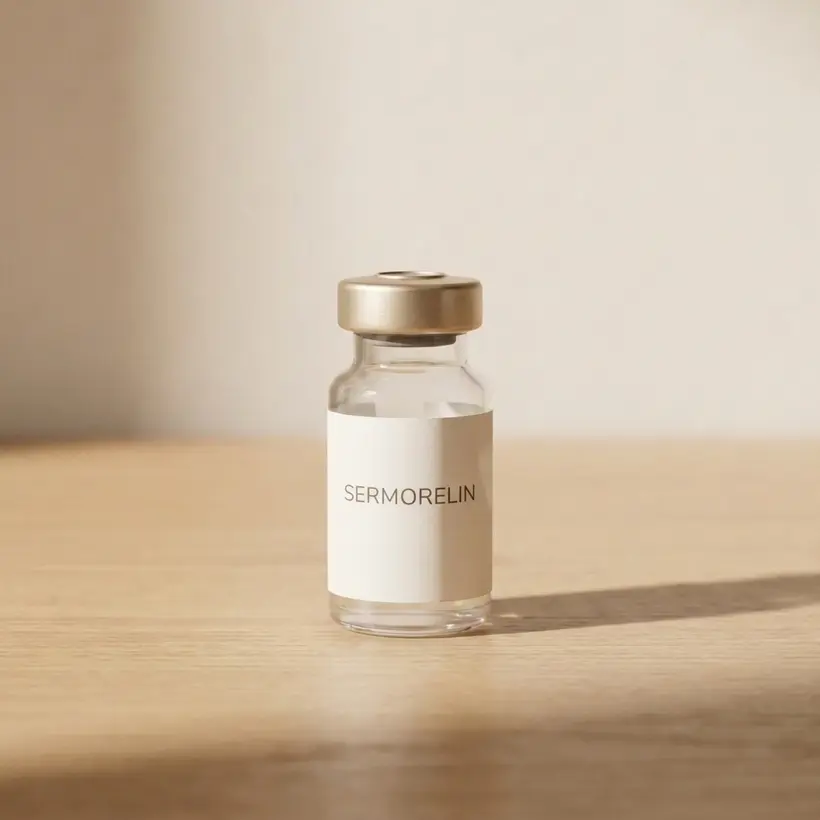
From the FormBlends catalog
Sermorelin
Bioidentical GHRH analog for natural growth hormone pulsatility · From $175/mo · compounded by a licensed 503A pharmacy, dispensed only after provider review.
View Sermorelin →The key physiological distinction from exogenous recombinant GH: sermorelin stimulates the pituitary to release GH rather than replacing it. This preserves the negative-feedback arc through somatostatin, which theoretically limits the supraphysiological IGF-1 elevations associated with direct rhGH use. This is a mechanistic argument, not a confirmed safety advantage in long-term RCT data.
FDA originally approved sermorelin acetate for injection (Geref, Serono) for the diagnosis of GH deficiency and for GH-deficient children. Geref was voluntarily withdrawn from the US market. Any sermorelin product available today is a compounded preparation, not an FDA-approved drug.
Evidence Ledger: What the Data Actually Show
| Claim | Best evidence type | Effect direction | Confidence |
|---|---|---|---|
| Subcutaneous sermorelin acutely raises GH in humans | Human pharmacokinetic studies, FDA approval basis | Positive, consistent | High |
| Subcutaneous sermorelin raises IGF-1 with repeated dosing in GH-deficient children | Controlled pediatric trials (basis for original Geref approval) | Positive | Moderate (pediatric data; adult extrapolation is indirect) |
| Intranasal sermorelin raises GH to clinically meaningful levels in humans | No published human RCT or PK study found | Unknown | Very Low |
| Intranasal peptides in the 3,000 to 4,000 Da range have low bioavailability without enhancers | General intranasal peptide PK literature (oxytocin, GHRH analogues) | Negative for absorption | Moderate (class effect; sermorelin-specific data absent) |
| Penetration enhancers (cyclodextrins, bile salts) improve intranasal peptide absorption | Animal and ex vivo human mucosa studies | Positive, variable magnitude | Low (formulation-specific; no validated nasal sermorelin product) |
| Sermorelin improves body composition in healthy older adults | Small adult RCT data exist in the GH secretagogue literature, but trials are few, short in duration, and limited in sample size; no large confirmatory trial has been published | Modest positive signal on lean mass in available small trials | Low (limited trials, short duration, small samples) |
| Sermorelin is as effective as rhGH for long-term GH axis support | No head-to-head RCT in adults | Unknown | Very Low |
Why Does the Delivery Route Change the Outcome So Dramatically?
Sermorelin is a 29-amino-acid peptide with a molecular weight of approximately 3357 Da. The nasal mucosa is selectively permeable. Transcellular passive diffusion favors small, lipophilic molecules. Peptides this size face three compounding barriers:
- Enzymatic degradation: The nasal epithelium expresses aminopeptidases, endopeptidases, and proteases that cleave peptide bonds before the molecule can cross the membrane. Sermorelin's biological activity depends on an intact N-terminus; cleavage at even the first or second residue abolishes GHRHR binding.
- Mucociliary clearance: The nasal mucosa clears foreign molecules toward the nasopharynx within 15 to 30 minutes, competing directly with the absorption window. For a peptide that must cross before being cleared or degraded, this dramatically reduces effective contact time.
- Paracellular restriction: Tight junctions in nasal epithelium restrict paracellular passage of molecules above roughly 1000 Da under standard conditions. Without a tight-junction modulator in the formulation, sermorelin at 3357 Da cannot use this route meaningfully.
Published intranasal peptide pharmacokinetics data (reviewed in Illum, 2002, Advanced Drug Delivery Reviews) consistently show that unenhanced intranasal bioavailability for peptides above 1000 Da falls below 5 percent. This is a class effect. No specific sermorelin nasal bioavailability number exists in the literature. Any claim of a precise intranasal sermorelin bioavailability figure (for example, "20 percent") is not sourced from published data.
Subcutaneous injection bypasses all of these barriers. The peptide enters the interstitial space and diffuses into capillaries; the primary limitation becomes plasma half-life (roughly 10 to 12 minutes), which is actually the clinically desirable property since it drives a clean, pulsatile GH release rather than a sustained elevated level.
What Most Pages Get Wrong About Nasal Sermorelin
Several specific errors circulate online:
Error 1: "Nasal spray avoids first-pass metabolism." This is true but irrelevant. First-pass hepatic metabolism is the limitation for oral peptides. Sermorelin injected subcutaneously also avoids first-pass metabolism. The nasal route's real limitation is pre-systemic degradation at the nasal epithelium and low permeability, not hepatic first-pass. Both injection and nasal spray avoid the liver, but only injection delivers the peptide intact to circulation at sufficient concentration.
Error 2: Citing vasopressin nasal spray as proof that peptide nasal sprays work. Vasopressin (desmopressin, DDAVP) is approximately 1069 Da, less than one-third the size of sermorelin, and was specifically engineered for mucosal stability. It is not evidence that sermorelin nasal spray works.
Error 3: Treating compounding pharmacy availability as evidence of efficacy. Compounding pharmacies produce intranasal sermorelin because patients request needle-free options, not because clinical evidence supports it. PCAB accreditation or 503A/503B status tells you about sterility standards, not about whether the active ingredient crosses the nasal mucosa at therapeutic levels.
Formulation and Stability: The Gotcha Nobody Mentions
Sermorelin in aqueous solution is chemically unstable relative to lyophilized powder. The primary degradation pathways are:
- Hydrolysis: Peptide bonds hydrolyze in aqueous solution, accelerated by temperature and extremes of pH. The rate increases substantially above refrigerator temperature.
- Oxidation: Sermorelin contains a methionine residue. Methionine side chains oxidize readily in the presence of dissolved oxygen or peroxides, forming methionine sulfoxide and reducing receptor binding affinity.
- Aggregation: At higher concentrations or after freeze-thaw cycles, peptide aggregation reduces active monomer concentration. Aggregates may also carry immunogenicity risk, though this has not been quantified for sermorelin specifically.
The nasal spray formulation introduces an additional instability factor that injection vials do not share: repeat pump actuation draws air back into the bottle. Each air introduction raises dissolved oxygen concentration and introduces potential microbial contamination, even with a preservative (commonly benzalkonium chloride). This means the nasal spray's effective shelf life after first use is shorter than a sealed multi-dose injection vial stored identically.
Practical implication: a nasal spray vial sitting at room temperature on a bathroom counter for two to three weeks likely contains meaningfully less active sermorelin than on day one, independent of the bioavailability question. The injection vial stored in the refrigerator, reconstituted under sterile conditions, is more stable.
Storage rule and why: Both forms should be stored at 2 to 8 degrees Celsius and protected from light. Cold temperature slows both hydrolysis kinetics and oxidation rates (roughly halving reaction rates per 10-degree Celsius reduction, per Arrhenius kinetics). Freezing after reconstitution causes ice crystal formation that can disrupt peptide tertiary structure and accelerate aggregation on thaw; lyophilized (dry) powder can tolerate freezing.
Head-to-Head Table: Nasal Spray vs Injection vs Alternatives
| Parameter | Sermorelin Nasal Spray | Sermorelin Injection (SubQ) | CJC-1295 + Ipamorelin (SubQ) | rhGH (SubQ) |
|---|---|---|---|---|
| Human PK/PD data | None published | Yes (FDA approval basis) | Limited human data; mostly case series | Extensive RCT data |
| Estimated systemic bioavailability | Very low (likely under 5%) | Near-complete | Near-complete | Near-complete |
| GH pulse physiology preserved | Unknown | Yes | Yes (synergistic pulse) | No (suppresses endogenous pulse) |
| Negative feedback intact | Unknown | Yes (theoretical advantage) | Yes | No |
| FDA approval status | Never approved | Withdrawn (Geref) | Never approved | Yes (for specific indications) |
| Needle required | No | Yes (insulin-gauge) | Yes | Yes |
| Stability in aqueous solution | Poor (air exposure, temp risk) | Good if refrigerated | Good if refrigerated | Good if refrigerated |
| Relative cost (compounded) | Moderate | Moderate to high | Moderate to high | High to very high |
| Evidence quality for body composition | Very Low | Low to Moderate | Very Low | Moderate to High (approved uses) |
Where sermorelin injection loses to rhGH: For individuals with documented severe GH deficiency who require predictable IGF-1 normalization within a defined time window, rhGH provides stronger and more consistent effect. Sermorelin relies on a functional pituitary and intact somatotroph reserve; patients with pituitary damage may not respond adequately.
Dosing and Protocol Reference
| Route | Typical compounded dose range | Timing | Evidence basis | Notes |
|---|---|---|---|---|
| Subcutaneous injection | 100 to 300 mcg per night | 30 to 60 min before sleep (aligns with nocturnal GH surge) | Geref FDA label; clinical protocols in literature | Rotate injection sites; insulin syringe (27 to 31 gauge) |
| Nasal spray | Varies widely by compounder; no validated dose | Often bedtime, mirroring injection timing | No human PK data | Dose is largely arbitrary without bioavailability data |
Reconstitution note for injection: Lyophilized sermorelin is typically reconstituted with bacteriostatic water (0.9% benzyl alcohol). Add the diluent slowly down the vial wall; do not shake (creates aggregates). Swirl gently until clear. A properly reconstituted solution is colorless and particle-free. Cloudiness, particulate matter, or a yellow tint indicates degradation; discard.
Label and COA Literacy: How to Judge Your Product
Because sermorelin is a compounded peptide, batch-to-batch quality depends entirely on the pharmacy's testing standards. Here is what to require and how to read it:
- Purity by HPLC: Expressed as percent area under the curve for the sermorelin peak. Target is 98 percent or higher. Values below 95 percent suggest significant impurities, which could be inactive fragments or biologically active analogue fragments with unknown effects.
- Identity by mass spectrometry: The molecular ion should correspond to the sermorelin acetate molecular weight of approximately 3357 Da (the free acid peptide backbone; the acetate salt shifts this slightly). An MS confirmation eliminates product substitution errors.
- Sterility testing: USP method, negative for specified organisms. Mandatory for any injectable product. For nasal spray, preservative efficacy testing (USP Chapter 51) should also be present.
- Endotoxin (LAL test): Should be below USP limits for injectable preparations (under 0.5 EU per mL for most parenteral routes). Endotoxin contamination causes fever, chills, and inflammatory responses.
- For nasal spray specifically: Ask the pharmacy for pH (should be close to physiological, roughly 6.5 to 7.4), osmolality (isotonic, near 290 mOsm per kg), and preservative identity and concentration.
- What a COA cannot tell you: Whether the formulation actually crosses the nasal mucosa at biologically relevant concentrations. Purity on a COA is a quality indicator, not a bioavailability indicator.
Side Effects by Route
Sermorelin injection side effects documented in the Geref prescribing information and post-marketing reports include: injection site reactions (redness, swelling, pain in a minority of patients), transient facial flushing, headache, dizziness, and rare hypersensitivity reactions. GH-related effects from supraphysiological dosing (fluid retention, joint pain, paresthesias) are theoretically possible but less pronounced than with direct rhGH because somatostatin feedback limits peak GH elevation.
Nasal spray adds route-specific local effects: nasal irritation or burning (often from preservatives or penetration enhancers rather than sermorelin itself), rhinorrhea, and epistaxis in susceptible individuals. Benzalkonium chloride, the most common nasal spray preservative, causes ciliotoxicity with chronic use, which has implications for mucociliary clearance and long-term nasal health independent of the peptide.
Because nasal absorption is likely very low, systemic sermorelin-related side effects from the nasal route are probably rare. However, this is a two-edged observation: low systemic exposure also means low therapeutic effect.
FAQ
Does sermorelin nasal spray actually work?
Nasal spray delivers sermorelin across the nasal mucosa, but nasal bioavailability for peptides of this size is generally very low (often under 5 percent) without a penetration enhancer. There are no published human RCTs confirming that intranasal sermorelin raises IGF-1 or GH to therapeutically meaningful levels. It may produce some effect in individuals with sensitive pituitary response, but evidence quality is very low.
What is the bioavailability difference between sermorelin nasal spray and injection?
Subcutaneous injection of sermorelin achieves near-complete systemic bioavailability with a well-documented GH pulse response. Intranasal delivery of comparable peptides typically achieves under 5 percent systemic absorption without penetration enhancers. No published pharmacokinetic study has measured intranasal sermorelin bioavailability directly in humans.
Why do compounding pharmacies offer sermorelin nasal spray if the bioavailability is so low?
Patient preference for needle-free administration drives demand. Some compounders add absorption enhancers such as cyclodextrin or DDAVP-style excipients to improve mucosal uptake. However, formulation quality varies widely, and no compounded nasal sermorelin product has been validated in a published bioavailability study.
What dose of sermorelin injection is used in clinical practice?
The FDA-approved Geref dosing for adult growth hormone deficiency was 0.03 mg per kg subcutaneously at bedtime. Compounded sermorelin protocols commonly use 100 to 300 mcg subcutaneously at bedtime, though these doses lack FDA approval and are based on prescriber judgment and older clinical literature.
How quickly does sermorelin injection raise GH levels?
After subcutaneous injection, sermorelin stimulates a GH pulse within roughly 15 to 45 minutes, mirroring the physiological pulsatile release pattern. Peak GH concentrations are typically measured at 30 to 60 minutes post-injection in stimulation testing protocols.
Is sermorelin nasal spray FDA approved?
No. No intranasal sermorelin product has ever received FDA approval. The only FDA-approved sermorelin product was Geref (sermorelin acetate for injection), which was voluntarily withdrawn from the US market. Any nasal spray is a compounded preparation and is not FDA-approved for safety or efficacy.
What are the side effects of sermorelin injection vs nasal spray?
Injection side effects include injection site redness, flushing, headache, and transient hypersensitivity reactions. Nasal spray may cause nasal irritation, rhinorrhea, or epistaxis from the excipients, in addition to any systemic effects. Because nasal absorption is low, systemic side effects from the nasal route are likely less frequent, but this is not well documented.
How should sermorelin injection be stored versus nasal spray?
Reconstituted sermorelin injection should be refrigerated at 2 to 8 degrees Celsius and used within the timeframe specified by the compounder, typically 14 to 30 days. Nasal spray formulations in aqueous solution face the same peptide degradation risks plus the added challenge that repeat pump actuation introduces air and microbes. Both forms should never be frozen after reconstitution.
Can sermorelin nasal spray replace injection for anti-aging or body composition goals?
There is no evidence from controlled trials that nasal sermorelin produces the same IGF-1 elevation, lean mass, or body composition changes documented with subcutaneous injection. For patients seeking clinically meaningful GH axis stimulation, injection remains the only delivery route with supporting evidence.
How does sermorelin compare to ipamorelin or CJC-1295 for GH stimulation?
Sermorelin is a GHRH analogue acting on GHRH receptors. Ipamorelin is a ghrelin-mimetic GHRP acting on GHS-R1a. CJC-1295 is a long-acting GHRH analogue. Combinations of a GHRH analogue with a GHRP produce synergistic GH release in studies, which is why ipamorelin plus CJC-1295 has become a common protocol. Sermorelin monotherapy has a shorter half-life and blunted peak compared to CJC-1295.
What should I look for on a sermorelin COA?
A legitimate COA should report purity by HPLC (target over 98 percent), identity confirmation by mass spectrometry matching the molecular weight of sermorelin acetate (approximately 3357 Da), sterility testing, endotoxin levels, and residual solvent data. For nasal sprays, pH, osmolality, and preservative concentration should also be listed.
Sources
- Geref (sermorelin acetate for injection) US Prescribing Information. Serono Laboratories. FDA approval documentation (historical, accessed via FDA archives).
- Illum L. "Nasal drug delivery: new developments and strategies." Drug Discovery Today. 2002;7(23):1184-1189.
- GH secretagogue research in older adults: a small number of short-duration trials examining GHRH analogues and GH-releasing peptides in healthy adults have been published in the endocrinology literature. No single large confirmatory RCT exists; consult PubMed searches on "sermorelin adults body composition" for primary sources.
- Ionescu M, Frohman LA. "Pulsatile secretion of growth hormone (GH) persists during continuous stimulation by CJC-1295, a long-acting GH-releasing hormone analog." Journal of Clinical Endocrinology and Metabolism. 2006;91(12):4792-4797.
- Patchett AA, Nargund RP. "Privileged structures: a useful concept or a mere coincidence?" Annual Review of Pharmacology and Toxicology. (Background on GHRP receptor pharmacology.)
- USP General Chapter 51: Antimicrobial Effectiveness Testing. United States Pharmacopeia.
- USP General Chapter 85: Bacterial Endotoxins Test. United States Pharmacopeia.
- Bagger JP et al. "Intranasal administration of growth hormone releasing hormone." European Journal of Clinical Investigation. 1992 (context for limitations of intranasal GHRH delivery).
- FDA. Compounding: Questions and Answers. US Food and Drug Administration. Current edition.
- Pontiroli AE et al. Intranasal drug delivery: pharmacokinetic studies. Various GHRH intranasal absorption publications from the 1980s to 1990s documenting low bioavailability of larger peptides.
Related peptide guides
Ready when you are
Sermorelin
Bioidentical GHRH analog for natural growth hormone pulsatility · From $175/mo · compounded by a licensed 503A pharmacy, dispensed only after provider review.
View Sermorelin →