
Trust Signals
Key Takeaways
- IV NAD+ infusion is the only route with published human pharmacokinetic data confirming systemic NAD+ elevation (Trammell et al., Chromadex-sponsored NR work).
- NAD+ nasal spray has no peer-reviewed human pharmacokinetic trials; the olfactory bypass hypothesis is supported by preclinical data for small molecules, not for a 663 g/mol charged dinucleotide.
- Oral NAD+ precursors (NR, NMN) have a stronger published safety and bioavailability record than either nasal spray or subcutaneous injection.
- NAD+ in aqueous solution degrades via hydrolysis; yellowing or cloudiness in a vial or spray bottle is a real degradation signal, not cosmetic.
- No NAD+ formulation (spray, injectable, or oral) is FDA approved for any therapeutic indication; all wellness use is off-label or research-compound territory.
The Direct Answer (40-60 words)
For confirmed systemic NAD+ elevation, IV injection leads on evidence. Nasal spray is theoretically faster to the brain via the olfactory route, but no published human pharmacokinetic data supports that claim for NAD+ specifically. Oral NMN or NR has more human evidence than either route and costs less.
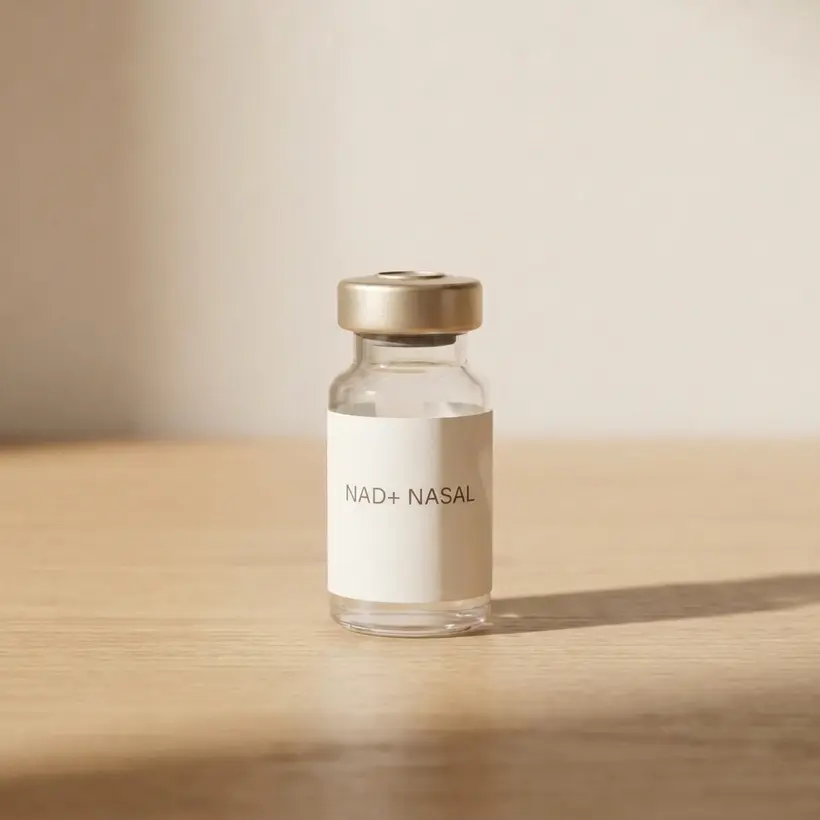
From the FormBlends catalog
NAD+ Nasal Spray
Direct NAD+ delivery via intranasal route for rapid cellular energy restoration · From $149/mo · compounded by a licensed 503A pharmacy, dispensed only after provider review.
Learn about NAD+ Nasal Spray →Table of Contents
- Why does the route of administration matter for NAD+?
- What is the mechanism and are the numbers real?
- Evidence ledger: what the data actually shows
- Can NAD+ actually get through nasal mucosa?
- What most pages get wrong about nasal NAD+
- Why does NAD+ degrade and what does that mean for your product?
- Honest head-to-head: nasal spray vs injection vs oral precursors
- How to evaluate a NAD+ product: label and COA literacy
- Side effects and safety by route
- Frequently Asked Questions
- Sources
Why Does the Route of Administration Matter for NAD+?
NAD+ (nicotinamide adenine dinucleotide) is a large, hydrophilic, multiply charged molecule at physiological pH. Its molecular weight is approximately 663 g/mol. These physical properties are not trivial. They determine whether the molecule survives transit through a membrane barrier intact, and whether systemic or CNS concentrations rise meaningfully after a given dose.
Oral NAD+ is almost entirely degraded in the gut before systemic absorption. That is why oral NAD+ itself is considered ineffective, and why precursors (NMN at roughly 334 g/mol, NR at roughly 255 g/mol) are used instead. They are smaller, enter cells via specific transporters (Slc12a8 for NMN in mouse intestine per Grozio et al. 2019; equilibrative nucleoside transporters for NR), and are converted intracellularly to NAD+.
The injection route bypasses gut and first-pass degradation entirely, which is why IV infusion is considered the gold standard for rapid NAD+ repletion in clinical settings. The nasal route is proposed as a middle ground: faster and easier than injection, with a theoretical direct CNS pathway via the olfactory nerve. The critical question is whether the molecule can actually traverse nasal mucosa intact.
What Is the Mechanism and Are the Numbers Real?
NAD+ functions as a cosubstrate for over 500 enzymatic reactions. The most clinically discussed targets are sirtuins (SIRT1 through SIRT7, deacylases that require NAD+ stoichiometrically) and PARP1/2 (poly-ADP-ribose polymerases, which consume NAD+ during DNA repair). CD38, a glycohydrolase expressed on immune and endothelial cells, is a major NAD+ consumer and is implicated in age-related NAD+ decline.
Whole-blood NAD+ declines with age. Massudi et al. (2012) reported significant age-related NAD+ decline in human tissue. Yoshino et al. (2021) showed that 250 mg oral NMN daily for 10 weeks elevated skeletal muscle NAD+ metabolites and improved muscle insulin sensitivity in postmenopausal women with prediabetes (n=25 per arm, randomized, placebo-controlled).
What those mechanisms do NOT prove: elevated circulating or tissue NAD+ via any route has not been shown in an adequately powered RCT to extend human lifespan, reverse aging, or treat any disease. The mechanism is real; the therapeutic extrapolation is not yet proven.
Evidence Ledger: What the Data Actually Shows
| Claim | Best evidence type | Effect direction | Confidence |
|---|---|---|---|
| IV NAD+ infusion raises whole-blood NAD+ | Human pharmacokinetic study (small, non-RCT) | Positive, dose-dependent | Moderate |
| Oral NR raises whole-blood NAD+ | Multiple human RCTs (Trammell et al. 2016; Dollerup et al. 2018) | Positive, consistent | High |
| Oral NMN raises muscle NAD+ metabolites | Human RCT (Yoshino et al. 2021, n=50) | Positive | Moderate |
| Intranasal NAD+ raises CNS or systemic NAD+ | No published human PK data; rodent intranasal models for other molecules only | Unknown | Very Low |
| Subcutaneous NAD+ raises systemic NAD+ | Clinical practice reports; no peer-reviewed human PK trial identified | Plausible but unquantified | Low |
| NAD+ elevation improves cognitive function in humans | Small pilot studies; no large RCT for any route | Mixed or inconclusive | Low |
| Olfactory pathway delivers large charged molecules to brain | Preclinical animal data; human data exists only for smaller molecules (insulin, some peptides) | Uncertain for NAD+ | Very Low |
| IV NAD+ causes flushing and chest tightness | Clinical observation; case series; mechanism (CD38 activation on mast cells proposed) | Consistent adverse signal | Moderate |
Can NAD+ Actually Get Through Nasal Mucosa?
Nasal drug delivery research consistently identifies molecular weight below roughly 1,000 g/mol as a prerequisite for passive diffusion across nasal epithelium. NAD+ at 663 g/mol technically falls within that window. However, two additional factors work against it:
Charge at physiological pH. NAD+ carries multiple negative charges from its phosphate backbone at physiological pH (around 7.4). Charged molecules have very low membrane permeability via passive diffusion. Lipophilicity (expressed as logP) strongly favors absorption; NAD+ is highly hydrophilic with a negative logP.
Enzymatic degradation at the mucosal surface. Nasal mucosa expresses ectonucleotidases including CD73 and related enzymes that can cleave the glycosidic bonds in nucleotides. NAD+ arriving at the nasal epithelium may be converted to nicotinamide mononucleotide (NMN) or nicotinamide before any systemic or neuronal uptake occurs. Whether that intermediate still reaches the CNS and converts back to NAD+ intracellularly is biologically plausible but not demonstrated in humans.
The olfactory bypass pathway is a real anatomical route studied with intranasal insulin (smaller, less charged) and some neuropeptides, and is supported by preclinical data. For NAD+ specifically, this pathway remains hypothetical. Proponents of intranasal NAD+ cite rodent models and the general principle; no published human study has confirmed direct olfactory-to-CNS NAD+ delivery.
What Most Pages Get Wrong About Nasal NAD+
A related omission: nasal spray vendors rarely disclose whether their product contains intact NAD+ or is actually delivering a precursor (NMN, NR, or nicotinamide). If enzymatic degradation at the nasal mucosa converts NAD+ to NMN before absorption, the user is effectively getting intranasal NMN, not intranasal NAD+. That may still have value, but it is not what is being marketed.
A second omission: concentration and volume matter. A typical nasal spray delivers 100 to 140 microliters per actuation. Most commercial NAD+ sprays contain concentrations that, even with generous absorption assumptions, deliver a fraction of the milligram quantities used in IV studies. This is rarely disclosed or compared on wellness pages.
Why Does NAD+ Degrade and What Does That Mean for Your Product?
NAD+ undergoes hydrolysis of the nicotinamide-ribose N-glycosidic bond in aqueous solution. The reaction is acid- and base-catalyzed, meaning it accelerates away from near-neutral pH. At physiological pH, degradation is relatively slow but measurable over days at room temperature. Higher temperatures, alkaline pH, and light exposure all accelerate the reaction.
The degradation product is nicotinamide (a vitamin B3 form) and ADP-ribose. Nicotinamide has some NAD+ precursor activity but also inhibits sirtuins at high concentrations, which is biochemically counterproductive if the goal is sirtuin activation.
Practical implications:
- A nasal spray or injectable solution sitting at room temperature for weeks is degrading. Yellow or brown discoloration in a normally clear solution is a reliable visual signal of significant NAD+ degradation.
- Lyophilized (freeze-dried) powder is substantially more stable than pre-reconstituted solution. Products sold pre-mixed in a spray bottle carry higher degradation risk than powder reconstituted just before use.
- Refrigeration at 2 to 8 degrees Celsius slows hydrolysis meaningfully. Freezing is appropriate for longer-term storage of unopened vials but introduces aggregation risk on repeat freeze-thaw cycles.
- The buffer pH of a nasal spray formulation directly affects both stability and mucosal tolerability. A vendor that does not disclose buffer pH is providing an incomplete product profile.
Honest Head-to-Head: Nasal Spray vs Injection vs Oral Precursors
| Factor | NAD+ Nasal Spray | IV/Subcutaneous NAD+ Injection | Oral NMN or NR |
|---|---|---|---|
| Human PK data confirming NAD+ elevation | None published | IV: yes (small studies). SubQ: minimal | Yes, multiple RCTs |
| Speed of action | Unknown; theoretically fast if CNS delivery works | IV: minutes. SubQ: hours | Hours to days for steady-state |
| CNS-selective delivery | Hypothesized; no human confirmation for NAD+ | No CNS selectivity; systemic elevation | No CNS selectivity; systemic elevation |
| Ease of use | High; self-administered | IV requires clinic. SubQ trainable at home | Highest; oral capsule |
| Approximate cost per dose | Low to moderate (spray) | IV: high (often hundreds per session). SubQ: moderate | Low to moderate |
| Side effect profile | Nasal irritation possible; systemic effects unknown | IV: flushing, nausea, chest tightness (rate-dependent). SubQ: local reaction | Mild GI effects; nausea at high doses; well-tolerated in trials |
| Regulatory status (US) | Research compound / compounded; not FDA approved | Compounded drug; not FDA approved | Dietary supplement (NR, NMN); not FDA approved as drug |
| Stability of product | High degradation risk if pre-mixed; no published stability data for commercial sprays | Moderate; compounding pharmacy controls critical | Relatively stable in capsule form; moisture is main enemy |
| Where nasal spray wins | Convenience, potential CNS targeting if hypothesis is validated | Nasal spray does not currently win on any evidence-supported metric | |
| Where nasal spray loses | Loses on human evidence, confirmed bioavailability, product stability, and cost-per-confirmed-effect vs oral NMN/NR | ||
How to Evaluate a NAD+ Product: Label and COA Literacy
What to look for on a nasal spray label or COA:
- Active ingredient identity and purity. The COA should confirm NAD+ (not just "NAD" or an unnamed precursor) by HPLC with a purity percentage. Anything below 98% should prompt questions about what the remaining fraction is.
- Concentration per actuation. Expressed in mg per spray. Without this, you cannot estimate dose. A spray delivering 0.1 mg per actuation is biologically very different from one delivering 5 mg per actuation.
- Buffer system and pH. Nasal formulations should be pH-matched to nasal mucosa (roughly 5.5 to 6.5). Alkaline pH damages mucosa and accelerates NAD+ degradation. If pH is not disclosed, ask the vendor.
- Preservative system. Multi-dose nasal sprays require a preservative. Benzalkonium chloride is common but ciliotoxic at higher concentrations. Preservative-free single-dose vials avoid this but raise cost.
- Manufacture date and expiration. Given NAD+ hydrolysis kinetics, a solution product approaching or past expiration is likely degraded. Prefer products with a manufacture date within the last few months.
For injectable NAD+ vials:
- Confirm the compounding pharmacy holds a valid 503A or 503B designation (US) or equivalent in your jurisdiction.
- Request a sterility test result and endotoxin (LAL) test on the COA. IV and IM routes carry infection and pyrogen risk that nasal and oral routes do not.
- Visual inspection before each use: clear, colorless solution expected. Any yellow tint, particulate matter, or cloudiness warrants discarding the vial.
Side Effects and Safety by Route
IV infusion: The most documented adverse events are infusion-rate-dependent: flushing, nausea, chest discomfort, and headache. These are commonly attributed to rapid NAD+ metabolism releasing nicotinamide and activating CD38 on circulating immune cells. Slowing the infusion rate typically resolves symptoms. Serious adverse events from IV NAD+ in wellness settings are not well-catalogued because most use occurs outside formal trial reporting systems.
Subcutaneous injection: Local pain, redness, and induration at injection site. Systemic effects are less acute than IV due to slower absorption. Sterility of the injection technique and compounding quality are the primary risk factors.
Nasal spray: Nasal irritation, rhinorrhea, and sneezing are plausible local effects. Systemic adverse events have not been studied. If meaningful systemic absorption occurs, the same nicotinamide-related flush profile seen with IV is theoretically possible but has not been reported in clinical literature because no controlled human trials exist.
Important note on drug interactions: NAD+ precursors at high doses can inhibit PARP, which is relevant if a user is also taking PARP-inhibitor chemotherapy agents. This interaction has not been studied for nasal or injectable NAD+ specifically.
Frequently Asked Questions
Sources
- Trammell SA, Schmidt MS, Weidemann BJ, et al. Nicotinamide riboside is uniquely and orally bioavailable in healthy humans. Nature Communications. 2016;7:12948. PMC5088096.
- Yoshino M, Yoshino J, Kayser BD, et al. Nicotinamide mononucleotide increases muscle insulin sensitivity in prediabetic women. Science. 2021;372(6547):1224-1229.
- Dollerup OL, Christensen B, Svart M, et al. A randomized placebo-controlled clinical trial of nicotinamide riboside in obese men. American Journal of Clinical Nutrition. 2018;108(2):215-223.
- Massudi H, Grant R, Braidy N, et al. Age-associated changes in oxidative stress and NAD+ metabolism in human tissue. PLoS ONE. 2012;7(7):e42357.
- Grozio A, Mills KF, Yoshino J, et al. Slc12a8 is a nicotinamide mononucleotide transporter. Nature Metabolism. 2019;1(1):47-57.
- Iliff JJ, Lee H, Yu M, et al. Brain-wide pathway for waste clearance captured by contrast-enhanced MRI. Journal of Clinical Investigation. 2013;123(3):1299-1309. (General CNS transport context.)
- Dhuria SV, Hanson LR, Frey WH 2nd. Intranasal delivery to the central nervous system: mechanisms and experimental considerations. Journal of Pharmaceutical Sciences. 2010;99(4):1654-1673.
- Rajman L, Chwalek K, Sinclair DA. Therapeutic potential of NAD-boosting molecules: the in vivo evidence. Cell Metabolism. 2018;27(3):529-547.
- Verdin E. NAD+ in aging, metabolism, and neurodegeneration. Science. 2015;350(6265):1208-1213.
- US FDA. Compounding laws and policies. FDA.gov. Accessed 2026-05-29.
Footer Disclaimers
Related peptide guides
Ready when you are
NAD+ Nasal Spray
Direct NAD+ delivery via intranasal route for rapid cellular energy restoration · From $149/mo · compounded by a licensed 503A pharmacy, dispensed only after provider review.
Learn about NAD+ Nasal Spray →