
Trust Signals
All claims graded by evidence type. No manufacturer relationships influence this comparison. Sources are listed at the bottom and limited to peer-reviewed literature, FDA labeling, and government pharmacopeial standards. Speculative claims are labeled as such throughout.
Key Takeaways
- Tesamorelin's 44-amino-acid sequence includes a trans-3-hexenoic acid modification that slows enzymatic degradation and is the structural basis for its superior pharmacokinetics versus sermorelin's 29-amino-acid fragment.
- Tesamorelin (Egrifta) has FDA approval backed by two Phase 3 RCTs in HIV lipodystrophy; sermorelin's original FDA approval for pediatric GHD was voluntarily withdrawn by the manufacturer in 2008, not revoked for safety reasons.
- Plasma half-lives differ modestly: roughly 10 to 20 minutes for sermorelin versus approximately 26 minutes for tesamorelin per the Egrifta prescribing information, but both require daily subcutaneous injection.
- Neither peptide survives oral administration due to gastrointestinal protease cleavage; any oral format claiming equivalence has no supporting pharmacokinetic evidence.
- Compounded sermorelin typically costs less than branded tesamorelin, but cost savings must be weighed against thinner adult evidence and compounding purity variability.
Which Should You Choose: Sermorelin or Tesamorelin?
Tesamorelin has stronger human RCT evidence, particularly for visceral fat reduction, and holds an FDA approval. Sermorelin is cheaper and more widely compounded but has a thinner adult evidence base. For most off-label wellness use, neither has proven benefit in pituitary-intact healthy adults. Choose based on evidence priority vs. cost, with a prescribing clinician overseeing labs.
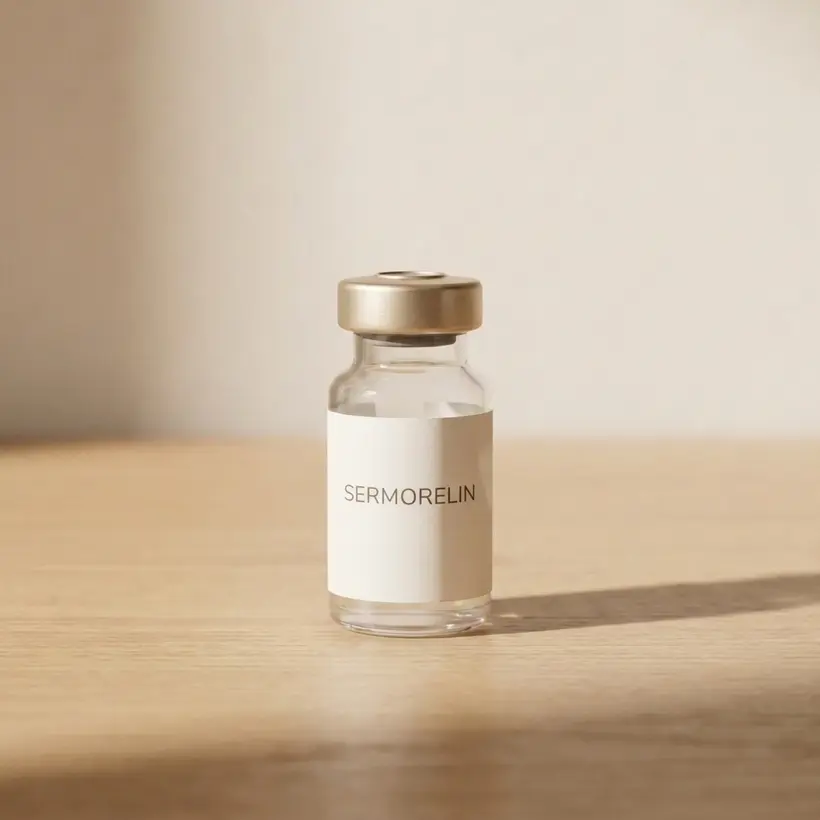
From the FormBlends catalog
Sermorelin
Bioidentical GHRH analog for natural growth hormone pulsatility · From $175/mo · compounded by a licensed 503A pharmacy, dispensed only after provider review.
View Sermorelin →Table of Contents
- What are sermorelin and tesamorelin, structurally?
- How do they work? Mechanism with specific numbers
- What does the evidence actually show? Evidence ledger
- Honest head-to-head comparison table
- What most pages get wrong about these peptides
- Why storage and formulation rules exist: the chemistry
- What are the real side effects and contraindications?
- How to read a COA or compounded product label
- Dosing and protocol: what real clinical use looks like
- Frequently asked questions
- Sources
What Are Sermorelin and Tesamorelin, Structurally?
Both are growth hormone-releasing hormone (GHRH) analogs that act on pituitary somatotroph cells. Endogenous human GHRH is a 44-amino-acid peptide. Sermorelin is the truncated N-terminal fragment spanning positions 1 through 29, which retains receptor-binding activity. This truncation was the basis of the original pharmaceutical product (Geref, manufactured by Serono), which was approved for GH stimulation testing and pediatric growth hormone deficiency.
Tesamorelin replicates the full 44-amino-acid sequence of human GHRH and adds a trans-3-hexenoic acid moiety conjugated to the N-terminus. This modification is not cosmetic. Dipeptidyl peptidase IV (DPP-IV) and other endopeptidases cleave native GHRH rapidly at the Ala2 position; the N-terminal modification sterically interferes with that cleavage, extending biological activity. This structural difference is the mechanistic justification for tesamorelin's longer half-life and its ability to achieve consistent IGF-1 elevation in the Phase 3 trials.
How Do They Work? Mechanism with Specific Numbers
Both peptides bind the GHRH receptor (GHRHR) on pituitary somatotrophs, a Gs-coupled receptor that activates adenylyl cyclase, raises intracellular cAMP, and triggers pulsatile GH secretion. The downstream effect: GH travels to the liver and peripheral tissues, stimulating IGF-1 synthesis. IGF-1 mediates most of the anabolic and lipolytic effects attributed to these compounds.
Pharmacokinetic specifics from available literature:
- Sermorelin: plasma half-life approximately 10 to 20 minutes in adult pharmacokinetic studies. Bioavailability after subcutaneous injection is not precisely established in the published literature for modern compounded formulations.
- Tesamorelin: the Egrifta (tesamorelin 2 mg) prescribing information reports a mean half-life of approximately 26 minutes following subcutaneous injection in HIV-positive adults. Peak plasma concentration (Cmax) in that population occurred at approximately 30 minutes post-injection.
What the mechanism does NOT prove: activating the GHRH receptor and raising GH pulse amplitude does not automatically translate into clinically meaningful changes in body composition, bone density, or aging markers in pituitary-intact healthy adults. Downstream effects depend on baseline somatotroph reserve, insulin sensitivity, sleep architecture (which also drives GH pulses), age-related pituitary downregulation, and concurrent IGF-1 levels. The mechanism is real; the magnitude of benefit in a healthy 45-year-old is not established by the mechanism alone.
What Does the Evidence Actually Show? Evidence Ledger
| Claim | Best Evidence Type | Peptide | Effect Direction | Confidence |
|---|---|---|---|---|
| Reduces trunk/visceral fat in HIV lipodystrophy | Phase 3 RCT (Falutz et al., NEJM 2007; Dhillon 2011 review of Egrifta trials) | Tesamorelin | Statistically significant reduction vs. placebo | High (within approved population) |
| Increases IGF-1 in adults with low GH | Small controlled trials and pharmacokinetic studies | Both | Modest increase; variable by baseline | Moderate |
| Stimulates GH secretion (pediatric GHD) | RCTs; basis of original FDA approval | Sermorelin | Positive GH stimulation | High (pediatric GHD only) |
| Body composition improvement in healthy adults | Small open-label studies, retrospective clinic data | Both | Modest or uncertain | Low |
| Anti-aging / longevity outcomes | Mechanism only; extrapolation from GH physiology | Both | Speculative | Very Low |
| Sleep quality improvement | Anecdotal / mechanism inference (GH pulses nocturnal) | Sermorelin (most claimed) | Unproven in RCTs | Very Low |
| Maintains pituitary axis feedback (vs. exogenous GH) | Physiological mechanism; endocrinology consensus | Both | Theoretically preserves feedback vs. direct GH | Moderate (mechanism) |
| Visceral fat reduction in non-HIV adults | Subgroup analyses, small trials | Tesamorelin | Directionally positive, not FDA-approved for this use | Low to Moderate |
Honest Head-to-Head Comparison Table
| Attribute | Sermorelin | Tesamorelin |
|---|---|---|
| Amino acid length | 29 (GHRH fragment 1-29) | 44 (full GHRH) + trans-3-hexenoic acid |
| FDA approval status | Discontinued (voluntarily, 2008); no current NDA | Approved (Egrifta, 2010) for HIV lipodystrophy |
| Plasma half-life | Approx. 10 to 20 minutes | Approx. 26 minutes (per Egrifta PI) |
| Strongest evidence base | Pediatric GHD (historical) | HIV-associated lipodystrophy (Phase 3 RCTs) |
| Cost (compounded) | Lower (widely compounded) | Higher (branded Egrifta very high; compounded less so) |
| Availability | 503A/503B compounding pharmacies | Branded Egrifta; also compounded off-label |
| Where it loses vs. the alternative | Weaker adult human RCT data; shorter sequence may mean less receptor occupancy duration | Higher cost; no advantage proven over sermorelin in healthy adults; off-label use extrapolated from narrow population |
| vs. exogenous recombinant GH (rHGH) | Both GHRH analogs lose on effect magnitude; rHGH directly raises GH levels without pituitary dependence | Same loss vs. rHGH; advantage is preservation of pulsatility and feedback, which may reduce side-effect burden (lower confidence) |
| Injection route | Subcutaneous, daily | Subcutaneous, daily |
| Oral bioavailability | None; protease-degraded | None; protease-degraded |
What Most Pages Get Wrong About These Peptides
The pituitary reserve problem. Most wellness content implies that anyone injecting sermorelin or tesamorelin will get a meaningful GH boost. This ignores the biological ceiling: both peptides require functional somatotroph cells to release GH. In adults with genuinely diminished pituitary reserve due to age-related somatotroph decline, the GH pulse amplitude response to GHRH stimulation is blunted. You are stimulating a gland that may already be producing near its remaining capacity. No GHRH analog creates new somatotrophs.
The compounding purity problem. Sermorelin is one of the most widely compounded peptides in U.S. wellness clinics. The 503A compounding framework allows it under a valid prescription, but compounded injectables are not FDA-tested for potency or sterility lot-by-lot. Independent testing of compounded peptides (reported by organizations like the Alliance for Pharmacy Compounding and covered in peer-reviewed pharmacy journals) has repeatedly found potency variation in compounded hormone products. A vial labeled 9 mg may contain significantly more or less. This is not a theoretical concern.
The FDA withdrawal misconception. Many pages imply sermorelin was "pulled" over safety issues. It was not. Serono discontinued Geref in 2008 as a business decision. The peptide is not banned; it is simply no longer manufactured as an approved drug product, which is precisely why it migrated to compounding channels.
Why Storage and Formulation Rules Exist: The Chemistry
Peptides degrade through three primary chemical pathways at room temperature or above: hydrolysis of peptide bonds (especially at aspartate-proline sequences), oxidation of methionine or cysteine residues, and physical aggregation where unfolded peptide chains associate into insoluble clusters that lose receptor-binding activity. All three accelerate with temperature.
For sermorelin and tesamorelin specifically, lyophilized (freeze-dried) powder is stable at room temperature for the duration specified by the manufacturer, but once reconstituted in bacteriostatic water, the peptide is in aqueous solution and all three degradation pathways accelerate. Refrigeration at 2 to 8 degrees Celsius slows hydrolysis kinetics substantially. The Egrifta prescribing information specifies use within 28 days of reconstitution when refrigerated. Compounded sermorelin vials should follow the beyond-use date (BUD) on the label, typically 30 days refrigerated.
Freezing a reconstituted vial is generally discouraged because freeze-thaw cycles promote aggregation even at sub-zero temperatures, and the bacteriostatic preservative (typically benzyl alcohol) does not protect against physical aggregation. A cloudy, particulate, or discolored reconstituted solution should be discarded; these are signs of aggregation or contamination, not minor cosmetic issues.
Why not mix with vitamin C or other antioxidant-containing solutions? Ascorbic acid is a reducing agent that can disrupt disulfide bonds in peptides and alter the redox environment of the solution, potentially degrading activity. This is the same chemistry behind the retinoid-vitamin-C separation rule in skincare, just applied to injectable peptides.
What Are the Real Side Effects and Contraindications?
Both peptides share the class-effect risk profile of elevated GH signaling:
- Fluid retention and edema (GH promotes sodium retention via IGF-1 effects on renal tubules)
- Arthralgias and myalgias, particularly at initiation
- Injection site reactions: erythema, pruritis, pain (reported in Egrifta RCT data)
- Worsening insulin resistance: GH is counter-regulatory to insulin; sustained elevation raises fasting glucose in susceptible individuals
- Carpal tunnel syndrome at higher or prolonged doses
Contraindications shared by both: active malignancy (GH and IGF-1 are mitogenic; stimulating GH in an oncology patient is contraindicated by mechanism and by regulatory guidance), pituitary tumor or structural hypothalamic disease, pregnancy. Tesamorelin's prescribing information additionally lists hypersensitivity to mannitol (an excipient in Egrifta).
The oncology contraindication is not speculative. IGF-1 receptor signaling drives proliferation in multiple tumor types. This is a hard stop, not a cautionary footnote.
How to Read a COA or Compounded Product Label
When evaluating a compounded sermorelin or tesamorelin product, a legitimate certificate of analysis (COA) should contain:
| COA Element | What to Look For | Red Flag |
|---|---|---|
| Identity confirmation | Mass spectrometry (MS) or LC-MS confirming molecular weight matches peptide sequence | HPLC only, no MS confirmation |
| Purity | Greater than 98% by HPLC for pharmaceutical-grade; stated as percentage | No purity percentage listed; "high purity" without a number |
| Endotoxin (LAL test) | Below USP limits for injectables (less than 5 EU/kg/hour for parenteral use) | No endotoxin test listed for an injectable product |
| Sterility | Sterility test passed for injectable preparations | Absent from COA for a subcutaneous injection product |
| Testing laboratory | Named, ISO-accredited third-party lab | "In-house testing only" or no lab name |
| Lot and date | Lot number matches vial label; date is recent | Generic COA not tied to a specific lot number |
On the vial label itself, confirm: peptide name and concentration (e.g., sermorelin 9 mg/3 mL), diluent type (bacteriostatic water with benzyl alcohol is standard), beyond-use date, compounding pharmacy name and state license number, prescribing physician name, and sterility statement. Absence of any of these on a vial received through a clinical channel is worth questioning before injection.
Dosing and Protocol: What Real Clinical Use Looks Like
The following reflects common off-label clinical practice; it is not a prescribing recommendation and requires physician oversight and baseline labs (fasting IGF-1, fasting glucose, HbA1c).
| Parameter | Sermorelin (off-label adult use) | Tesamorelin (approved dose / off-label) |
|---|---|---|
| Typical dose range | 200 to 500 mcg per injection, commonly discussed in clinic literature | 2 mg once daily (FDA-approved dose for lipodystrophy per Egrifta PI) |
| Injection timing | Before bed, to align with nocturnal GH pulse | Before bed per most clinical protocols; Egrifta PI specifies subcutaneous abdomen |
| Monitoring | IGF-1 at 3 months; fasting glucose at baseline and follow-up | Same; Egrifta PI recommends glucose monitoring given insulin resistance risk |
| Cycle length | Highly variable in practice; 3 to 6 months common off-label | Egrifta trials ran 26 to 52 weeks; fat returns after discontinuation in RCT data |
| Combination use | Often combined with GHRP-2 or ipamorelin in practice (additive GH release) | Same combinations used off-label; no RCT data for combination in healthy adults |
One finding worth noting from the tesamorelin RCTs: trunk fat reduction observed during the trial period partially or fully reversed after discontinuation. This means tesamorelin is a maintenance therapy in the approved population, not a one-time intervention. The same is likely true off-label, though long-term compliance data in healthy adults does not exist.
Frequently Asked Questions
Sermorelin is a 29-amino-acid fragment of endogenous GHRH with a short plasma half-life of roughly 10 to 20 minutes. Tesamorelin is the full 44-amino-acid GHRH analog stabilized with a trans-3-hexenoic acid modification that extends its activity and gives it FDA approval specifically for HIV-associated lipodystrophy. Tesamorelin has more robust human RCT evidence; sermorelin's modern evidence base is thinner.
Yes. Tesamorelin (brand name Egrifta) received FDA approval in 2010 for reducing excess abdominal fat in HIV-infected adults with lipodystrophy. Sermorelin held FDA approval for pediatric growth hormone deficiency but that approval was withdrawn in 2008 when the original manufacturer discontinued the product, not due to a safety finding.
Tesamorelin has the stronger evidence. Phase 3 RCTs in HIV lipodystrophy showed statistically significant trunk fat reduction. For general adult body composition outside that population the evidence is weaker for both peptides. Sermorelin's fat-reduction claims in healthy adults rest largely on small studies and inference from growth hormone physiology.
Sermorelin has a plasma half-life of approximately 10 to 20 minutes in published pharmacokinetic data. Tesamorelin's trans-3-hexenoic acid modification slows degradation; its half-life is approximately 26 minutes per the Egrifta prescribing information. Both require daily subcutaneous injection because neither survives oral administration.
No. Both are peptides that are cleaved by gastrointestinal proteases before meaningful systemic absorption occurs. They must be administered by subcutaneous injection. Any oral or sublingual product claiming equivalent bioavailability to injected sermorelin or tesamorelin lacks supporting pharmacokinetic evidence.
Both share the class-effect side-effect profile of elevated GH: fluid retention, arthralgias, injection site reactions, and potential worsening of insulin resistance. Tesamorelin's prescribing information from RCT data reports injection site erythema and limb pain as among the more common adverse events. Both are contraindicated in active malignancy because GH signaling can promote tumor growth.
Sermorelin compounded by a 503A pharmacy is typically less expensive than branded tesamorelin (Egrifta), which carries a high list price without insurance. Compounded tesamorelin is also available and costs less than branded, but compounded products carry their own purity and potency uncertainties. Cost advantage goes to compounded sermorelin, evidence advantage goes to tesamorelin.
Small studies have shown sermorelin raises GH pulse amplitude and can modestly increase IGF-1 in adults with low-normal GH, but effect sizes are variable and the adult evidence base is limited. The degree of IGF-1 elevation depends heavily on baseline pituitary reserve, which declines with age and varies widely between individuals.
Both should be refrigerated at 2 to 8 degrees Celsius after reconstitution. Peptide bond hydrolysis and aggregation accelerate significantly at room temperature. Egrifta's prescribing information specifies use within 28 days of reconstitution when refrigerated. Compounded sermorelin vials should follow the BUD assigned by the compounding pharmacy, typically 30 days refrigerated.
A credible certificate of analysis should include identity confirmation by HPLC or mass spectrometry, purity percentage (typically stated as greater than 98 percent for research-grade), endotoxin testing results, sterility testing if injectable, and the testing laboratory name. Absence of mass spectrometry confirmation is a red flag because HPLC alone cannot distinguish a peptide from a structurally similar impurity.
Yes, it is prescribed off-label for body composition and anti-aging purposes by some clinicians. This use is not FDA-approved and the evidence is extrapolated from the HIV lipodystrophy RCTs. Patients and prescribers should understand they are moving beyond the approved indication when using tesamorelin for general wellness.
Neither has strong RCT evidence in pituitary-intact healthy adults for fat loss or anti-aging outcomes. If you are working with a clinician and the goal is visceral fat reduction with the most evidence behind it, tesamorelin's RCT data is more persuasive. If cost is the primary constraint and you accept thinner evidence, compounded sermorelin is the more common off-label choice.
Sources
- Falutz J, Allas S, Blot K, et al. Metabolic effects of a growth hormone-releasing factor in patients with HIV. New England Journal of Medicine. 2007;357(23):2359-2370.
- Egrifta (tesamorelin for injection) Prescribing Information. Theratechnologies Inc. FDA-approved labeling. Accessible via FDA.gov Drugs@FDA.
- Dhillon S. Tesamorelin: a review of its use in the management of HIV-associated lipodystrophy. Drugs. 2011;71(8):1071-1091.
- Walker RF. Sermorelin: a better approach to management of adult-onset growth hormone insufficiency? Clinical Interventions in Aging. 2006;1(4):307-308.
- Ionescu M, Frohman LA. Pulsatile secretion of growth hormone (GH) persists during continuous stimulation by CJC-1295, a long-acting GH-releasing hormone analog. Journal of Clinical Endocrinology and Metabolism. 2006;91(12):4792-4797. (Contextual reference for GHRH analog pulsatility mechanisms.)
- U.S. Pharmacopeia. General Chapter 797: Pharmaceutical Compounding, Sterile Preparations. USP-NF. Relevant to BUD and sterility requirements for compounded injectables.
- FDA Drug Databases. Geref (sermorelin acetate) NDA 019764. Product discontinuation 2008. Accessible via FDA.gov.
- Vance ML, Mauras N. Growth hormone therapy in adults and children. New England Journal of Medicine. 1999;341(16):1206-1216. (Background on GH axis pharmacology.)
- Alliance for Pharmacy Compounding (A4PC). Compounding and complex drug products: policy and practice considerations. Position paper, referenced for compounding quality variability context.
Related peptide guides
Ready when you are
Sermorelin
Bioidentical GHRH analog for natural growth hormone pulsatility · From $175/mo · compounded by a licensed 503A pharmacy, dispensed only after provider review.
View Sermorelin →