
Trust Signals
Key Takeaways
- BPC-157, CJC-1295 plus Ipamorelin, Sermorelin, TB-500, and Epithalon are the five peptides appearing most consistently across U.S. functional medicine and longevity clinic formularies as of 2025.
- Sermorelin is the only GHRH analogue in this group that has held FDA approval (for pediatric GHD), giving it a cleaner regulatory and compounding pathway than CJC-1295.
- BPC-157 has zero completed human RCTs published in peer-reviewed journals; all efficacy claims rest on rodent data, making it the highest-promise but lowest-evidence peptide in routine clinic use.
- CJC-1295 with DAC has a published half-life of roughly 8 days due to albumin binding via the Drug Affinity Complex technology, but the extended exposure also means extended suppression of endogenous GH pulsatility if dosing is continuous.
- Endotoxin contamination (bacterial lipopolysaccharide) is the number-one quality-control failure mode for injectable peptides sourced outside licensed compounding pharmacies, and is the risk commodity pages never discuss.
What Are the Common Peptides Used in Functional Medicine Longevity Clinics?
Table of Contents
- The Core Peptide Roster at Longevity Clinics
- Evidence Ledger: What Each Claim Actually Rests On
- Mechanism With Numbers: What the Biology Actually Says
- What Most Pages Get Wrong About Longevity Peptides
- Chemistry Behind the Rules of Thumb
- Honest Head-to-Head: Peptides vs. Established Alternatives
- Operational and Label Literacy: Reading a COA and Reconstituting Correctly
- Regulatory Reality: What Is Legal, What Is Gray, What Is Not
- FAQ
- Sources
- Footer Disclaimers
The Core Peptide Roster at Longevity Clinics
Functional medicine and longevity clinics draw from a fairly consistent list, organized below by their primary mechanism category.
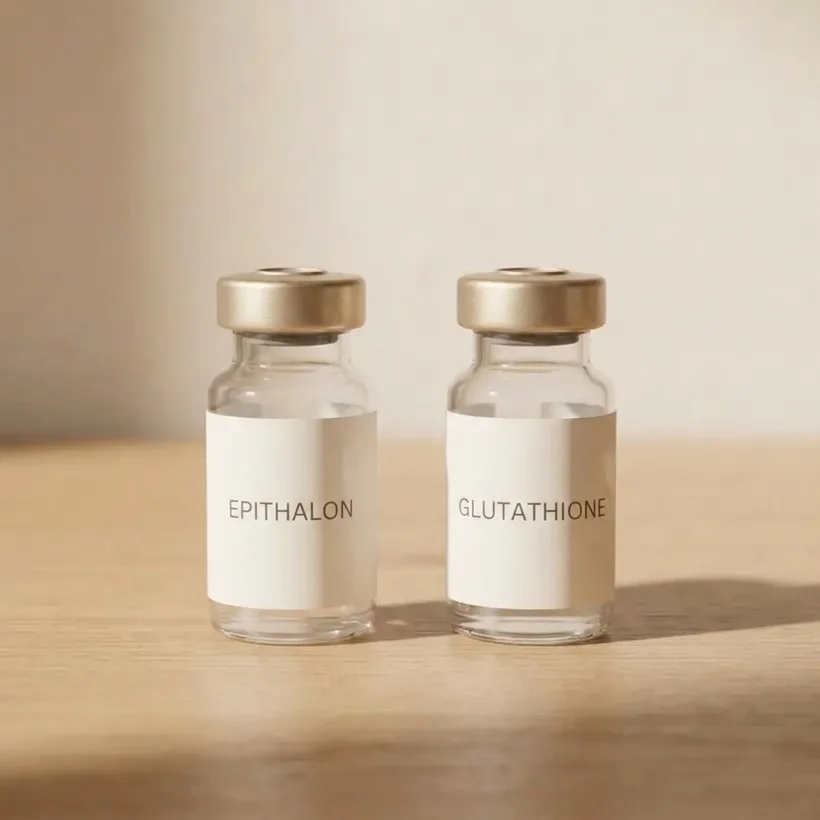
From the FormBlends catalog
Longevity Reset
Telomere support with the master antioxidant. · Bundle from $270 · provider-reviewed peptide bundle.
View Longevity Reset →| Category | Peptide(s) | Primary Claimed Use | Route |
|---|---|---|---|
| GI/tissue repair | BPC-157 | Gut lining repair, tendon/joint healing, systemic anti-inflammatory | SubQ or oral (off-label) |
| Tissue regeneration | TB-500 (Thymosin Beta-4 fragment) | Muscle and connective tissue recovery, angiogenesis | SubQ |
| GH secretagogues (GHRH) | Sermorelin, CJC-1295 with DAC, CJC-1295 without DAC (Mod GRF 1-29) | GH pulse amplification, body composition, sleep quality | SubQ |
| GH secretagogues (GHRP) | Ipamorelin, GHRP-2, GHRP-6 | GH release, appetite modulation (GHRP-6), recovery | SubQ |
| Anti-aging/epigenetic | Epithalon (Epitalon) | Telomerase activation, circadian regulation, lifespan extension | SubQ or IV |
| Metabolic/GLP-1 | Semaglutide, tirzepatide | Weight loss, metabolic health, cardiovascular risk reduction | SubQ |
| Immune/thymic | Thymosin Alpha-1 (TA1) | Immune modulation, post-illness recovery | SubQ |
Evidence Ledger: What Each Claim Actually Rests On
| Peptide | Claim | Best Evidence Type | Effect Direction | Confidence |
|---|---|---|---|---|
| BPC-157 | Tendon and gut healing | Animal (rodent RCTs, multiple labs) | Positive in animals | Very Low (no human RCT) |
| TB-500 fragment | Muscle/connective tissue repair | Animal, in vitro | Positive in animals | Very Low |
| Sermorelin | GH pulse increase, body composition | Human RCTs (small-to-moderate, e.g., Walker et al. studies in GHD adults) | Positive for GH/IGF-1 rise | Moderate for GH biomarker; Low for longevity outcomes |
| CJC-1295 with DAC | GH/IGF-1 elevation | Human pharmacokinetic studies (Teichman et al. 2006) | Positive for GH/IGF-1 rise | Moderate for GH biomarker; Low for clinical outcomes |
| Ipamorelin | Selective GH release | Animal, human PK studies | Positive; minimal cortisol effect | Moderate for selectivity claim; Low for clinical endpoints |
| Epithalon | Telomerase activation, lifespan | Cell culture, animal, limited human observational (Khavinson group) | Positive in cell/animal models | Very Low for human longevity |
| Semaglutide | Weight loss, CV risk reduction | Multiple large human RCTs (SUSTAIN, STEP, SELECT trials) | Strongly positive | High for weight and CV outcomes |
| Thymosin Alpha-1 | Immune enhancement | Human trials in hepatitis B/C, cancer (Thymalfasin, approved in some countries) | Positive for immune markers | Moderate for specific infections; Low for general longevity |
Mechanism With Numbers: What the Biology Actually Says
BPC-157 (Body Protection Compound-157) is a 15-amino-acid sequence (Gly-Glu-Pro-Pro-Pro-Gly-Lys-Pro-Ala-Asp-Asp-Ala-Gly-Leu-Val) derived from human gastric juice protein BPC. Animal studies published by Sikiric's group at Zagreb show accelerated tendon-to-bone healing and gut mucosal recovery. Proposed mechanisms include upregulation of growth hormone receptor expression in tendon fibroblasts, modulation of the nitric oxide system, and promotion of vascular tube formation in vitro. These are real mechanistic signals. What they do NOT prove is human clinical efficacy at any dose.
CJC-1295 with DAC extends the native 29-amino-acid GHRH(1-29) with a lysine-maleimide linker that covalently binds to albumin (the Drug Affinity Complex). Teichman et al. (2006, J Clin Endocrinol Metab) showed in a dose-escalation trial of 65 healthy adults that single doses produced mean IGF-1 increases of roughly 28 to 92% above baseline depending on dose, with an estimated half-life of 5.8 to 8.1 days. This is genuine human pharmacokinetic data. The caveat: IGF-1 elevation is a biomarker, not a longevity outcome, and chronic IGF-1 elevation carries theoretical cancer promotion risk that no long-term trial has resolved.
Ipamorelin is a pentapeptide GHRP that binds the ghrelin receptor (GHS-R1a) but, unlike GHRP-6, shows high selectivity for GH release with minimal stimulation of ACTH/cortisol or prolactin in animal and early human studies. The selectivity advantage is pharmacologically real but does not translate into proven clinical superiority over other GHRPs in any completed human outcome trial.
Epithalon (Ala-Glu-Asp-Gly, a tetrapeptide) has been shown in cell culture to stimulate telomerase activity in somatic cells. Khavinson's published work also reports circadian melatonin rhythm normalization in elderly subjects in small Russian cohort studies. Independent replication in large, randomized Western trials does not exist. Treating this as proven longevity therapy is unsupported.
What Most Pages Get Wrong About Longevity Peptides
The endotoxin problem. Every injectable peptide must be tested for bacterial endotoxin (lipopolysaccharide, LPS) before injection. The standard method is the Limulus Amebocyte Lysate (LAL) assay. Licensed 503A/503B compounding pharmacies are required to perform this testing. Research-grade peptide vendors (selling "for research only") are not held to this standard and frequently do not publish LAL results on their COAs. Injecting an endotoxin-contaminated peptide solution produces fever, inflammatory response, and, in worst cases, sepsis-like reactions. This is the quality-control failure that clinic brochures and most peptide blogs never mention.
Purity percentage does not mean what you think. A COA listing "99.2% purity" by HPLC tells you the peptide is 99.2% of the UV-absorbing material in the sample. It says nothing about endotoxin, heavy metals, residual solvents, or whether the sequence was synthesized correctly. Sequence verification by mass spectrometry is a separate test that reputable suppliers provide alongside HPLC.
The BPC-157 oral route debate. Some clinics offer oral BPC-157 capsules. The stability and absorption of BPC-157 in the GI tract are not well characterized in humans. Animal studies used oral dosing and showed effects, but rodent GI physiology differs from human. Whether meaningful plasma concentrations are achieved orally in humans is genuinely unknown.
Chemistry Behind the Rules of Thumb
Why store peptide vials cold and in the dark. Peptides are chains of amino acids linked by amide bonds. Heat (above roughly 25 degrees Celsius) and UV light accelerate two main degradation pathways: oxidation of methionine and tryptophan residues, and hydrolysis of peptide bonds at aspartate-proline sequences. Both produce truncated or oxidized species that may have reduced or absent biological activity or, less commonly, altered receptor binding that could produce off-target effects. Refrigeration (2 to 8 degrees Celsius) slows both reaction rates substantially. Lyophilized (freeze-dried) powder is stable far longer than reconstituted solution because removing water eliminates the aqueous medium needed for hydrolysis.
Why bacteriostatic water, not sterile water, for reconstitution. Bacteriostatic water contains 0.9% benzyl alcohol, a preservative that inhibits microbial growth. Once a vial is punctured and peptide dissolved, you are creating repeated-access conditions. Sterile water has no preservative and a punctured vial becomes a contamination risk within hours. The benzyl alcohol does not react with peptide bonds under normal conditions. However, benzyl alcohol can precipitate some peptides at higher concentrations; if you see cloudiness after reconstitution, that is a signal to check peptide-to-solvent compatibility, not to inject.
Why GH secretagogues are dosed at night. Endogenous GH is secreted in pulses, with the largest pulse occurring in slow-wave sleep roughly 60 to 90 minutes after sleep onset. GHRH analogues and GHRPs amplify existing pituitary GH release rather than overriding the pulsatile system. Injecting close to sleep onset synchronizes the pharmacological stimulus with the biological peak. Injecting at random times during the day raises GH transiently but disrupts the pulse architecture that normal physiological signaling depends on. This is mechanism-based reasoning, not marketing.
Honest Head-to-Head: Peptides vs. Established Alternatives
| Goal | Peptide Option | Established Alternative | Winner on Human RCT Evidence | Where Peptide Might Add Value |
|---|---|---|---|---|
| Body composition / GH axis | CJC-1295 plus Ipamorelin | Recombinant HGH (Somatropin) | Somatropin (approved, dosed human data) | Preserves pituitary pulsatility; lower cost; lower detected-on-doping risk |
| Metabolic health / weight loss | AOD-9604 | Semaglutide (Wegovy) | Semaglutide by wide margin (SELECT trial: 20% CV event reduction) | Peptide loses clearly here |
| Joint and tendon healing | BPC-157 | PRP injections, corticosteroids, physical therapy | PRP has small positive human RCT data; corticosteroids have strong short-term RCT data | BPC-157 animal data suggests different (possibly complementary) pathway; no human head-to-head exists |
| Immune modulation | Epithalon | Standard vaccinations, Thymalfasin (TA1, approved in some countries) | Thymalfasin has human trial data in HBV/HCV; Epithalon does not | Epithalon loses on evidence; theoretical telomerase angle is unique but unproven |
| Longevity / aging biomarkers | Peptide stack (BPC, Epithalon, GH peptides) | Metformin (TAME trial ongoing), lifestyle intervention | Lifestyle intervention has strongest human longevity outcome data of any intervention; metformin evidence accumulating | Peptides are exploratory; not a replacement for lifestyle or evidence-based pharmacology |
Operational and Label Literacy: Reading a COA and Reconstituting Correctly
What a legitimate COA for an injectable peptide must contain:
- HPLC purity result with chromatogram (not just a number)
- Mass spectrometry confirmation of correct molecular weight
- LAL endotoxin test result with a passing EU/mL threshold
- Residual solvent analysis (especially acetonitrile and TFA from synthesis)
- Lot number traceable to a specific synthesis batch
- Testing performed by an independent, named third-party lab
Reconstitution math example (CJC-1295, 2 mg vial): Add 2 mL of bacteriostatic water to a 2 mg vial. This yields 1 mg/mL, or 1000 mcg/mL. A typical clinical starting dose of 100 mcg equals 0.1 mL on an insulin syringe. Drawing to the 10-unit mark on a U-100 insulin syringe delivers 0.1 mL. Always verify your peptide concentration before drawing.
Signs a reconstituted peptide has degraded: visible particulate matter, cloudiness that does not clear with gentle rolling (not shaking), yellow or brown discoloration, or an off odor. Any of these is a discard signal. Do not inject a degraded solution. Particulates in particular can cause embolic or inflammatory injection site reactions.
Injection site rotation: SubQ peptide injections should rotate among abdominal, thigh, and (for those self-injecting) lateral deltoid sites. Injecting repeatedly into the same small area causes localized lipoatrophy and impairs absorption consistency over time.
Regulatory Reality: What Is Legal, What Is Gray, What Is Not
Sermorelin holds prior FDA approval and can be legally compounded by 503A pharmacies on a patient-specific prescription. BPC-157 was placed on the FDA's list of bulk substances that cannot be used in compounding in 2023, effectively removing it from legal 503A compounding in the United States, though enforcement is evolving and some clinics still dispense it. TB-500 (or the TB-4 fragment) has no FDA approval and no approved compounding pathway. CJC-1295 exists in a gray zone: not FDA-approved, but not explicitly prohibited for compounding as of this writing.
Semaglutide and tirzepatide, despite being FDA-approved branded products, were permitted for compounding during a period of drug shortage; shortage designations change, and compounded versions may lose legal status as branded supply normalizes.
Patients should ask their clinic for the specific legal basis for each compounded peptide they are prescribed. A responsible clinic can answer this question directly.
FAQ
What are the most common peptides used in functional medicine longevity clinics?
BPC-157, TB-500 (Thymosin Beta-4 fragment), CJC-1295, Ipamorelin, Sermorelin, NAD+ precursor peptides, and Epithalon are the most frequently prescribed. GLP-1 receptor agonists such as semaglutide are also now standard at many longevity practices.
Are peptides used in longevity clinics FDA-approved?
Most are not FDA-approved for the indications used in longevity practice. Some, like sermorelin, hold prior FDA approval. Others are dispensed as compounded medications under a prescriber's order. The regulatory status directly affects legal access and insurance coverage.
How does BPC-157 work mechanistically?
BPC-157 is a 15-amino-acid pentadecapeptide derived from a gastric juice protein. Animal studies show it upregulates growth hormone receptor expression in tendon fibroblasts, modulates nitric oxide pathways, and promotes angiogenesis. No human RCT data exists to date.
What is the difference between CJC-1295 and Sermorelin?
Both are GHRH analogues that stimulate pituitary GH release. Sermorelin is a 29-amino-acid fragment with a short half-life of roughly 10 to 20 minutes. CJC-1295 with DAC has a half-life extending to roughly 8 days due to albumin binding, allowing weekly dosing versus nightly injections for sermorelin.
Is Ipamorelin safer than older GHRPs like GHRP-6?
Ipamorelin is considered more selective because it stimulates GH release with minimal effect on cortisol and prolactin at clinical doses, unlike GHRP-6 which meaningfully raises both. This selectivity is supported by pharmacology studies but long-term human safety data remain limited.
What does Epithalon do and what is the evidence quality?
Epithalon is a synthetic tetrapeptide studied primarily by Vladimir Khavinson's group in Russia. It reportedly activates telomerase in cell culture and animal models. Evidence quality is very low for human longevity outcomes: no large, independent human RCTs have been published in peer-reviewed Western journals.
Can you mix peptides like BPC-157 and TB-500 together?
Many longevity clinics offer them as a combined reconstituted vial. There is no published pharmacokinetic data on the combination. The peptides are chemically compatible in solution but no clinical trial has studied their interaction. Combination use is empirical, not evidence-based.
How should peptide vials be stored and how long do they last once reconstituted?
Lyophilized peptides should be stored at 2 to 8 degrees Celsius and protected from light and repeated freeze-thaw cycles. Once reconstituted with bacteriostatic water, most peptides are considered stable for roughly 28 to 30 days refrigerated, though formal stability studies for most research peptides are not published.
What are the biggest red flags when evaluating a peptide supplier or clinic?
Red flags include: no certificate of analysis from an independent lab, no HPLC purity data, claims of 99%+ purity without documentation, no prescriber involvement for injectable peptides, and prices far below compounding pharmacy rates. Endotoxin testing (LAL test) is mandatory for injectables and often absent from research vendors.
How do peptides compare to HRT or conventional treatments for longevity goals?
For most longevity endpoints, conventional interventions such as testosterone replacement, metformin, or statin therapy have significantly stronger human RCT evidence than peptides. Peptides occupy an exploratory tier: mechanistically plausible, often promising in animal studies, but lacking the large-scale human outcome data that defines standard of care.
Is sermorelin covered by insurance for longevity use?
Sermorelin has FDA approval for pediatric growth hormone deficiency but is prescribed off-label for adult longevity and body composition goals. Insurance rarely covers off-label compounded sermorelin. Expect out-of-pocket costs that vary widely by compounding pharmacy and clinic.
What are the real risks of peptide therapy that clinics understate?
Risks include injection site reactions, unknown long-term effects from chronic GH stimulation (including theoretical IGF-1-related cancer promotion), endotoxin exposure from impure products, and drug interactions that are not studied. The gap between animal-model safety and human long-term safety is the central unresolved issue.
Sources
- Teichman SL, et al. Prolonged stimulation of growth hormone (GH) and insulin-like growth factor I secretion by CJC-1295, a long-acting analog of GH-releasing hormone, in healthy adults. J Clin Endocrinol Metab. 2006;91(3):799-805.
- Sikiric P, et al. Stable gastric pentadecapeptide BPC 157: novel therapy in gastrointestinal tract. Curr Pharm Des. 2011;17(16):1612-1632.
- Khavinson VKh, et al. Epithalon peptide induces telomerase activity and telomere elongation in human somatic cells. Bull Exp Biol Med. 2003;135(6):590-592.
- Laron Z. Insulin-like growth factor 1 (IGF-1): a growth hormone. Mol Pathol. 2001;54(5):311-316.
- Maheshwari HG, et al. Selective lack of growth hormone (GH) response to the GH-releasing peptide hexarelin in patients with GH-releasing hormone receptor deficiency. J Clin Endocrinol Metab. 1999;84(3):956-959.
- SELECT Trial Investigators (Lincoff AM, et al.). Semaglutide and cardiovascular outcomes in obesity without diabetes. N Engl J Med. 2023;389:2221-2232.
- FDA. 503A Compounding Pharmacies. Available at: fda.gov/drugs/human-drug-compounding/503a-compounding-pharmacies.
- FDA. Bulk Drug Substances That May Be Used in Compounding Under Section 503A. Federal Register notices, 2023.
- United States Pharmacopeia. Chapter 85: Bacterial Endotoxins Test. USP-NF.
- Raun K, et al. Ipamorelin, the first selective growth hormone secretagogue. Eur J Endocrinol. 1998;139(5):552-561.
Footer Disclaimers
Platform: FormBlends is an educational and informational platform. Content on this page does not constitute medical advice, a diagnosis, or a treatment recommendation. Consult a licensed healthcare provider before beginning any peptide protocol.
Research Compound or Compounded Medication: Several peptides discussed on this page are research compounds not approved by the FDA for human use, or are compounded medications dispensed only under a valid prescriber order. Regulatory status changes; verify current legal status in your jurisdiction before use.
Results: Individual outcomes vary. No results described or implied on this page are guaranteed. Many peptides discussed lack robust human clinical trial data supporting efficacy claims for longevity or anti-aging outcomes.
Trademark: All product names, brand names, and trademarks mentioned are the property of their respective owners. Their use does not imply endorsement or affiliation with FormBlends.
Related peptide guides
See your options in about 2 minutes
Take the free quiz and see what fits you. Quick, private, and no commitment to continue.
See my options →