Last October, a 54-year-old civil engineer named Mark in Scottsdale told his prescriber something that stuck with me. "I'd been running Epithalon cycles for two years, sleeping like I was 30 again, but my skin still looked 60. Adding GHK Cu was the first time I felt like the inside and the outside were moving in the same direction." His prescriber, noting no adverse labs over six months of combined use, described it as "the most logically paired stack I write." Neither of them claimed it reversed aging. But both felt it was doing something neither peptide accomplished alone.
That's the core pitch for combining these two peptides: they don't do the same thing. And in a field where most interventions target a single pathway, hitting two distinct mechanisms at once is, at minimum, an interesting bet.
What Each Peptide Actually Does
GHK Cu is the copper-bound form of a naturally occurring tripeptide (Gly-His-Lys) that circulates in human plasma. Your body already makes it. The problem is that plasma concentrations decline measurably with age. The research base, which spans both Western molecular biology and Russian bioregulatory work, links GHK Cu primarily to skin remodeling, wound repair, connective tissue maintenance, hair quality, and gene expression patterns associated with regeneration. It's a tissue-level peptide. What you see in the mirror is its domain.
Epithalon (also spelled Epitalon) is a synthetic tetrapeptide out of Khavinson's group at the Saint Petersburg Institute of Bioregulation and Gerontology. Its proposed mechanisms center on telomerase activation, pineal gland function, circadian rhythm normalization, and upregulation of antioxidant and stress-response gene pathways. The evidence base leans heavily Russian, with limited Western replication to date. It's an internal peptide. You feel it before you see it, mostly through sleep changes and a hard-to-quantify sense of resilience.
Here's the thing: these two don't compete. They don't even overlap.
Why the Combination Makes Mechanical Sense
Biological aging isn't one broken thing. It's dozens of broken things happening in parallel, like a house deteriorating because the roof leaks, the foundation cracks, and the wiring frays all at the same time. Fixing the roof doesn't stop the foundation problem. That's the basic argument for multi-peptide stacking in longevity protocols.
GHK Cu works at the connective tissue and skin level, addressing what researchers sometimes call the "visible aging phenotype." Epithalon targets deeper cellular machinery: telomere attrition, circadian disruption, oxidative stress gene regulation. The complementarity is almost too clean. One handles the exterior, the other the interior. One is dosed continuously over weeks, the other in short discrete cycles.
That non-overlapping dosing structure matters practically, too. You don't have to coordinate injection timing within the day or worry about one peptide interfering with the other's absorption window.
I should be honest about the limitation, though: no controlled trial has ever tested this specific combination. The rationale is mechanistic plausibility, not proven additive benefit. That's a real gap. Plausibility and proof are different animals.
Three Common Protocol Patterns
Most practitioners who prescribe this stack use one of three approaches.
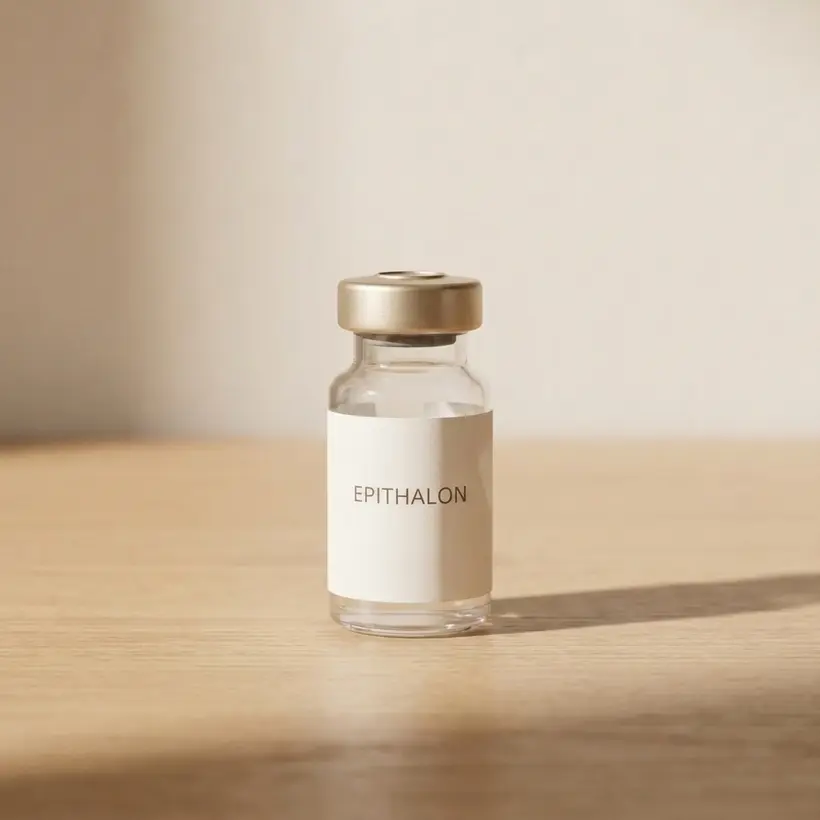
From the FormBlends catalog
Epithalon (Epitalon)
The telomerase activator for cellular youth · From $199/mo · compounded by a licensed 503A pharmacy, dispensed only after provider review.
View Epithalon (Epitalon) →Pattern 1: Continuous GHK Cu with a cycled Epithalon window. This is the most common setup. GHK Cu runs at 1 to 3 mg subcutaneous daily for 8 to 12 weeks. Somewhere in the first or middle portion of that window, a 10 to 20 day Epithalon cycle is layered in at 5 to 10 mg daily. The GHK Cu provides a steady tissue-repair backdrop while Epithalon does its shorter, more concentrated work.
Pattern 2: Synchronized cycling. Both peptides start and stop together over a defined 20 to 30 day window. Simpler to manage. Potentially easier for patients who don't want to think about staggered start dates.
Pattern 3: Sequential. A full GHK Cu course runs first, then an Epithalon cycle begins after GHK Cu is complete. Less common. The thinking here is to let each peptide work without any theoretical interaction, though no evidence suggests they interfere with each other when co-administered.
Most longevity-focused patients run one or two of these stack cycles per year rather than running peptides continuously. Think of it like seasonal maintenance rather than daily medication.
The Practical Stuff: Injections, Mixing, Storage
Both peptides come lyophilized (freeze-dried powder) and get reconstituted with bacteriostatic water before use. The dispensing pharmacy provides specific reconstitution instructions, and those instructions vary by concentration and vial size, so follow what comes with your product.
Both are administered subcutaneously. Standard injection site rotation applies: abdominal subcutaneous tissue, thigh, upper outer arm. Rotate to avoid localized irritation.
One important note: do not mix these two in the same syringe. It's not standard practice, and no pharmacy I'm aware of recommends it. Two separate injections. Takes an extra minute. Worth the caution.
Reconstituted solutions go in the refrigerator. Lyophilized powder is more shelf-stable but still benefits from cool, dark storage.
What People Report Feeling
Subjective reports from this combination tend to follow a predictable pattern, though individual variation is significant.
GHK Cu effects typically build gradually across the course. Patients describe improved skin texture, changes in hair quality, and a general sense of tissue recovery. These aren't dramatic overnight changes. More like noticing after four or five weeks that something looks different.
Epithalon effects tend to show up faster and more distinctly within the cycle window. The most consistent report is improved sleep quality, sometimes within the first week. Some patients describe a subjective stress resilience that's difficult to quantify but easy to notice when it's present.
When asked whether the combination feels synergistic, most patients describe it as additive. Two separate benefits layered on top of each other, not some emergent third effect. Which, given the non-overlapping mechanisms, is exactly what you'd predict.
Where This Falls Apart (or at Least Gets Complicated)
Active cancer or recent cancer history. Epithalon's proposed telomerase activation is the specific concern here. Telomerase is a double-edged enzyme: it maintains telomere length in healthy cells but could theoretically support malignant cell proliferation. The data isn't conclusive in either direction, but the theoretical risk makes most prescribers cautious. If you have active malignancy, this stack is not the place to start.
Active autoimmune disease. GHK Cu has immunomodulatory properties. Epithalon influences broader gene expression patterns. In a patient with active autoimmune flares, the interaction between immune modulation and gene expression changes deserves careful prescriber evaluation.
Pregnancy and lactation. Neither peptide. Full stop.
Expectation management. If someone wants a guarantee that this stack will extend lifespan or reverse measurable biomarkers of aging, the data simply isn't there. This is a research-informed longevity protocol, not an FDA-approved treatment. The distinction matters, and patients who can't sit with that uncertainty may be better served by interventions with stronger evidence bases (exercise, sleep optimization, metabolic health).
How It Compares to Other Longevity Stacks
The GHK Cu and Epithalon pairing is one of several combination patterns in peptide-based longevity protocols. A few reference points:
Epithalon plus Thymalin is a classic Russian bioregulator pairing, combining pineal-derived and thymus-derived peptides. More common in Russian gerontology practice than in Western clinics.
GHK Cu plus Thymosin Beta 4 skews toward tissue repair and regeneration rather than longevity per se. Better thought of as a healing stack than an aging stack.
GHK Cu, Epithalon, and BPC 157 broadens the approach by adding gut and tissue healing signaling to the longevity base. More moving parts, more variables, less clarity on what's doing what.
All of these are described patterns in clinical use. None are validated in the way a Phase III drug trial validates a therapy.
Frequently Asked Questions
Why combine GHK Cu and Epithalon?
They target entirely different aspects of biological aging. GHK Cu works on connective tissue, skin, and visible aging features. Epithalon targets proposed telomere maintenance and circadian function. The non-overlapping mechanisms are the whole point of the combination.
Can I take them in the same syringe?
No. Mixing in the same syringe is not standard practice, and no dispensing pharmacy I've seen recommends it. Administer them as separate subcutaneous injections.
How often should I run this stack?
One or two cycles per year is the most common pattern among longevity-focused patients. More frequent cycling has been described but lacks strong evidence support.
How long until I notice effects?
Epithalon-associated effects (primarily sleep quality) often emerge within the first one to two weeks of a cycle. GHK Cu effects develop more gradually, typically becoming noticeable several weeks into a continuous course.
Are there safety concerns with the combination?
The primary theoretical concern involves Epithalon's proposed telomerase activation in patients with cancer history, and GHK Cu's immunomodulatory profile in patients with active autoimmune conditions. Long-term safety data across multiple years of combined use does not exist. These are important unknowns.
Do I need a prescription?
Yes. Compounded peptides require a valid prescription from a licensed prescriber, filled by a licensed compounding pharmacy.
Is there clinical trial data on this specific combination?
No. The combination rationale is based on mechanistic complementarity of the individual peptides, not on direct combination trial evidence.
Related Reading
- Epithalon Hub
- GHK Cu Hub
- Epithalon Dosage Protocols
- Epithalon Benefits and Telomere Research
- Best Peptides for Healing and Recovery
Compliance Footer
Neither GHK Cu nor Epithalon is approved by the FDA for the prevention, mitigation, treatment, or cure of any disease. Compounded peptides are prepared by licensed compounding pharmacies for individual patients under a valid prescription from a licensed prescriber. Information on this page is educational and is not medical advice. Individual results vary.
---
Not FDA-approved. Compounded peptides are prepared by licensed 503A pharmacies for individual patients based on a prescriber's clinical judgment. FormBlends is not a medical practice. Individual results vary. Consult a licensed clinician before starting any peptide therapy.
Ready when you are
Epithalon (Epitalon)
The telomerase activator for cellular youth · From $199/mo · compounded by a licensed 503A pharmacy, dispensed only after provider review.
View Epithalon (Epitalon) →