Last October, a 47-year-old engineer named Brian in Austin told his prescriber he'd been sleeping "like a college kid again" after nine days on ipamorelin plus CJC-1295. His IGF-1 had climbed from 118 ng/mL at baseline to 212 ng/mL at the eight-week mark. "The sleep was the first thing," he said. "Body comp didn't start moving until week six or seven, but the sleep was almost immediate." Brian's experience is one data point, not proof. But it tracks with what the pharmacology predicts and what compounding clinics report over and over: sleep comes first, everything else follows.
Ipamorelin is a synthetic pentapeptide (Aib-His-D-2-Nal-D-Phe-Lys-NH2) that binds the ghrelin receptor on the anterior pituitary and triggers growth hormone release. It belongs to the growth hormone releasing peptide (GHRP) family, but its claim to relevance in 2026 isn't just that it works. Older GHRPs work too. The reason ipamorelin dominates modern compounding practice is that it works cleanly, stimulating GH without dragging cortisol, prolactin, or ACTH along for the ride. That selectivity is the whole story.
A few things to establish upfront: ipamorelin is not FDA-approved as a drug in the United States. It is prepared by licensed 503A compounding pharmacies as a prescription for an individual patient, based on a prescriber's clinical judgment. Typical subcutaneous dosing is 200 to 300 micrograms, one to three times daily, most commonly at bedtime and post-workout. And in almost every modern protocol, it's paired with a GHRH analog, usually CJC-1295 without DAC. We'll get to why.
The Selectivity Advantage (and Why It Matters More Than Potency)
Raun et al. first described ipamorelin in 1998 in the European Journal of Endocrinology, and the paper's key finding wasn't about raw GH output. It was about what ipamorelin didn't do. Earlier GHRPs like GHRP-6 and hexarelin could push growth hormone hard, but they also spiked cortisol and prolactin. That made them difficult to dose aggressively or use long-term.
Think of it like a volume knob versus a mixing board. GHRP-6 turned up everything at once. Ipamorelin lets you raise the GH channel without blowing out the cortisol and prolactin tracks. Sondergaard E et al. confirmed this in human subjects in 2003: ipamorelin produced dose-dependent GH release with no significant cortisol or prolactin spike.
Here's the thing: "selective" doesn't mean "zero effect on cortisol, ever, at any dose." The selectivity is relative. At standard clinical doses, the cortisol and prolactin elevations are minimal and clinically inconsequential. At very high or sustained doses, some effect may appear. But compared to the older GHRPs, the difference is large enough to change how the peptide can actually be used in practice.
The practical upshot: ipamorelin can be dosed two or three times a day, cycled for months, without the cortisol-related fatigue, mood disruption, or prolactin issues that limited GHRP-2 and GHRP-6 protocols.
How It Works at the Receptor Level
Ipamorelin binds the ghrelin receptor (GHS-R1a) on somatotroph cells in the anterior pituitary. Receptor activation triggers intracellular calcium signaling and amplifies GH release. This is mechanistically distinct from the GHRH pathway. GHRH analogs (sermorelin, CJC-1295, tesamorelin) bind a completely different receptor, the GHRH receptor. The two systems operate in parallel.
The GHRH pathway provides the primary "go" signal. The ghrelin/GHRP pathway amplifies that signal and also suppresses somatostatin, which acts as the GH-release brake. When you activate only one of these two pathways, you get a partial response. When you activate both simultaneously, you get a response that's substantially larger than the sum of the two individual effects. This is genuine pharmacological fit, not just additive benefit.
That fit is why nobody serious about outcomes prescribes ipamorelin alone anymore.
The CJC-1295 Stack: Why It's the Default Protocol
This is the single most important practical point in this entire article.
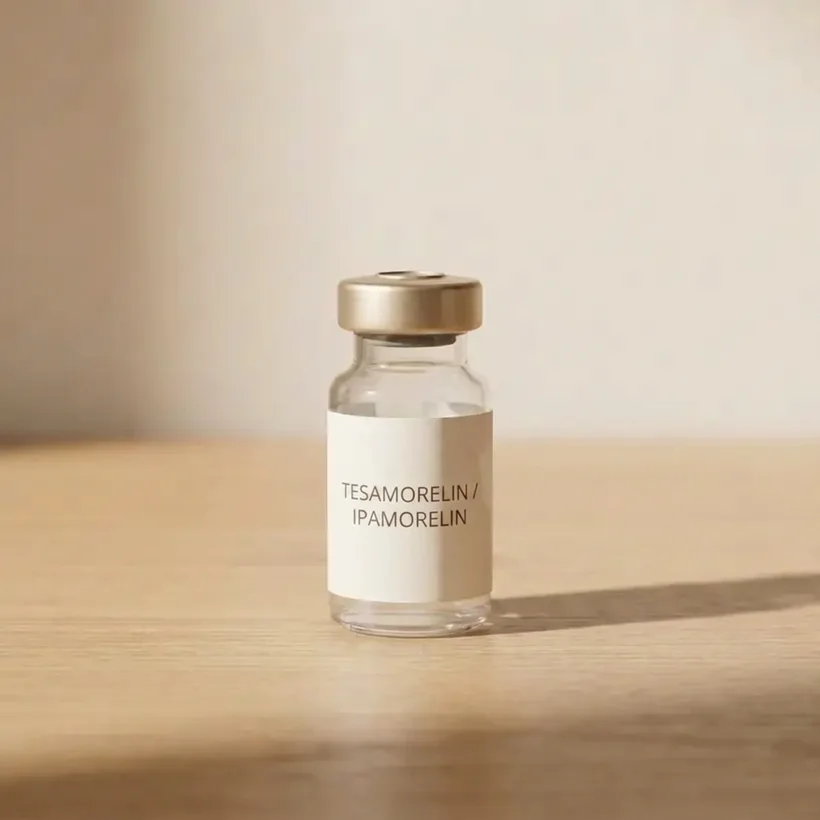
From the FormBlends catalog
Tesamorelin / Ipamorelin Blend
Growth-hormone pathway support in one blend · From $299/mo · compounded by a licensed 503A pharmacy, dispensed only after provider review.
View Tesamorelin / Ipamorelin Blend →Read the full CJC-1295 / ipamorelin stack protocol guide.
The standard protocol pairs ipamorelin (the GHRP, ghrelin side) with CJC-1295 without DAC (the GHRH analog side). The two peptides are frequently co-compounded in a single vial, so you're drawing one injection, not two. The typical combination dose is CJC-1295 (no-DAC) at 100 to 200 mcg plus ipamorelin at 200 to 300 mcg, administered together subcutaneously.
Why CJC-1295 (no-DAC) over sermorelin as the GHRH analog? Honestly, the pharmacology is similar. Both are short-half-life GHRH analogs. Sermorelin plus ipamorelin is a mechanistically valid stack. But CJC-1295 (no-DAC) has become the dominant GHRH analog in stacked compounding protocols, partly because of accumulated clinical familiarity and partly because of dosing convenience. The sermorelin-plus-ipamorelin combination exists but is less commonly prescribed in current practice.
Could you use ipamorelin alone? Sure. It will release some GH. But the magnitude of response is meaningfully smaller than the combined protocol. If you're going through the trouble of subcutaneous injections, prescriber visits, and lab monitoring, getting a partial response by omitting the synergistic component seems like poor strategy.
What the Research Actually Supports
I'll be direct about where the evidence is strong and where it gets thin.
GH and IGF-1 elevation. This is solid. Raun K et al. 1998 demonstrated dose-dependent GH release with corresponding IGF-1 elevation in animal models. Sondergaard E et al. 2003 confirmed GH release in humans with the expected selective profile. The basic pharmacology is well characterized.
Selectivity over older GHRPs. Also solid. Multiple studies have compared cortisol and prolactin responses. Ipamorelin consistently produces less elevation than GHRP-2, GHRP-6, and hexarelin.
Body composition in adults. Here's where the evidence gets thinner. Long-term human randomized controlled trials looking specifically at ipamorelin (alone or in the CJC-1295 stack) for body composition in aging adults are limited. Clinical use in this area is driven by combining the direct pharmacology data (ipamorelin reliably raises GH and IGF-1) with the broader GH-axis literature (elevated GH and IGF-1 in the physiological range support lean mass, fat metabolism, recovery) plus accumulated prescriber and compounding-pharmacy experience.
Bone metabolism. Some animal evidence suggests positive effects on bone parameters through GH-axis activation, but human data is sparse.
The boring truth is that ipamorelin's mechanistic profile is well proven in humans. Its long-term clinical outcomes for anti-aging and body composition goals rest partly on extrapolation from the GH-axis literature and partly on clinical experience. That's the honest framing, and anyone telling you otherwise is selling something.
Dosing Protocols in Practice
Standard dose: 200 to 300 mcg subcutaneous per injection.
Frequency: One to three times daily. The most common pattern is twice daily (morning and bedtime, or pre/post-workout and bedtime). Three times daily (morning fasted, around training, and bedtime) is occasionally used for more aggressive GH-pulse stimulation.
Timing logic:
- Bedtime dose amplifies the natural nocturnal GH pulse. This is non-negotiable in virtually every protocol.
- Pre- or post-workout dose aligns GH release with the recovery window.
- Morning fasted dose adds a third pulse if dosing three times daily.
When combined with CJC-1295 (no-DAC): 100 to 200 mcg CJC-1295 plus 200 to 300 mcg ipamorelin, drawn from a co-compounded vial, same injection. Same schedule.
Cycling: The common approach is 5 days on, 2 days off, for 8 to 12 week cycles. Some prescribers use continuous daily dosing with re-evaluation at 12 weeks. There's no consensus on which cycling pattern is superior; the off-days are thought to prevent receptor desensitization, though direct evidence for this in the context of ipamorelin specifically is limited.
Injection sites: Subcutaneous abdominal fat, anterior thigh, or upper outer arm. Rotate.
Your specific protocol is determined by your prescriber.
Side Effects: What Actually Happens
Ipamorelin has one of the cleanest side-effect profiles in the GH-axis peptide category. That's not marketing; it's what the pharmacology predicts and what clinics report.
Common (mild, usually transient):
- Brief redness or warmth at the injection site
- Mild headache, especially during the first week
- Facial flushing shortly after injection
- Mild appetite increase (ghrelin receptor activity; usually inconsequential)
- Vivid dreams (often the earliest subjective sign that the peptide is working)
Less common:
- Water retention
- Joint stiffness
- IGF-1 climbing above the reference range (dose reduction indicated)
- Mild dizziness right after injection
- Transient fatigue
Rare:
- Significant edema
- Persistent headache
- Allergic reaction
The appetite effect deserves its own note. Because ipamorelin acts at the ghrelin receptor (ghrelin is the body's hunger hormone), some appetite increase is expected. For most patients it's mild enough to ignore. For someone on an aggressive caloric deficit, it's worth knowing about. The effect is substantially milder than GHRP-6, which could make people ravenous within 20 minutes of injection.
The absence of meaningful cortisol or prolactin elevation is the defining feature. Patients on long-term ipamorelin protocols generally don't develop the elevated cortisol or hyperprolactinemia that limited older GHRPs.
How Ipamorelin Compares to Sermorelin and Hexarelin
These three get grouped together constantly online, but they're mechanistically different peptides.
Sermorelin is a GHRH analog. It binds the GHRH receptor, not the ghrelin receptor. Short half-life. Preserves the natural pulsatile GH pattern. Lower potency per injection. Different mechanism entirely from ipamorelin. Sermorelin is used as monotherapy for general GH-axis support or as the GHRH component of a stack.
Ipamorelin is a GHRP. Ghrelin receptor agonist. Selective. Usually combined with a GHRH analog (CJC-1295 no-DAC) rather than used alone.
Hexarelin is an older GHRP. More potent for raw GH output than ipamorelin, but it comes with significant cortisol and prolactin elevation, especially at higher doses or with prolonged use. It's been largely displaced by ipamorelin in modern practice. More potent on paper, worse in practice. The selectivity advantage of ipamorelin matters more than brute-force GH output for most patients.
Read the full sermorelin vs ipamorelin comparison.
Where this falls apart for people researching online is the assumption that these are interchangeable. They're not. Sermorelin and ipamorelin act on different receptors. They complement each other in a stack. They don't substitute for each other.
What to Expect and When
For patients on the CJC-1295 (no-DAC) plus ipamorelin stack:
Weeks 1 to 2. Sleep improvement is the earliest signal. Deeper sleep, easier time falling asleep, vivid dreams. Mild appetite uptick. Athletes and active patients sometimes notice faster recovery from training sessions.
Weeks 3 to 6. Sleep benefits solidify. Subjective recovery improvement becomes consistent. Some measurable body composition change in active patients who are also dialing in nutrition and training.
Weeks 8 to 12. The clearest body composition changes for responders. Some patients report improved skin quality. Energy and recovery are consistently better. This is the standard window for a repeat IGF-1 draw to check levels.
Weeks 12 to 24. Sustained benefit window. Most patients and prescribers re-evaluate at this point: continue at current dose, taper, switch protocols, or stop.
Non-responders exist. A meaningful minority of patients don't perceive significant benefit. Options at that point include dose escalation, adjusting timing or injection schedule, switching to a different GH-axis protocol (such as tesamorelin), or simply discontinuing.
Cost
Typical FormBlends cash pricing for compounded ipamorelin:
- Ipamorelin alone, 5 mg vial: $80 to $120
- Ipamorelin alone, 10 mg vial: $130 to $180
- CJC-1295 (no-DAC) / ipamorelin combination vial: $140 to $220 per month at standard dosing
- CJC-1295 (no-DAC) / ipamorelin pre-filled multi-dose preparation: variable
Insurance does not typically cover compounded ipamorelin. HSA and FSA card payment is generally accepted.
Frequently Asked Questions
Is ipamorelin the same as sermorelin? No. Ipamorelin is a GHRP (ghrelin receptor agonist). Sermorelin is a GHRH analog (GHRH receptor agonist). Different receptor, different mechanism, different clinical use. They're complementary, not interchangeable.
Why is ipamorelin almost always paired with CJC-1295? The GHRH pathway and the ghrelin/GHRP pathway are synergistic. Combining a GHRH analog (CJC-1295) with a GHRP (ipamorelin) produces a GH response larger than either alone. This is the pharmacological basis for the standard stack.
Can I use ipamorelin alone? Yes, but the more common clinical pattern is the stack. Ipamorelin alone produces GH release, but the magnitude is smaller than the combined protocol.
How long until I see body composition changes? Sleep changes within 1 to 2 weeks. Body composition changes typically measurable at 8 to 12 weeks. Full effects over 4 to 6 months.
Will ipamorelin make me hungrier? Mild appetite increase is common because ipamorelin acts at the ghrelin receptor. The effect is usually mild and manageable. Older GHRPs like GHRP-6 had much stronger appetite effects.
Does ipamorelin raise cortisol or prolactin? The defining characteristic of ipamorelin is its selectivity: minimal cortisol, prolactin, and ACTH elevation at standard doses. Older GHRPs elevated these substantially; ipamorelin does not, per published clinical studies.
Will ipamorelin show up on a drug test? Yes. Ipamorelin and other GHRPs are on the WADA Prohibited List under category S2. Competitive athletes subject to anti-doping testing should not use ipamorelin.
Can I take ipamorelin with BPC-157 or TB-500? Yes, ipamorelin is commonly combined with tissue-repair peptides like BPC-157 or TB-500. Discuss with your prescriber.
Do I need lab work? Baseline IGF-1 and a fasting metabolic panel are standard. Repeat IGF-1 at 8 to 12 weeks. The target is the upper half of the age-adjusted reference range, not above the upper limit.
Can women take ipamorelin? Yes. Ipamorelin is widely used in female patients. Pregnancy and breastfeeding are contraindications.
Is the CJC-1295 / ipamorelin combination dose I see online accurate? Standard compounded stacks pair approximately 100 to 200 mcg CJC-1295 (no-DAC) with 200 to 300 mcg ipamorelin per injection. Your specific dose is determined by your prescriber based on your labs and clinical picture.
How to Get Ipamorelin Through FormBlends
- Complete the digital intake form.
- Submit existing labs or have the prescriber order baseline IGF-1 and metabolic panel.
- Book the telehealth consult.
- Discuss whether ipamorelin alone, ipamorelin plus CJC-1295, or another GH-axis protocol fits your goals.
- If clinically appropriate, the prescription is written.
- The compounded preparation ships from a licensed 503A compounding pharmacy.
- Follow-up at 4 and 8 weeks, repeat IGF-1 at 8 to 12 weeks.
See ipamorelin compounded preparation pricing and order.
See the CJC-1295 + ipamorelin combination preparation.
Back to peptide therapy overview.
---
Disclaimer: Compounded ipamorelin is not an FDA-approved drug. It is a prescription medication prepared by a licensed 503A compounding pharmacy for an individual patient based on a prescriber's clinical judgment. Research suggests potential benefits for GH-axis support in adults with age-related decline; individual results vary. Ipamorelin is contraindicated in pregnancy, breastfeeding, active malignancy, and severe untreated metabolic disease. Side effects can occur. Information on this page is for educational purposes and is not medical advice. Do not self-administer peptides obtained from unregulated sources.
Ready when you are
Tesamorelin / Ipamorelin Blend
Growth-hormone pathway support in one blend · From $299/mo · compounded by a licensed 503A pharmacy, dispensed only after provider review.
View Tesamorelin / Ipamorelin Blend →