Key Takeaway
Poor sleep wrecks everything. Your energy, recovery, mood, body composition, and cognitive function all depend on quality rest. If you have tried the standard sleep hygiene tips and still struggle, peptides for sleep may be worth discussing with your provider.
Poor sleep wrecks everything. Your energy, recovery, mood, body composition, and cognitive function all depend on quality rest. If you have tried the standard sleep hygiene tips and still struggle, peptides for sleep may be worth discussing with your provider. Certain peptides support the biological processes that produce deep, restorative sleep. And unlike traditional sleep medications, they work with your body's natural systems rather than sedating you.
Key Takeaways: - Learn how peptides can support better sleep - Building a Sleep-Focused Peptide Protocol - Sleep Hygiene Practices That Amplify Peptide Benefits - Measuring Your Sleep Improvements
How Peptides Can Support Better Sleep
Your sleep quality depends on a complex interplay of hormones, neurotransmitters, and circadian signals. Peptide therapy targets several of these systems.
Growth hormone and sleep are deeply connected. Your body releases the largest pulse of growth hormone during stage 3 deep sleep. When GH production declines with age, deep sleep often declines with it. It becomes a vicious cycle: less GH means lighter sleep, and lighter sleep means even less GH production.
Growth hormone peptides like CJC-1295 and Ipamorelin may help break this cycle. By stimulating GH release, they can support the deep sleep stages where your body does its most critical repair and recovery work.
DSIP (Delta Sleep-Inducing Peptide) is a peptide specifically studied for its sleep-promoting effects. Research suggests it may support slow-wave (delta) sleep without the grogginess associated with traditional sleep medications. Some providers include it in sleep-focused protocols.
"We now have cardiovascular outcomes data showing semaglutide reduces MACE events by 20% in people with obesity, independent of diabetes status. The SELECT trial[1] changed how we think about these medications.") Dr. A. Michael Lincoff, MD, Cleveland Clinic, lead author of SELECT
BPC-157 may also contribute to sleep improvement indirectly by reducing pain and inflammation that can disrupt sleep. If physical discomfort is keeping you awake, addressing the root cause through can improve sleep quality naturally.
Your provider will evaluate your specific sleep issues before recommending any peptide protocol. Sleep disorders have many causes, and peptides aren't appropriate for all of them.
Free Download: Wolverine Stack Protocol Card Track your sleep peptide protocol alongside your nightly sleep data with our printable card. Includes space for bedtime, wake time, and sleep quality ratings. Get yours free (we'll email it to you instantly.
[Download CTA Button]
Building a Sleep-Focused Peptide Protocol
A sleep-focused peptide protocol is designed around timing, dosing, and supporting habits that maximize the sleep benefits.
CJC-1295 and Ipamorelin are the most commonly prescribed peptides for sleep improvement. The typical approach involves injecting 30-60 minutes before bed on an empty stomach. This timing aligns the peptide's GH-stimulating effects with your natural nighttime growth hormone pulse.
Many users report noticeable sleep improvements within the first week. Deeper sleep, fewer nighttime awakenings, and more vivid dreams are commonly described. The vivid dreams are a sign that you're spending more time in REM sleep, which is a positive indicator.
Dosing matters for sleep. Some people find that higher doses cause restlessness or excessive dreaming that disrupts sleep. Your provider may start with a lower dose and gradually increase based on your sleep response. This is why from day one is so valuable. The data helps your provider dial in the right dose faster.
Fasting before injection is important. Eat your last meal at least 2-3 hours before your bedtime injection. improved insulin blunts the GH response, and a full stomach can also interfere with sleep quality independently of the peptide.
Consistency is key. Take your peptide at approximately the same time each night. Your body's circadian system responds to consistency, and a regular injection time helps your biological clock improve the GH response.
Sleep Hygiene Practices That Amplify Peptide Benefits
Peptides are powerful tools, but they work best within a supportive sleep environment. These practices amplify your results.
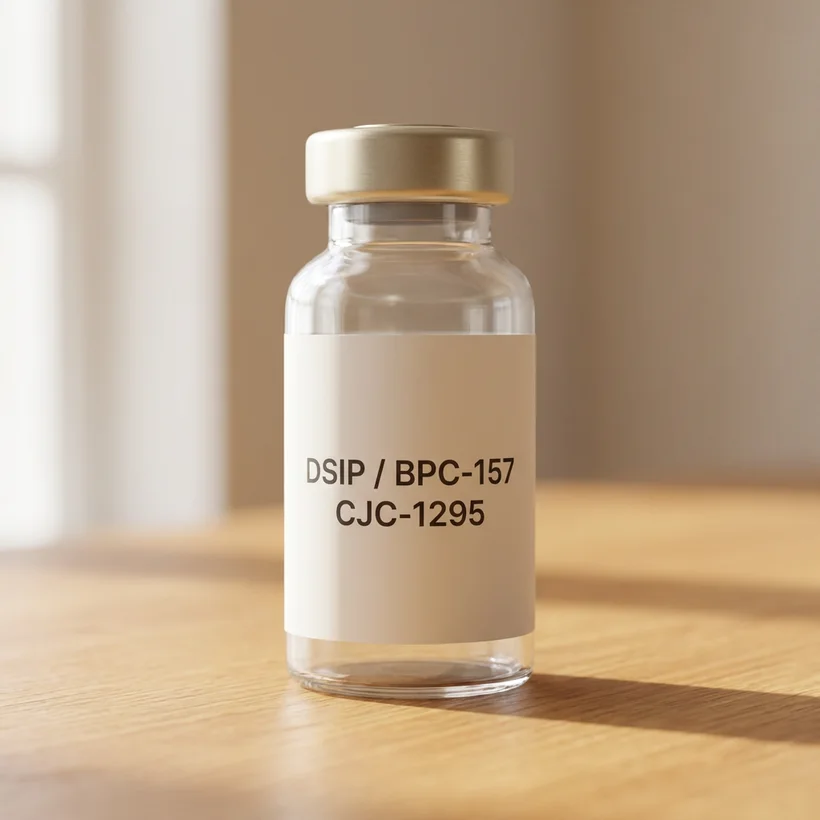
From the FormBlends catalog
Sleep + Recovery Stack
Sleep and repair support with DSIP, BPC-157, and CJC · From $299/mo · compounded by a licensed 503A pharmacy, dispensed only after provider review.
View Sleep + Recovery Stack →Light management is the single most impactful change you can make. Bright light in the morning sets your circadian clock. Dim lighting in the evening triggers melatonin production. Blue light from screens in the last hour before bed can delay melatonin release by 30-90 minutes. Use blue light blocking glasses or simply put screens away after sunset.
Temperature matters more than most people realize. Your body temperature needs to drop by 1-2 degrees to initiate sleep. A cool bedroom (65-68 degrees Fahrenheit) helps with this. A warm shower 60-90 minutes before bed also helps because the subsequent cooling effect triggers drowsiness.
Caffeine has a longer half-life than you think. Caffeine's half-life is 5-6 hours, meaning half of your afternoon coffee is still in your system at bedtime. Cut caffeine by noon, or at least by 2 PM, to avoid interference with your sleep peptide protocol.
Exercise timing matters. Regular exercise improves sleep quality significantly, but intense training within 2-3 hours of bedtime can raise core temperature and stress hormones enough to interfere. Morning or early afternoon workouts are ideal. If you must train later, focus on lighter activities.
Create a consistent wind-down routine. A 30-minute pre-sleep routine signals your brain that sleep is approaching. This could include gentle stretching, reading a physical book, light journaling, or breathing exercises. Pair this with your peptide injection for a powerful sleep-priming ritual.
Measuring Your Sleep Improvements
You can't manage what you don't measure. Tracking your sleep helps you and your provider evaluate whether the protocol is working.
Subjective metrics include how rested you feel upon waking, how long it takes to fall asleep, how many times you wake during the night, your energy levels throughout the day, and your mood and cognitive clarity in the morning.
Objective metrics from a sleep tracker or smartwatch include total sleep time, time in deep sleep and REM stages, heart rate variability during sleep, and movement or restlessness data.
The integrates daily tracking for both your peptide protocol and your sleep metrics. Seeing injection timing and sleep quality side by side helps identify what is working.
Timeline for improvement: Many users see initial sleep improvements within 3-7 days. Deeper benefits in body composition, recovery, and cognitive function from improved sleep develop over 4-8 weeks. If you don't notice any changes after 2-3 weeks, contact your provider to discuss dose adjustments or additional evaluation. Your also play a significant role in sleep quality and should be reviewed as part of the overall plan.
Frequently Asked Questions
Can peptides replace sleeping pills?
Peptides work differently than traditional sleep medications. They support your body's natural sleep processes rather than sedating you. Some people find that peptide therapy reduces their need for sleep medications, but this should always be discussed with your provider. Never stop a prescribed sleep medication without medical guidance.
How quickly will peptides improve my sleep?
Many users notice improved sleep quality within the first 3-7 days of starting CJC-1295/Ipamorelin. Deeper sleep, more dreams, and feeling more rested upon waking are common early signs. Full benefits typically develop over 2-4 weeks of consistent use.
Do peptides for sleep cause drowsiness the next morning?
Unlike many traditional sleep medications, growth hormone peptides don't typically cause next-day grogginess. Most users report feeling more alert and energized in the morning, not less. If you experience morning grogginess, your dose or timing may need adjustment.
Can I use peptides for sleep if I also take melatonin?
Many providers consider low-dose melatonin compatible with sleep peptide protocols. But always disclose all supplements to your prescribing provider. They can advise on timing and dosing to ensure everything works together effectively.
Will I become dependent on peptides for sleep?
Growth hormone peptides don't create the physical dependency associated with some sleep medications. When you cycle off, your sleep may return to its pre-peptide baseline, but it won't get worse than it was before you started. Cycling protocols with off periods are standard practice.
Start your goals Today
Every transformation starts with a single step. Talk to a licensed FormBlends provider about whether this approach is right for you) consultations are free and confidential.
Medical References
- Lincoff AM, Brown-Frandsen K, Colhoun HM, et al. Semaglutide and Cardiovascular Outcomes in Obesity without Diabetes. N Engl J Med. 2023;389(24):2221-2232. [PubMed | ClinicalTrials.gov | DOI]
Sources &. References
- Sikiric P, Hahm KB, Blagaic AB, et al. Stable Gastric Pentadecapeptide BPC 157, Robert's Cytoprotection, Adaptive Cytoprotection, and Therapeutic Effects. Curr Pharm Des. 2018;24(18):1990-2001. Doi:10.2174/1381612824666180515125918
- Chang CH, Tsai WC, Lin MS, et al. The promoting effect of pentadecapeptide BPC 157 on tendon healing involves tendon outgrowth, cell survival, and cell migration. J Appl Physiol. 2011;110(3):774-780. Doi:10.1152/japplphysiol.00945.2010
- Seiwerth S, Brcic L, Vuletic LB, et al. BPC 157 and blood vessels. Curr Pharm Des. 2014;20(7):1121-1125. Doi:10.2174/13816128113199990421
- Bock-Marquette I, Saxena A, White MD, et al. Thymosin beta4 activates integrin-linked kinase and promotes cardiac cell migration, survival and cardiac repair. Nature. 2004;432(7016):466-472. Doi:10.1038/nature03000
- Malinda KM, Sidhu GS, Mani H, et al. Thymosin beta4 accelerates wound healing. J Invest Dermatol. 1999;113(3):364-368. Doi:10.1046/j.1523-1747.1999.00708.x
- Ionescu M, Frohman LA. Pulsatile secretion of growth hormone (GH) persists during continuous stimulation by CJC-1295, a long-acting GH-releasing hormone analog. J Clin Endocrinol Metab. 2006;91(12):4792-4797. Doi:10.1210/jc.2006-1702
This article is for educational purposes only and doesn't constitute medical advice. Always consult with a licensed healthcare provider before starting, changing, or stopping any medication or supplement. FormBlends connects you with licensed providers who can evaluate your individual health needs.
Last updated: 2026-03-24
Ready when you are
Sleep + Recovery Stack
Sleep and repair support with DSIP, BPC-157, and CJC · From $299/mo · compounded by a licensed 503A pharmacy, dispensed only after provider review.
View Sleep + Recovery Stack →