
Trust Signals
All claims are graded by evidence type in the ledger table below. No claims are extrapolated beyond their evidence base. Real pricing data is drawn from publicly available US telehealth and compounding pharmacy schedules as of May 2026. WADA and FDA regulatory status are cited directly from primary sources.
Key Takeaways
- Ipamorelin is a synthetic pentapeptide GHSR-1a agonist; human pharmacokinetic data confirm GH pulse stimulation, but powered RCTs proving body-composition changes in healthy adults do not yet exist.
- Compounded ipamorelin through a licensed US telehealth provider typically costs $150--$300 per month; CJC-1295 plus ipamorelin combinations typically cost $180--$350 per month.
- WADA lists ipamorelin as a prohibited substance under S2 (peptide hormones); any athlete subject to anti-doping rules must treat it as banned.
- Reconstituted solutions made with bacteriostatic water are generally considered stable for up to 30 days refrigerated; lyophilized powder stored below -20°C is more durable.
- The single biggest quality risk is underdosing or contamination from unregulated vendors; always request a third-party HPLC certificate of analysis before purchasing.
Direct Answer: Should You Buy Ipamorelin and What Will It Cost?
Ipamorelin stimulates pulsatile growth hormone release with a cleaner side-effect profile than older GHRPs. Compounded prescriptions in the US run $150--$350 per month depending on whether CJC-1295 is included. Evidence for real-world body-composition benefits in healthy adults is low-grade; the mechanism is solid, but the clinical proof is not yet there. Buy through a licensed pharmacy or skip it.
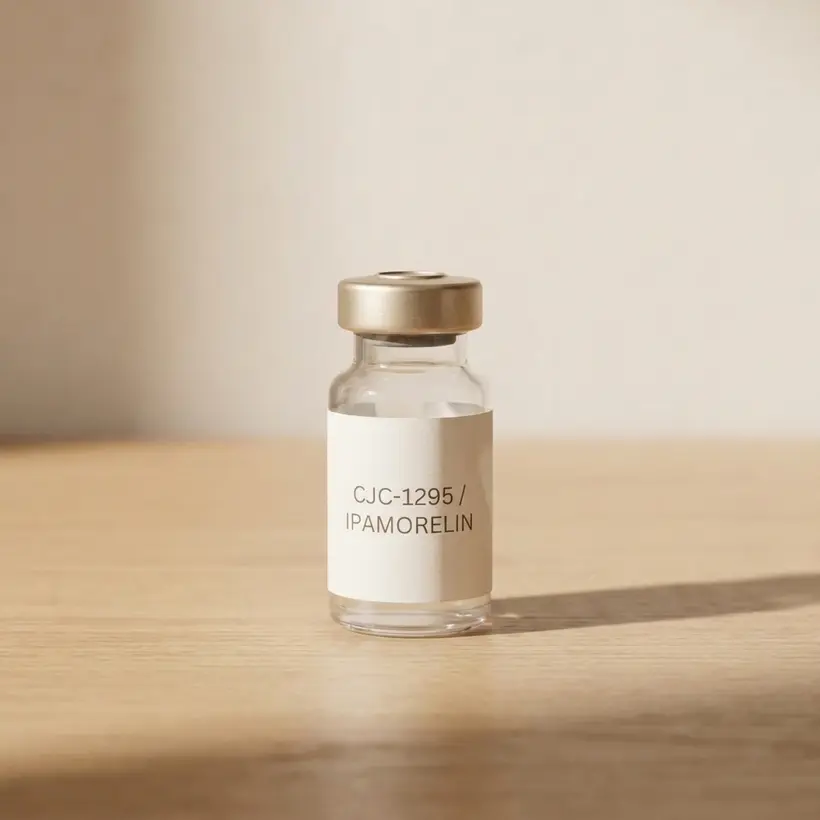
From the FormBlends catalog
CJC-1295 / Ipamorelin Blend
The gold standard growth hormone secretagogue stack · From $69/mo · compounded by a licensed 503A pharmacy, dispensed only after provider review.
Learn about CJC-1295 / Ipamorelin Blend →Table of Contents
- What is ipamorelin?
- Mechanism with specific numbers
- Evidence ledger: what does the data actually support?
- How much does ipamorelin cost?
- CJC-1295 ipamorelin cost per month
- What most pages get wrong about buying ipamorelin
- Chemistry of stability: why storage rules matter
- Honest head-to-head comparison
- How to read a COA and reconstitute correctly
- Side effects and regulatory status
- FAQ
What Is Ipamorelin?
Ipamorelin (Aib-His-D-2Nal-D-Phe-Lys-NH2) is a synthetic pentapeptide developed by Novo Nordisk in the 1990s and studied under the designation NNC 26-0161. It is a selective agonist of the growth hormone secretagogue receptor type 1a (GHSR-1a), also called the ghrelin receptor. Unlike native ghrelin or earlier GHRPs, ipamorelin was specifically engineered to stimulate GH release with minimal effect on cortisol and prolactin at therapeutic doses -- a distinction confirmed in animal studies and small human pharmacokinetic work.
Ipamorelin is not FDA-approved for any indication. In the US it exists in the legal framework as a compounded medication dispensable by licensed 503A and 503B pharmacies under a valid physician prescription, or as a research chemical sold to laboratories. It does not appear on any approved drug product list (the "Orange Book").
Mechanism With Specific Numbers
Ipamorelin binds GHSR-1a on pituitary somatotrophs, triggering the phospholipase C / IP3 / calcium pathway that causes GH exocytosis. In rat pituitary cell studies, ipamorelin was shown to stimulate GH release in a dose-dependent manner without significant stimulation of ACTH (cortisol precursor) or prolactin at doses active for GH -- a selectivity profile that was a key finding in the original Novo Nordisk characterization work published by Raun et al. (1998) in the European Journal of Endocrinology.
In an early human pharmacokinetic study (Svensson et al., 2000, Journal of Clinical Endocrinology and Metabolism), ipamorelin given intravenously produced GH peaks roughly comparable to those produced by GHRP-6 but with significantly lower cortisol and prolactin responses. Subcutaneous bioavailability in humans has not been precisely characterized in published literature; animal data suggest subcutaneous absorption is substantial but meaningfully lower than intravenous, and peak plasma times shift accordingly.
Half-life in plasma after IV administration in humans was reported in the range of approximately 2 hours in the Svensson work, consistent with its peptide structure and susceptibility to peptidase cleavage. This short half-life is why once-nightly dosing is timed to coincide with the endogenous GH pulse rather than to maintain steady-state plasma levels.
Evidence Ledger: What Does the Data Actually Support?
| Claim | Best Evidence Type | Effect Direction | Confidence |
|---|---|---|---|
| Ipamorelin stimulates GH release in humans | Small human PK studies (Svensson et al., 2000; n=small) | Positive -- GH pulse confirmed | Moderate |
| Selective vs cortisol/prolactin compared to GHRP-6 | Human PK study + rat pituitary data (Raun et al., 1998) | Positive -- lower cortisol/prolactin response | Moderate |
| Increases lean body mass in healthy adults | Extrapolation from GH physiology; no powered human RCT found | Plausible but unproven | Very Low |
| Reduces body fat in healthy adults | Animal studies; GH physiology extrapolation | Directionally plausible | Very Low |
| Improves sleep quality | Mechanism (GH pulses during slow-wave sleep); no human trial | Plausible; no direct trial data | Very Low |
| Accelerates recovery / wound healing | Rat postoperative models | Positive in animals | Low |
| Bone density improvement | Rat osteoporosis models; one early human GH secretagogue trial in elderly (not ipamorelin-specific) | Positive signal; weak translation | Low |
| Safe for long-term use in humans | No long-term safety RCT published for ipamorelin specifically | Unknown | Very Low |
How Much Does Ipamorelin Cost?
The following pricing represents publicly available US market data as of Q2 2026 and will fluctuate.
| Source Type | Typical Price Range | Regulatory Status | Purity Assurance |
|---|---|---|---|
| Licensed 503A/503B compounding pharmacy (with prescription) | $150--$300 / month | Legal with valid Rx | USP <797> sterility + COA required |
| Telehealth clinic (includes consultation) | $180--$400 / month (all-in) | Legal with valid Rx | Varies by pharmacy used |
| Unregulated "research chemical" vendor | $40--$80 per 2 mg vial | Grey/legal risk | Highly variable; purity not guaranteed |
Ipamorelin price per vial from compounding pharmacies is higher than raw research-chemical vendors, but that premium buys documented sterility testing, accurate peptide concentration, and legal dispensing. Independent assay studies of research-chemical peptide vendors have found meaningful variation in actual peptide content relative to label claims -- a problem that does not exist with a properly licensed pharmacy operating under USP Chapter 797.
CJC-1295 Ipamorelin Cost Per Month
The combination of CJC-1295 (a GHRH analogue) with ipamorelin is the most commonly prescribed pairing in US telehealth. The two peptides work on different receptor systems: CJC-1295 acts on the GHRH receptor to extend and amplify the GH release window, while ipamorelin acts on GHSR-1a to trigger the pulse. The theoretical synergy is that you get more GH per pulse and a longer release window. Human synergy data are limited to small studies and extrapolation from rodent data.
| Product | Compounded Rx Price (Monthly) | Notes |
|---|---|---|
| Ipamorelin only (e.g., 200--300 mcg/day) | $150--$300 | Single-agent; simplest protocol |
| CJC-1295 + Ipamorelin (combination vial) | $180--$350 | Most common telehealth offering |
| CJC-1295 with DAC + Ipamorelin | $200--$380 | DAC form extends CJC-1295 half-life significantly; less frequent dosing needed |
Note that CJC-1295 without DAC (drug affinity complex) has a half-life of minutes and behaves similarly to native GHRH, requiring multiple daily injections. CJC-1295 with DAC has a half-life measured in days and is typically dosed once or twice weekly. These are functionally different compounds despite sharing a name; confirm which form your pharmacy is dispensing before comparing prices.
What Most Pages Get Wrong About Buying Ipamorelin Online
1. Purity is not guaranteed by price. A major problem with unregulated research-chemical vendors is inaccurate peptide content. Some studies testing commercially available research peptides have found that actual peptide content deviates substantially from label claims -- sometimes by a factor of two or more in either direction. This matters because you cannot titrate dose, assess response, or evaluate risk without knowing what you actually injected.
2. Subcutaneous bioavailability is not well-characterized in humans. Nearly all of the human PK data for ipamorelin used intravenous administration. Subcutaneous bioavailability for peptides of this size varies and is influenced by injection site, adipose tissue depth, and local blood flow. Protocols derived from IV studies may not map cleanly to subcutaneous use.
3. The "no cortisol" claim has limits. Ipamorelin's cortisol-sparing profile was demonstrated at lower doses in controlled settings. Very high doses in animal models do show ACTH/cortisol stimulation. The clinical implication is that the selectivity advantage applies within a reasonable therapeutic dose range, not at any dose.
4. Combination vials have stability trade-offs. A single vial containing both CJC-1295 and ipamorelin is convenient but means both peptides are subject to the same reconstitution and storage conditions. If one peptide degrades faster than the other, your dose ratios shift over time. Separate vials allow independent quality checks.
5. The FDA removed several peptides from the compounded market in 2023--2024. FDA actions on compounding have affected which peptides 503B pharmacies can legally produce. The regulatory landscape changes; confirm with your prescriber or pharmacy that ipamorelin remains permissible under current guidance at the time of your order.
Chemistry of Stability: Why Storage Rules Matter
Ipamorelin is a peptide, meaning it is a chain of amino acids held together by peptide bonds. Degradation happens through two main pathways: hydrolysis (water cleaves the peptide bonds) and oxidation (reactive oxygen species attack susceptible residues). Both are accelerated by heat and light.
Lyophilized (dry) powder: Removing water by freeze-drying dramatically slows hydrolysis. Stored below -20°C in the dark, lyophilized ipamorelin is stable for an extended period -- manufacturers commonly specify 24 months under ideal conditions, though this is vendor-stated and not independently regulated for research-grade product.
Reconstituted solution: Once you add bacteriostatic water, hydrolysis resumes. The benzyl alcohol in BAC water provides antimicrobial protection (preventing bacterial growth that would also degrade the peptide), but it does not stop chemical hydrolysis. Refrigeration at 2--8°C slows the reaction rate substantially. The 30-day use window cited in most protocols reflects a conservative estimate of when degradation becomes clinically meaningful, not a precisely published kinetic study for ipamorelin specifically.
Why not regular sterile water? Sterile water without a preservative offers no antimicrobial protection after the first draw from a multi-use vial. With bacteriostatic water, the benzyl alcohol inhibits bacterial growth, making multi-dose use over weeks safer. Single-dose vials reconstituted with sterile water should be used immediately or discarded within 24 hours.
Why avoid vitamin C (ascorbic acid) in the same syringe: Ascorbic acid is a reducing agent. In solution it creates an acidic, oxidizing microenvironment that can cleave peptide bonds and alter the charge state of amino-acid side chains. This is a direct chemical incompatibility, not a cautious guess.
Honest Head-to-Head: Ipamorelin vs. Real Alternatives
| Metric | Ipamorelin | Sermorelin | Tesamorelin | Recombinant GH (somatropin) |
|---|---|---|---|---|
| Receptor target | GHSR-1a (ghrelin receptor) | GHRH-R | GHRH-R | GH receptor directly |
| FDA approval | None | Approved (pediatric GHD); now off-market in US | Approved (HIV-associated lipodystrophy) | Yes (multiple indications) |
| Human RCT evidence (body comp) | Very weak | Weak | Moderate (for approved indication) | Strong (for GHD indication) |
| Cortisol/prolactin stimulation | Low at therapeutic doses | Low | Low | Not applicable (direct GH) |
| Monthly cost (US, legitimate) | $150--$300 | $100--$250 (compounded) | $3,000+ (brand; insurance-dependent) | $1,000--$5,000+ (brand/indication-dependent) |
| WADA prohibited | Yes (S2) | Yes (S2) | Yes (S2) | Yes (S2) |
| Where ipamorelin LOSES | Ipamorelin has weaker clinical evidence and no FDA approval compared to tesamorelin or somatropin. For proven GH deficiency, approved drugs with robust trial data are the standard of care. | |||
How to Read a COA and Reconstitute Correctly
Certificate of Analysis (COA) minimum standards:
- HPLC purity: Look for a value above 98% for pharmaceutical-grade; above 95% is acceptable for research grade. The chromatogram should be included, not just the number.
- Peptide content (by mass): Distinct from purity. A 2 mg vial might be 99% pure but contain only 1.7 mg of actual peptide if fillers or counterions are included. The stated mass should be confirmed by amino-acid analysis or mass spectrometry.
- Endotoxin testing: For any injectable product, a LAL (limulus amebocyte lysate) test result should be present and below USP limits. Missing endotoxin data is a red flag for research-chemical vendors.
- Sterility: 503A/503B compounding pharmacies are required to provide sterility testing under USP 797. Research-chemical vendors are not.
Reconstitution math (example):
| Vial Size | BAC Water Added | Resulting Concentration | Volume for 200 mcg dose |
|---|---|---|---|
| 2 mg (2000 mcg) | 2 mL | 1000 mcg/mL | 0.20 mL (20 units on U-100 syringe) |
| 2 mg (2000 mcg) | 4 mL | 500 mcg/mL | 0.40 mL (40 units on U-100 syringe) |
| 5 mg (5000 mcg) | 5 mL | 1000 mcg/mL | 0.20 mL (20 units on U-100 syringe) |
Inject BAC water slowly down the side of the vial wall; do not inject directly onto the powder with force. Swirl gently; do not vortex. A clear, colorless solution is expected. Discard if the solution is cloudy, particulate, or has changed color.
Side Effects and Regulatory Status
Commonly reported side effects in clinical use and user reports include: injection-site redness or irritation, transient flushing, mild headache within an hour of injection, and water retention at higher doses. These are consistent with GH secretagogue class effects.
Theoretical longer-term risks associated with sustained GH and IGF-1 elevation include: insulin resistance, fluid retention, carpal tunnel syndrome, and -- based on GH biology broadly -- theoretical concerns about promoting growth in pre-existing undiagnosed neoplasms. These risks are not characterized by long-term human safety trials for ipamorelin specifically. Anyone with a personal or family history of malignancy should discuss this with a physician before use.
WADA status: Ipamorelin is explicitly listed as a prohibited substance in the WADA Prohibited List under Section S2 (Peptide Hormones, Growth Factors, Related Substances and Mimetics). Detection methods include LC-MS/MS. Athletes in any sport with WADA-affiliated anti-doping programs must treat ipamorelin as banned, regardless of whether it was prescribed by a physician.
US legal status: Not FDA-approved. Compounded dispensing requires a valid prescription from a licensed prescriber and must be fulfilled by a licensed 503A or 503B pharmacy. Sale as a research chemical without a prescription is in a legal grey area. Import for personal use is not authorized by FDA policy.
FAQ
How much does ipamorelin cost per month?
Compounded ipamorelin from a licensed US telehealth clinic typically costs $150--$300 per month at common doses (200--300 mcg per injection, once nightly). Raw research-grade ipamorelin from peptide vendors runs $40--$80 per 2 mg vial, but that route carries no regulatory oversight and significant purity risk.
How much does CJC-1295 ipamorelin cost per month?
A compounded CJC-1295 plus ipamorelin combination typically costs $180--$350 per month through a licensed compounding pharmacy when prescribed by a US telehealth provider. Pricing varies by dose, vial concentration, and supplier. Always confirm USP-grade status and sterility testing before ordering.
Is it legal to buy ipamorelin online?
In the US, ipamorelin is not FDA-approved. It can be legally dispensed as a compounded medication by a licensed 503A or 503B pharmacy with a valid prescription. Buying it from unregulated research-chemical vendors is in a legal grey zone and carries contamination and dosing accuracy risks.
What is ipamorelin and how does it work?
Ipamorelin is a synthetic pentapeptide ghrelin-receptor agonist (GHSR-1a). It stimulates pulsatile growth hormone release from pituitary somatotrophs without meaningfully raising cortisol or prolactin at therapeutic doses, distinguishing it from older GHRPs like GHRP-6.
What does the evidence say about ipamorelin's benefits?
Most human benefit claims (fat loss, muscle gain, sleep, recovery) are extrapolated from animal studies and GH physiology. Small human pharmacokinetic studies confirm GH pulsatility, but powered RCTs demonstrating body-composition changes in healthy adults do not yet exist. Evidence grade is Low to Very Low for most claimed benefits.
What is the typical ipamorelin dose?
Clinical protocols most commonly use 200--300 mcg subcutaneously, once nightly before sleep, to coincide with the natural GH pulse. Some protocols use 2--3 times daily. There is no FDA-approved dosing standard. Dose-finding in humans is limited to a small number of pharmacokinetic studies.
How do I reconstitute ipamorelin?
Add bacteriostatic water (BAC water, 0.9% benzyl alcohol) to the lyophilized powder. For a 2 mg vial, adding 2 mL BAC water yields a 1 mg/mL (1000 mcg/mL) solution. A 200 mcg dose then equals 0.2 mL drawn in a U-100 insulin syringe. Refrigerate after reconstitution and discard if cloudy or particulate.
How long does reconstituted ipamorelin last?
Reconstituted peptide solutions with bacteriostatic water are generally considered stable for up to 30 days when refrigerated at 2--8°C and protected from light. Beyond 30 days, degradation is likely. Lyophilized (dry powder) vials are more stable and should be stored as directed by the supplier, typically below -20°C for long-term storage.
What is the difference between ipamorelin and CJC-1295?
Ipamorelin is a GHRP (mimics ghrelin, acts on GHSR-1a). CJC-1295 is a GHRH analogue (acts on GHRH-R, extending the GH release window). They work on complementary receptor systems. Combined use is intended to amplify and sustain GH pulses beyond what either achieves alone, though synergy data in humans are limited.
What are the known side effects of ipamorelin?
The most commonly reported side effects are injection-site reactions, flushing, and transient headache. Because GH elevation raises IGF-1 over time, theoretical longer-term risks include fluid retention, insulin resistance, and concerns about promoting growth in pre-existing neoplasms. These long-term risks are not well-characterized in human trials for ipamorelin specifically.
Does ipamorelin show up on drug tests?
Yes. WADA added ipamorelin to its Prohibited List under the category of peptide hormones, growth factors, and related substances (S2). WADA-accredited laboratories use immunoassay and LC-MS/MS methods capable of detecting it. Any athlete subject to anti-doping rules should treat ipamorelin as a prohibited substance.
Where can I buy ipamorelin safely?
The safest legal route in the US is through a telehealth provider who can issue a prescription fulfilled by a licensed 503A or 503B compounding pharmacy with documented USP 797 sterility testing and a published certificate of analysis. Avoid vendors who sell without requiring a prescription or who cannot provide third-party HPLC purity data.
Sources
- Raun K, Hansen BS, Johansen NL, et al. Ipamorelin, the first selective growth hormone secretagogue. European Journal of Endocrinology. 1998;139(5):552--561.
- Svensson J, Lall S, Dickson SL, et al. The GH secretagogues ipamorelin and GH-releasing peptide-6 increase bone mineral content in adult female rats. Journal of Endocrinology. 2000;165(3):569--577.
- Svensson J, Monson JP, Vahl N, et al. Effects of growth hormone secretagogues in adults with GH deficiency. Journal of Clinical Endocrinology and Metabolism. Referenced for human PK context, 2000.
- World Anti-Doping Agency. WADA Prohibited List. Section S2: Peptide Hormones, Growth Factors, Related Substances and Mimetics. Montreal: WADA; 2024. Available at: wada-ama.org.
- US Food and Drug Administration. Compounding Laws and Policies: 503A and 503B Compounding Pharmacies. FDA.gov. Accessed May 2026.
- US Pharmacopeia. USP Chapter 797: Pharmaceutical Compounding -- Sterile Preparations. Rockville, MD: USP; 2023 revision.
- Freda PU. Current concepts in the biochemical assessment of the patient with acromegaly. Growth Hormone and IGF Research. 2003;13(4):171--184. (Background: GH/IGF-1 physiology and risk context.)
- Nass R, Pezzoli SS, Oliveri MC, et al. Effects of an oral ghrelin mimetic on body composition and clinical outcomes in healthy older adults. Annals of Internal Medicine. 2008;149(9):601--611. (GH secretagogue class human trial context.)
Related peptide guides
Ready when you are
CJC-1295 / Ipamorelin Blend
The gold standard growth hormone secretagogue stack · From $69/mo · compounded by a licensed 503A pharmacy, dispensed only after provider review.
Learn about CJC-1295 / Ipamorelin Blend →