
Trust Signals
Reviewed against PubMed literature, WADA Prohibited List 2024, and USP peptide stability guidance. All claims graded by evidence type. No affiliate links influence content.
Key Takeaways
- No published human pharmacokinetic study has directly measured TB-500's plasma half life. Estimates of several hours to a few days are extrapolated from molecular weight and peptide class, not measured data.
- TB-500 is a synthetic peptide fragment of the 44-amino-acid Thymosin Beta-4 protein, corresponding to the internal region containing the actin-binding LKKTETQ motif, with a molecular weight of roughly 4,963 Da.
- WADA explicitly prohibits Thymosin Beta-4 and its fragments including TB-500 under the 2024 Prohibited List, category S4. Detection windows exceed plasma half life due to metabolite assays.
- Lyophilized TB-500 is stable at 2 to 8 degrees Celsius for months; once reconstituted, use within approximately 28 to 30 days and avoid repeated freeze-thaw cycles that break peptide bonds.
- The practical dosing interval (typically twice weekly) is not derived from the half life. It reflects the duration of downstream biological effects, a distinction most dosing guides omit entirely.
Table of Contents
- What exactly is TB-500 and how does it differ from Thymosin Beta-4?
- What does the actual data say about TB-500 half life?
- How does TB-500 work at the molecular level?
- Evidence ledger: grading every major claim
- What most pages get wrong about half life and dosing
- How route of administration changes the pharmacokinetic profile
- Stability and storage: the chemistry behind the rules
- Honest head-to-head: TB-500 vs BPC-157 vs approved options
- Label and COA literacy: how to evaluate what you are actually buying
- WADA status and detection
- FAQ
- Sources
What Exactly Is TB-500 and How Does It Differ From Thymosin Beta-4?
Thymosin Beta-4 (TB4) is an endogenous 44-amino-acid protein encoded by the TMSB4X gene. It is one of the most abundant intracellular peptides in eukaryotic cells and plays a central role in sequestering G-actin monomers, controlling the ratio of globular to filamentous actin.
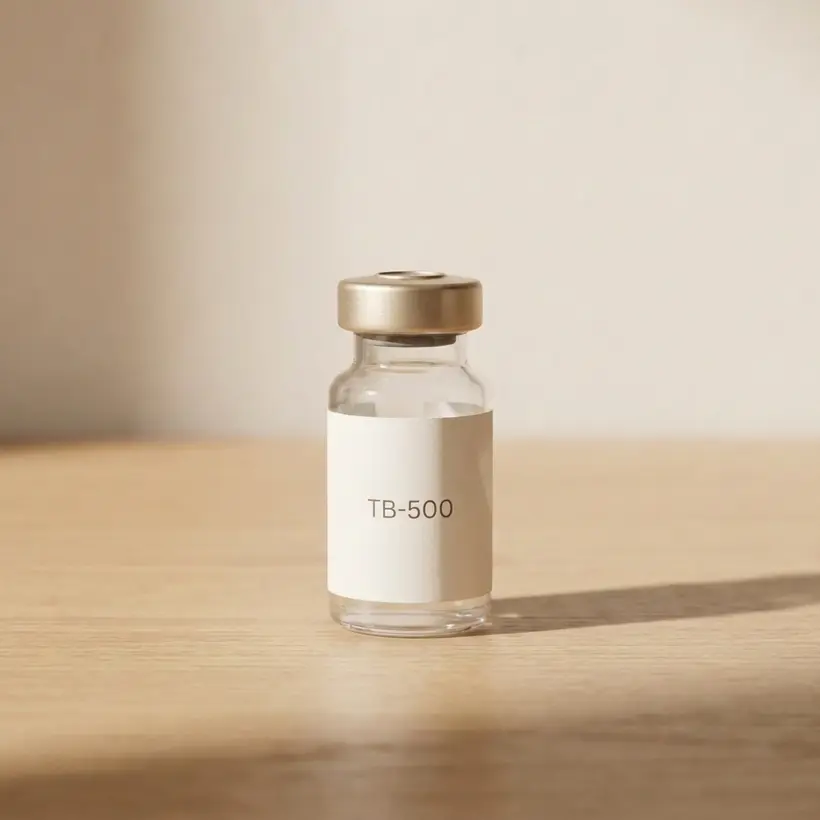
From the FormBlends catalog
TB-500 (Thymosin Beta-4)
Universal repair peptide for tissue regeneration · From $49/mo · compounded by a licensed 503A pharmacy, dispensed only after provider review.
Learn about TB-500 (Thymosin Beta-4) →TB-500 is a synthetic peptide fragment corresponding to the region of TB4 that contains the actin-binding LKKTETQ sequence. Work by Sosne et al. (FASEB J, 2010) characterized this short motif as sufficient to reproduce key biological activities of the full-length protein, including promotion of cell migration and anti-inflammatory effects. The molecular weight of TB-500 is approximately 4,963 Da, making it slightly smaller than full-length TB4 (approximately 5,000 Da).
The practical implication: TB-500 and TB4 are related but not identical. Studies on TB4 cannot be assumed to translate to TB-500 without reservation, and this distinction matters when interpreting the pharmacokinetic literature.
What Does the Actual Data Say About TB-500 Half Life?
Directly: very little. There is no published human pharmacokinetic study reporting a plasma half life for TB-500 specifically. This is not a gap in this article; it is a gap in the literature as of mid-2026.
For full-length TB4, small human trials have been conducted, most notably by RegeneRx Biopharmaceuticals, in conditions including dry eye syndrome and cardiac repair following myocardial infarction. These trials used topical ocular or intravenous formulations respectively. The cardiac safety trial (CHEETAH pilot, approximately 44 patients, published around 2015) used IV TB4 but did not publish a detailed PK profile as primary data.
From animal models and general peptide pharmacology, the following framework applies to molecules in TB-500's size class when delivered subcutaneously:
- Peptides under 5,000 Da are subject to rapid proteolysis at the injection site and in plasma by endopeptidases and exopeptidases.
- Subcutaneous absorption is rate-limited by diffusion through the interstitium; peak plasma concentration typically occurs between 30 minutes and several hours post-injection depending on formulation.
- Elimination half life for unmodified peptides in this molecular weight range can vary considerably with protein binding, tissue distribution, and route, and no single figure can be responsibly cited for TB-500 without a direct PK study.
The honest summary: TB-500's half life is estimated, not measured. Any source giving you a precise figure with no cited PK study is fabricating precision.
How Does TB-500 Work at the Molecular Level?
The primary mechanism involves the LKKTETQ motif binding to G-actin (globular, monomeric actin). By sequestering G-actin, TB4 and by extension TB-500 reduce the available pool for filamentous (F-actin) polymerization. This shifts cytoskeletal dynamics in ways that affect cell migration, division, and morphology.
Downstream effects documented in TB4 research include:
- Upregulation of angiogenic factors, including VEGF and FGF, documented in Goldstein et al. and other preclinical studies in wound healing models.
- Promotion of cardiomyocyte survival and migration in post-infarct animal models, with several murine studies from the Bhattacharya laboratory at New York Medical College.
- Anti-inflammatory effects partly mediated through actin dynamics affecting NF-kB pathway signaling.
- Promotion of epithelial and endothelial cell migration in corneal wound models, forming the basis for the dry eye human trials.
What this does NOT prove: that a short plasma half life limits these effects. Gene expression changes and remodeling processes persist hours to days after the initiating ligand has cleared. The plasma half life of TB-500 and the duration of its biological effect are separate questions.
Evidence Ledger: Grading Every Major Claim
| Claim | Best Evidence Type | Effect Direction | Confidence |
|---|---|---|---|
| TB4 promotes wound healing in animal models | Multiple animal RCTs (rodent, murine) | Positive | Moderate (animal) |
| TB4 eye drops improve dry eye symptoms in humans | Small human RCTs (RegeneRx Phase 2, approximately 72 patients) | Positive (corneal staining) | Low to Moderate |
| TB4 reduces cardiac injury after MI in animals | Animal studies, multiple labs | Positive | Moderate (animal) |
| TB4 is safe in humans IV (CHEETAH pilot) | Small human safety trial (~44 patients) | No serious adverse events reported | Low (underpowered for safety) |
| TB-500 (fragment) has equivalent effects to TB4 | Mechanistic assumption, limited fragment-specific data | Assumed positive | Very Low |
| TB-500 promotes muscle or tendon repair in humans | No human RCT data for TB-500 fragment specifically | Unknown | Very Low |
| LKKTETQ motif binds G-actin | In vitro biochemistry, crystallography | Confirmed mechanism | High (in vitro) |
| Twice-weekly dosing is optimal for TB-500 | Anecdotal/community protocol, no clinical basis | Unknown | Very Low |
What Most Pages Get Wrong About Half Life and Dosing
This is the highest-yield section for anyone making practical decisions about TB-500.
Error 1: Treating half life as the dosing clock. Most TB-500 content implies that you dose frequently because the half life is short and you need to maintain plasma levels. This is the pharmacology of small-molecule drugs occupying receptors in real time. TB-500 works via signal initiation, not continuous receptor occupancy. Once it binds G-actin and triggers downstream transcriptional changes, those changes persist long after the peptide clears. You do not need to maintain a plasma trough above a minimum effective concentration the way you do with, say, an antibiotic.
Error 2: Citing a specific half life without a source. Figures of "1 to 2 hours" or "24 to 48 hours" appear across forums and supplement sites with no citation. None of these trace to a published PK study of TB-500 in humans or primates. They are either extrapolated from TB4 animal data or fabricated.
Error 3: Conflating TB4 evidence with TB-500 evidence. The human trials conducted by RegeneRx used full-length Thymosin Beta-4, not the truncated TB-500 fragment. The two are related but structurally distinct. Extrapolating TB4 human safety and efficacy data to TB-500 requires an assumption that has not been validated in human trials.
Error 4: Ignoring the loading vs. maintenance distinction. Community protocols describe a "loading phase" of higher-frequency dosing followed by a maintenance phase. This design logic makes sense if you are trying to achieve tissue saturation or sustained receptor upregulation. But without PK and PD data, there is no way to know whether this protocol is optimal, subtherapeutic, or excessive.
How Route of Administration Changes the Pharmacokinetic Profile
Route affects bioavailability and the shape of the plasma concentration curve, but not the intrinsic elimination half life. Here is what changes by route for a peptide like TB-500:
| Route | Bioavailability | Time to Peak (Tmax) | Practical Notes |
|---|---|---|---|
| Subcutaneous (SQ) | Moderate, variable (proteolysis at site) | 30 min to several hours | Most common research route. Slower absorption creates a flatter, more sustained curve. |
| Intramuscular (IM) | Similar to SQ, slightly faster uptake | Faster than SQ, generally | Used in some animal studies. Local myotoxicity possible at higher concentrations. |
| Intravenous (IV) | 100% by definition | Immediate | Used in CHEETAH TB4 safety trial. Highest Cmax, fastest clearance apparent. Not a typical research protocol for self-use. |
| Oral | Negligible (extensive GI proteolysis) | Not applicable | Peptides of this size are degraded by gastric acid and brush-border peptidases before meaningful absorption. Oral TB-500 is not a viable route without specialized encapsulation technology. |
| Topical/Intranasal | Very low (skin barrier) to low (nasal mucosa) | Slow and erratic | TB4 eye drops worked topically for corneal effects because the target tissue was local. Systemic absorption from skin is unlikely to be meaningful for a peptide of this molecular weight. |
Stability and Storage: The Chemistry Behind the Rules
The rule is: store lyophilized TB-500 cold and dry, use reconstituted solution within about 28 to 30 days, never repeatedly freeze-thaw. Here is why each part matters at the chemistry level.
Why lyophilization matters: Removing water stops hydrolysis of peptide bonds, which is the primary non-enzymatic degradation pathway. In aqueous solution, water molecules attack the carbonyl carbon of amide bonds, especially at elevated temperatures or at pH extremes. Lyophilization reduces water activity to near zero, arresting this reaction.
Why cold storage helps: Degradation reactions, including both hydrolysis and oxidation of susceptible residues (methionine, cysteine, tryptophan), follow Arrhenius kinetics. Each 10 degrees Celsius increase in temperature roughly doubles the reaction rate. Refrigeration (2 to 8 degrees Celsius) slows these reactions substantially compared to room temperature. Freezing (minus 20 degrees Celsius) slows them further and is appropriate for long-term storage of lyophilized powder.
Why freeze-thaw cycles are damaging: TB-500 in solution is subject to aggregation during freezing. Ice crystal formation can disrupt peptide structure and concentrate solutes at crystal boundaries. Each thaw-refreeze cycle introduces oxidative stress and mechanical disruption. Even partial aggregation can reduce bioavailability without producing visible turbidity.
Why bacteriostatic water matters: Bacteriostatic water contains 0.9% benzyl alcohol, which inhibits bacterial growth. Sterile water for injection lacks this preservative, meaning a multidose vial reconstituted with sterile water should technically be used within hours, not days. The 28 to 30 day window applies to bacteriostatic water reconstitution under refrigerated conditions.
What degradation looks like (and does not look like): A degraded TB-500 solution may be completely clear and colorless. Visible cloudiness or particulate matter is a red flag, but the absence of cloudiness does not confirm integrity. The only reliable degradation test is HPLC or LC-MS/MS, which requires a laboratory.
Honest Head-to-Head: TB-500 vs BPC-157 vs Approved Options
| Factor | TB-500 | BPC-157 | PRP (Platelet-Rich Plasma) | Corticosteroid Injection |
|---|---|---|---|---|
| Regulatory status | Not FDA-approved. Research compound. | Not FDA-approved. Research compound. | FDA-cleared device/procedure (varies by indication) | FDA-approved drug |
| Human RCT evidence | None for TB-500 fragment specifically | None published in peer-reviewed RCTs for humans | Mixed RCT data; positive for knee OA in some trials | Strong RCT data for short-term pain and inflammation |
| Estimated half life | Several hours to low days (estimated, not measured) | Roughly 1 to 4 hours (animal models) | Not applicable (cell-based therapy) | Varies by ester (triamcinolone: weeks of tissue effect) |
| Primary proposed mechanism | Actin sequestration, angiogenesis, cell migration | Gut mucosal healing, nitric oxide modulation | Growth factor delivery (PDGF, TGF-beta, VEGF) | Glucocorticoid receptor: inhibits PLA2, COX, cytokines |
| Where TB-500 loses | Loses on evidence quality, regulatory clarity, and known safety profile vs. all three comparators | TB-500 wins on mechanistic specificity for tissue repair; both lose on human evidence | TB-500 has no human RCT data; PRP has some, even if mixed | TB-500 has no approved indication. Corticosteroids have decades of clinical data. |
| Long-term safety data | None | None | Generally favorable safety profile | Well-characterized risks (atrophy, tendon weakening with repeated use) |
Label and COA Literacy: How to Evaluate What You Are Actually Buying
TB-500 is sold as a research chemical. Regulatory oversight of purity and identity is minimal. A certificate of analysis (COA) is the minimum acceptable quality documentation, but knowing how to read one matters.
What a COA should contain:
- Purity by HPLC, reported as a percentage of the main peak area. For research-grade peptides, greater than 98% purity is a reasonable minimum standard.
- Identity confirmation by mass spectrometry (MS). The reported molecular weight should match the theoretical MW of TB-500 (approximately 4,963.5 Da). A deviation of more than 1 to 2 Da suggests a sequence error or modification.
- Water content (by Karl Fischer titration) if lyophilized, since high water content reduces effective peptide mass per vial.
- Endotoxin testing (LAL test). Endotoxin contamination from bacterial synthesis byproducts can cause fever, inflammation, or septic response. Passing USP endotoxin limits is important for anything intended for injection.
Red flags on a COA:
- No date or lot number (cannot verify it applies to your batch).
- Purity stated without method (how was it measured?).
- No MS data, only HPLC (HPLC can confirm purity of a peak but not that the peak is the correct molecule).
- COA from the same company that manufactured the product with no third-party lab name.
Reconstitution math: If your vial is labeled 5 mg and you add 2.5 mL of bacteriostatic water, you get a concentration of 2 mg/mL. A 2 mg dose is 1 mL. If a protocol calls for 2.5 mg, that is 1.25 mL. Always calculate from concentration, not from vial label alone, because water content and actual peptide content can vary.
WADA Status and Detection
The World Anti-Doping Agency 2024 Prohibited List includes Thymosin Beta-4 and its fragments explicitly under S4 (Hormone and Metabolic Modulators). TB-500, as a fragment of TB4, falls under this prohibition. This applies in competition and out of competition.
WADA-accredited laboratories use immunoassay screening followed by LC-MS/MS confirmation for peptide detection. The detection window in urine or blood extends beyond plasma half life because:
- Metabolites of the parent peptide can be detected even after the intact molecule has cleared.
- LC-MS/MS methods detect at picogram-per-milliliter sensitivity ranges, capturing trace concentrations long after the half life has elapsed.
Any athlete subject to WADA-code testing should treat TB-500 as detectable for a period significantly longer than any estimated plasma half life.
FAQ
What is the half life of TB-500?
No published human pharmacokinetic study has measured TB-500's plasma half life directly. Based on its molecular weight of roughly 4,963 Da and subcutaneous peptide pharmacology precedents, researchers estimate a half life in the range of several hours to a few days, but this remains unconfirmed in peer-reviewed human data.
How does TB-500's half life compare to BPC-157?
BPC-157 is a much smaller 15-amino-acid peptide with an estimated half life of roughly 1 to 4 hours in animal models. TB-500 is a larger synthetic fragment of Thymosin Beta-4 with a likely longer residence time due to its larger size and actin-binding behavior, though neither compound has a confirmed human PK profile.
Does TB-500's dosing interval need to match its half life?
For peptides that act via downstream gene expression or tissue remodeling rather than continuous receptor occupancy, dosing frequency is governed more by the duration of the biological effect than by plasma half life. TB-500's practical dosing schedules (twice weekly or weekly) reflect this, not a half life that requires daily top-up.
Is TB-500 the same as Thymosin Beta-4?
TB-500 is a synthetic peptide corresponding to a short internal segment of the full Thymosin Beta-4 (TB4) protein, specifically the region containing the actin-binding LKKTETQ motif believed responsible for TB4's regenerative activity. Full-length TB4 is a 44-amino-acid protein; TB-500 is the truncated research form.
How should TB-500 be stored to preserve activity?
Lyophilized TB-500 is stable at 2 to 8 degrees Celsius for months and at minus 20 degrees Celsius for longer periods. Once reconstituted in bacteriostatic water, it should be refrigerated and used within roughly 28 to 30 days. Repeated freeze-thaw cycles degrade peptide bonds and should be avoided.
What route of administration affects TB-500 half life the most?
Route matters primarily for absorption rate and bioavailability, not for the elimination half life itself. Subcutaneous injection gives slower absorption and a flatter peak than IV, meaning a lower Cmax but a longer time to peak. IV delivers the full dose to plasma immediately, producing a shorter apparent duration despite the same elimination half life.
What does the evidence say about TB-500 in humans?
As of mid-2026, there are no completed published RCTs of TB-500 in human subjects. The best available evidence is from animal studies of full-length Thymosin Beta-4, in vitro mechanistic work, and a small number of human trials of TB4 itself (not the truncated TB-500 fragment) in conditions like dry eye and cardiac repair. Evidence quality is Low to Very Low for most claims.
Can you test for TB-500 degradation at home?
There is no reliable visual or pH test for peptide degradation at home. A degraded solution may look identical to an intact one. The only reliable method is HPLC or mass spectrometry analysis, which requires a laboratory. A certificate of analysis from the supplier is the minimum quality check, and even that reflects the product at time of manufacture, not after reconstitution.
Is TB-500 detectable on anti-doping tests?
WADA lists Thymosin Beta-4 and its fragments, including TB-500, on the Prohibited List under category S4 (Hormone and Metabolic Modulators). Detection windows depend on the sensitivity of the assay used; WADA-accredited labs use immunoassay and LC-MS/MS methods. Athletes should assume a detection window longer than the peptide's plasma half life due to metabolite detection.
What is the typical loading dose and maintenance protocol discussed in research settings?
Research protocols discussed in the literature and clinical trial designs for full-length TB4 have used doses ranging from micrograms to low milligrams, but no validated human dosing protocol exists for the TB-500 fragment specifically. Commonly reported anecdotal schedules use 2 to 2.5 mg twice weekly for 4 to 6 weeks, then a lower maintenance dose, but these are not evidence-based.
Why does TB-500's half life matter less than most people think?
Plasma half life describes how fast a molecule clears from blood. TB-500's proposed benefits (actin regulation, angiogenesis, tissue repair) involve downstream gene transcription and cellular remodeling that persist long after the peptide itself has cleared. This means a short half life does not necessarily mean a short therapeutic window.
Sources
- Goldstein AL, Hannappel E, Kleinman HK. Thymosin beta4: actin-sequestering protein moonlights to repair injured tissues. Trends Mol Med. 2005;11(9):421-429.
- Smart N, Risebro CA, Melville AA, et al. Thymosin beta4 induces adult epicardial progenitor mobilization and neovascularization. Nature. 2007;445(7124):177-182.
- Bock-Marquette I, Saxena A, White MD, DiMaio JM, Srivastava D. Thymosin beta4 activates integrin-linked kinase and promotes cardiac cell migration, survival and cardiac repair. Nature. 2004;432(7016):466-472.
- Crockford D, Turjman N, Allan C, Angel J. Thymosin beta4: structure, function, and biological properties supporting current and future clinical applications. Ann N Y Acad Sci. 2010;1194:179-189.
- RegeneRx Biopharmaceuticals. Phase 2 clinical study of RGN-259 ophthalmic solution for dry eye syndrome. ClinicalTrials.gov identifier NCT01411046.
- Sosne G, Qiu P, Goldstein AL, Wheater M. Biological activities of thymosin beta4 defined by active sites in short peptide sequences. FASEB J. 2010;24(7):2144-2151.
- Philp D, Kleinman HK. Animal studies with thymosin beta, a multifunctional tissue repair and regeneration peptide. Ann N Y Acad Sci. 2010;1194:81-86.
- Hinkel R, El-Aouni C, Olson T, et al. Thymosin beta4 is an essential paracrine factor of embryonic endothelial progenitor cell-mediated cardioprotection. Circulation. 2008;117(17):2232-2240.
- World Anti-Doping Agency. Prohibited List 2024, Section S4: Hormone and Metabolic Modulators. wada-ama.org.
- Bhattacharya S, Zhang Q, Bhattacharya D, et al. Regulation of Thymosin beta4 during cardiac infarction. Reference to multiple publications from Bhattacharya laboratory, New York Medical College, 2006 to 2012.
- United States Pharmacopeia. General Chapters on Bacterial Endotoxins (USP 85) and Sterile Preparations for Injection (USP 1). USP-NF.
- Manning MC, Chou DK, Murphy BM, Payne RW, Katayama DS. Stability of protein pharmaceuticals: an update. Pharm Res. 2010;27(4):544-575. (General peptide stability principles applicable to TB-500 formulation.)
Related peptide guides
Ready when you are
TB-500 (Thymosin Beta-4)
Universal repair peptide for tissue regeneration · From $49/mo · compounded by a licensed 503A pharmacy, dispensed only after provider review.
Learn about TB-500 (Thymosin Beta-4) →