
Trust Signals
Key Takeaways
- Semax plasma half life is approximately 2 to 8 minutes, driven by rapid cleavage by tissue peptidases, yet subjective cognitive effects are reported for 4 to 8 hours after intranasal dosing.
- Semax is a 7-amino-acid synthetic peptide (sequence: Met-Glu-His-Phe-Pro-Gly-Pro) with a molecular weight of roughly 887 g/mol, derived from the ACTH 4-10 fragment.
- Intranasal delivery is not "direct brain access." Olfactory nerve transport is partial and slow; most systemically absorbed semax is degraded before crossing the blood-brain barrier.
- BDNF upregulation, the most-cited mechanism, is well established in rodent studies but unconfirmed by controlled human trials in healthy populations.
- Russian clinical protocols use courses of 10 to 14 days, not indefinite daily use. No long-term human safety data exist outside those short clinical settings.
What Is the Semax Half Life and How Quickly Does It Work?
The semax half life in plasma is very short, estimated in the range of 2 to 8 minutes, because peptidases in blood and tissue cleave the heptapeptide rapidly. Despite this brief plasma window, intranasal doses produce effects users describe lasting 4 to 8 hours. The disconnect is explained not by prolonged peptide presence but by downstream signaling cascades the peptide triggers before it is degraded.
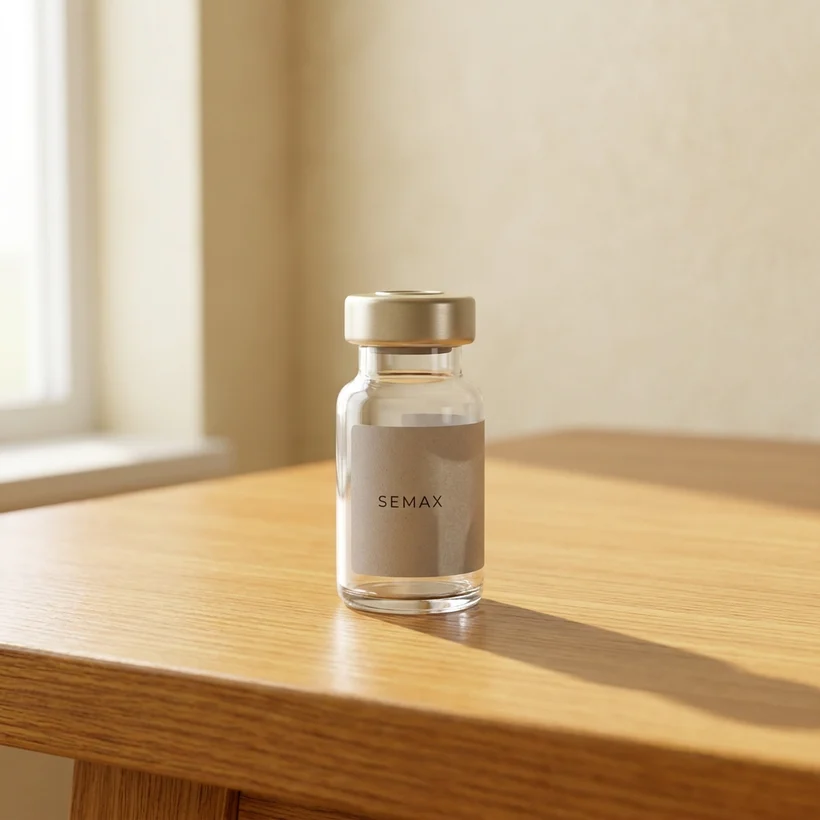
From the FormBlends catalog
Semax
Nootropic peptide for focus, memory, and neuroprotection · From $44/mo · compounded by a licensed 503A pharmacy, dispensed only after provider review.
Learn about Semax →Table of Contents
- What is semax and where does the half life estimate come from?
- Timeline: minute-by-minute from dose to effect
- Mechanism with numbers: what semax actually does in the brain
- Evidence ledger: grading every major claim
- What most pages get wrong about semax bioavailability
- Why the stability rules exist: the chemistry behind storage
- Honest head-to-head: semax vs. alternatives
- Operational and label literacy: reading a COA, dosing math, signs of degradation
- FAQ
- Sources
- Footer disclaimers
What Is Semax and Where Does the Half Life Estimate Come From?
Semax (research designations include ACTH 4-10 analogue or the trade name Semax in Russian pharmacopeia) is a synthetic heptapeptide with the sequence Met-Glu-His-Phe-Pro-Gly-Pro. The proline residues at positions 5 and 7 confer some resistance to aminopeptidases, but tissue peptidases, particularly in nasal mucosa, blood, and kidney, still cleave the peptide within minutes of systemic exposure.
The 2 to 8 minute half life estimate comes from animal pharmacokinetic studies measuring radioactively labeled analogues or HPLC quantification of the intact peptide in plasma after intravenous or subcutaneous administration. No published human pharmacokinetic study with modern bioanalytical methods has yet established a precise human plasma half life with confidence. Treat the 2 to 8 minute figure as a reasonable animal-derived approximation, not a confirmed human value.
Timeline: Minute-by-Minute From Dose to Effect
| Time Post-Dose | What Is Happening (Proposed) | Evidence Basis | Confidence |
|---|---|---|---|
| 0 to 5 min | Peptide contacts nasal mucosa; partial absorption via olfactory epithelium and systemic nasal vasculature; plasma concentration peaks rapidly then falls | Animal PK, mechanism inference | Low to Moderate |
| 5 to 15 min | Melanocortin receptor (MC4R, MC5R) binding in CNS; early dopaminergic and serotonergic tone changes inferred from animal models | Animal receptor binding studies | Low |
| 15 to 30 min | Subjective onset of heightened focus or alertness reported by most users; corresponds to window cited in small Russian clinical trials | Small human trials (clinical populations), self-report | Low to Moderate |
| 1 to 2 hours | Peak self-reported cognitive effect; peak window cited in clinical studies for attention and working memory tasks | Small human trials (stroke, cognitive impairment) | Low to Moderate |
| 4 to 8 hours | Gradual offset of acute effects; downstream receptor modulation persists after peptide clearance | Self-report, mechanistic inference | Very Low to Low |
| Days to weeks (repeated dosing) | Putative cumulative BDNF upregulation and neuroplasticity benefits; basis for 10 to 14-day course protocols | Rodent studies; very limited human data | Very Low |
Mechanism With Numbers: What Semax Actually Does in the Brain
Semax acts primarily at melanocortin receptors (principally MC4R and MC5R in the CNS), with secondary activity on opiate and dopamine systems inferred from animal studies. Here is what the evidence actually shows.
BDNF elevation in rodents: Multiple rodent studies, including work by Dolotov et al. (2006) in the Journal of Neurochemistry, document that semax increases BDNF mRNA expression in hippocampus and cortex. The direction of effect is consistently positive across these animal studies, and the increases are described as substantial relative to control values, though reported magnitudes vary by dose, brain region, and experimental design. These animal findings cannot be directly extrapolated to humans. BDNF is a large protein (molecular weight approximately 27 kDa as a dimer) that does not cross the blood-brain barrier itself, so any BDNF effect must be driven by local CNS production, not peripheral BDNF entering the brain.
What this does NOT prove: Elevated BDNF mRNA in a rodent hippocampus does not confirm that a human intranasal dose at typical self-use amounts (100 to 900 micrograms per day) will raise brain BDNF protein to a level that produces measurable cognitive or neuroprotective change. The translation gap here is significant.
Melanocortin receptor binding: Semax shows affinity for MC4R in the nanomolar range in in vitro assays (exact Ki values vary by assay and are not uniformly agreed upon in the literature). MC4R is densely expressed in hypothalamus, brainstem, and cortex. MC4R agonism is associated with norepinephrine release and attention-related effects in animal models, which is the most plausible acute mechanism for the focus effects users report.
Neuropeptide signaling cascade duration: Once a G-protein coupled receptor (like MC4R) is activated, downstream cAMP-PKA signaling can persist for tens of minutes to hours after the initiating ligand is gone. This cascade duration, not continued peptide presence, most likely explains why effects outlast the 2 to 8 minute plasma half life by a factor of 20 to 60.
Evidence Ledger: Grading Every Major Claim
| Claim | Best Evidence Available | Effect Direction | Confidence |
|---|---|---|---|
| Semax improves cognitive outcomes after ischemic stroke | Small RCTs and controlled trials in Russian literature (n typically 30 to 100 per study) | Positive (modest) | Low to Moderate |
| Semax elevates BDNF in the CNS | Multiple rodent studies, very limited human data | Positive in animals | Moderate (animals); Very Low (humans) |
| Semax improves cognitive performance in healthy humans | No published RCT in healthy adults | Unknown | Very Low |
| Semax has neuroprotective effects in brain injury models | Animal models (rat ischemia, oxidative stress) | Positive in animals | Low |
| Acute focus or alertness effect within 15 to 30 min of intranasal dose | Self-report, small clinical trials in impaired populations | Positive (reported) | Low |
| Semax is safe for repeated intranasal use over 10 to 14 days | Russian clinical experience, small trials; no large safety RCT | No serious events reported at standard doses | Low |
| Melanocortin receptor agonism drives acute CNS effects | In vitro binding, animal models, mechanism inference | Consistent with mechanism | Low to Moderate |
| Oral semax is bioavailable | General peptide pharmacokinetics (no semax-specific oral PK study identified) | Negative (not bioavailable) | Moderate (class effect) |
What Most Pages Get Wrong About Semax Bioavailability
The majority of semax content online implies that intranasal delivery routes the peptide directly and efficiently into the brain via olfactory nerves, bypassing systemic clearance almost entirely. This is misleading in two important ways.
First, olfactory nerve transport is real but slow and partial. The olfactory pathway moves molecules along axons at rates of roughly 0.1 to a few millimeters per hour, which means transport to deep brain structures from the nasal epithelium takes hours, not minutes. Onset effects at 15 to 30 minutes after dosing are therefore not explainable by olfactory nerve transport. They are more likely from rapid systemic absorption through the nasal vasculature and any fraction that crosses the blood-brain barrier before being degraded.
Second, a large fraction of any intranasally applied peptide is degraded at the nasal mucosa itself. Aminopeptidases and endopeptidases are abundant in nasal epithelial cells. Bioavailability studies on analogous small peptides consistently show that only a fraction of the applied dose reaches systemic circulation intact, let alone the CNS.
Practical implication: The actual CNS-delivered dose from a typical 100 to 300 microgram nasal spray may be substantially lower than the nominal dose. This matters when you are trying to interpret whether a given dose is within the range used in animal studies showing BDNF effects.
Why the Stability Rules Exist: The Chemistry Behind Storage
Semax contains a methionine residue at position 1. Methionine is a sulfur-containing amino acid that is susceptible to oxidation; the thioether side chain oxidizes to methionine sulfoxide in the presence of oxygen, trace metals, light, and elevated temperature. This oxidation changes the electronic character of the N-terminus and can reduce receptor binding affinity, potentially converting active peptide into an inactive or less-active form without any visible change to the solution.
The histidine at position 3 is also pH-sensitive. At pHs above roughly 8, histidine imidazole side chains deprotonate, which changes the local charge distribution of the peptide and can affect both solubility and receptor binding.
What this means for storage: Refrigerate at 2 to 8 degrees Celsius to slow both oxidative and hydrolytic degradation. Keep away from direct light because ultraviolet energy catalyzes oxidation. Use amber or opaque containers. Do not freeze reconstituted solutions repeatedly because freeze-thaw cycling generates reactive oxygen species and can cause aggregation. The manufacturer recommendation of use within 30 days of opening is not arbitrary caution; it reflects real degradation kinetics for a methionine-containing peptide in aqueous solution at neutral pH.
Degradation you cannot always see: A clear, colorless solution can still contain significant amounts of oxidized semax (methionine sulfoxide form) that is less potent. The only way to confirm intact peptide is HPLC testing.
Honest Head-to-Head: Semax vs. Alternatives
| Compound | Approval Status | Mechanism | Human RCT Evidence (cognitive, healthy adults) | Acute Onset | Where It Loses |
|---|---|---|---|---|---|
| Semax (intranasal) | Approved in Russia/Ukraine; research compound in US/EU | MC4R agonism, BDNF upregulation (animal), neuropeptide signaling | None in healthy adults | 15 to 30 min (reported) | No healthy-adult RCT; bioavailability uncertainty; short plasma half life; sourcing and purity inconsistency |
| Modafinil | FDA-approved (narcolepsy, shift work); prescription required | Dopamine transporter inhibition, orexin system | Multiple RCTs; modest benefit in sleep-deprived adults | 1 to 2 hours | Scheduled drug in most countries; cardiovascular and psychiatric contraindications; tolerance reported |
| Piracetam | Not FDA-approved; approved in some EU countries | AMPA receptor modulation, membrane fluidity | RCTs in cognitive impairment patients; weak evidence in healthy adults | 30 to 60 min | Effect size in healthy adults very small; not sold legally as supplement in US |
| Caffeine plus L-theanine | Generally recognized as safe (GRAS); OTC | Adenosine antagonism; GABA-A modulation | Multiple RCTs in healthy adults; consistent modest benefit | 20 to 45 min | Tolerance; sleep disruption; not claimed to be neuroprotective |
| Selank (related peptide) | Research compound; Russian approval for anxiety | Tuftsin analogue; enkephalin regulation | None in healthy adults | 15 to 30 min (reported) | Even less human data than semax; more anxiolytic than cognitive in profile |
Semax wins on mechanistic specificity and animal-model evidence for neuroprotection. It loses on regulatory status, oral uselessness, sourcing reliability, and the complete absence of healthy-adult RCT data. A skeptical clinician would choose caffeine plus L-theanine for cognitive enhancement in a healthy person today, because the evidence actually supports it.
Operational and Label Literacy: Reading a COA, Dosing Math, Signs of Degradation
Reading a semax COA. A credible certificate of analysis should show:
- HPLC purity at or above 98 percent. Anything below 95 percent is low grade for peptide research purposes.
- Mass spectrometry confirmation of molecular weight. The free acid form of Met-Glu-His-Phe-Pro-Gly-Pro has a monoisotopic mass of approximately 887.4 Da. The acetate salt form (common in research peptides) will differ slightly. If the reported mass does not match either form within instrument tolerance (typically plus or minus 1 Da), the identity is unconfirmed.
- Endotoxin testing (LAL test). For any peptide intended for nasal or injectable use, bacterial endotoxin contamination causes inflammatory responses. Look for values below 1 EU/mg (EU = endotoxin unit) as a general threshold, though lower is better.
- Sterility or bioburden data if relevant to your route.
Reconstitution math. Russian pharmaceutical semax nasal drops are typically supplied as 0.1 percent (1 mg/mL) solutions. If you receive lyophilized (freeze-dried) research semax, the math is: to make a 1 mg/mL solution from 10 mg lyophilized peptide, add 10 mL bacteriostatic or sterile water. A standard nasal spray pump delivers roughly 0.1 mL per actuation, meaning each spray delivers approximately 100 micrograms at 1 mg/mL. Double-check your pump's delivery volume against the manufacturer spec before calculating dose.
Dosing context from clinical protocols. Russian clinical studies have used doses ranging from 200 to 900 micrograms per day intranasally, often split across two to three administrations, for 10 to 14 day courses. These doses are in clinical populations, not healthy people. There is no established effective dose for cognitive enhancement in healthy adults.
Signs of degraded semax solution:
- Visible cloudiness or particulate matter (aggregation or contamination; discard)
- Yellow or brownish discoloration (oxidation products; potency likely reduced)
- Unusual odor (microbial contamination or significant chemical degradation)
- A solution that is still clear can still be degraded at the methionine residue; HPLC is the only way to confirm
FAQ
What is the half life of semax?
Semax has a plasma half life estimated at roughly 2 to 8 minutes due to rapid enzymatic cleavage by tissue peptidases. However, intranasal delivery extends brain tissue exposure well beyond that window because the peptide bypasses systemic circulation partly through olfactory transport.
How long does it take for semax to work?
Most users report noticing effects within 15 to 30 minutes of intranasal dosing. Peak effects on attention and working memory are generally described at 1 to 2 hours post-dose. Downstream BDNF-related effects, if they occur, would take days to weeks of repeated dosing.
How long do semax effects last?
Subjective cognitive effects typically last 4 to 8 hours in self-reports and small clinical studies, despite semax clearing plasma within minutes. This duration mismatch is explained by downstream receptor modulation and neuropeptide signaling cascades, not continued peptide presence.
Does semax need to build up over time?
Acute effects appear after a single dose. Putative neuroplasticity benefits tied to BDNF upregulation, if real, would require repeated dosing over days to weeks, as BDNF protein synthesis takes time. No human RCT has confirmed a cumulative cognitive benefit on a defined schedule.
What is semax and where is it approved?
Semax is a synthetic heptapeptide (Met-Glu-His-Phe-Pro-Gly-Pro) derived from the ACTH 4-10 fragment. It is approved as a prescription drug in Russia and Ukraine for stroke recovery and cognitive disorders. It is not FDA-approved and is classified as a research compound in most Western countries.
What route of administration has the best bioavailability for semax?
Intranasal delivery is standard and preferred. Oral bioavailability is negligible because peptidases in the GI tract cleave semax before absorption. Subcutaneous injection is used in some research protocols but bypasses the olfactory nerve pathway thought to contribute to rapid CNS entry.
How should semax nasal drops be stored to preserve potency?
Semax solutions should be stored at 2 to 8 degrees Celsius (refrigerated) and kept away from light. Once opened or reconstituted, use within 30 days is a common manufacturer recommendation. Degraded semax may appear cloudy or develop particulates; discard such solutions.
How does semax compare to racetams for cognitive enhancement?
Semax has a more specific proposed mechanism (BDNF, MCR signaling) with some human trial data in clinical populations. Racetams like piracetam have older, larger evidence bases but also in clinical populations, not healthy people. Neither has an RCT confirming cognitive enhancement in healthy adults.
Can semax be used daily long term?
Russian clinical protocols typically use semax in courses of 10 to 14 days, not indefinitely. Long-term daily use data in humans is essentially absent. Melanocortin receptor desensitization is a theoretical concern with extended dosing but has not been systematically studied in humans.
What does a COA for semax peptide show, and what should I check?
A semax certificate of analysis should show HPLC purity above 98 percent, mass spectrometry confirmation of the correct molecular weight (approximately 887 g/mol for the free acid form), and ideally endotoxin testing. Check that the sequence listed is Met-Glu-His-Phe-Pro-Gly-Pro with the correct N-terminal methionine.
Is the BDNF-boosting effect of semax proven in humans?
BDNF upregulation by semax is well-documented in rodent models. Human evidence is limited to a small number of studies in stroke or cognitive-impairment patients. No controlled trial in healthy humans has confirmed measurable BDNF elevation from standard intranasal semax doses.
What are the known side effects of semax?
The most commonly reported side effect is nasal irritation from the carrier solution. Some users report transient anxiety or irritability at higher doses, consistent with melanocortin receptor activity. Serious adverse events have not been well characterized in large human trials.
Sources
- Dolotov OV, Karpenko EA, Inozemtseva LS, et al. Semax, an analogue of ACTH 4-7, regulates BDNF and trkB expression in the rat hippocampus. Journal of Neurochemistry. 2006;97(Suppl 1):82-86.
- Agapova TY, Agniullin YV, Shram SI, et al. Comparative effects of Semax and its Pro-Gly-Pro fragment on the dopaminergic system of the rat brain in experimental amnesia. Neurochemical Journal. 2007;1(3):241-249.
- Eremin KO, Kudrin VS, Saransaari P, et al. Semax, an ACTH 4-10 analogue with nootropic properties, activates dopaminergic and serotonergic brain systems in rodents. Neurochemical Research. 2005;30(12):1493-1500.
- Umriukhin PE, Kolik LG, Nadorov SA, Kudrin VS, Klodt PM, Nazarova GA, Grivennikov IA, Myasoedov NF, Rayevsky KS. ACTH(4-10) analogue (Semax) affects beta-endorphin concentration in the blood and brain of rats. Brain Research. 2001;900(2):237-241.
- Illum L. Transport of drugs from the nasal cavity to the central nervous system. European Journal of Pharmaceutical Sciences. 2000;11(1):1-18. (Covers olfactory transport rates and bioavailability limits for intranasally administered peptides.)
- Ugwoke MI, Agu RU, Verbeke N, Kinget R. Nasal mucoadhesive drug delivery: background, applications, trends and future perspectives. Advanced Drug Delivery Reviews. 2005;57(11):1640-1665. (Covers nasal mucosal peptidase activity and absorption fractions.)
- Myasoedov NF, Andreeva LA, Grivennikov IA, Ivanitsky AM. Peptides with ACTH-like activity: structure, synthesis, mechanisms of action. Russian Chemical Bulletin. 1997;46(5):785-799.
- Grivennikov IA. Neurotrophin-like effect of ACTH/MSH neuropeptides. Neurochemical Journal. 2007;1(2):91-97.
Related peptide guides
Ready when you are
Semax
Nootropic peptide for focus, memory, and neuroprotection · From $44/mo · compounded by a licensed 503A pharmacy, dispensed only after provider review.
Learn about Semax →