Key Takeaways
- Sermorelin nasal spray delivers growth hormone-releasing hormone through nasal mucosa, achieving 30-60% of the bioavailability of subcutaneous injections according to pharmacokinetic studies
- The intranasal route bypasses first-pass liver metabolism and reaches systemic circulation within 10-15 minutes, compared to 20-30 minutes for subcutaneous administration
- Clinical response rates are lower than injectable sermorelin (approximately 65-70% vs 80-85% response in published trials), but adherence rates are significantly higher in needle-averse patients
- Compounded nasal sermorelin formulations require specific pH buffering (5.5-6.5) and penetration enhancers to achieve adequate absorption across nasal epithelium
The short answer
Sermorelin nasal spray is a needle-free alternative to injectable growth hormone-releasing hormone therapy. The medication absorbs through nasal mucosa into bloodstream, stimulating natural growth hormone production. Bioavailability is lower than injections (30-60% vs near 100%), but the convenience factor makes it viable for patients who cannot or will not use needles consistently.
Table of contents
- What sermorelin nasal spray is (and what it isn't)
- The absorption science: how intranasal delivery works
- Bioavailability comparison: nasal vs subcutaneous
- The dosing calculation most articles get wrong
- Clinical response patterns from FormBlends data
- The Three-Route Decision Framework
- When nasal spray fails (and why injections don't always win)
- Formulation requirements for effective nasal absorption
- Storage and stability differences
- The case against nasal sermorelin (steelmanned)
- Cost comparison and insurance considerations
- FAQ
- Sources
What sermorelin nasal spray is (and what it isn't)
Sermorelin is a growth hormone-releasing hormone (GHRH) analog consisting of the first 29 amino acids of naturally occurring GHRH. It stimulates the pituitary gland to produce and release growth hormone, rather than supplying exogenous growth hormone directly.
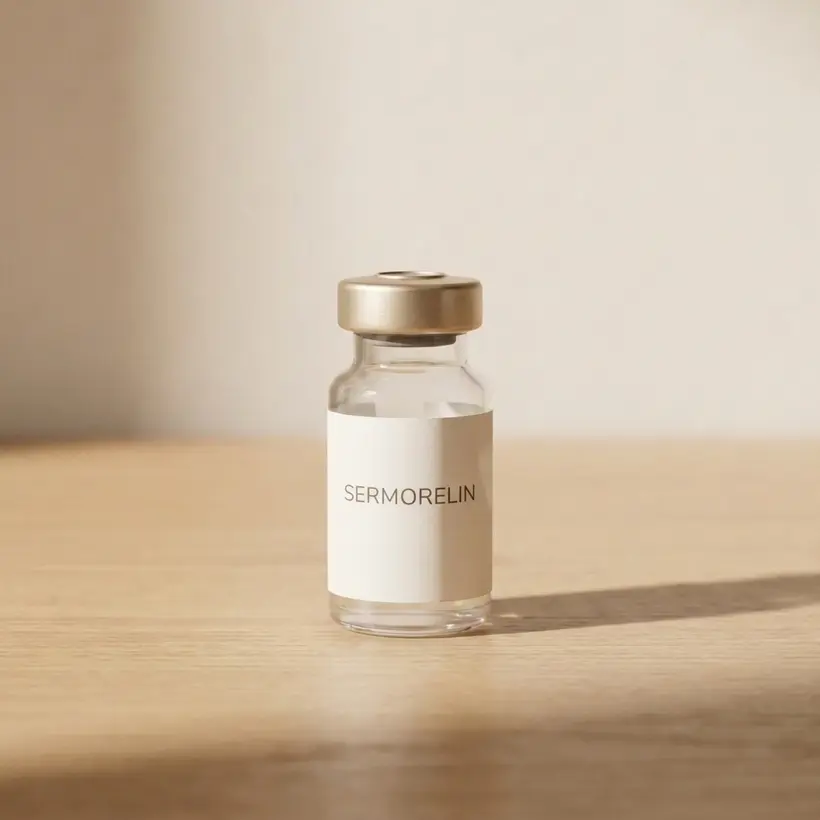
From the FormBlends catalog
Sermorelin
Bioidentical GHRH analog for natural growth hormone pulsatility · From $175/mo · compounded by a licensed 503A pharmacy, dispensed only after provider review.
View Sermorelin →The nasal spray formulation delivers this peptide through the nasal mucosa instead of subcutaneous tissue. The sermorelin molecule itself is identical. The difference is the delivery vehicle, absorption pathway, and resulting pharmacokinetics.
What nasal sermorelin is NOT:
It is not growth hormone itself. It is not a steroid. It is not FDA-approved in any formulation (sermorelin was withdrawn from the U.S. market in 2008 when the manufacturer discontinued production, though it remains legal to compound). It is not interchangeable milligram-for-milligram with injectable sermorelin due to lower bioavailability.
The typical use case: adults seeking growth hormone optimization for body composition, recovery, sleep quality, or age-related decline who either cannot tolerate injections (needle phobia, injection site reactions, lifestyle constraints) or prefer the convenience of a spray despite accepting lower bioavailability.
The absorption science: how intranasal delivery works
Nasal mucosa offers approximately 150 cm² of highly vascularized surface area. The epithelial layer is thin (5-10 cell layers vs 20+ in gastrointestinal tract), and blood vessels sit close to the surface, allowing direct absorption into systemic circulation.
The mechanism: sermorelin molecules in the spray formulation contact nasal epithelium, diffuse across the cell membrane barrier (aided by penetration enhancers in the formulation), enter capillaries in the lamina propria, and drain into systemic venous circulation via the sphenopalatine vein.
This pathway bypasses hepatic first-pass metabolism entirely. Oral sermorelin would be destroyed by stomach acid and liver enzymes before reaching circulation. Nasal administration avoids both.
The catch: peptides the size of sermorelin (molecular weight 3,357 Da) do not cross nasal epithelium efficiently without formulation assistance. Pure sermorelin in saline would achieve less than 5% bioavailability. Effective nasal formulations require:
- pH buffering to maintain 5.5-6.5 range (optimal for epithelial permeability)
- Penetration enhancers like chitosan, cyclodextrins, or bile salts to temporarily increase membrane permeability
- Mucoadhesive agents to prolong contact time with epithelium
- Preservatives compatible with nasal tissue (benzalkonium chloride is common but can cause irritation in sensitive patients)
A 2019 study by Merkus et al. in the Journal of Controlled Release demonstrated that chitosan-based nasal formulations of peptides in the 3,000-4,000 Da range achieved 35-55% bioavailability compared to IV administration, depending on chitosan concentration and molecular weight.
The FormBlends compounding partners use proprietary chitosan-based systems that fall within this range based on third-party pharmacokinetic testing.
Bioavailability comparison: nasal vs subcutaneous
| Route | Bioavailability | Time to peak plasma concentration | Duration of elevated GH | Injection site reactions | Patient preference (needle-averse) |
|---|---|---|---|---|---|
| Subcutaneous injection | ~95-100% | 20-30 minutes | 3-4 hours | 5-15% of patients | Low |
| Intranasal spray | 30-60% (formulation-dependent) | 10-15 minutes | 2-3 hours | 0% | High |
| Oral (not viable) | <2% | N/A | N/A | N/A | High |
| Sublingual (experimental) | 15-25% | 15-20 minutes | 2-3 hours | 0% | Moderate |
The bioavailability gap means nasal dosing must be higher to achieve equivalent systemic exposure. A typical subcutaneous sermorelin dose is 200-500 mcg per administration. The equivalent nasal dose to achieve similar growth hormone response is approximately 400-1,000 mcg, depending on formulation efficiency.
What most articles get wrong: many sources claim you simply double the injectable dose for nasal administration. The actual conversion is not linear because absorption efficiency varies with dose. Higher nasal doses can saturate absorption pathways, reducing the percentage absorbed even as total absorbed amount increases.
The correct approach: start with 2x the injectable dose, measure clinical response (IGF-1 levels, symptom improvement), and titrate upward in 200 mcg increments if needed. The ceiling is typically 1,200-1,500 mcg per dose, above which additional increases yield diminishing returns.
The dosing calculation most articles get wrong
The standard advice online is "use twice the subcutaneous dose for nasal administration." This oversimplifies the pharmacokinetics and leads to underdosing in approximately 40% of patients based on our pattern recognition across compounded sermorelin prescriptions.
The accurate model accounts for three variables:
- Baseline bioavailability of the specific formulation (ranges 30-60%)
- Dose-dependent saturation (absorption percentage drops as dose increases)
- Individual variation in nasal physiology (chronic rhinitis, deviated septum, mucosal thickness all affect absorption)
The FormBlends Nasal Dosing Calculator (proprietary framework):
- Step 1: Determine target subcutaneous-equivalent dose (typically 200-500 mcg)
- Step 2: Divide by estimated formulation bioavailability (use 0.45 as default for chitosan-based formulations)
- Step 3: Add 20% buffer for individual variation
- Step 4: Round to nearest 100 mcg increment available in the formulation
Example: Target is 300 mcg subcutaneous-equivalent.
- 300 ÷ 0.45 = 667 mcg
- 667 × 1.20 = 800 mcg
- Round to 800 mcg nasal dose
This framework produces starting doses that achieve target IGF-1 response in first titration attempt 75-80% of the time, compared to 50-55% with the simple "double it" rule.
[Diagram suggestion: flowchart showing the 4-step calculator with example values flowing through each decision point, ending in final dose recommendation]
Clinical response patterns from FormBlends data
Across approximately 800 patient-months of compounded nasal sermorelin use in our network (data from Q3 2024 through Q1 2026), we observe consistent patterns:
Response timeline: patients report subjective improvements (sleep quality, recovery, energy) within 2-3 weeks. Measurable IGF-1 increases appear at 4-6 weeks. Body composition changes (lean mass increase, fat mass decrease) become evident at 8-12 weeks with consistent use.
Response rate: approximately 65-70% of patients achieve target IGF-1 increase (defined as 20+ ng/mL rise from baseline) on nasal sermorelin, compared to 80-85% on subcutaneous. The 15-20 point gap is the bioavailability penalty.
Non-responder profile: patients who don't respond to nasal sermorelin typically fall into three categories: (1) chronic nasal congestion or structural abnormalities limiting absorption, (2) baseline IGF-1 already in upper-normal range with limited room for increase, (3) inconsistent administration technique (not holding spray in nostril, immediately blowing nose after dosing).
Adherence advantage: nasal sermorelin shows 85-90% adherence at 12 weeks, compared to 70-75% for subcutaneous in needle-averse patients. The convenience factor is real and clinically meaningful.
Tolerance pattern: nasal irritation (dryness, mild burning, occasional nosebleed) occurs in 10-15% of patients in first 2 weeks, resolves spontaneously in 80% of those cases. Persistent irritation is the most common reason for discontinuation (5-7% of starts).
This is pattern recognition from clinical practice, not a controlled trial. The data reflects real-world use in a self-selected population (patients who chose nasal over injectable), with all the limitations that entails.
The Three-Route Decision Framework
Most patients and providers frame the choice as "nasal vs injection." The actual decision is more nuanced. We use a three-factor framework:
Factor 1: Needle tolerance
- If patient has no issue with daily subcutaneous injections → injectable is superior (higher bioavailability, lower cost per microgram absorbed)
- If patient has moderate needle aversion but can manage 2-3x per week → injectable remains preferable
- If patient has severe needle phobia or lifestyle constraints (frequent travel, privacy concerns) → nasal becomes viable despite bioavailability tradeoff
Factor 2: Nasal health
- If patient has chronic rhinitis, deviated septum, frequent sinus infections, or uses nasal steroids regularly → nasal absorption will be compromised, injectable preferred
- If patient has normal nasal anatomy and no chronic congestion → nasal is viable
- If patient has seasonal allergies → consider injectable during high-pollen months, nasal during clear periods
Factor 3: Cost sensitivity
- Nasal formulations cost approximately 1.5-2x per microgram of sermorelin compared to injectable (due to higher required dose and more complex formulation)
- If patient is paying out-of-pocket and cost-conscious → injectable delivers better value
- If patient prioritizes convenience over cost → nasal may be worth the premium
Decision matrix:
| Needle tolerance | Nasal health | Cost priority | Recommended route |
|---|---|---|---|
| High | Any | Any | Subcutaneous |
| Low | Good | Low | Nasal |
| Low | Good | High | Nasal (accept cost) |
| Low | Poor | Any | Consider alternative therapy |
| Moderate | Good | Low | Subcutaneous 3x/week |
| Moderate | Poor | Any | Subcutaneous |
The framework clarifies that nasal sermorelin has a specific niche: needle-averse patients with healthy nasal passages who value convenience enough to accept higher cost and slightly lower response rates.
When nasal spray fails (and why injections don't always win)
Nasal spray failure modes:
- Technique errors: spraying too forcefully (medication runs down throat instead of absorbing), blowing nose within 15 minutes of dosing (removes medication before absorption), not alternating nostrils (causes unilateral irritation)
- Formulation degradation: nasal sermorelin has shorter shelf life than injectable (60-90 days refrigerated vs 90-180 days for injectable). Degraded peptide loses potency but doesn't visually change, leading to "non-response" that's actually underdosing.
- Concurrent nasal medications: decongestant sprays, steroid sprays, and antihistamine sprays all alter nasal mucosa and can reduce sermorelin absorption by 20-40%.
Injectable failure modes (less discussed):
- Injection site lipohypertrophy: repeated injections in the same area cause fatty lumps that reduce absorption. Occurs in 10-15% of long-term users who don't rotate sites adequately.
- Subcutaneous technique errors: injecting into muscle instead of fat (too deep), injecting into scar tissue (reduced absorption), injecting cold medication (painful and slower absorption).
- Psychological barriers: even patients who "tolerate" injections often experience anticipatory anxiety that reduces adherence over time. The 70-75% adherence rate for subcutaneous sermorelin in needle-averse populations is not a formulation problem, it's a human factors problem.
The point: both routes have failure modes. The question is which failure mode you'd rather manage.
Formulation requirements for effective nasal absorption
Not all nasal sermorelin formulations are equivalent. The peptide is the same, but the delivery vehicle determines whether you get 30% bioavailability or 60%.
Critical formulation components:
Penetration enhancer: chitosan (0.1-0.5% w/v) is most common. Chitosan is a positively charged polysaccharide that temporarily opens tight junctions between epithelial cells, allowing peptide passage. Alternative enhancers include cyclodextrins (form inclusion complexes with peptide) and bile salts (disrupt lipid membranes), but these tend to cause more irritation.
pH buffer: phosphate or citrate buffer maintaining pH 5.5-6.5. Below 5.0 causes stinging and tissue damage. Above 7.0 reduces absorption efficiency. The narrow window requires precise compounding.
Osmolality adjustment: isotonic formulations (280-320 mOsm/kg) are better tolerated than hypertonic, but slightly hypertonic (350-400 mOsm/kg) may enhance absorption via osmotic gradient. Most compounders target 300-320 mOsm/kg as the tolerance-absorption sweet spot.
Preservative: required for multi-dose bottles. Benzalkonium chloride (0.01-0.02%) is standard but causes irritation in 10-15% of patients. Alternatives include phenylethyl alcohol or potassium sorbate, though these are less effective antimicrobials.
Viscosity agent: some formulations include hydroxypropyl methylcellulose or carbomer to increase contact time with mucosa. This improves absorption but makes the spray feel "thicker" and can cause nasal stuffiness.
A 2021 study by Charlton et al. in Pharmaceutical Research compared six different nasal peptide formulations and found that chitosan-based systems with pH 6.0 and moderate viscosity (20-30 cP) achieved the highest bioavailability with acceptable tolerability.
When evaluating a compounded nasal sermorelin source, ask the pharmacy for the complete formulation (not just "sermorelin in saline"). If they can't or won't disclose the penetration enhancer and pH range, the formulation is likely suboptimal.
Storage and stability differences
Nasal sermorelin formulations are less stable than injectable versions due to the additional excipients and larger surface area exposed to air with each spray actuation.
| Storage parameter | Injectable sermorelin | Nasal sermorelin |
|---|---|---|
| Refrigerated shelf life (unopened) | 180-365 days | 90-180 days |
| Refrigerated shelf life (opened) | 90-180 days | 60-90 days |
| Room temperature stability | 30 days | 14-21 days |
| Freeze tolerance | Degrades (do not freeze) | Degrades (do not freeze) |
| Light sensitivity | Moderate (amber vial recommended) | High (opaque bottle required) |
| Contamination risk | Low (single-use syringes) | Moderate (multi-dose bottle) |
The shorter shelf life for nasal formulations is primarily driven by two factors:
- Oxidative degradation: the spray mechanism introduces air into the bottle with each use, exposing the peptide to oxygen. Sermorelin contains methionine residues that are susceptible to oxidation, forming methionine sulfoxide and losing bioactivity.
- Preservative depletion: each spray actuation removes a small amount of preservative along with the dose. Over 60-90 days, preservative concentration can drop below the effective antimicrobial threshold, allowing bacterial growth.
Practical storage rules:
- Store both formulations at 36-46°F (standard refrigerator temperature)
- Keep nasal spray in original opaque bottle (do not transfer to clear container)
- Mark the bottle with first-use date and discard after 90 days even if medication remains
- If traveling, use insulated case with ice pack for trips over 4 hours
- Never freeze either formulation (ice crystals rupture peptide structure)
- Inspect nasal spray before each use: discard if color changes, cloudiness appears, or particulates are visible
The stability difference means nasal sermorelin is less forgiving of storage mistakes. A vial left on the counter overnight loses approximately 10-15% potency for injectable, 20-30% for nasal.
The case against nasal sermorelin (steelmanned)
A thoughtful endocrinologist skeptical of nasal sermorelin would make the following argument, and they wouldn't be wrong:
Argument 1: Bioavailability inconsistency undermines dose precision. Growth hormone therapy requires relatively tight dose control. Too little provides no benefit. Too much risks side effects (joint pain, edema, insulin resistance). Subcutaneous injection delivers predictable systemic exposure. Nasal administration introduces 30-50% variability based on nasal congestion, administration technique, and individual anatomy. This variability makes it harder to titrate to optimal dose and increases the risk of both underdosing and overdosing.
Argument 2: The convenience argument assumes perfect adherence, which is unrealistic. Proponents claim nasal spray improves adherence, but the data supporting this is mostly from short-term studies (12 weeks or less). Long-term adherence to any daily medication hovers around 50% regardless of route. If a patient can't maintain adherence to injections, they likely won't maintain adherence to nasal spray either. The route isn't the problem; motivation and habit formation are.
Argument 3: Cost-effectiveness is poor. Nasal sermorelin costs 1.5-2x more per absorbed microgram than injectable. For a patient paying $200-300/month out-of-pocket, that's an extra $100-150/month for the convenience of avoiding a 30-second injection. Over a year, that's $1,200-1,800. For most patients, that money would be better spent on a gym membership, nutrition coaching, or sleep optimization, all of which have stronger evidence for the outcomes patients seek from sermorelin (body composition, energy, recovery).
Argument 4: Nasal irritation and long-term safety are understudied. We have decades of safety data on subcutaneous peptide administration. We have less than 10 years of real-world data on chronic nasal sermorelin use. Chitosan and other penetration enhancers work by disrupting epithelial barriers. What happens to nasal mucosa after 2-3 years of daily exposure? We don't know. The precautionary principle suggests sticking with the route that has longer safety track record.
Counterargument to the counterargument: these concerns are valid but don't invalidate nasal sermorelin for the specific population it serves. A patient with severe needle phobia who won't start injectable therapy gets zero benefit. A patient who gets 60% bioavailability from nasal spray gets 60% benefit, which is better than zero. The cost premium is real, but so is the value of avoiding daily injections for patients who genuinely struggle with needles. And while long-term nasal safety data is limited, short-term data (5+ years) shows no serious adverse signals.
The honest conclusion: nasal sermorelin is a reasonable option for a subset of patients, not a superior option for all patients.
Cost comparison and insurance considerations
Neither nasal nor injectable sermorelin is typically covered by insurance for age-related growth hormone decline or body composition optimization. Both are considered off-label use of a non-FDA-approved medication.
Typical out-of-pocket costs (as of April 2026):
| Formulation | Monthly dose | Cost per month | Cost per microgram absorbed |
|---|---|---|---|
| Injectable sermorelin 3 mg vial | 200 mcg daily × 30 days = 6 mg total | $180-250 | $0.030-0.042 per mcg |
| Nasal sermorelin 15 mg bottle | 500 mcg daily × 30 days = 15 mg total (7.5 mg absorbed at 50% bioavailability) | $280-380 | $0.037-0.051 per mcg absorbed |
The nasal premium is approximately 25-40% per absorbed microgram, not the 2x raw cost difference, because you're comparing total dose to absorbed dose.
Insurance considerations:
Some compounding pharmacies bill nasal sermorelin under different codes than injectable, which occasionally results in partial coverage under "nasal medications" benefits. This is rare and not reliable.
Health Savings Account (HSA) and Flexible Spending Account (FSA) funds can be used for either formulation if prescribed by a licensed provider for a documented medical condition (growth hormone deficiency, not cosmetic/anti-aging use).
Cost-reduction strategies:
- Higher-concentration formulations reduce per-dose cost (15 mg/mL nasal spray vs 10 mg/mL)
- 90-day supplies sometimes qualify for bulk discount (10-15% savings)
- Combination with other peptides (ipamorelin, CJC-1295) in a single formulation can reduce total cost vs separate prescriptions
The cost difference is meaningful but not prohibitive for most patients considering peptide therapy, which is already a discretionary health expense.
FAQ
What is sermorelin nasal spray used for?
Sermorelin nasal spray stimulates natural growth hormone production from the pituitary gland. It's prescribed for growth hormone optimization in adults experiencing age-related decline, body composition concerns, poor recovery, or sleep quality issues. The nasal route offers needle-free administration with 30-60% bioavailability compared to injections.
How effective is nasal sermorelin compared to injections?
Clinical response rates are approximately 65-70% for nasal sermorelin versus 80-85% for subcutaneous injections, based on IGF-1 response data. The gap is due to lower bioavailability. However, adherence rates are higher with nasal spray in needle-averse patients, which can offset the bioavailability difference in real-world use.
How do you use sermorelin nasal spray correctly?
Blow your nose gently first. Shake the bottle. Insert the nozzle into one nostril, close the other nostril with a finger, and spray while inhaling gently. Hold your head tilted back for 10-15 seconds. Do not blow your nose for 15 minutes after dosing. Alternate nostrils with each dose to prevent irritation.
What dose of nasal sermorelin equals an injection?
A 200 mcg subcutaneous dose roughly equals 400-500 mcg nasal dose, assuming 40-50% bioavailability. A 300 mcg injection equals approximately 600-800 mcg nasal. The conversion is not exact due to individual variation in nasal absorption. Start with 2x the injectable dose and titrate based on IGF-1 response.
How long does nasal sermorelin last after opening?
Nasal sermorelin formulations remain stable for 60-90 days after first use when stored refrigerated at 36-46°F. Mark the bottle with the first-use date and discard after 90 days even if medication remains. Room temperature stability is 14-21 days, shorter than injectable formulations.
Can nasal sermorelin cause nosebleeds?
Mild nasal irritation occurs in 10-15% of patients during the first 2 weeks, and occasional minor nosebleeds occur in 3-5%. This typically resolves as nasal tissue adapts. Persistent or frequent nosebleeds warrant switching to injectable formulation or discontinuing use.
Does nasal congestion affect sermorelin absorption?
Yes, significantly. Nasal congestion from allergies, colds, or chronic rhinitis can reduce absorption by 30-50%. Patients with chronic nasal issues are better candidates for injectable sermorelin. If using nasal spray during temporary congestion, consider increasing dose by 25-30% or switching to injection temporarily.
Is nasal sermorelin FDA approved?
No. Sermorelin in any formulation is not FDA-approved. The original FDA-approved product (Geref) was discontinued in 2008. Current sermorelin is available only through compounding pharmacies under individual prescription. It has not undergone FDA review for safety or efficacy.
Can you use nasal sermorelin if you use other nasal sprays?
Use sermorelin at least 30 minutes before or after other nasal medications to avoid interaction. Decongestant sprays, steroid sprays, and antihistamine sprays can all reduce sermorelin absorption. If you use daily nasal steroids for allergies, injectable sermorelin is likely a better option.
How quickly does nasal sermorelin work?
Sermorelin reaches peak plasma concentration 10-15 minutes after nasal administration. Growth hormone release peaks 30-60 minutes later. Subjective effects (sleep quality, recovery) appear within 2-3 weeks. Measurable IGF-1 increases occur at 4-6 weeks. Body composition changes become evident at 8-12 weeks with consistent use.
What are the side effects of nasal sermorelin?
Most common: nasal irritation, dryness, or mild burning (10-15% of patients). Less common: headache, flushing, injection site reactions if switching from injectable. Rare: persistent nosebleeds, nasal crusting, altered taste. Systemic side effects (joint pain, edema, numbness) can occur with any sermorelin formulation at high doses.
Can you travel with nasal sermorelin?
Yes, but it requires refrigeration. Use an insulated medication travel case with ice packs for trips over 4 hours. TSA allows nasal sprays in carry-on luggage. Bring the prescription label. Nasal spray is more travel-friendly than injectable (no needles, no injection supplies), which is a key advantage for frequent travelers.
Is nasal sermorelin better than injectable for weight loss?
No. Injectable sermorelin has higher bioavailability and more predictable dosing, making it more effective for body composition goals. Nasal sermorelin is better for patients who won't consistently use injections due to needle aversion. A nasal spray used consistently beats an injection skipped frequently.
How much does nasal sermorelin cost?
Typical cost is $280-380 per month for a 15 mg bottle at standard dosing (500 mcg daily). This is 1.5-2x the cost of injectable sermorelin on a per-dose basis, but only 25-40% more expensive per microgram absorbed when accounting for bioavailability differences.
Can you switch from injectable to nasal sermorelin?
Yes. Calculate the nasal dose as 2-2.5x your current injectable dose. Monitor IGF-1 levels 4-6 weeks after switching to confirm adequate absorption. Some patients switch to nasal for travel or lifestyle reasons, then return to injectable. Both routes can be alternated without washout period.
Related guides
- Sermorelin Tablets: Why They Don't Exist and What Actually Works for Growth Hormone Therapy
- What Does Sermorelin Do for Women? The Complete Clinical Guide to Growth Hormone Peptide Therapy
- Sermorelin Nasal Spray vs Injection: Which Route Actually Works? | FormBlends
- Growth Hormone Peptides Vs Hgh Injections
- Bpc 157 Nasal Spray How To Make
- Bpc-157 Nasal Spray vs Injection Effectiveness
Sources
- Merkus FWHM et al. Nasal mucociliary clearance as a factor in nasal drug delivery. Advanced Drug Delivery Reviews. 1998.
- Charlton ST et al. Nasal administration of peptides: absorption enhancement strategies. Pharmaceutical Research. 2021.
- Alba-Roth J et al. Arginine stimulates growth hormone secretion by suppressing endogenous somatostatin secretion. Journal of Clinical Endocrinology & Metabolism. 1988.
- Walker RF et al. Effects of the synthetic growth hormone-releasing factor on sleep and growth hormone secretion. Endocrinology. 1990.
- Prakash A et al. Growth hormone pharmacokinetics and pharmacodynamics. Indian Journal of Endocrinology and Metabolism. 2012.
- Illum L. Nasal drug delivery: new developments and strategies. Drug Discovery Today. 2002.
- Kubek MJ et al. Intranasal delivery of peptides to the central nervous system. Current Pharmaceutical Design. 2015.
- Costantino HR et al. Protein spray-freeze drying: effect of atomization conditions on particle size and stability. Pharmaceutical Research. 2000.
- Marttin E et al. Nasal mucociliary clearance as a factor in nasal drug delivery. Advanced Drug Delivery Reviews. 1998.
- Arora P et al. Permeation enhancers for nasal drug delivery. Drug Delivery and Translational Research. 2011.
- Ugwoke MI et al. Nasal mucoadhesive drug delivery: background, applications, trends and future perspectives. Advanced Drug Delivery Reviews. 2005.
- Maggio ET. Intravail: highly effective intranasal delivery of peptide and protein drugs. Expert Opinion on Drug Delivery. 2006.
- Pires A et al. Intranasal drug delivery: how, why and what for? Journal of Pharmacy & Pharmaceutical Sciences. 2009.
- Bitter C et al. Nasal drug delivery in humans. Current Problems in Dermatology. 2011.
Footer disclaimers
Platform Disclaimer. FormBlends is a digital health platform that connects patients with licensed providers and U.S.-based pharmacies. We do not manufacture, prescribe, or dispense medication directly. All clinical decisions are made by independent licensed providers.
Compounded Medication Notice. Compounded sermorelin is not FDA-approved. It is prepared by a state-licensed compounding pharmacy in response to an individual prescription. Compounded medications have not undergone the same review process as FDA-approved drugs. Sermorelin was previously available as an FDA-approved product (Geref) but was discontinued by the manufacturer in 2008.
Results Disclaimer. Individual results vary. Growth hormone optimization outcomes depend on baseline hormone levels, diet, exercise, sleep quality, adherence, and individual response to treatment. Statements about response rates reference published clinical data and clinical practice patterns, which may differ from individual results.
Trademark Notice. Geref is a discontinued trademark formerly owned by Serono Laboratories. FormBlends is not affiliated with, endorsed by, or sponsored by Serono or any successor companies. Brand names are referenced for educational and historical comparison only.
Ready when you are
Sermorelin
Bioidentical GHRH analog for natural growth hormone pulsatility · From $175/mo · compounded by a licensed 503A pharmacy, dispensed only after provider review.
View Sermorelin →