Last spring, a 48-year-old IT manager named David in Austin told his prescriber he was paying $2,200 a month for pharmaceutical-grade HGH through a concierge clinic. His IGF-1 was running 387 ng/mL, well above the top of reference range. His sleep was great. His body composition had improved. He also had bilateral wrist tingling, morning puffiness that hadn't gone away in four months, and a fasting glucose that had crept from 92 to 114. "I feel better than I did at 40," he said, "but I'm starting to wonder what I'm paying for this with." His prescriber switched him to compounded sermorelin at roughly $220 a month. Three months later his IGF-1 settled at 248, the wrist tingling resolved, and fasting glucose came back down to 97. His words at follow-up: "The gains are smaller. But I'm not scared of my own bloodwork anymore."
That story captures the central tension of the sermorelin vs HGH debate pretty well. One approach overrides your biology. The other works with it. And the right pick depends on what problem you're actually trying to solve.
The Fundamental Mechanical Split
Sermorelin is a 29-amino-acid fragment of natural GHRH (growth hormone releasing hormone). It lands on GHRH receptors on the anterior pituitary and coaxes the gland into releasing a pulse of your own growth hormone. That's it. The peptide is the doorbell; the pituitary is still the one answering.
Recombinant human growth hormone (rhGH) skips the door entirely. It's a synthetic copy of the full 191-amino-acid human GH molecule, injected subcutaneously, delivered straight into circulation.
Here's the thing that matters most: when sermorelin pushes IGF-1 up, the hypothalamus releases somatostatin and shuts the next pulse down. There's a built-in ceiling. Your body regulates the response the same way it regulates everything else, through negative feedback. With rhGH, that ceiling doesn't exist. You inject the hormone. It circulates. The feedback loop has nothing to regulate because the GH isn't coming from the pituitary.
Think of it like the difference between turning up the thermostat and pointing a blowtorch at the thermometer. One works within the system. The other produces heat regardless of what the system wants.
Practically, this means:
- Sermorelin: pulsatile GH release, physiologic IGF-1 elevation, self-limiting, requires a working pituitary.
- rhGH: continuous GH elevation for hours post-injection, dose-proportional with no endogenous brake, works even if the pituitary is destroyed.
Why the Legal Difference Is Bigger Than You'd Expect
In the U.S., rhGH is not just a prescription drug. It occupies a uniquely restricted legal category. Federal law limits prescribing to specific FDA-approved indications: pediatric GH deficiency, adult GH deficiency confirmed by stimulation testing, certain genetic conditions, short bowel syndrome, HIV wasting. Off-label prescribing of rhGH carries legal exposure that goes well beyond what applies to most medications. Possession and distribution outside approved channels can trigger serious federal penalties.
Sermorelin? Not a controlled substance. It was originally FDA-approved as Geref for pediatric diagnostic use, though that branded product is no longer on the market. Today it's available as a compounded medication prepared by licensed 503A/503B compounding pharmacies for individual patients with a valid prescription. The compounded adult use is off-label, but legally straightforward.
This regulatory gap is enormous in practice. It's the reason most adults exploring GH-axis support end up considering sermorelin first, and often last.
The Cost Reality
The numbers here aren't close.
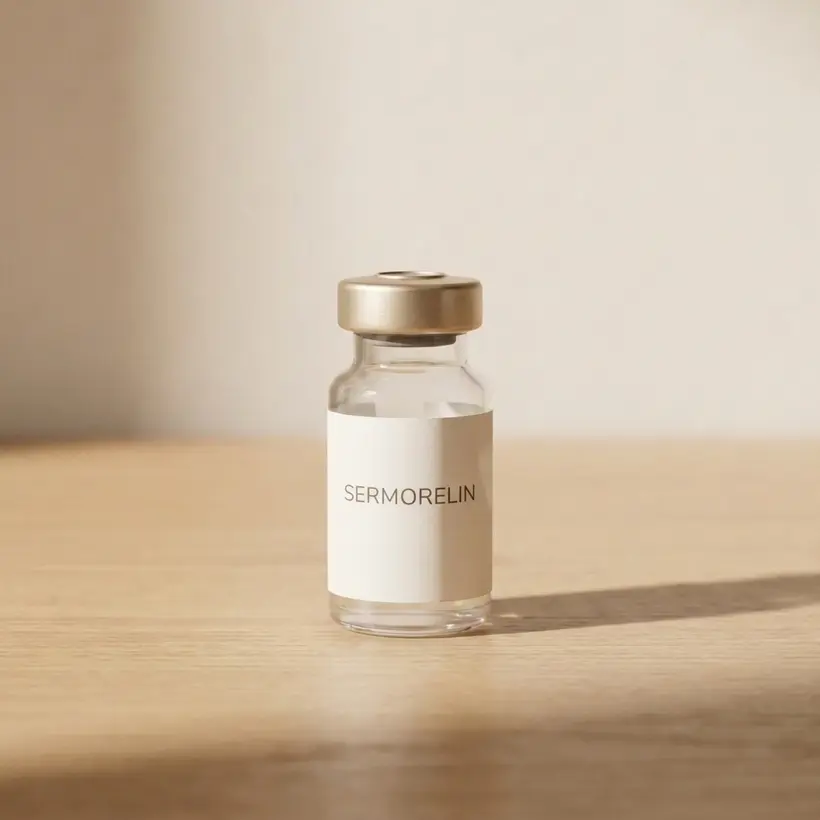
From the FormBlends catalog
Sermorelin
Bioidentical GHRH analog for natural growth hormone pulsatility · From $175/mo · compounded by a licensed 503A pharmacy, dispensed only after provider review.
View Sermorelin →Brand rhGH at typical adult doses runs $1,000 to $3,000+ per month. Insurance will cover it for FDA-approved indications if you jump through the prior authorization hoops, but out-of-pocket for off-label use? Almost nobody sustains that long-term.
Compounded sermorelin typically lands between $150 and $400 per month. Insurance generally doesn't cover compounded peptides either, but the out-of-pocket is manageable enough that patients can run therapy for 6 to 12 months without financial distress.
I'd estimate cost drives the final decision in at least half the cases where a patient could theoretically access either option. That's not cynicism. That's just how healthcare works when one option costs seven to ten times more than the other.
Side Effects: Where the Feedback Loop Earns Its Keep
The side effect profiles track directly from the mechanism.
rhGH at typical adult doses produces:
- Edema and water retention (often visibly pronounced, especially in the face and hands)
- Carpal tunnel syndrome
- Joint pain and arthralgias
- Insulin resistance and rising fasting glucose
- IGF-1 that can blow past the top of the reference range
- With long-term supraphysiologic exposure, acromegaly-like soft tissue changes
Sermorelin at physiologic doses produces:
- Mild injection-site irritation (the most common complaint by far)
- Transient flushing in the first couple of weeks
- Occasional mild headache early on
- Some fluid retention, but typically less noticeable
- Modest glucose effects, usually subclinical
- IGF-1 that stays in or near the reference range because the feedback loop caps it
David's story above isn't unusual. The wrist tingling, the facial puffiness, the creeping fasting glucose: those are textbook rhGH side effects at doses that produce "impressive" results. Sermorelin's milder profile isn't a limitation. It's a feature of a system that still has its own brakes.
Honest Talk About Magnitude of Effect
I won't pretend the two produce equivalent results. They don't.
At typical doses, rhGH delivers more dramatic body composition changes, higher IGF-1 peaks, more pronounced recovery benefits, and faster visible results (often within 4 to 8 weeks). The trade-off is that side effects arrive on roughly the same timeline.
Sermorelin works more slowly. Sleep improvements usually show up in the first two weeks (this is the most reliable early signal that the peptide is doing its job). Body composition shifts take 8 to 12 weeks to become noticeable. The effects are real but measured. You're restoring something closer to your body's youthful baseline, not overriding it.
Whether "more" is better depends entirely on your situation. For diagnosed severe adult GH deficiency, rhGH replacement is the medical standard for good reason; the pituitary isn't capable of responding to a GHRH analog. For age-related GH decline in someone with an intact pituitary, the physiologic approach of sermorelin usually carries a better risk-to-benefit ratio. My own opinion: most adults in the wellness category are better served by the gentler tool. The people who genuinely need rhGH know it because they've had the endocrine workup that proves it.
Who Actually Ends Up on Which
rhGH makes clinical sense for:
- Confirmed adult GH deficiency (by stimulation testing, not just a low-ish IGF-1)
- Pediatric short stature meeting diagnostic criteria
- HIV wasting
- Short bowel syndrome
- Specific genetic syndromes like Turner or Prader-Willi
Outside those boxes, rhGH use gets legally complicated, financially punishing, and medically harder to justify.
Sermorelin fits for:
- Adults with age-related GH decline (subclinical, not frank GHD)
- Patients targeting better sleep, body composition, and recovery
- Patients who want to preserve physiologic regulation rather than override it
- Patients for whom rhGH cost or legal exposure is a dealbreaker
- Anyone with intact pituitary function
The pituitary requirement is non-negotiable. If there's significant pituitary disease, sermorelin won't work. The peptide is a signal, and if the receiver is broken, it doesn't matter how loud you ring the bell.
Long-Term Safety and Cycling
The long-term data concern with rhGH at supraphysiologic doses centers on sustained IGF-1 elevation above the reference range. Epidemiologic data links chronically elevated IGF-1 with increased risk of certain cancers, progressive insulin resistance, and soft tissue overgrowth. Monitoring is non-optional.
Sermorelin's safety profile over time looks different precisely because the feedback loop keeps IGF-1 in a physiologic corridor. That doesn't mean monitoring is unnecessary (it always is), but the risk calculus genuinely differs.
On cycling: rhGH is usually run continuously because cycling doesn't meaningfully reduce side effects and stopping produces noticeable regression. Sermorelin is commonly cycled (five days on, two off per week, or longer blocks of six months on with a break) partly by convention in compounded practice and partly on the theoretical basis of GHRH receptor preservation. The cycling tradition isn't backed by randomized trials, but it's well-established among experienced prescribers.
The Misuse Problem Worth Naming
A non-trivial amount of rhGH circulating in the wellness and bodybuilding world comes from outside legal and medical channels. That means counterfeit products, mislabeled concentrations, contamination risk, no medical oversight, and federal legal exposure. Sermorelin prescribed by a licensed clinician and prepared by a licensed compounding pharmacy is a fundamentally different category. It stays inside legal and medical structures. That distinction matters more than most comparison articles bother to mention.
FAQ
Is sermorelin as effective as HGH? Sermorelin produces a milder, more gradual version of the body composition and IGF-1 effects you get from rhGH. Whether the magnitude is "enough" depends entirely on what you're trying to accomplish and what your baseline looks like.
Is sermorelin legal? Yes, when prescribed by a licensed clinician and dispensed by a licensed compounding pharmacy for an individual patient. It is not a controlled substance.
Is HGH legal? HGH is legal when prescribed for an FDA-approved indication. Off-label use and unprescribed possession carry significant legal risk under federal law.
Can I switch from HGH to sermorelin? This needs to be managed by the prescriber overseeing your therapy. The two work through completely different mechanisms, and direct dose-for-dose substitution doesn't make pharmacologic sense.
Which has fewer side effects? Sermorelin at physiologic doses has a meaningfully milder side effect profile than rhGH at typical adult doses. The intact feedback loop is the reason: it prevents the supraphysiologic hormone exposure that drives most of rhGH's adverse effects.
How long before I notice sermorelin working? Sleep improvements are typically the first signal, often within one to two weeks. Body composition and recovery changes develop more gradually over 8 to 12 weeks.
Does sermorelin work if my pituitary is damaged? No. Sermorelin requires a functional pituitary gland. If pituitary function is significantly impaired, it cannot produce the GH release the peptide is designed to trigger.
---
Sermorelin is not FDA-approved for the treatment of any condition in adults. Compounded sermorelin is prepared by licensed pharmacies for individual patients based on a prescriber's clinical judgment. This article is educational only and does not constitute medical advice. Talk to a qualified clinician before starting any peptide therapy.
Related reading: Sermorelin Dosage Protocols | Sermorelin Benefits and Research | Sermorelin Side Effects Explained | Sermorelin Results Timeline | Order Compounded Sermorelin
Ready when you are
Sermorelin
Bioidentical GHRH analog for natural growth hormone pulsatility · From $175/mo · compounded by a licensed 503A pharmacy, dispensed only after provider review.
View Sermorelin →