All GLP-1 medications from licensed 503A compounding pharmacies Browse Products
Tb 500 Dosage And Protocol Guide
You have been prescribed TB-500 or you are considering it. Now you want to understand the TB-500 dosage protocol) how much, how often, and for how long.
You have been prescribed TB-500 or you're considering it. Now you want to understand the TB-500 dosage protocol) how much, how often, and for how long. This guide explains how licensed providers typically approach TB-500 therapy so you can have an informed conversation with your healthcare team.
You have been prescribed TB-500 or you're considering it. Now you want to understand the TB-500 dosage protocol) how much, how often, and for how long. This guide explains how licensed providers typically approach TB-500 therapy so you can have an informed conversation with your healthcare team.
Key Takeaways:
- Understanding TB-500 Dosing Phases
- Injection Technique and Site Rotation
- Reconstitution calculator: Preparing Your TB-500
- Monitoring Your Progress on TB-500
Every protocol should be personalized. What works for one person may not be right for another. Your provider will determine your specific dosing based on your clinical needs, health history, and treatment goals.
How TB-500 Dosing Phases
Most TB-500 protocols follow a two-phase approach: loading and maintenance. This structure is based on the pharmacology of the peptide and clinical observations from providers who prescribe it.
The loading phase aims to build up tissue-level concentrations of TB-500. During this phase, doses are typically higher and injections more frequent. The goal is to saturate your body with the peptide so it can begin its tissue repair work.
Loading phases typically last 4-6 weeks. Some providers use a 4-week loading phase for acute conditions and a 6-week phase for chronic issues. The idea is that longer-standing problems may need more time to establish therapeutic levels.
The maintenance phase follows loading. Doses are reduced and injection frequency may decrease. The goal shifts from building up levels to maintaining them while your body continues its repair process.
Maintenance phases vary widely based on the condition being treated. Some providers recommend 4-6 weeks of maintenance. Others extend maintenance for several months, especially for chronic conditions.
Rest periods are sometimes incorporated between cycles. Some protocols include a 2-4 week break between treatment cycles. This allows providers to assess your progress without the peptide and determine if additional cycles are warranted.
Your will design a protocol specific to your situation. Self-dosing without medical supervision isn't recommended.
Injection Technique and Site Rotation
"What makes tirzepatide particularly interesting is the dual GIP/GLP-1 mechanism. We're seeing that GIP receptor activation appears to amplify the metabolic effects in ways we didn't fully anticipate from the preclinical data.", Dr. Ania Jastreboff, MD, PhD, Yale School of Medicine, lead author of SURMOUNT-1[1]
Popular Therapeutic Peptides by Use Case. Based on published peptide research literature.
View data table
Bar chart showing popular therapeutic peptides by use case: BPC-157 (88), TB-500 (82), Sermorelin (78), Ipamorelin (75), GHK-Cu (70)
Category
Clinical Interest Score
Detail
BPC-157
88
Tissue repair and gut healing
TB-500
82
Injury recovery
Sermorelin
78
Growth hormone support
Ipamorelin
75
Anti-aging and recovery
GHK-Cu
70
Skin and tissue repair
TB-500 is administered via subcutaneous injection. This means the injection goes into the fat layer just beneath your skin (not into muscle.
Free Download: Peptide Protocol Planner (12-Week)
Track your TB-500 injections, doses, sites, and progress with this structured planner. Includes a site rotation diagram and space for symptom notes. Get yours free) we'll email it to you instantly.
[Email Input] [Download Button]
Preparation steps:
1. Wash your hands thoroughly
2. Clean the injection site with an alcohol swab
3. Clean the vial top with an alcohol swab
4. Draw the prescribed dose using an insulin syringe
5. Pinch a fold of skin at the injection site
6. Insert the needle at a 45-degree angle
7. Inject slowly and steadily
8. Release the skin fold and withdraw the needle
9. Apply light pressure with a clean cotton ball
Common injection sites include:
- Lower abdomen (most common (2 inches from the navel)
- Upper outer thigh
- Back of the upper arm
Site rotation is important. Don't inject in the same spot repeatedly. Rotate between at least 3-4 sites. This reduces the risk of injection site reactions, lipodystrophy (changes in the fat tissue), and discomfort.
Some providers suggest injecting closer to the area of injury when possible. For example, if you're using TB-500 for a shoulder issue, injecting in the deltoid area may be suggested. Discuss this with your provider.
Use the to log each injection) date, time, dose, and site. This makes it easy to rotate properly and gives your provider accurate information during follow-up visits.
Reconstitution: Preparing Your TB-500
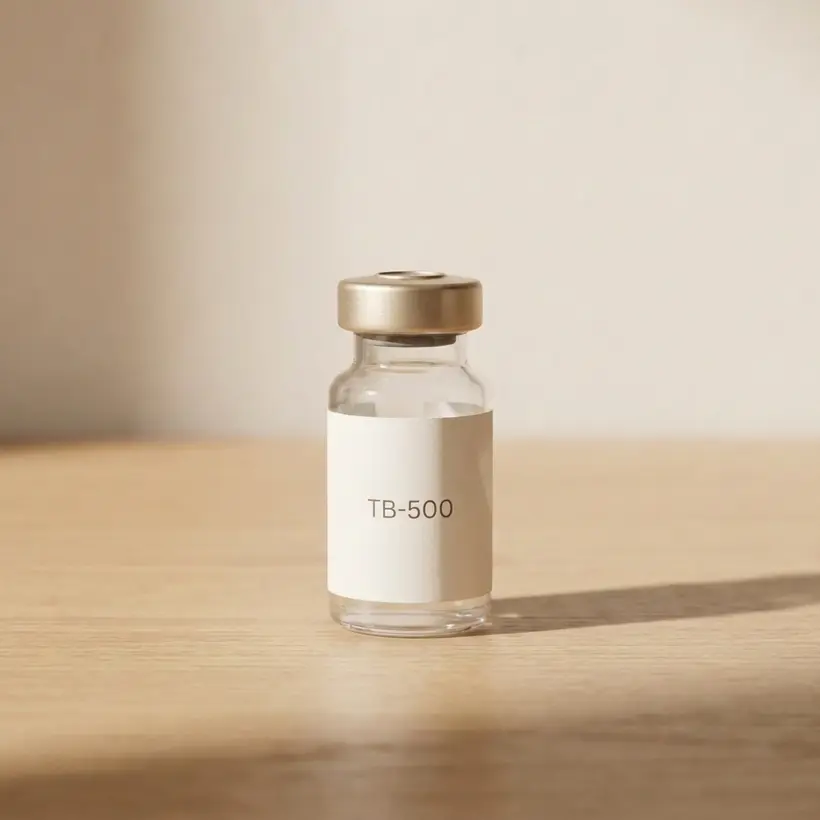
TB-500 arrives as a lyophilized (freeze-dried) powder in a vial. Before you can inject it, you need to reconstitute it with bacteriostatic water.
From the FormBlends catalog
TB-500 (Thymosin Beta-4)
Universal repair peptide for tissue regeneration · From $49/mo · compounded by a licensed 503A pharmacy, dispensed only after provider review.
What you need:
- TB-500 vial (powder)
- Bacteriostatic water
- Insulin syringes
- Alcohol swabs
Basic reconstitution process:
1. Clean the tops of both the TB-500 vial and the bacteriostatic water vial
2. Draw the prescribed amount of bacteriostatic water into a syringe
3. Inject the water into the TB-500 vial slowly, aiming the stream at the side of the vial (not directly onto the powder
4. Gently swirl the vial until the powder dissolves completely. Don't shake vigorously
5. Store the reconstituted solution in the refrigerator
The concentration of your reconstituted TB-500 depends on how much bacteriostatic water you add. This determines how much liquid you draw for each dose. Our does the math for you) enter your vial size and desired dose, and it tells you exactly how much water to add and how much to draw per injection.
For a complete walkthrough with visual guidance, read our .
Storage after reconstitution:
- Refrigerate at 36-46 degrees Fahrenheit (2-8 degrees Celsius)
- Use within 3-4 weeks of reconstitution
- Never freeze reconstituted peptides
- Keep away from direct light
Monitoring Your Progress on TB-500
Tracking your response to TB-500 helps your provider improve your protocol. Here is what to monitor.
Subjective measures:
- Pain levels (rate 1-10 daily)
- Range of motion in affected areas
- Sleep quality
- Energy levels
- Overall recovery speed
Objective measures your provider may track:
- Imaging studies (MRI, ultrasound) before and after treatment
- Physical examination findings
- Functional assessments specific to your condition
What to report to your provider:
- Any injection site reactions (redness, swelling, pain)
- New symptoms that develop during treatment
- Improvements or lack of improvement in your primary concern
- Any other medications or supplements you start during treatment
Keep a daily log for the first few weeks. After that, weekly notes are typically sufficient. The makes this easy with built-in protocol tracking. Your provider can review your logs during follow-up appointments.
Schedule check-ins with your provider at weeks 4, 8, and 12 of your protocol. These touchpoints allow for dose adjustments, protocol changes, and informed decisions about continuing treatment.
Frequently Asked Questions
How quickly will I notice results from TB-500?
Response timelines vary by condition. Some people report subtle improvements in 1-2 weeks, particularly in inflammation and comfort levels. More significant tissue repair effects typically become noticeable at 4-8 weeks. Complete protocol results are usually assessed at 8-12 weeks.
Can I adjust my TB-500 dose on my own?
No. TB-500 dosing should only be adjusted by your prescribing provider. If you feel your dose is too high (side effects) or too low (no response), contact your provider to discuss adjustments. Self-adjusting can lead to suboptimal outcomes or unnecessary side effects.
What happens if I miss a TB-500 injection?
If you miss a scheduled injection, take it as soon as you remember. If it's close to your next scheduled dose, skip the missed one and continue your regular schedule. Don't double up on doses. Note the missed dose in your tracking log and mention it to your provider.
Should I take TB-500 on an empty stomach?
TB-500 is injected subcutaneously, so stomach contents don't affect absorption. You can inject at any time regardless of meals. Choose a consistent time that works for your schedule.
How long can I stay on TB-500?
Treatment duration depends on your clinical indication and provider recommendation. Typical cycles run 8-16 weeks. Some conditions may warrant repeated cycles with rest periods between them. Your provider will assess your progress and determine whether continued treatment is appropriate.
Ready to Take the Next Step?
Your health outcomes is personal, and you deserve a plan that fits. FormBlends connects you with licensed providers who can evaluate your needs and create a personalized protocol.
Medical References
Jastreboff AM, Aronne LJ, Ahmad NN, et al. Tirzepatide Once Weekly for the Treatment of Obesity. N Engl J Med. 2022;387(3):205-216. [PubMed | ClinicalTrials.gov | DOI]
Sources &. References
Bock-Marquette I, Saxena A, White MD, et al. Thymosin beta4 activates integrin-linked kinase and promotes cardiac cell migration, survival and cardiac repair. Nature. 2004;432(7016):466-472. Doi:10.1038/nature03000
Malinda KM, Sidhu GS, Mani H, et al. Thymosin beta4 accelerates wound healing. J Invest Dermatol. 1999;113(3):364-368. Doi:10.1046/j.1523-1747.1999.00708.x
The information in this article is intended for educational use only and shouldn't be considered medical advice. Consult a qualified healthcare provider before making any changes to your medication or supplement regimen. FormBlends helps with connections with licensed providers for personalized medical guidance.
Last updated: 2026-03-24
Ready when you are
TB-500 (Thymosin Beta-4)
Universal repair peptide for tissue regeneration · From $49/mo · compounded by a licensed 503A pharmacy, dispensed only after provider review.
Custom header image for Tb 500 Dosage And Protocol Guide, Peptide Therapy, and better treatment decision-making.
Peptide decision path
Move from research interest to supervised review
Related treatment context
Tb 500 Dosage And Protocol Guide should be evaluated through research status, legal access, source quality, safety context, and clinician oversight rather than a shortcut purchase decision.
A printable 2-page reference covering popular peptides, dosing ranges, stacking protocols, and storage.
Free download. We'll also send helpful GLP-1 guides to your inbox. Unsubscribe anytime.
Medical Disclaimer: This content is for informational purposes only and does not constitute medical advice. Always consult a qualified healthcare provider before starting, stopping, or changing any medication or treatment. FormBlends articles are source-checked against medical and regulatory references, but they are not a substitute for a personal medical consultation.
Written by FormBlends Editorial Research
Prepared by FormBlends Editorial Research.
Ready to get started?
Provider-reviewed GLP-1 and peptide therapy, delivered to your door.