
Trust Signals
Key Takeaways
- No human RCT has established a safe or effective TB-500 dose; every milligram figure in circulation is extrapolated from equine and rodent studies.
- TB-500 is the synthetic fragment of Thymosin Beta-4 covering amino acids 17-23 (the LKKTETQ actin-binding peptide), not the full 43-amino-acid protein; dose equivalence is unknown.
- The community loading protocol of 4-8 mg per week derives primarily from veterinary wound-healing and equine tendon research, not human pharmacokinetic data.
- TB-500 is on the WADA Prohibited List (S2 class) regardless of dose; any measurable quantity disqualifies competitive athletes.
- A 10 mg vial reconstituted with 2 mL bacteriostatic water yields 5 mg/mL; each 0.1 mL drawn delivers 0.5 mg, giving clear, reproducible dosing arithmetic.
What Is the Correct TB-500 Dosage?
The most referenced research protocol uses a loading phase of 4-8 mg per week (commonly split into two injections of 2-4 mg each) for 4-6 weeks, followed by a maintenance phase of roughly 2-2.5 mg per week. These figures originate from veterinary and animal model data, not controlled human trials. There is no FDA-approved human dose and no published Phase I dose-escalation trial for TB-500 specifically.
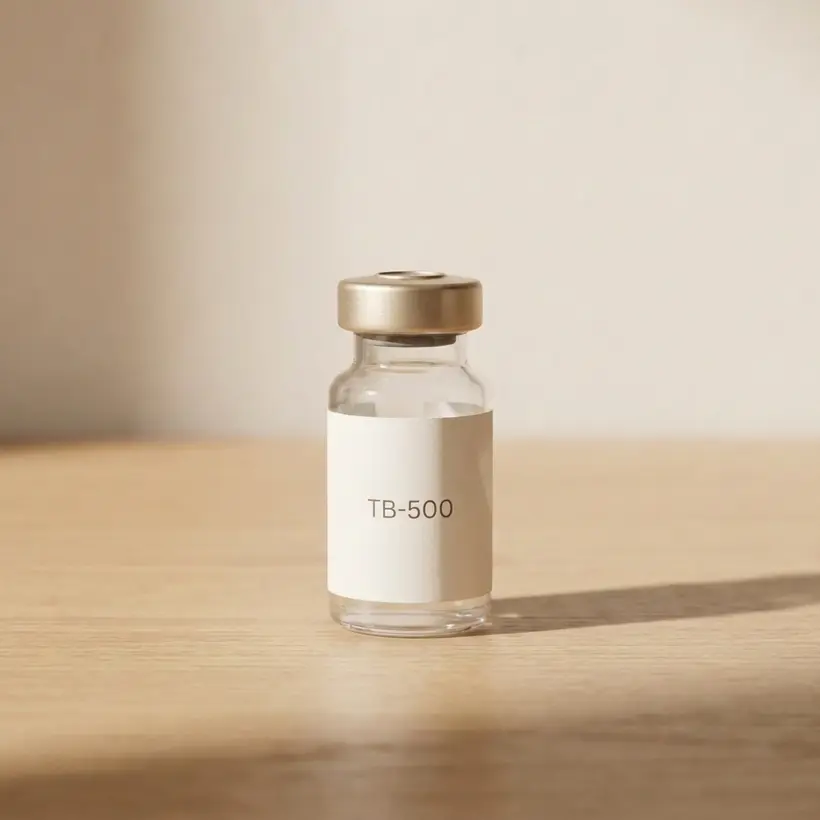
From the FormBlends catalog
TB-500 (Thymosin Beta-4)
Universal repair peptide for tissue regeneration · From $49/mo · compounded by a licensed 503A pharmacy, dispensed only after provider review.
Learn about TB-500 (Thymosin Beta-4) →Table of Contents
- Evidence Ledger: What the Data Actually Supports
- Mechanism With Numbers: Why Any Dose Works at All
- Dosage Protocol Table: Loading, Maintenance, Frequency
- TB-500 10mg Vial: Reconstitution Math and Syringe Guide
- What Most Dosage Pages Get Wrong
- Chemistry Behind Storage and Stability Rules
- Honest Head-to-Head: TB-500 vs. BPC-157 vs. Approved Alternatives
- Label and COA Literacy: How to Evaluate a TB-500 Product
- WADA, Legal Status, and Regulatory Reality
- Frequently Asked Questions
- Sources
Evidence Ledger: What the Data Actually Supports
Every major claim about TB-500 dosing is graded below. Read the confidence column before acting on any figure.
| Claim | Best Evidence Type | Effect Direction | Confidence |
|---|---|---|---|
| TB-500 (Tβ4 fragment 17-23) promotes actin polymerization and cell migration in vitro | In vitro mechanistic (multiple labs) | Positive | Moderate |
| Thymosin Beta-4 (full peptide) accelerates wound healing in rodent and equine models | Animal studies, some equine RCTs | Positive | Moderate (animal); Low (human extrapolation) |
| Loading dose of 4-8 mg/week is effective or safe in humans | Community extrapolation from animal data; no human RCT | Unknown | Very Low |
| Maintenance dose of 2-2.5 mg/week is effective or safe in humans | Community convention; no controlled human data | Unknown | Very Low |
| Subcutaneous injection is a valid route | Animal studies; mechanism plausibility | Plausible | Low |
| TB-500 is detectable by WADA-approved anti-doping tests | WADA technical documents and published LC-MS/MS methods | Confirmed | High |
| Reconstituted peptide degrades faster at room temperature than at 2-8 C | General peptide chemistry; USP guidance on biologics | Positive (degradation accelerates with heat) | High (principle); Low (TB-500-specific kinetics) |
| Daily dosing offers additional benefit over twice-weekly dosing | No comparative data in any species | Unknown | Very Low |
Mechanism With Numbers: Why Any Dose Works at All
TB-500 is a 7-amino-acid synthetic peptide (Ac-LKKTETQ-NH2) corresponding to positions 17-23 of the 43-amino-acid Thymosin Beta-4 (Tβ4). This segment contains the actin-binding motif responsible for sequestering G-actin (globular actin) and facilitating F-actin (filamentous actin) assembly at the leading edge of migrating cells.
Key mechanistic data points from published research:
- Thymosin Beta-4 is one of the most abundant intracellular peptides in mammalian cells, with concentrations in the micromolar range intracellularly. The fragment TB-500 acts extracellularly to trigger cell migration via integrin and AKT signaling pathways (Sosne et al., multiple publications 2002-2012).
- In rodent cardiac injury models, Tβ4 administration was associated with cardiomyocyte survival and reduced apoptosis; effects were observed at doses in the microgram-per-kilogram intraperitoneal range (Bock-Marquette et al., Nature 2004).
- An equine tendon study (Dyson, and separately work from Schnabel et al.) evaluated intra-tendinous administration, though published dose-response curves for TB-500 specifically (versus full Tβ4) are sparse in peer-reviewed literature.
- Upregulation of metalloproteinases (MMP-2) and integrin-linked kinase (ILK) downstream of Tβ4 has been quantified in corneal and wound-healing models, with statistically significant effects at doses in the nanomolar range in cell culture.
Dosage Protocol Table: Loading, Maintenance, Frequency
The table below reflects community-derived protocols that are widely referenced in research forums and compounding contexts. These are NOT clinical guidelines. Each value carries a Very Low evidence grade for human efficacy and safety.
| Phase | Weekly Dose | Per Injection | Injections/Week | Duration | Evidence Grade |
|---|---|---|---|---|---|
| Loading (acute injury) | 6-8 mg | 2-4 mg | 2-3x | 4-6 weeks | Very Low |
| Loading (general/moderate) | 4-6 mg | 2-3 mg | 2x | 4-6 weeks | Very Low |
| Maintenance | 2-2.5 mg | 1-1.25 mg | 2x | 4-6 weeks or ongoing | Very Low |
| Preventive/low exposure | 1-2 mg | 0.5-1 mg | 2x | As needed | Very Low |
Frequency note: The question "how much TB-500 should I take daily" reflects a common misunderstanding. TB-500 is not a daily-dose compound in any published protocol or animal study design. Twice-weekly injection spacing is the minimum practical interval given the peptide's presumed tissue half-life, which has not been formally characterized in humans.
TB-500 10mg Vial: Reconstitution Math and Syringe Guide
A 10 mg vial is one of the most common commercial sizes. Here is the exact reconstitution arithmetic.
| Bacteriostatic Water Added | Resulting Concentration | Volume for 0.5 mg dose | Volume for 2 mg dose | Volume for 4 mg dose |
|---|---|---|---|---|
| 1 mL | 10 mg/mL | 0.05 mL (5 units on U-100) | 0.2 mL (20 units) | 0.4 mL (40 units) |
| 2 mL | 5 mg/mL | 0.1 mL (10 units on U-100) | 0.4 mL (40 units) | 0.8 mL (80 units) |
| 4 mL | 2.5 mg/mL | 0.2 mL (20 units on U-100) | 0.8 mL (80 units) | 1.6 mL (not practical in one draw) |
Practical tip: Most researchers use 2 mL of bacteriostatic water in a 10 mg vial (5 mg/mL). This puts a 2 mg dose at exactly 0.4 mL (40 units on a standard U-100 insulin syringe), which is readable and minimizes measurement error. Adding water: inject bacteriostatic water into the vial slowly against the glass wall, do not shake, swirl gently to dissolve the lyophilized cake.
What Most TB-500 Dosage Pages Get Wrong
This is the section competitors skip. Three critical points:
1. Bioavailability of a 7-mer Peptide via Subcutaneous Injection Is Not Established
Most dosage guides present milligram numbers as if subcutaneous injection delivers a known fraction to target tissue. For a 7-amino-acid peptide with a molecular weight of roughly 800 Da, subcutaneous absorption is plausible (small enough to diffuse from subcutaneous depot), but serum half-life and tissue distribution for TB-500 specifically have not been published in a pharmacokinetic study. The full Tβ4 peptide (43 AA, ~4,960 Da) has different PK characteristics entirely. You cannot assume the doses that worked IV or IP in rodents translate directly to SQ in humans.
2. TB-500 Is Not Thymosin Beta-4 and the Two Are Sold Interchangeably
A significant fraction of products sold as "TB-500" contain the full Thymosin Beta-4 sequence. Others contain only the 17-23 fragment. These are different molecules with different molecular weights, different manufacturing complexity, and potentially different dose requirements. HPLC/MS verification on a COA is the only way to confirm which you have. Most pages do not mention this ambiguity at all.
3. Purity Variation in Research-Grade TB-500 Is Substantial
Research peptide suppliers operating outside pharmaceutical GMP standards are not required to meet USP identity, purity, or potency specifications. Third-party lab testing of research peptides (reviewed in various community audits) has found purity ranging from above 98% to below 80% in products sold under the same nominal description. A 10 mg vial at 80% purity delivers effectively 8 mg of active peptide if the impurities are inactive, but impurities could also be biologically active degradation products. No commodity dosage page addresses this.
Chemistry Behind the Storage and Stability Rules
Peptide degradation follows several well-characterized pathways. Understanding them lets you make real decisions rather than just follow rules.
Deamidation: Asparagine (Asn) and glutamine (Gln) residues undergo non-enzymatic deamidation, converting to aspartate or glutamate. This changes the charge and often the biological activity of the peptide. Rate increases significantly above 4 degrees Celsius and is accelerated at neutral to basic pH. TB-500 does not contain asparagine in its 7-residue sequence (LKKTETQ), so this specific pathway is less relevant than for longer peptides, but applies if you have full Tβ4.
Hydrolysis: Peptide bonds are susceptible to hydrolysis in aqueous solution, especially at extremes of pH and elevated temperature. This is why lyophilized (dry) powder is stable for much longer than reconstituted solution. At 2-8 degrees Celsius in slightly acidic bacteriostatic water, hydrolysis is slow but not zero. The 28-30 day post-reconstitution guidance is a conservative general standard for research peptides, not a TB-500-specific kinetic study result.
Aggregation and adsorption: Small peptides can adsorb to glass and plastic surfaces, effectively reducing the concentration in solution. Low-concentration preparations (under ~0.5 mg/mL) in large volumes are most vulnerable. Reconstituting to higher concentrations (5 mg/mL) and drawing doses as small volumes reduces this loss.
Freeze-thaw cycling: Repeated freeze-thaw cycles promote peptide aggregation. If you will not use a vial within 28 days, divide the reconstituted solution into single-dose aliquots, freeze them at -20 C, and thaw only what you need each session.
Honest Head-to-Head: TB-500 vs. BPC-157 vs. Approved Alternatives
| Compound | Mechanism | Best Human Evidence | Regulatory Status (US) | Where TB-500 Wins | Where TB-500 Loses |
|---|---|---|---|---|---|
| TB-500 | Actin sequestration, cell migration via Tβ4 fragment | No human RCT; animal and equine data | Not FDA approved; research compound | Potential systemic reach via injection; some cardiac-injury animal data | No human dose-response data; WADA banned; sourcing ambiguity |
| BPC-157 | Growth hormone receptor modulation, angiogenesis, NO pathway | No human RCT; rodent GI and tendon models | Not FDA approved; research compound | Oral bioavailability plausible for GI targets; not currently on WADA list | Similar evidence gap; different target tissue profile |
| Platelet-Rich Plasma (PRP) | Growth factor cocktail (PDGF, TGF-beta, VEGF) at injury site | Multiple RCTs; mixed results in tendinopathy and osteoarthritis | FDA-regulated; autologous; physician-administered | Human evidence exists; autologous (no contamination risk) | Effect size modest in best RCTs; invasive; expensive |
| NSAIDs (e.g., ibuprofen) | COX-1/COX-2 inhibition, prostaglandin reduction | Extensive human RCTs | FDA approved OTC and Rx | Strong evidence for acute pain; known safety profile | May impair tendon healing with chronic use; GI and CV risks |
| Corticosteroid injection | Anti-inflammatory via glucocorticoid receptor | Many RCTs; short-term pain benefit well established | FDA approved, physician-administered | Rapid pain relief; established protocol | Evidence of tendon weakening with repeated use; does not repair tissue |
Honest concession: For any acute musculoskeletal injury where a patient wants evidence-based care, PRP (despite modest effect sizes) and standard physiotherapy have more human data than TB-500. The peptide's theoretical mechanism is interesting; its clinical evidence base is not yet adequate to displace established options.
Label and COA Literacy: How to Evaluate a TB-500 Product
If you are evaluating a research-grade TB-500 product, here is what to look for on a Certificate of Analysis (COA):
- Identity confirmation: The COA should list a molecular weight result (expected: approximately 799-800 Da for the LKKTETQ fragment; approximately 4,963 Da for full Tβ4). If only a name is listed without mass spec confirmation, identity is unverified.
- Purity by HPLC: Look for greater than 98% purity. Values below 95% are a concern. The method should be stated (reverse-phase HPLC is standard).
- Endotoxin testing: Research peptides for injection should have an endotoxin result reported (LAL test). A result below 1 EU/mg is a reasonable threshold; absence of this test is a red flag for injectable products.
- Lot number and date: The COA should match the lot number printed on the vial. A generic COA without a lot-specific number is not a product-specific certificate.
- Stated sequence: The COA should name the amino acid sequence or confirm it matches TB-500 (Ac-LKKTETQ-NH2) if the fragment is what you are purchasing.
WADA, Legal Status, and Regulatory Reality
TB-500, as a fragment of Thymosin Beta-4, appears on the WADA Prohibited List under category S2 (Peptide Hormones, Growth Factors, Related Substances and Mimetics), where Thymosin Beta-4 and its releasing factors are explicitly named. This prohibition is in-competition and out-of-competition. Any detectable level disqualifies an athlete; there is no threshold dose below which a positive result is excused.
In the United States, TB-500 is not an FDA-approved drug and has no approved NDA or ANDA. It is sold as a research compound or, in some compounding contexts, as an investigational agent. The FDA has issued warning letters to compounders of peptides including Thymosin Beta-4 derivatives. Regulations in other countries vary; some classify it as a prescription-only veterinary medicine (where equine use has been studied).
Frequently Asked Questions
What is the standard TB-500 dosage for injury recovery?The most commonly cited research protocol uses a loading phase of roughly 4-8 mg per week (often split into two injections) for 4-6 weeks, followed by a maintenance phase of 2-2.5 mg per week. These figures derive from veterinary and preclinical data, not human RCTs. No FDA-approved human dose exists.
How much TB-500 should I take daily?TB-500 is not typically dosed daily. Most protocols dose 2-4 times per week during loading. Daily dosing is not supported by any human clinical trial and increases cumulative exposure without established safety data.
What does a TB-500 10mg vial contain and how is it divided?A 10 mg vial contains 10 milligrams of lyophilized TB-500 peptide. Reconstituted with 2 mL bacteriostatic water, each 0.1 mL (one tick on a U-100 insulin syringe) delivers 0.5 mg. A loading dose of 2 mg would require 0.4 mL per injection.
Is there a difference between TB-500 and Thymosin Beta-4 in dosing?TB-500 is a synthetic fragment of Thymosin Beta-4 (amino acids 17-23, the actin-binding domain). It is not identical to the full 43-amino-acid peptide. Dose equivalence between the two has not been established in any published human trial.
How long does a TB-500 loading phase last?Commonly cited loading phases run 4-6 weeks at higher weekly doses. There is no human RCT defining optimal duration. The 4-6 week window is derived from equine wound-healing studies and extrapolated community practice.
Can TB-500 dosage be adjusted by body weight?Weight-based dosing for TB-500 in humans has not been validated in clinical trials. Equine studies used weight-based doses (micrograms per kilogram), but direct extrapolation to humans is not scientifically established. Most community protocols use flat milligram doses.
What injection route is used for TB-500?Subcutaneous injection is the predominant route reported in research settings. Some protocols describe intramuscular injection. Intravenous administration has been used in some animal studies but is not a standard self-administration route.
What are the signs that a TB-500 vial has degraded?Degradation signs include visible cloudiness or particulates after reconstitution, a yellow or brown tint in solution (lyophilized powder should be white to off-white), and a foul odor. A properly reconstituted solution should be clear and colorless.
Does TB-500 require a prescription?TB-500 is not FDA-approved as a drug and has no approved prescription pathway in the United States. It is sold as a research compound. Use in humans outside a clinical trial is off-label and in a regulatory gray area. Regulations vary by country.
Is TB-500 banned in sport?Yes. Thymosin Beta-4 and its fragments, including TB-500, are listed on the WADA Prohibited List under peptide hormones, growth factors, related substances, and mimetics (S2 class). Athletes subject to anti-doping rules should not use TB-500 in any dose.
How should a TB-500 vial be stored after reconstitution?Reconstituted TB-500 should be refrigerated at 2-8 degrees Celsius and used within approximately 28-30 days. Freeze-thaw cycling degrades peptide bonds. The lyophilized (dry) powder is more stable and can be stored at -20 degrees Celsius for longer periods.
What is the highest dose of TB-500 reported in studies?In preclinical and equine research, doses have ranged widely. Rodent models have used doses in the microgram-per-kilogram range intravenously or intraperitoneally. No maximum tolerated dose has been formally established in humans.
Sources
- Bock-Marquette I, Saxena A, White MD, Dimaio JM, Srivastava D. Thymosin beta4 activates integrin-linked kinase and promotes cardiac cell migration, survival and cardiac repair. Nature. 2004;432(7016):466-472.
- Sosne G, Qiu P, Goldstein AL, Wheater M. Biological activities of thymosin beta4 defined by active sites in actin and copper binding domains. FASEB J. 2010;24(7):2144-2151.
- Goldstein AL, Hannappel E, Kleinman HK. Thymosin beta4: actin-sequestering protein moonlights to repair injured tissues. Trends Mol Med. 2005;11(9):421-429.
- Philp D, Badamchian M, Scheremeta B, Nguyen M, Goldstein AL, Kleinman HK. Thymosin beta 4 and a synthetic peptide containing its actin-binding domain promote dermal wound repair in db/db diabetic mice and in aged mice. Wound Repair Regen. 2003;11(1):19-24.
- World Anti-Doping Agency. Prohibited List 2024. S2: Peptide Hormones, Growth Factors, Related Substances and Mimetics. Available at: https://www.wada-ama.org/en/prohibited-list
- Sosne G, Qiu P, Christopherson PL, Wheater MK. Thymosin beta 4 suppression of corneal NFkappaB: a potential anti-inflammatory pathway. Exp Eye Res. 2007;84(4):663-669.
- U.S. Food and Drug Administration. Compounding and the FDA: Questions and Answers. Guidance on peptide compounding. Available at: https://www.fda.gov/drugs/human-drug-compounding
- Hannappel E. beta-Thymosins. Ann N Y Acad Sci. 2007;1112:21-37.
- Kleinman HK, Sosne G. Thymosin beta4 promotes dermal healing. Adv Wound Care (New Rochelle). 2016;5(4):204-213.
- USP General Chapter on Pharmaceutical Compounding -- Sterile Preparations (797). United States Pharmacopeia and National Formulary. Current edition guidance on beyond-use dating and sterility.
Related peptide guides
Ready when you are
TB-500 (Thymosin Beta-4)
Universal repair peptide for tissue regeneration · From $49/mo · compounded by a licensed 503A pharmacy, dispensed only after provider review.
Learn about TB-500 (Thymosin Beta-4) →