Last October, a 44-year-old named Mark in Phoenix started a TB-500 loading protocol for a chronic rotator cuff issue that had resisted cortisone, PT, and sheer denial. On day three, he messaged his prescriber: "I feel like I'm getting the flu. Achy, foggy, kind of wiped out. Should I stop?" His provider told him to hold the next dose for 48 hours, then resume. By week two, the malaise was gone. By week six, he had overhead pressing pain-free for the first time in two years. "The first few days were rough," he told a friend. "After that, nothing."
Mark's experience is about as typical as TB-500 side effect stories get. The reactions tend to be mild, front-loaded, and self-limiting. But "typical" is doing a lot of heavy lifting when we're talking about a peptide with almost no formal human safety data. Here's what's actually been observed, what remains theoretical, and who should steer clear entirely.
The Honesty Problem With "Side Effects" Data
Let's be blunt about what we know and don't know.
Most of what we understand about TB-500 safety comes from three sources: preclinical animal studies on thymosin beta-4 (Tβ4), a small number of human trials on related Tβ4 compounds (the ophthalmic agent RGN-259 being the most notable), and accumulated clinical experience within compounding telehealth practice. That last source is real and valuable, but it isn't a randomized controlled trial. There is no large, long-term safety study of compounded TB-500 in humans.
So every "side effect" described below should be understood within that context. We're working with patterns from practice and biological plausibility, not Phase III trial data.
What People Actually Report
Injection-site stuff. This is the single most common complaint: mild redness, a brief sting, sometimes a small welt that fades within a few hours. Rotating injection sites almost always prevents recurrence. It's about as remarkable as a mosquito bite.
Fatigue and head pressure during loading. A meaningful percentage of patients describe something like low-grade brain fog, mild fatigue, or a vague pressure in the head during the first one to two weeks. It resolves on its own and, notably, doesn't correlate with any abnormal lab findings. Think of it like an immune system recalibration; the body notices something new is happening, grumbles about it, then adjusts.
Flu-like malaise. This is what Mark experienced. A subset of patients get achy, run-down feelings after the first one to three doses. Research suggests this may relate to systemic immune signaling activity (Sosne et al., Experimental Eye Research, 2007). It almost always clears with continued use. The patients who push through rarely mention it again.
Local warmth or tingling. Some people report warmth, a mild tingling, or a sensation of "fullness" near the area they're trying to heal. Whether that reflects genuine local activity or is a non-specific perception remains unclear. It's interesting. It's also not alarming.
The less common stuff: occasional headaches, transient nausea, lightheadedness if injection speed is too fast, and bruising at the injection site. None of these are unique to TB-500; they overlap with what's reported for virtually any subcutaneous peptide therapy.
The Angiogenesis Question (and Why It Matters)
Here's where TB-500 side effect discussions get more serious, even if the concern remains theoretical.
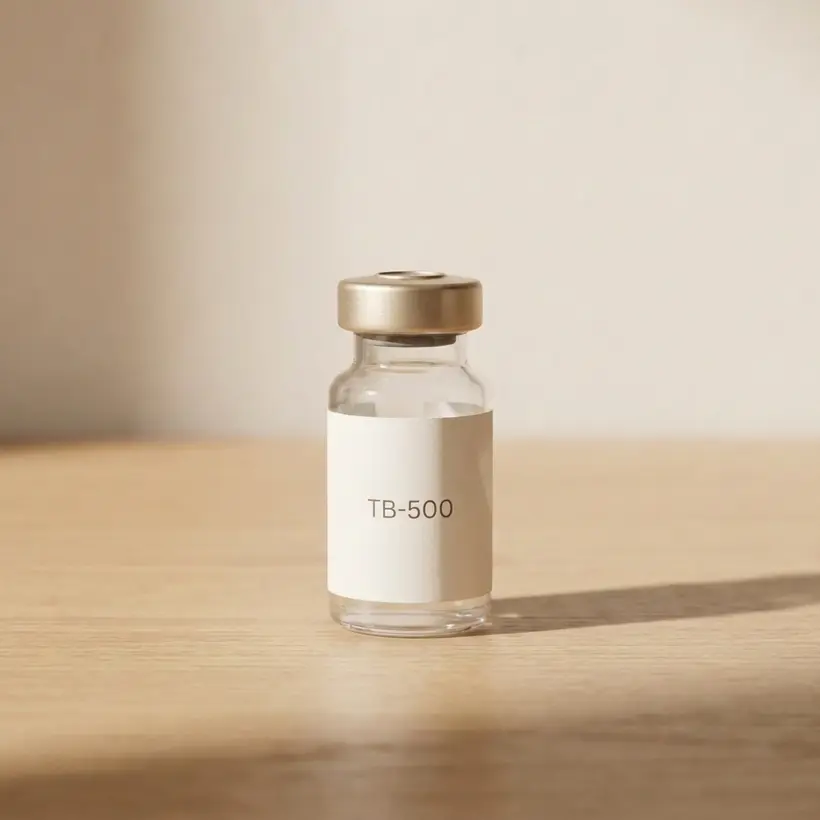
From the FormBlends catalog
TB-500 (Thymosin Beta-4)
Universal repair peptide for tissue regeneration · From $49/mo · compounded by a licensed 503A pharmacy, dispensed only after provider review.
Learn about TB-500 (Thymosin Beta-4) →Tβ4 promotes angiogenesis, the formation of new blood vessels. That's a feature, not a bug; it's a core part of how the peptide supports tissue repair (Goldstein et al., Trends in Molecular Medicine, 2005). But tumor growth also depends on angiogenesis. So the logical question becomes: could a pro-angiogenic peptide feed an existing cancer or help a dormant one wake up?
The honest answer: there is no published human case of TB-500 causing or accelerating cancer. Zero. But the mechanism is biologically plausible enough that responsible prescribers treat it as a hard contraindication in patients with active or recent malignancy. This is the medical equivalent of not finding out the hard way.
A closely related concern involves cell migration. Tβ4 promotes cell motility, which is helpful for healing but theoretically relevant to metastatic spread (Crockford et al., Annals of the New York Academy of Sciences, 2010). Same situation: no human evidence of harm, but the mechanistic overlap is why "active cancer" sits at the top of the do-not-use list.
Autoimmune Disease and Immune Modulation
TB-500 influences macrophage polarization and inflammatory cytokine activity. For most people, that's a therapeutic benefit. For someone with active autoimmune disease, particularly during a flare, it introduces an unpredictable variable into an already unstable system.
No published evidence shows TB-500 worsening autoimmune conditions. But there's also no published evidence showing it's safe in that population. The responsible position is prescriber-led individualized review, not a blanket green light.
Who Should Not Use TB-500
Hard contraindications:
- Active malignancy or recent cancer treatment (without explicit oncology input)
- Pregnancy or lactation
- Children and adolescents
- Active untreated infections (defer use until resolved)
- Known hypersensitivity to peptide therapies or benzyl alcohol (the preservative in bacteriostatic water)
Requires careful prescriber review:
- Active autoimmune disease
- History of clotting disorders
- Concurrent use of other research-stage peptides
On drug interactions: there are essentially no well-documented pharmacological interactions, mostly because TB-500 hasn't been studied in interaction trials. The obvious flag is combining it with other immunomodulatory or angiogenic agents (anti-VEGF therapies, for example), which should be reviewed with the prescriber before starting.
When to Stop and Call Your Prescriber
Most TB-500 reactions are minor inconveniences. A few warrant immediate attention:
- A significant injection-site reaction (large redness, induration, pain that persists)
- Signs of an allergic response (hives, facial swelling, difficulty breathing)
- New or worsening swollen lymph nodes
- Unexplained bruising or bleeding
- Any new neurological symptom
- Fatigue that persists beyond the first two weeks
The boring truth is that serious reactions are rare in practice. But "rare" isn't "impossible," and you shouldn't be your own clinician when something feels off.
Long-Term Use and the Cycling Question
There are no long-term human safety studies of compounded TB-500. None. Conservative clinical practice favors limited cycles with planned breaks rather than indefinite continuous administration. This isn't paranoia; it's what you do when the long-term data simply doesn't exist yet. You use the peptide for a defined purpose, take breaks, and reassess.
Most "Side Effects" Are Actually Handling Errors
This is the part that doesn't get enough attention. A surprising number of negative experiences reported online have nothing to do with TB-500 itself. They're sterility and storage failures.
Contaminated vials, reused syringes, improper reconstitution, room-temperature storage of reconstituted peptide: these can all produce reactions that get blamed on the molecule when the real problem is technique. The basics:
- Wipe the vial septum with alcohol before every draw
- Use a new insulin syringe each time. Every single time.
- Reconstitute only with appropriate bacteriostatic water
- Refrigerate the reconstituted vial immediately
- Discard roughly 28 days after reconstitution
- If the solution is discolored, cloudy, or has particulates, throw it out
Treating your vial like a leftover container in the back of the fridge is a recipe for an infection you'll mistakenly attribute to TB-500.
Citations
Crockford D et al. Thymosin beta4: structure, function, and biological properties supporting current and future clinical applications. Annals of the New York Academy of Sciences. 2010.
Sosne G et al. Thymosin beta 4 promotes corneal wound healing and decreased inflammation in vivo. Experimental Eye Research. 2007.
Goldstein AL et al. Thymosin beta4: actin-sequestering protein moonlights to repair injured tissues. Trends in Molecular Medicine. 2005.
FAQ
Is TB-500 dangerous?
Reported reactions in clinical practice are usually mild and self-limiting. The absence of long-term human data and the theoretical concerns around cancer and immune modulation mean it should only be used under prescriber supervision and never in contraindicated populations.
Does TB-500 cause cancer?
There is no published human evidence of TB-500 causing cancer. The pro-angiogenic mechanism is the biological basis for the conservative contraindication in patients with active or recent malignancy.
Why do I feel tired during the first week?
Research suggests possible immune-signaling activity during the early loading phase (Sosne et al., 2007). Mild fatigue typically resolves on its own. If it persists beyond two weeks, contact your prescriber.
Can I keep injecting if I have a bruise at the injection site?
Switch to a different site and let the bruised area heal. If you're bruising at multiple sites or the bruising seems disproportionate, get prescriber review.
Is TB-500 banned in sports?
Yes. The World Anti-Doping Agency lists thymosin beta-4 as a prohibited substance. Competitive athletes subject to anti-doping testing should not use TB-500. Period.
How long do initial side effects typically last?
Most patients who experience flu-like symptoms or fatigue see resolution within the first one to two weeks. Injection-site reactions usually clear within hours.
Should I take TB-500 with food?
TB-500 is administered by subcutaneous injection, so food timing is irrelevant to absorption. That said, some patients report less nausea when they don't inject on a completely empty stomach.
Internal Links
- Hub: TB-500 overview
- Pillar: Peptide therapy overview
- Product: TB-500 product page
- Sibling: TB-500 dosage protocols
- Sibling: TB-500 benefits research
- Sibling: TB-500 cycling protocols
---
Disclaimer: TB-500 is not approved by the FDA for any indication. Compounded TB-500 is prepared for individual patients through licensed compounding pharmacies based on prescriber clinical judgment. This content is educational and is not medical advice. Research-stage peptides should only be used under qualified prescriber supervision. Individual results vary.
Ready when you are
TB-500 (Thymosin Beta-4)
Universal repair peptide for tissue regeneration · From $49/mo · compounded by a licensed 503A pharmacy, dispensed only after provider review.
Learn about TB-500 (Thymosin Beta-4) →