Key Takeaway
Is TB-500 safe to use with GLP-1 medications? Complete interaction safety review covering pharmacology, metabolic pathways, and clinical considerations for this combination.
TB-500 and GLP-1 medications have no known pharmacological interaction and are considered safe to use together under physician supervision. The interaction safety profile is favorable because these compounds work through entirely different biological systems. TB-500 operates through thymosin beta-4 pathways involving actin regulation and cell migration for tissue repair. GLP-1 receptor agonists operate through incretin signaling for appetite suppression and metabolic regulation. There's no overlap at the receptor, enzyme, or pharmacokinetic level.
How the Pharmacology of Each Compound
TB-500: Mechanism and Metabolism
TB-500 is a synthetic peptide corresponding to the active region of thymosin beta-4. Its primary biological function involves sequestering actin monomers, which gives cells the cytoskeletal flexibility needed to migrate to sites of tissue damage. This cell migration is the starting point for wound healing, tendon repair, muscle recovery, and connective tissue remodeling.
TB-500 also stimulates angiogenesis through VEGF and other growth factor pathways, and it modulates inflammatory responses by affecting pro-inflammatory cytokine expression. From a safety perspective, two key metabolic facts matter: TB-500 is cleared from the body through standard peptide hydrolysis (enzymatic breakdown of the peptide chain), and it isn't processed through the cytochrome P450 enzyme system in the liver.
GLP-1 Medications: Mechanism and Metabolism
The GLP-1 receptor agonist class includes semaglutide (Ozempic, Wegovy), tirzepatide (Mounjaro, Zepbound), and liraglutide (Saxenda). These medications bind to GLP-1 receptors (and in tirzepatide's case, also GIP receptors) in the brain, pancreas, and gut. Their effects include appetite suppression, enhanced insulin secretion, reduced glucagon output, and slowed gastric emptying.
Like TB-500, GLP-1 medications are metabolized through proteolytic degradation rather than CYP450 enzymes. This shared metabolic characteristic is actually a positive factor for interaction safety, because neither compound occupies the enzymatic pathways where most drug interactions occur.
Can You Combine Them? The Interaction Safety Assessment
Level 1: Receptor Analysis
The first layer of interaction safety assessment looks at receptor targets. TB-500 doesn't bind to GLP-1 receptors. It doesn't bind to GIP receptors. It doesn't bind to insulin receptors, glucagon receptors, or any receptor in the incretin signaling pathway. Conversely, GLP-1 medications don't bind to actin, don't interact with thymosin beta-4 signaling, and don't engage with the FAK-paxillin or VEGF pathways that TB-500 uses for tissue repair.

This means there's zero receptor-level competition. Neither compound blocks, amplifies, or modifies the receptor activity of the other.
Level 2: Enzyme and Metabolic Pathway Analysis
The most common cause of drug-drug interactions is competition for CYP450 enzymes in the liver. When two drugs are metabolized by the same CYP450 isoform, one can inhibit the other's clearance, causing dangerous accumulation. This entire category of interaction risk is eliminated with TB-500 and GLP-1 medications because neither compound uses CYP450 enzymes for metabolism. Both are degraded through proteolysis by peptidase enzymes.
Level 3: Pharmacokinetic Analysis
GLP-1 medications slow gastric emptying, which can alter the absorption of orally administered drugs. This is a real concern for some medication combinations, but it's irrelevant for TB-500 because TB-500 is injected subcutaneously. It bypasses the GI tract entirely. GLP-1-induced changes in gastric motility have no effect on TB-500's absorption, distribution, or bioavailability.
The half-lives of these compounds are also independent. GLP-1 medications have extended half-lives (semaglutide approximately 7 days, tirzepatide approximately 5 days) that support weekly dosing. TB-500 has a shorter effective window, typically requiring two to three injections per week during loading. These dosing schedules don't create any pharmacokinetic interference.
Level 4: Clinical Observation
No published randomized controlled trial has studied the combination of TB-500 with any GLP-1 medication in human subjects. But the combination is increasingly prescribed in clinical practice. Physicians who manage both peptide therapy and GLP-1 programs report no adverse interactions. This clinical experience, combined with the pharmacological analysis above, provides a solid basis for supervised use.
Potential Benefits of the Combination
Tissue Repair During Weight Loss
GLP-1 medications produce significant weight loss that requires structural adaptation throughout the body. TB-500 supports this adaptation through its tissue repair, angiogenic, and anti-inflammatory properties.
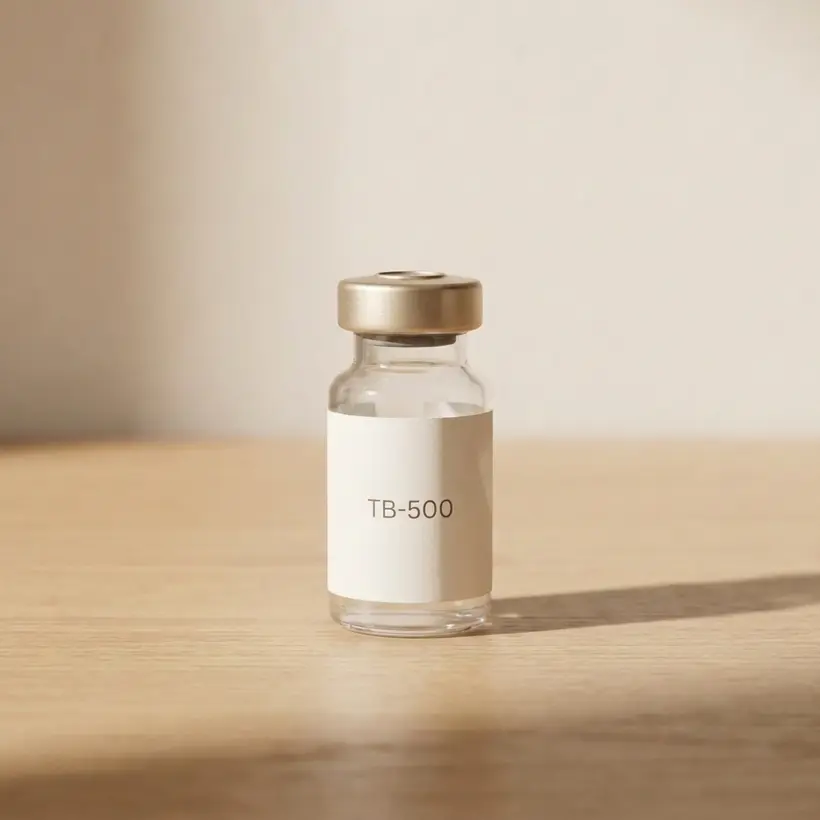
From the FormBlends catalog
TB-500 (Thymosin Beta-4)
Universal repair peptide for tissue regeneration · From $49/mo · compounded by a licensed 503A pharmacy, dispensed only after provider review.
Learn about TB-500 (Thymosin Beta-4) →Exercise Recovery
Active GLP-1 patients benefit from TB-500's ability to accelerate the repair of exercise-induced tissue damage, supporting consistent training that enhances weight loss outcomes.
Joint and Connective Tissue Health
TB-500's connective tissue repair properties complement the mechanical benefits of weight loss for patients with joint concerns.
Complementary Anti-Inflammatory Activity
GLP-1 medications reduce metabolic inflammation. TB-500 reduces tissue-level inflammation. Together they address chronic inflammation from two different biological directions.
Protocol Considerations
GLP-1 medications follow their standard titration schedules without modification. TB-500 is introduced after 2 to 4 weeks on the GLP-1 alone, following a loading phase (5 to 10 mg weekly, 2 to 3 injections, for 4 to 6 weeks) and maintenance phase (2.5 to 5 mg weekly, 1 to 2 injections, for 4 to 10 weeks). TB-500 is cycled with breaks between rounds. Different injection sites are used for each compound. Contact provider for current pricing
Regular physician monitoring, including check-ins and periodic blood work, ensures the combination remains appropriate over time.
Who Should Consider This Combination
- GLP-1 patients seeking tissue repair support for musculoskeletal recovery during active weight loss.
- Patients with joint or tendon concerns using GLP-1 medications for weight management.
- Active patients on GLP-1 therapy who want recovery support for training demands.
- Patients wanting complementary anti-inflammatory support alongside metabolic improvement from GLP-1 medications.
Contraindications include pregnancy, nursing, age under 18, active malignancies, and all standard GLP-1 medication contraindications.
Frequently Asked Questions
Could TB-500 make GLP-1 side effects worse?
There's no known mechanism for TB-500 to worsen GLP-1 side effects. The most common GLP-1 side effects are gastrointestinal (nausea, vomiting, diarrhea, constipation). TB-500 doesn't affect gastric motility, appetite signaling, or GI function. Its anti-inflammatory properties may provide indirect benefit, though TB-500 isn't specifically a GI-protective agent. For targeted GI support, BPC-157 is more commonly used.
Does TB-500 interact differently with tirzepatide than with semaglutide?
No. The interaction safety profile is the same across all GLP-1 class medications. Tirzepatide's additional GIP receptor activation doesn't create any new interaction with TB-500, because TB-500 doesn't bind to GIP receptors. The choice between semaglutide and tirzepatide is a separate clinical decision based on metabolic goals and tolerability.
Is there any blood test that can detect an interaction between these compounds?
There's no specific test for this interaction because no interaction has been identified. Standard monitoring blood work (metabolic panel, liver function, kidney function, inflammatory markers) is performed to track the overall health of patients on combination protocols. Any unexpected changes in these markers would prompt clinical investigation.
What should I do if I experience a new symptom after adding TB-500?
Report any new symptoms to your prescribing physician immediately. Because TB-500 is introduced after establishing your GLP-1 baseline, new symptoms that appear after TB-500 introduction can be evaluated in context. Your physician may adjust the TB-500 dose, pause it temporarily, or investigate other causes. This is one of the key reasons for the staggered introduction approach.
Medical References
- Goldstein AL, Hannappel E, Sosne G, Kleinman HK. Thymosin beta4: a multi-functional regenerative peptide. Basic properties and clinical applications. Expert Opin Biol Ther. 2012;12(1):37-51. [PubMed | DOI]
Safe Combination Therapy at FormBlends
The interaction safety profile between TB-500 and GLP-1 medications is well-supported by pharmacological analysis and clinical experience. At FormBlends, our physicians provide thorough evaluation, personalized protocols, pharmaceutical-grade compounds from licensed compounding pharmacies, and ongoing monitoring for all combination therapies.
Start your consultation at FormBlends.com
Ready when you are
TB-500 (Thymosin Beta-4)
Universal repair peptide for tissue regeneration · From $49/mo · compounded by a licensed 503A pharmacy, dispensed only after provider review.
Learn about TB-500 (Thymosin Beta-4) →