Key Takeaway
Complete stacking guide for TB-500 and GLP-1 medications. How to build a tissue repair and weight management stack with loading phases, maintenance, and cycling strategies.
Stacking TB-500 with GLP-1 medications creates a two-layer protocol that pairs tissue repair with metabolic weight management. This stacking guide covers how to build the stack, what each compound contributes, how they work together without interfering, and how physicians structure the dosing and cycling for maximum benefit. TB-500 provides the recovery and structural health layer while GLP-1 medications provide the metabolic transformation layer.
The Stack Components
TB-500: Your Recovery Foundation
TB-500 is a synthetic peptide derived from thymosin beta-4, a naturally occurring protein that orchestrates tissue repair at the cellular level. Thymosin beta-4 works by regulating actin, the structural protein that gives cells their shape and ability to move. When tissue is damaged, thymosin beta-4 allows repair cells to become mobile and migrate to the injury site. TB-500 replicates this function.
In a stacking context, TB-500 is the compound responsible for musculoskeletal recovery, connective tissue repair, anti-inflammatory support, and tissue quality during body composition changes. It's administered subcutaneously with a loading phase followed by maintenance dosing.
GLP-1 Medications: Your Metabolic Core
GLP-1 receptor agonists (semaglutide, tirzepatide, liraglutide) form the metabolic backbone of this stack. They produce reliable, significant weight loss by suppressing appetite, slowing gastric emptying, improving insulin function, and reducing caloric intake. In the stack, GLP-1 medications handle the weight loss and metabolic improvement while TB-500 handles the structural adaptation your body needs during that transformation.
Can You Stack These Compounds?
Yes. Stacking TB-500 with GLP-1 medications is pharmacologically sound. The compounds act through completely independent biological systems:
View data table
| Category | Clinical Interest Score | Detail |
|---|---|---|
| BPC-157 | 88 | Tissue repair and gut healing |
| TB-500 | 82 | Injury recovery |
| Sermorelin | 78 | Growth hormone support |
| Ipamorelin | 75 | Anti-aging and recovery |
| GHK-Cu | 70 | Skin and tissue repair |

- TB-500 uses actin regulation and cell migration pathways. GLP-1 uses incretin receptor signaling.
- Neither is a CYP450 substrate. Both are cleared through proteolysis.
- TB-500 is injected subcutaneously, so GLP-1-induced gastric motility changes are irrelevant.
- There's no receptor competition, no enzyme competition, and no shared clearance pathway.
Potential Benefits of This Stack
Full-Spectrum Body Recomposition
GLP-1 medications drive the metabolic side of body recomposition through caloric reduction and fat loss. TB-500 supports the structural side through tissue repair, connective tissue health, and musculoskeletal recovery. Together, the stack addresses what your body is losing (excess fat) and how your body is adapting to that loss (tissue remodeling and recovery).
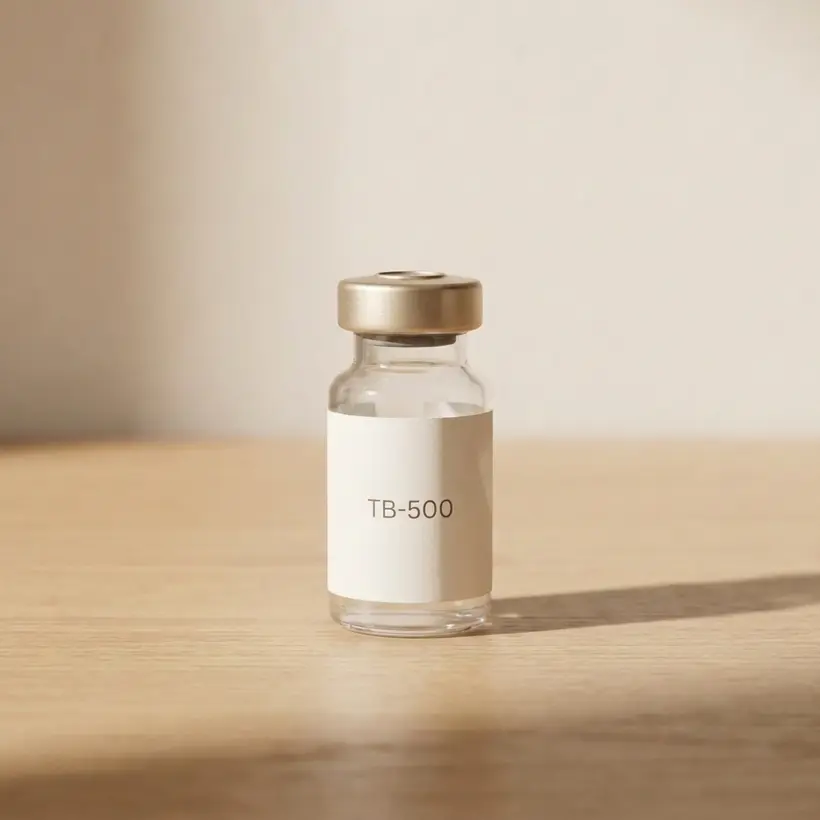
From the FormBlends catalog
TB-500 (Thymosin Beta-4)
Universal repair peptide for tissue regeneration · From $49/mo · compounded by a licensed 503A pharmacy, dispensed only after provider review.
Learn about TB-500 (Thymosin Beta-4) →Training Durability
Consistent exercise is the most important behavioral factor in long-term weight management success. TB-500 supports training durability by accelerating recovery between sessions, reducing overuse injury risk, and maintaining the structural health of tissues under new physical demands. Patients who recover faster train more consistently, and consistent training amplifies the weight loss benefits of GLP-1 therapy.
Joint Longevity
The stack provides joint support from two directions: GLP-1 medications reduce the mechanical load on joints through weight loss, and TB-500 promotes repair of joint connective tissue through its cell migration and anti-inflammatory properties.
Multilevel Inflammation Management
GLP-1 medications reduce metabolic inflammation (driven by excess visceral fat, insulin resistance, and metabolic dysfunction). TB-500 reduces tissue-level inflammation (driven by injury, overuse, and chronic tissue stress). The stack addresses both sources simultaneously.
Protocol Considerations: Building the Stack
Your physician designs the specific stack. This guide reflects common clinical practice.
Stack Architecture
Think of this stack as having two layers that run on different schedules:
- Layer 1 (GLP-1): Continuous, long-term. Weekly injections following standard titration. This is the permanent base of the stack.
- Layer 2 (TB-500): Cyclical. Loading phase followed by maintenance, then off-cycle. This layer is turned on and off based on recovery needs.
Layer 1 Setup: GLP-1
Start your GLP-1 medication at its standard initial dose and follow the prescribed titration. Allow 2 to 4 weeks on GLP-1 alone before adding TB-500. This establishes your baseline tolerance and allows clean identification of GLP-1 side effects. From $299
Layer 2 Setup: TB-500
After the GLP-1 baseline period, add TB-500:
- Loading: 5 to 10 mg weekly (2 to 3 injections) for 4 to 6 weeks.
- Maintenance: 2.5 to 5 mg weekly (1 to 2 injections) for 4 to 10 weeks.
- Off-cycle: 4+ weeks with no TB-500. GLP-1 continues.
Expanding the Stack
For patients with GI concerns during GLP-1 titration, some physicians add BPC-157 as a third layer for gastroprotection. The BPC-157/TB-500 pairing is one of the most established peptide stacks, and layering a GLP-1 medication underneath creates a thorough three-compound approach. This requires physician management of additional dosing and monitoring variables.
Weekly Schedule Example
During TB-500 loading with weekly GLP-1 injection:
- Monday: TB-500 injection (abdomen, 2.5 to 5 mg)
- Wednesday: TB-500 injection (thigh, 2.5 to 5 mg)
- Friday or Saturday: GLP-1 injection (upper arm or opposite abdomen quadrant)
During TB-500 maintenance:
- Tuesday: TB-500 injection (2.5 to 5 mg)
- Friday or Saturday: GLP-1 injection
Different injection sites for each compound, every time.
Cycle Planning Over 12 Months
A typical year on this stack might include:
- Months 1 to 4: GLP-1 titration + first TB-500 cycle (loading + maintenance)
- Months 4 to 5: GLP-1 continuation + TB-500 off-cycle
- Months 5 to 8: GLP-1 maintenance dose + second TB-500 cycle if needed
- Months 8 to 9: Off-cycle assessment
- Months 9 to 12: GLP-1 maintenance + optional third TB-500 cycle based on activity level and goals
Your physician adjusts this timeline based on your recovery needs, body composition progress, and overall health.
Who Should Consider This Stack
- GLP-1 patients with active training programs who need structured recovery support.
- Patients losing substantial weight who want tissue adaptation support during rapid body recomposition.
- Patients with joint or soft tissue injuries using GLP-1 therapy for weight management.
- Patients wanting thorough anti-inflammatory support from both metabolic and tissue-level sources.
- Performance-focused individuals who want to improve physical recovery alongside weight loss.
Don't stack these compounds if you're pregnant or nursing, under 18, have active cancer, or have contraindications to GLP-1 medications.
Frequently Asked Questions
Is TB-500 the best peptide to stack with a GLP-1?
It depends on your primary goal. TB-500 is ideal for musculoskeletal recovery and anti-inflammatory support. BPC-157 is better for GI protection during GLP-1 titration. Sermorelin targets growth hormone improvement. Your physician recommends the peptide (or combination of peptides) that matches your specific needs.
Can I stack TB-500 with a GLP-1 if I have other health conditions?
Possibly, but this requires careful physician evaluation. Conditions including cardiovascular disease, autoimmune disorders, diabetes, and kidney or liver impairment require additional consideration when building any peptide stack. Full medical history disclosure is important for safe protocol design.
What is the minimum commitment for this stack to be worthwhile?
Most patients need at least one full TB-500 cycle (8 to 12 weeks) to meaningfully assess benefits. GLP-1 medications require several months of titration before reaching maintenance doses and peak weight loss rates. Plan for at least 3 to 4 months to evaluate the full stack.
How much does the full stack cost?
Total cost depends on the specific GLP-1 medication, TB-500 dosing and cycle length, and monitoring frequency. At FormBlends, we provide transparent pricing for all components before you begin. Contact provider for current pricing From $299
Medical References
- Goldstein AL, Hannappel E, Sosne G, Kleinman HK. Thymosin beta4: a multi-functional regenerative peptide. Basic properties and clinical applications. Expert Opin Biol Ther. 2012;12(1):37-51. [PubMed | DOI]
Build Your Stack at FormBlends
A well-designed stack requires the right compounds, the right dosing, and the right medical oversight. At FormBlends, our physicians build TB-500 and GLP-1 stacking protocols tailored to your health profile, activity level, and goals. We provide pharmaceutical-grade compounds from licensed compounding pharmacies and monitor every phase of your stack.
Start your consultation at FormBlends.com
Ready when you are
TB-500 (Thymosin Beta-4)
Universal repair peptide for tissue regeneration · From $49/mo · compounded by a licensed 503A pharmacy, dispensed only after provider review.
Learn about TB-500 (Thymosin Beta-4) →