Key Takeaway
Complete stacking guide for TB-500 and semaglutide. Learn how to layer tissue repair peptide therapy with GLP-1 weight management for optimal results under physician supervision.
Stacking TB-500 with semaglutide combines a powerful tissue repair peptide with one of the most effective GLP-1 weight loss medications available. This guide walks through how these compounds complement each other, the safety basis for combining them, and how physicians structure this stack for patients who want musculoskeletal recovery support alongside their weight management program. Both compounds work through independent pathways with no known interaction.
How the Stack Components
TB-500: What It Brings to the Stack
TB-500 is a synthetic version of the active region of thymosin beta-4, a protein involved in tissue repair throughout the body. Its primary biological activities include promoting cell migration to injury sites, stimulating new blood vessel formation (angiogenesis), reducing inflammation at the cellular level, and supporting repair of connective tissue including tendons, ligaments, and muscle fibers.
TB-500 is administered subcutaneously, typically following a higher-dose loading phase followed by a lower maintenance dose. It's one of the most widely used recovery-focused peptides in clinical practice.
Semaglutide: What It Brings to the Stack
Semaglutide is a GLP-1 receptor agonist that reduces appetite, improves insulin sensitivity, and promotes substantial weight loss. Marketed as Wegovy for weight management and Ozempic for type 2 diabetes, it represents the gold standard in pharmaceutical weight loss therapy. Semaglutide is injected once weekly and follows a graduated dose titration over 16 to 20 weeks.
Can You Stack TB-500 and Semaglutide?
Yes, and the pharmacological reasoning is straightforward. TB-500 acts through actin regulation and cell migration pathways. Semaglutide acts through GLP-1 receptor activation. These are entirely separate biological systems with no points of intersection. Neither compound is a CYP450 substrate. both are degraded through proteolysis. There's no receptor competition, no enzymatic competition, and no pharmacokinetic interference. For a complete cost breakdown, see our compare semaglutide prices.

No controlled human trial has studied this specific combination. The safety rationale is based on independent safety profiles, non-overlapping mechanisms, and clinical experience from physicians who prescribe both.
Potential Benefits of the TB-500 and Semaglutide Stack
Recovery Support for Active Weight Loss Patients
Most semaglutide patients incorporate exercise into their weight management plan. For patients who are new to exercise or significantly increasing their activity level, the musculoskeletal system faces new stresses. TB-500's tissue repair properties provide a recovery support layer for tendons, ligaments, and muscles that are adapting to increased demands.
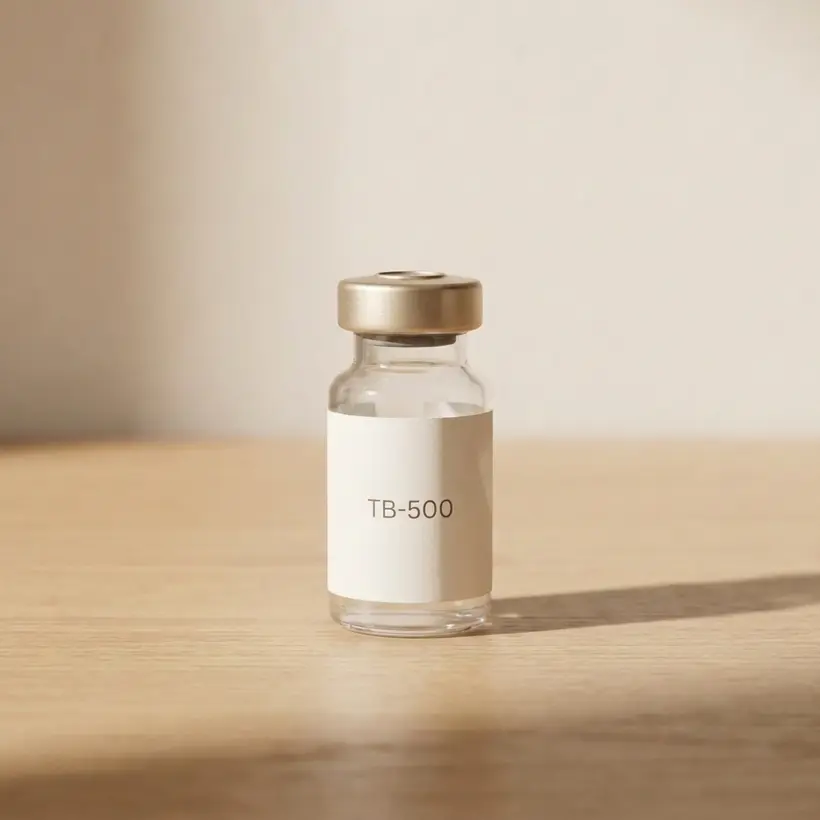
From the FormBlends catalog
TB-500 (Thymosin Beta-4)
Universal repair peptide for tissue regeneration · From $49/mo · compounded by a licensed 503A pharmacy, dispensed only after provider review.
Learn about TB-500 (Thymosin Beta-4) →Joint and Connective Tissue Health
Patients who carried excess weight for years may have pre-existing joint and connective tissue wear. As they lose weight and become more active, these structures need to heal and adapt. TB-500's documented effects on connective tissue repair in preclinical models make it a relevant addition for patients with joint concerns.
Anti-Inflammatory Complement
Obesity is associated with chronic systemic inflammation. Semaglutide reduces inflammation indirectly through weight loss and metabolic improvement. TB-500 has demonstrated direct anti-inflammatory properties in preclinical research. The combination may address inflammation from both metabolic and tissue-level directions.
Skin and Tissue Quality During Weight Loss
Rapid weight loss can affect skin elasticity and connective tissue integrity. TB-500's role in angiogenesis and cellular repair may support better tissue quality during significant body composition changes, though this application is based on mechanistic reasoning rather than controlled clinical data.
Protocol Considerations: Structuring the Stack
All dosing decisions require physician supervision. This framework reflects common clinical practice.
Foundation Layer: Semaglutide
Semaglutide is the primary compound in this stack and follows its standard titration: 0.25 mg weekly for 4 weeks, then 0.5 mg for 4 weeks, then 1.0 mg for 4 weeks, continuing upward to the target dose (up to 2.4 mg for Wegovy). This titration is never accelerated or modified because of TB-500 co-administration. From $299
Recovery Layer: TB-500
TB-500 is introduced after the semaglutide baseline is established (typically after 2 to 4 weeks of semaglutide alone). The TB-500 protocol typically follows this structure:
- Loading phase (4 to 6 weeks): 5 to 10 mg per week, split into 2 to 3 subcutaneous injections. This builds tissue concentration and initiates the repair response.
- Maintenance phase (4 to 10 weeks): 2.5 to 5 mg per week in 1 to 2 injections. This sustains the repair effects at a lower dose.
- Off-cycle (4+ weeks): TB-500 is discontinued for a period before reassessing whether another cycle is needed.
Injection Schedule Example
A typical weekly schedule might look like this during the loading phase:
- Monday: TB-500 subcutaneous injection (2.5 to 5 mg)
- Wednesday or Thursday: TB-500 subcutaneous injection (2.5 to 5 mg)
- Saturday: Semaglutide subcutaneous injection (per current titration dose)
Different injection sites are used for each injection. During maintenance, TB-500 drops to one or two injections per week.
Stacking with Additional Peptides
Some physicians add BPC-157 to this stack for enhanced GI protection and complementary tissue repair. The BPC-157/TB-500 combination is one of the most established peptide stacks, and adding semaglutide as the metabolic layer creates a three-compound protocol. Multi-compound stacks require careful physician oversight.
Monitoring the Stack
Regular check-ins every 2 to 4 weeks during the initial phase, transitioning to monthly during maintenance. Blood work every 8 to 12 weeks to monitor metabolic markers, inflammatory markers (CRP, ESR), liver and kidney function, and hormone levels as appropriate.
Who Should Consider This Stack
- Semaglutide patients increasing physical activity who want proactive musculoskeletal recovery support.
- Patients with joint or tendon concerns starting or continuing semaglutide therapy.
- Patients losing significant weight who want tissue remodeling support during body composition changes.
- Athletes or active individuals using semaglutide who need recovery support for training.
- Patients interested in anti-inflammatory support from both metabolic and tissue-repair perspectives.
Contraindications include pregnancy, nursing, age under 18, active malignancies, and all standard semaglutide contraindications (medullary thyroid carcinoma history, MEN2 syndrome, pancreatitis history).
Frequently Asked Questions
Is the TB-500 and semaglutide stack better than BPC-157 and semaglutide?
They serve different primary purposes. TB-500 is generally chosen for its musculoskeletal recovery and anti-inflammatory properties. BPC-157 is often chosen for its gastroprotective and gut healing profile. Some patients stack all three. The best choice depends on your specific goals, and your physician will help determine which combination is most appropriate.
How quickly will I notice effects from adding TB-500?
Most patients begin to notice recovery improvements within 2 to 4 weeks of starting the loading phase. Joint comfort and post-exercise recovery are often the first noticeable changes. Full benefits typically develop over the 8 to 12 week cycle.
Can TB-500 help prevent the muscle loss associated with semaglutide?
TB-500 isn't an anabolic agent and doesn't directly prevent muscle loss. But its tissue repair and anti-inflammatory properties may support muscle health during the metabolic stress of caloric restriction. Resistance training and adequate protein intake remain the primary strategies for preserving lean mass during GLP-1 therapy.
What happens when I stop TB-500 but continue semaglutide?
Semaglutide continues to work independently of TB-500. The tissue repair benefits of TB-500 may persist for some time after discontinuation, as the healing processes it supported continue. You can resume TB-500 cycles as needed based on your physician's assessment.
Medical References
- Goldstein AL, Hannappel E, Sosne G, Kleinman HK. Thymosin beta4: a multi-functional regenerative peptide. Basic properties and clinical applications. Expert Opin Biol Ther. 2012;12(1):37-51. [PubMed | DOI]
Start Your Stack at FormBlends
Building an effective stack requires pharmaceutical-grade compounds, personalized dosing, and ongoing medical supervision. At FormBlends, our physicians design TB-500 and semaglutide protocols tailored to your health history, activity level, and goals. We provide everything you need, from compounds to monitoring, in one coordinated program.
Start your consultation at FormBlends.com
Ready when you are
TB-500 (Thymosin Beta-4)
Universal repair peptide for tissue regeneration · From $49/mo · compounded by a licensed 503A pharmacy, dispensed only after provider review.
Learn about TB-500 (Thymosin Beta-4) →