Key Takeaway
Tesamorelin stands apart from other GH peptides because of its specific evidence for reducing visceral fat. This Tesamorelin visceral fat resource covers the important information you need to make informed decisions. This is the dangerous fat that surrounds your organs and drives metabolic disease.
Tesamorelin stands apart from other GH peptides because of its specific evidence for reducing visceral fat. This Tesamorelin visceral fat resource covers the important information you need to make informed decisions. This is the dangerous fat that surrounds your organs and drives metabolic disease. While many GH peptides improve body composition generally, Tesamorelin has been studied specifically for visceral fat reduction and has FDA-approved applications in certain populations.
Key Takeaways: - Understand what makes tesamorelin different - Learn how tesamorelin reduces visceral fat - Dosing and Protocol - Combining Tesamorelin with Other Treatments
If you're concerned about belly fat that doesn't respond to diet and exercise, Tesamorelin may be worth discussing with your provider.
What Makes Tesamorelin Different
Tesamorelin is a synthetic analog of growth hormone releasing hormone (GHRH). It stimulates your pituitary gland to produce and release growth hormone naturally. What makes it unique in the GH peptide space is the quality and specificity of its clinical evidence.
FDA-approved indication: Tesamorelin (brand name Egrifta) is FDA-approved for the reduction of excess abdominal fat in HIV-positive patients with lipodystrophy. This makes it one of the few GH-related peptides with FDA recognition for a specific condition.
Clinical trial evidence: Multiple randomized, double-blind, placebo-controlled trials have demonstrated that Tesamorelin significantly reduces visceral adipose tissue. Participants in these trials showed measurable reductions in trunk fat measured by CT scan.
Mechanism of action: Like CJC-1295, Tesamorelin signals the pituitary to release GH. The resulting GH elevation promotes lipolysis (fat breakdown), particularly in visceral fat deposits. Visceral fat cells are more responsive to GH-mediated lipolysis than subcutaneous fat cells.
Key distinctions from other GH peptides: - More reliable clinical trial data than most GH peptides - Specifically studied for visceral fat reduction - Doesn't cause the appetite increase seen with MK-677 - Generally well-tolerated in clinical trials
"What makes tirzepatide particularly interesting is the dual GIP/GLP-1 mechanism. We're seeing that GIP receptor activation appears to amplify the metabolic effects in ways we didn't fully anticipate from the preclinical data.") Dr. Ania Jastreboff, MD, PhD, Yale School of Medicine, lead author of SURMOUNT-1[1]
Learn about to understand the market.
How Tesamorelin Reduces Visceral Fat
Visceral fat behaves differently from the fat under your skin. It's metabolically active, producing inflammatory compounds and hormones that increase your risk of heart disease, type 2 diabetes, and other conditions.
Free Download: Protocol Planner Track your Tesamorelin protocol with body composition measurements, waist circumference logging, and lab monitoring schedules. Get yours free, we'll email it to you instantly. [Download Your Free Protocol Planner]
The GH-visceral fat connection: Growth hormone has a preferential effect on visceral fat cells. These cells have more GH receptors than subcutaneous fat cells. When GH levels increase, visceral fat responds more dramatically to the lipolytic signal.
Clinical results: In critical trials, Tesamorelin reduced visceral adipose tissue by approximately 15-18% over 26 weeks of treatment. This was measured by CT scan, the gold standard for visceral fat assessment.
Beyond fat reduction: Tesamorelin treatment in clinical trials also showed improvements in triglyceride levels and other metabolic markers. Reducing visceral fat itself improves metabolic health regardless of the method used.
What Tesamorelin doesn't do: - It doesn't cause significant overall weight loss (visceral fat reduction may not change scale weight much) - It doesn't directly reduce subcutaneous fat as effectively as visceral fat - Benefits may reverse after discontinuation if underlying causes persist - It isn't a substitute for diet and exercise
Track your waist circumference and body composition changes in the .
Dosing and Protocol
Tesamorelin dosing is based on clinical trial protocols and provider experience.
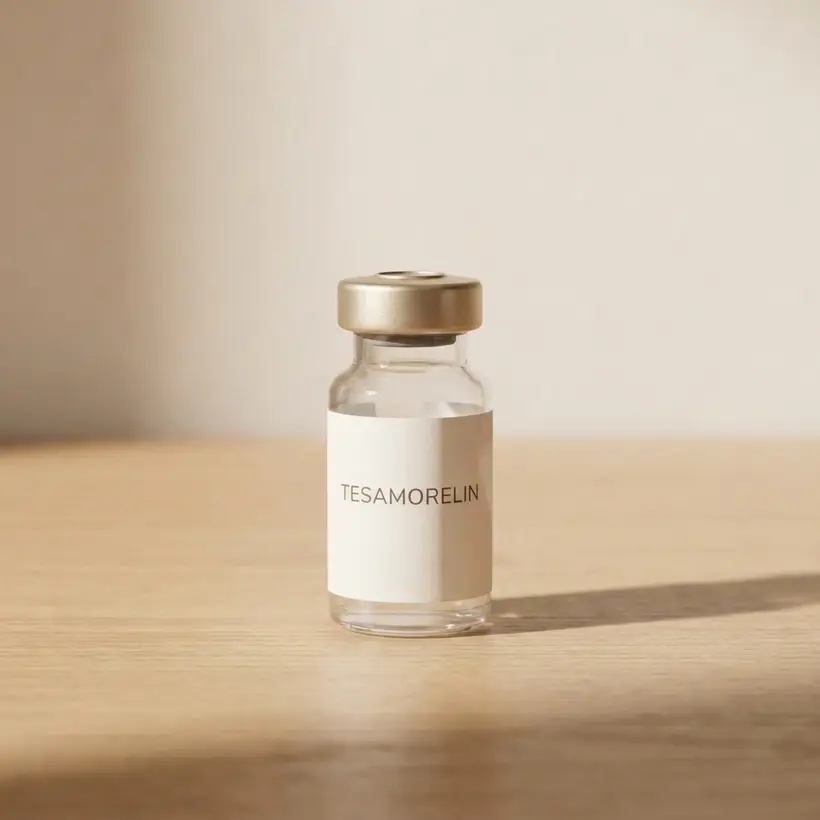
From the FormBlends catalog
Tesamorelin
GHRH analog studied for visceral-fat reduction; the molecule was approved as Egrifta · From $249/mo · compounded by a licensed 503A pharmacy, dispensed only after provider review.
View Tesamorelin →Standard dosing: - 2mg subcutaneous injection daily - Injected in the abdomen - Take on an empty stomach, preferably at bedtime or in the morning before eating
Protocol duration: - Clinical trials ran for 26-52 weeks - Minimum 12 weeks to assess response - Most providers recommend 6-12 month protocols - Benefits may diminish after discontinuation
Monitoring: - Waist circumference every 4 weeks - IGF-1 levels at baseline and every 3 months - Fasting glucose and HbA1c (Tesamorelin can affect glucose metabolism) - Lipid panel at baseline and follow-up - DEXA or CT scan for precise visceral fat measurement if available
Who is a good candidate: - Adults with improved visceral fat (waist circumference over 40 inches for men, 35 inches for women) - People with metabolic syndrome or pre-metabolic risk factors - Those who haven't achieved adequate visceral fat reduction through lifestyle alone - Not recommended for people with active pituitary or hypothalamic disease
Your can evaluate whether Tesamorelin is appropriate for your situation.
Combining Tesamorelin with Other Treatments
Tesamorelin can be part of a thorough metabolic health strategy.
With GLP-1 medications: Some providers combine Tesamorelin with semaglutide or tirzepatide. GLP-1 medications reduce overall body weight and appetite, while Tesamorelin may specifically target visceral fat. This combination requires monitoring for blood sugar effects from both treatments.
With exercise: Resistance training and cardiovascular exercise enhance the visceral fat-reducing effects of Tesamorelin. Exercise independently reduces visceral fat, and the combination may be combined.
With nutrition improvement: A diet rich in protein and reduced in processed carbohydrates supports both visceral fat reduction and the muscle-preserving effects of improved GH. Check out our for nutrition guidance.
With other GH peptides: Tesamorelin is typically used as a standalone GH-stimulating peptide rather than combined with CJC-1295 or other GHRH analogs. Adding Ipamorelin may be considered but discuss with your provider to avoid excessive GH stimulation.
Read about for additional strategies.
Frequently Asked Questions
How is Tesamorelin different from CJC-1295?
Both are GHRH analogs that stimulate natural GH release. Tesamorelin has stronger clinical trial evidence specifically for visceral fat reduction. CJC-1295 (especially combined with Ipamorelin) is more commonly used for broader anti-aging and recovery goals. Tesamorelin requires daily injection, while CJC-1295 with DAC can be dosed less frequently.
Will I regain visceral fat after stopping Tesamorelin?
Clinical data suggests that visceral fat may gradually return after discontinuing Tesamorelin if lifestyle factors aren't addressed. Maintaining exercise, nutrition, and healthy habits during and after treatment helps sustain results.
Can Tesamorelin help with non-alcoholic fatty liver disease?
Some Current Available data suggest that reducing visceral fat improves liver health markers. Early studies have explored Tesamorelin for NAFLD with promising results. This is an active area of research but not yet an established indication.
Is Tesamorelin safe for people with diabetes?
Tesamorelin can affect glucose metabolism. In clinical trials, some participants experienced increases in blood sugar. People with diabetes can use Tesamorelin under close monitoring, but glucose levels must be tracked carefully and diabetes medications may need adjustment.
Your Personalized Plan Is Waiting
No two patients are the same, and your protocol shouldn't be either. FormBlends providers create customized treatment plans based on your health profile, goals, and preferences.
Medical References
- Jastreboff AM, Aronne LJ, Ahmad NN, et al. Tirzepatide Once Weekly for the Treatment of Obesity. N Engl J Med. 2022;387(3):205-216. [PubMed | ClinicalTrials.gov | DOI]
Sources &. References
- Ionescu M, Frohman LA. Pulsatile secretion of growth hormone (GH) persists during continuous stimulation by CJC-1295, a long-acting GH-releasing hormone analog. J Clin Endocrinol Metab. 2006;91(12):4792-4797. Doi:10.1210/jc.2006-1702
This content is provided for informational and educational purposes only. It isn't a substitute for professional medical advice, diagnosis, or treatment. Always seek the advice of a licensed healthcare provider with any questions about a medical condition or treatment plan.
Last updated: 2026-03-24
Ready when you are
Tesamorelin
GHRH analog studied for visceral-fat reduction; the molecule was approved as Egrifta · From $249/mo · compounded by a licensed 503A pharmacy, dispensed only after provider review.
View Tesamorelin →