The short answer
A 2-tablespoon serving of full-fat cream cheese has 100 calories, 10 g of fat (6 g saturated), and 2 g of protein. It can fit a weight-loss plan at the right portion, but it's calorie-dense, low-protein, and almost always paired with high-calorie carriers like bagels. The vehicle is usually the problem, not the cheese.
Table of contents
- The 30-second answer
- What's actually in a serving
- Reading the label like a clinician
- The vehicle problem: why cream cheese rarely arrives alone
- Cream cheese vs other spreads (table)
- How cream cheese fits into a GLP-1 plan
- A simple swap framework
- Better alternatives for the same craving
- FAQ
- Footer disclaimers
What's actually in a serving
Standard full-fat cream cheese (Philadelphia, Kraft, store-brand) has a short ingredient list: pasteurized milk and cream, salt, carob bean gum, cheese culture. The block-style sold in 8 oz packages has the same composition as the spreadable tub version, with slightly less moisture.
Check your GLP-1 eligibility
Use our free BMI Calculator to see if you may qualify for provider-reviewed GLP-1 therapy.
Try the BMI Calculator →The macros per 2 tablespoons (1 oz, 28 g) of full-fat cream cheese:
- 100 calories
- 10 g total fat
- 6 g saturated fat
- 30 mg cholesterol
- 90 mg sodium
- 1 g carbohydrate
- 2 g protein
The 2-tablespoon serving is the FDA reference amount. The portion most people actually use on a bagel is closer to 3 to 4 tablespoons, which doubles the calorie load.
A few worth noting: cream cheese has more saturated fat per calorie than butter, gram for gram. The protein content is among the lowest of any cheese (cottage cheese has 12 g per half cup, ricotta has 14 g). And the calcium content is lower than most cheeses because cream cheese is made from cream rather than from curds.
Reading the label like a clinician
Per 2 tablespoons (1 oz):
| Macro | Amount | % daily value |
|---|---|---|
| Calories | 100 | 5% |
| Total fat | 10 g | 13% |
| Saturated fat | 6 g | 30% |
| Cholesterol | 30 mg | 10% |
| Sodium | 90 mg | 4% |
| Total carbohydrate | 1 g | 0% |
| Protein | 2 g | 4% |
A clinician's read: it's energy-dense, low in micronutrients, and almost devoid of protein. The 30% saturated fat per serving stands out. Public health guidance from the American Heart Association and the U.S. Dietary Guidelines (2020-2025) recommends keeping saturated fat under 10% of daily calories, which works out to roughly 22 g per day on a 2,000 calorie diet. Two servings of cream cheese (4 tablespoons) eat more than half of that allowance.
The satiety profile is poor. Foods with high fat-to-protein ratios tend to score low on satiety indexes (Holt et al., European Journal of Clinical Nutrition, original 1995 work updated 2024). At 5:1 fat-to-protein, cream cheese is in the bottom quartile of common foods for keeping you full per calorie.
Translation: 200 calories of cream cheese will leave you hungrier than 200 calories of cottage cheese, Greek yogurt, or a hard-boiled egg.
The vehicle problem: why cream cheese rarely arrives alone
The biggest issue with cream cheese for weight loss isn't the cream cheese itself. It's what cream cheese is paired with.
A typical cream cheese eating moment:
- Bagel + cream cheese: plain bagel (around 270 calories) plus 3 Tbsp cream cheese (around 150 calories) = 420 calories before any fillings.
- Bagel + lox + cream cheese: the same plus 2 oz smoked salmon (around 70 calories) = 490 calories. Better protein profile, still calorie-heavy.
- Crackers + cream cheese + jelly: 6 Ritz crackers (around 100 calories) + 2 Tbsp cream cheese + 2 Tbsp pepper jelly (around 80 calories) = around 280 calories of bites that disappear in five minutes.
- Cream cheese frosting on cake: the cream cheese is functionally a dessert ingredient at this point.
The pattern: cream cheese is almost always a vehicle for another high-calorie food. Its smooth texture and bland flavor make it easy to combine with sugar, refined carbs, and salty crackers. The combination is engineered to be eaten in volume.
This is the part of "is cream cheese healthy for weight loss" that's often missed. The cream cheese might add 100 calories, but the bagel underneath adds 270, and the breakfast that should have been 350 calories ends up at 500.
Cream cheese vs other spreads (head-to-head)
| Spread | Serving | Cal | Protein | Fat | Sat fat | Sodium | Best for |
|---|---|---|---|---|---|---|---|
| Cream cheese (full-fat) | 2 Tbsp | 100 | 2 g | 10 g | 6 g | 90 mg | Rich flavor in small amount |
| Cream cheese (whipped) | 2 Tbsp | 70 | 2 g | 6 g | 4 g | 90 mg | Lower calorie density |
| Cream cheese (1/3 less fat) | 2 Tbsp | 70 | 3 g | 5 g | 4 g | 130 mg | Closer to plain |
| Greek cream cheese | 2 Tbsp | 70 | 5 g | 4 g | 3 g | 110 mg | Better protein |
| Cottage cheese (whipped, 2%) | 2 Tbsp | 25 | 4 g | 0.5 g | 0 g | 80 mg | High protein per cal |
| Hummus | 2 Tbsp | 70 | 2 g | 6 g | 1 g | 130 mg | Plant-based |
| Mashed avocado | 2 Tbsp | 50 | 0.5 g | 5 g | 0.5 g | 0 mg | Lower sat fat |
| Almond butter | 2 Tbsp | 200 | 7 g | 18 g | 1.5 g | 0 mg | Most filling |
| Plain Greek yogurt (2%) | 2 Tbsp | 20 | 3 g | 1 g | 0.5 g | 10 mg | Closest substitute |
| Butter | 2 Tbsp | 200 | 0 g | 22 g | 14 g | 180 mg | Avoid for weight loss |
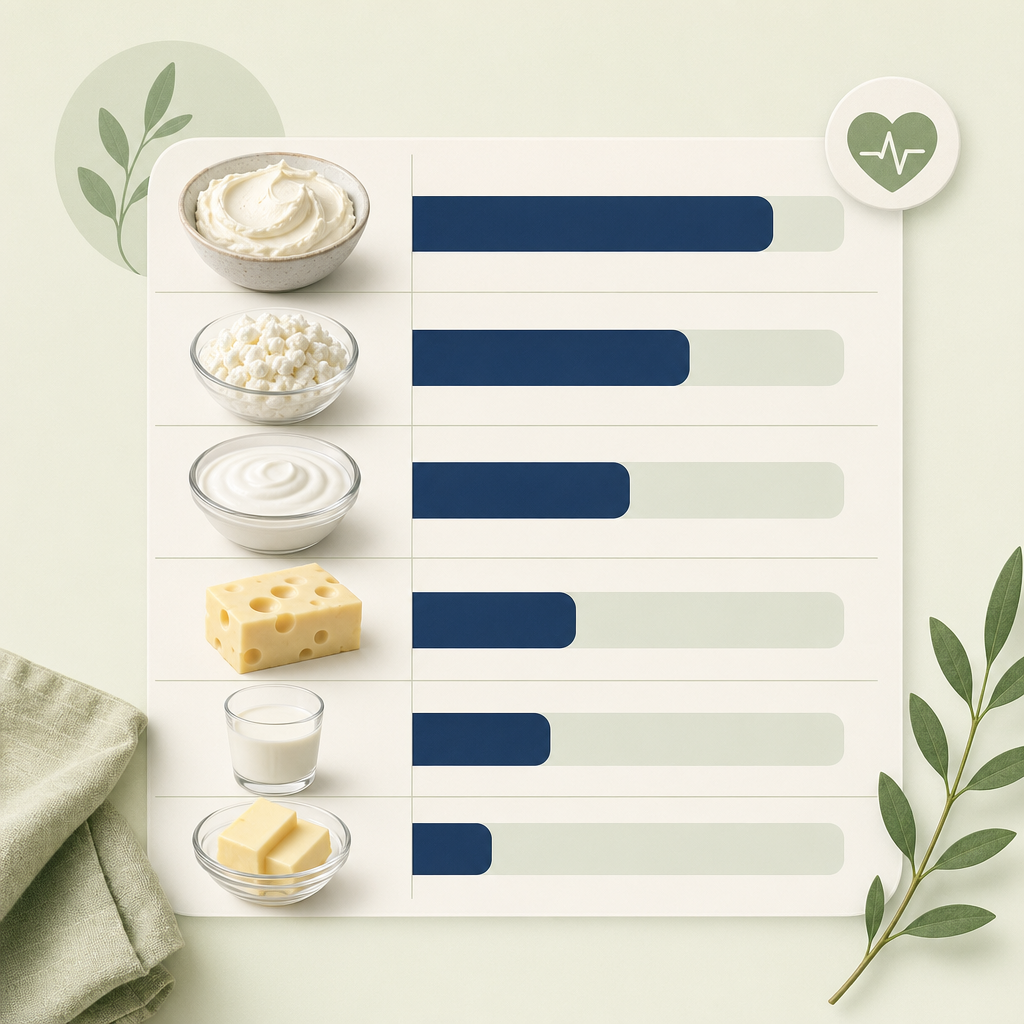
If you're using cream cheese as a flavor in small amounts, full-fat is fine. If you're using it as a major component (multiple tablespoons on a bagel several mornings a week), Greek cream cheese, whipped cream cheese, or whipped cottage cheese delivers a similar mouth-feel with less energy density and more protein.
How cream cheese fits into a GLP-1 plan
If you're on compounded semaglutide or tirzepatide, your eating patterns usually shift within 4 to 8 weeks. Appetite drops, portion sizes shrink, and high-fat foods often start triggering more nausea than they did before. Cream cheese sits in an interesting place in this shift.
The good:
- Small portions go a long way because flavor is rich
- Protein content is low but not zero
- Easy to combine with high-protein foods (smoked salmon, Greek yogurt) for a balanced bite
The bad:
- High fat content can trigger GI side effects in some patients during titration
- The carrier (bagel, cracker, etc.) is usually the calorie problem
- Saturated fat load adds up quickly
The practical approach: use cream cheese as a small flavor component, not a main ingredient. A teaspoon spread on cucumber rounds with a little dill is satisfying and fits a 1,200 to 1,500 calorie target. Two tablespoons on a bagel does not.
If you've had GLP-1-induced reflux or nausea, cream cheese in larger portions is a common trigger. (See our piece on why GLP-1s can cause acid reflux for the mechanism.)
A simple swap framework
The pattern that works for most weight-loss patients: keep cream cheese in the rotation but cap it at flavor-amount portions, and use higher-protein bases as the main spread.
Sample weekly breakfast rotation:
| Day | Breakfast |
|---|---|
| Mon | Greek yogurt parfait with berries and granola |
| Tue | Whole-wheat thin bagel + 1 Tbsp Greek cream cheese + 2 oz smoked salmon |
| Wed | Veggie omelet + 1 slice whole-grain toast |
| Thu | Cottage cheese + cucumber + 1 tsp everything bagel seasoning |
| Fri | Whole-wheat thin bagel + 2 Tbsp whipped cream cheese + tomato slices |
| Sat | Avocado toast + 2 eggs |
| Sun | Greek yogurt smoothie + 1 oz almonds |
Cream cheese shows up twice in the week, in modest amounts, on substrates with controlled calorie loads. That's the kind of relationship a typical weight-loss plan can sustain. Daily 4-Tbsp servings on full-size bagels is the kind that quietly stalls progress.
Better alternatives for the same craving
If you want the cream-cheese-on-something experience but with a more favorable nutrition profile:
- Whipped cottage cheese with herbs. 1/2 cup of low-fat cottage cheese blended in a food processor for 30 seconds turns into a spread with the texture of whipped cream cheese and 12+ grams of protein. Add fresh dill, chives, or everything bagel seasoning for flavor.
- Greek yogurt cream cheese (skyr-based). Several brands now sell strained-yogurt-based cream cheese with double the protein and half the fat of regular. Texture is slightly tangier, comparable in spreadability.
- Mashed white bean spread. White beans, lemon, garlic, and olive oil blended smooth gives you a creamy spread with fiber and plant protein at about 50 calories per 2 Tbsp.
- Ricotta on toast. Whole-milk ricotta has 12 g of protein per half-cup and 1/3 the fat of cream cheese.
- Hummus with feta on top. Doubles the protein, adds fiber, and the salt content scratches the cream-cheese-on-everything-bagel itch.
None of these taste exactly like cream cheese, but most patients find them satisfying once they break the cream cheese habit.
FAQ
Is cream cheese healthy for weight loss?
Cream cheese isn't unhealthy, but it's calorie-dense and low in protein. A 2-Tbsp serving has 100 calories with only 2 g of protein. It can fit a weight-loss plan in flavor-sized amounts, but it's almost always paired with high-calorie vehicles like bagels and crackers, which is where most of the trouble starts.
How many calories are in cream cheese?
Full-fat cream cheese has 100 calories per 2 tablespoons. Whipped cream cheese has about 70. Reduced-fat (1/3 less fat) has 70. Greek-style cream cheese has 70 with about 5 g of protein.
Is cream cheese keto-friendly?
Yes. With 1 g of carbohydrate per 2-Tbsp serving, cream cheese fits well within a ketogenic plan. The fat content is high enough to count toward your fat target, and the saturated fat load should be balanced with other foods.
Is reduced-fat cream cheese better for weight loss?
The 1/3 less fat version saves 30 calories per serving. Whether that matters depends on how often you eat it. For most patients, switching to whipped or reduced-fat is a marginal improvement. Switching to a high-protein alternative (Greek cream cheese, whipped cottage cheese) is a more meaningful one.
Can I eat cream cheese on a GLP-1 medication like compounded semaglutide?
Generally yes, in moderate amounts. Some patients find that high-fat foods trigger nausea or reflux during titration. If you notice symptoms after cream cheese, switch to lower-fat alternatives. Small flavor-amount portions are usually well tolerated.
Is cream cheese high in protein?
No. Cream cheese is low in protein at 2 g per 2-Tbsp serving. Cottage cheese, ricotta, and Greek yogurt all have substantially more protein per calorie.
Does cream cheese have probiotics?
Cream cheese contains live cultures during fermentation, but most cream cheese sold commercially is heat-treated after culturing, which kills the cultures. If you want probiotic benefits, choose Greek yogurt, kefir, or labneh instead.
Is cream cheese inflammatory?
Saturated fat in moderate amounts isn't strongly linked to inflammation in current evidence (a notable shift from the 2000s view). The 6 g of saturated fat per cream cheese serving isn't a problem at small portions. Daily heavy consumption may push your saturated fat intake above guidelines.
How does cream cheese compare to butter for spreading?
Cream cheese has half the calories and half the saturated fat of butter, plus a small amount of protein. For weight loss, cream cheese is the better choice if you'd otherwise use butter. For both, portion control is the main lever.
Is the carb count in cream cheese low enough for diabetes?
Yes. With 1 g of carbohydrate per serving, cream cheese has minimal impact on blood glucose. The fat content can slow gastric emptying, which is generally helpful for blood sugar stability.
Can I use cream cheese as a snack on its own?
Few people enjoy plain cream cheese, but a 2-Tbsp portion with cucumber slices, celery, or bell pepper strips makes a satisfying low-carb snack at around 130 calories total. The fiber from the vegetables improves satiety meaningfully.
Is cream cheese frosting cake the worst way to eat cream cheese?
For weight loss, yes. Cream cheese frosting is essentially cream cheese, butter, and powdered sugar, with most of the calories coming from sugar. A typical slice of carrot cake with cream cheese frosting runs 400 to 600 calories, with 30+ grams of sugar.
Should I switch to vegan cream cheese for weight loss?
Vegan cream cheese (Kite Hill, Tofutti, Violife) has comparable calorie counts to dairy cream cheese (around 70 to 90 calories per 2 Tbsp) but typically less saturated fat. Protein content is similar (1 to 2 g). The choice is largely about taste preference, dairy tolerance, and ingredient quality.
How do I portion cream cheese to avoid overeating?
Use a measuring tablespoon when serving. Spread cream cheese thinly across the bagel or cracker rather than piling it. Buy single-serving cream cheese cups, which are pre-portioned at 1 oz. Or scoop your portion into a small bowl and put the tub away before you start eating.
Author / review note
Reviewed by the FormBlends Medical Team. References include the U.S. Dietary Guidelines for Americans 2020-2025, the American Heart Association guidance on saturated fat intake, Holt et al. European Journal of Clinical Nutrition (satiety index, original 1995 with 2024 update), and the USDA FoodData Central database, accessed Q1 2026.
Footer disclaimers
Platform Disclaimer. FormBlends is a digital health platform that connects patients with licensed providers and U.S.-based pharmacies. We do not manufacture, prescribe, or dispense medication directly. All clinical decisions are made by independent licensed providers.
Compounded Medication Notice. Compounded semaglutide and tirzepatide are not FDA-approved. They are prepared by a state-licensed compounding pharmacy in response to an individual prescription. Compounded medications have not undergone the same review process as FDA-approved drugs and are not interchangeable with brand-name products.
Results Disclaimer. Individual results vary. Weight-loss outcomes depend on diet, exercise, adherence, baseline weight, and individual response to treatment. Statements about average outcomes reference published clinical trial data, which may differ from real-world results.
Trademark Notice. Brand names referenced (Philadelphia, Kraft, Kite Hill, Tofutti, Violife, Ritz) are the property of their respective owners. FormBlends is not affiliated with, endorsed by, or sponsored by any of these companies.
Related guides
- Is Skinny Pop Healthy for Weight Loss? An Honest Answer Backed by the Nutrition Label
- Are Ritz Crackers Healthy for Weight Loss? An Honest Answer Backed by the Nutrition Label
- The Best Time to Eat Ice Cream for Weight Loss? An Honest Answer Backed by the Calorie Math
- Are Grits Healthy for Weight Loss? Here's What the Nutrition Label Actually Says
- Are Saltine Crackers Healthy for Weight Loss? An Honest Look at the Nutrition
- Can Boiled Pierogies Be Healthy for Weight Loss? An Honest Look at the Nutrition
See your options in about 2 minutes
Take the free quiz and see what fits you. Quick, private, and no commitment to continue.
See my options →