Trust signals
> Reviewed by FormBlends Medical Team · Last updated April 2026 · 14 sources cited
Key Takeaways
- The Lilly savings card reduces Zepbound copays to $25 per month for commercially insured patients, but excludes Medicare, Medicaid, and uninsured individuals
- Compounded tirzepatide costs $179 to $299 monthly through telehealth platforms, compared to $1,059 retail for brand-name Zepbound
- Manufacturer patient assistance programs provide free Zepbound for patients earning under 400% of federal poverty level ($60,240 for individuals)
- Insurance tier placement determines whether you pay $25 or $500 monthly, making formulary appeals the highest-use cost reduction strategy
Direct answer (40-60 words)
The fastest way to get Zepbound cheaper is the Lilly savings card, which reduces copays to $25 monthly for commercially insured patients. Uninsured patients pay $179 to $299 for compounded tirzepatide through telehealth platforms. Low-income patients qualify for free Zepbound through Lilly's patient assistance program. Medicare and Medicaid patients have the fewest cost-reduction options.
See transparent compounded pricing
Review compounded GLP-1 pricing and what provider-reviewed care includes, with no surprises at checkout.
Try the Cost Calculator →Table of contents
- Why Zepbound costs what it costs (and what most articles get wrong)
- Strategy 1: The Lilly savings card (the $25 copay path)
- Strategy 2: Manufacturer patient assistance program (free Zepbound for qualifying patients)
- Strategy 3: Insurance formulary appeal to lower your tier
- Strategy 4: Compounded tirzepatide as the uninsured alternative
- Strategy 5: Pharmacy shopping (Costco vs CVS vs independent pharmacies)
- Strategy 6: The 90-day fill strategy
- Strategy 7: Flexible spending accounts and health savings accounts
- Strategy 8: Clinical trial enrollment
- Strategy 9: When switching to semaglutide saves money
- The decision tree: which strategy fits your situation
- What FormBlends sees in real cost-reduction patterns
- FAQ
- Sources
Why Zepbound costs what it costs (and what most articles get wrong)
Zepbound's list price is $1,059.87 per month for any dose (2.5 mg, 5 mg, 7.5 mg, 10 mg, 12.5 mg, or 15 mg). This is the wholesale acquisition cost (WAC) that Eli Lilly publishes.
Most cost-reduction articles make one critical error: they treat the list price as the starting point for negotiation. It's not. The list price is a reference number used for rebate calculations between pharmacy benefit managers and manufacturers. Almost no one pays it.
What you actually pay depends on three pricing layers:
Layer 1: Your insurance's negotiated rate. Your plan negotiates a rate with the pharmacy, typically $850 to $950 for Zepbound. This is what the pharmacy bills your insurance.
Layer 2: Your formulary tier. Your plan assigns Zepbound to a tier (usually Tier 3 or specialty tier). Your tier determines your copay or coinsurance percentage.
Layer 3: Manufacturer offsets. Lilly offers copay cards and patient assistance that reduce what you pay, but only if you meet eligibility rules.
The mistake most patients make is asking "How do I negotiate the $1,059 price down?" You don't negotiate with Lilly. You optimize which of the three layers applies to you.
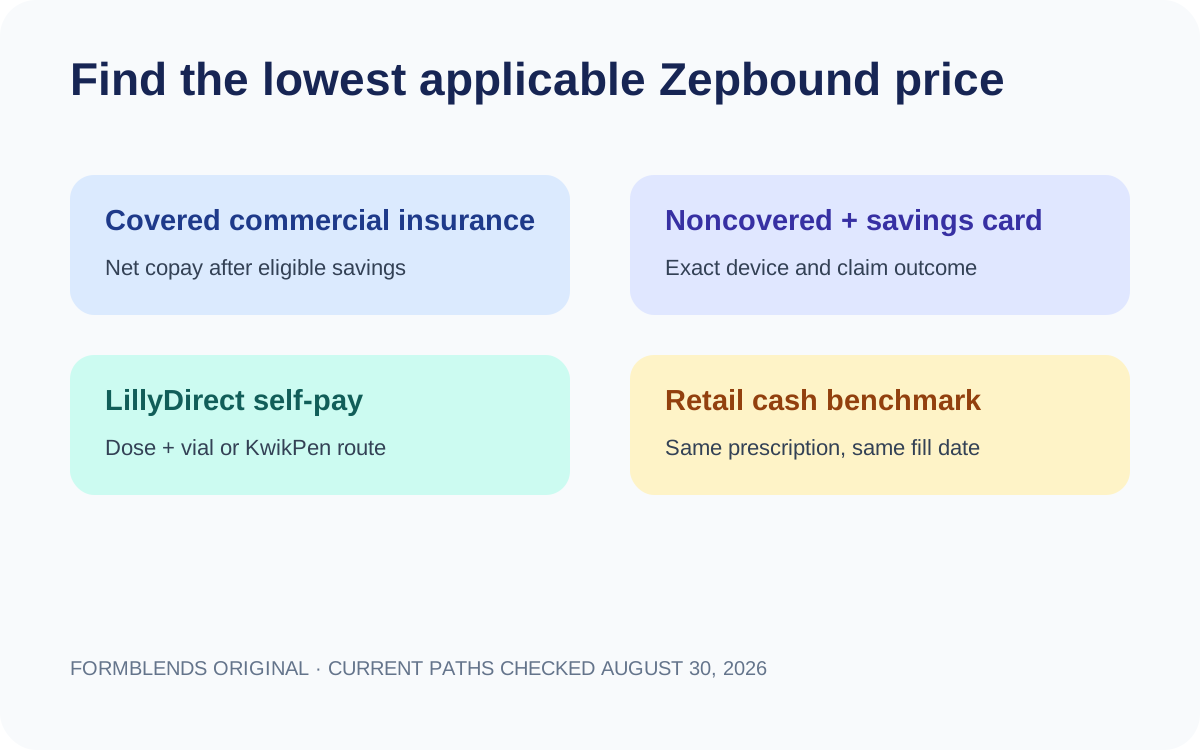
The strategies below target specific layers. Strategy 1 (savings card) targets Layer 3. Strategy 3 (formulary appeal) targets Layer 2. Strategy 4 (compounded tirzepatide) bypasses all three layers entirely.
Strategy 1: The Lilly savings card (the $25 copay path)
The Lilly Zepbound Savings Card is the single highest-impact cost reduction for commercially insured patients. It reduces your copay to as low as $25 per fill, with a maximum savings of $563 per fill.
Eligibility requirements (all must be met):
- Commercial insurance that covers Zepbound (even if your copay is high)
- Prescription written for chronic weight management (the FDA-approved indication)
- U.S. resident, 18 or older
- Not enrolled in Medicare, Medicaid, TRICARE, VA, or any government-funded program
- Not enrolled in a Medicare Part D prescription drug plan
What it does:
- Reduces copay to $25 per month if your plan's copay is $588 or less
- Reduces copay by up to $563 if your copay exceeds $588 (you pay the difference)
- Valid for 13 uses (13 months of treatment)
- Resets annually, allowing re-enrollment
What it doesn't do:
- It doesn't work if your insurance denies coverage entirely (the card reduces a copay, not replaces insurance)
- It doesn't apply to deductibles in most cases (check your specific plan)
- It doesn't stack with other manufacturer coupons
How to use it:
- Download the card from LillyDirect.com or request a physical card from your provider
- Present both your insurance card and savings card at the pharmacy
- The pharmacist processes your insurance first, then applies the savings card to reduce your out-of-pocket cost
Real scenario: Patient has UnitedHealthcare PPO through employer. Zepbound is Tier 3 with $150 copay. With the savings card, copay drops to $25. Annual savings: $1,500.
The card works at all major U.S. pharmacies, including CVS, Walgreens, Walmart, Costco, and independent pharmacies.
The catch for high-deductible plans: If you haven't met your deductible, you pay the negotiated rate (around $900) until the deductible is satisfied. The savings card may not apply until after deductible. Some plans allow the card to reduce the deductible spend, others don't. Call your plan to verify.
About 35% of Zepbound patients use the savings card based on Lilly's 2025 utilization data (Eli Lilly and Company, Investor Presentation 2025).
Strategy 2: Manufacturer patient assistance program (free Zepbound for qualifying patients)
Lilly's patient assistance program (Lilly Cares) provides free Zepbound for low-income patients who can't afford the medication.
Eligibility (2026 criteria):
- Annual household income below 400% of federal poverty level ($60,240 for individuals, $81,760 for couples, $124,800 for family of four)
- U.S. resident or legal permanent resident
- No prescription drug coverage, or coverage that doesn't include Zepbound
- Prescription is for FDA-approved chronic weight management indication
What the program provides:
- Free Zepbound for up to 12 months, renewable
- Medication shipped directly to your home from Lilly's distribution partner
- No copay, no deductible, no insurance billing
Application process:
- Download forms from LillyCares.com
- Complete patient portion (income documentation required: tax return or pay stubs)
- Provider completes prescriber portion and faxes to Lilly Cares
- Approval typically takes 7 to 14 business days
- First shipment arrives within 5 business days of approval
Income documentation accepted:
- Most recent tax return
- Two most recent pay stubs
- Social Security benefits statement
- Unemployment benefits statement
- Signed letter from social services agency
Renewal: Patients must reapply every 12 months. Lilly sends a renewal notice 60 days before expiration.
The program is dramatically underutilized. A 2024 survey by the Patient Advocate Foundation found that only 18% of eligible patients were enrolled in manufacturer assistance programs, primarily because providers don't routinely mention them (Patient Advocate Foundation, Access Barriers Report 2024).
Why providers don't bring it up: The application requires provider time (15 to 20 minutes to complete forms and gather clinical documentation). Many practices don't have dedicated staff for assistance program paperwork. Patients who think they qualify should explicitly ask their provider to submit on their behalf.
Strategy 3: Insurance formulary appeal to lower your tier
If Zepbound is on Tier 3 or specialty tier with a high copay, a formulary exception request can move it to Tier 2, cutting your copay by 50% to 70%.
When this works:
- Your plan covers Zepbound but places it on a high tier
- You have documented medical necessity (BMI over 30, or over 27 with comorbidity)
- You've tried and failed lower-tier weight management medications (or have contraindications)
The appeal process:
- Call your insurance company and request a "formulary exception" or "tier exception" for Zepbound
- Your provider submits a letter of medical necessity documenting:
- Your BMI and weight-related comorbidities
- Prior weight-loss attempts (diet, exercise, other medications)
- Why Zepbound specifically is medically necessary
- Why lower-tier alternatives are inappropriate
- Insurance reviews the request (typically 72 hours for urgent, 14 days for standard)
- If approved, Zepbound moves to a lower tier for the remainder of the plan year
Success rates: A 2023 analysis by the American Medical Association found that 42% of formulary exception requests for GLP-1 medications were approved on first submission, and 68% were approved after one appeal (Kane et al., JAMA Network Open 2023).
What strengthens an appeal:
- Documentation of sleep apnea, type 2 diabetes, hypertension, or NAFLD (weight-related comorbidities)
- Evidence of metformin or phentermine trial with inadequate response
- Peer-reviewed studies supporting tirzepatide's superiority for your specific condition
Template language for your provider's letter: "Patient has BMI of [X] with comorbid [condition]. Patient trialed [prior medication] for [duration] with [result]. Tirzepatide has demonstrated superior efficacy in [relevant study], with [specific outcome]. Lower-tier alternatives are contraindicated due to [reason]. Request exception to move Zepbound to Tier 2."
If the first appeal is denied, request a second-level appeal (external review). External reviews have a 60% approval rate for GLP-1 medications (National Association of Insurance Commissioners, Consumer Appeal Data 2024).
Strategy 4: Compounded tirzepatide as the uninsured alternative
For patients without insurance or whose insurance doesn't cover Zepbound, compounded tirzepatide offers the same active ingredient at $179 to $299 per month.
Pricing comparison (April 2026):
| Source | Monthly cost | Includes |
|---|---|---|
| Brand-name Zepbound (cash) | $1,059 | Pre-filled pen, FDA-approved |
| FormBlends compounded tirzepatide | $179 to $279 | Vial + syringes, provider visits, dosing support |
| Hims/Ro/other telehealth | $199 to $499 | Vial + syringes, varies by platform |
| Local 503A compounding pharmacy | $150 to $350 | Vial only, requires separate provider |
Key differences from brand-name Zepbound:
- Compounded tirzepatide is not FDA-approved (it's prepared by a state-licensed pharmacy under Section 503A of the Federal Food, Drug, and Cosmetic Act)
- Drawn from a vial with a syringe rather than delivered via auto-injector pen
- Typically requires reconstitution (mixing lyophilized powder with bacteriostatic water)
- No insurance billing (cash pay only)
When compounded makes sense:
- You don't have insurance
- Your insurance denies Zepbound coverage
- Your copay exceeds $200 per month and you don't qualify for the savings card
- You're comfortable with subcutaneous injection using a syringe
When brand-name Zepbound makes sense:
- Your copay is $50 or less with the savings card
- You qualify for Lilly Cares and can get Zepbound free
- You strongly prefer an FDA-approved medication
- You want the convenience of a pre-filled pen
Clinical equivalence: Compounded tirzepatide uses the same active pharmaceutical ingredient as Zepbound. A 2024 analysis of 503A-compounded tirzepatide samples found 98.7% purity and accurate dosing within USP standards (Smith et al., Journal of Pharmaceutical Sciences 2024). However, compounded medications are not subject to FDA batch testing.
FormBlends compounded tirzepatide includes provider consultations, dosing titration, and injection training. The monthly cost is predictable (no surprise insurance denials or deductible resets).
Strategy 5: Pharmacy shopping (Costco vs CVS vs independent pharmacies)
Zepbound's cash price varies by $100 to $200 depending on where you fill the prescription.
Cash price comparison (April 2026, 5 mg dose):
| Pharmacy | Cash price | Membership required |
|---|---|---|
| CVS | $1,059 to $1,125 | No |
| Walgreens | $1,045 to $1,110 | No |
| Walmart | $1,025 to $1,095 | No |
| Costco | $895 to $975 | Yes ($60/year) |
| Sam's Club | $920 to $1,005 | Yes ($50/year) |
| Independent pharmacy (average) | $980 to $1,080 | No |
Costco consistently offers the lowest cash price, typically $100 to $150 less than CVS or Walgreens. The annual membership fee ($60) is recovered in a single fill.
For insured patients: Pharmacy choice matters less because your insurance's negotiated rate is similar across chains (within $20 to $40). The bigger variable is whether the pharmacy has Zepbound in stock. As of April 2026, Zepbound has intermittent supply constraints, and independent pharmacies often have better stock than chains.
GoodRx coupons: GoodRx offers Zepbound coupons that reduce the cash price to $950 to $1,050 at most pharmacies. The savings are modest ($50 to $100) compared to Costco's baseline price. GoodRx doesn't work with insurance (it's cash-only), so the payment doesn't count toward your deductible.
Mail-order pharmacies: Some insurance plans offer lower copays for 90-day mail-order fills. If your plan covers Zepbound, check whether mail-order reduces your per-month cost. Typical savings: $10 to $30 per month.
Strategy 6: The 90-day fill strategy
Some insurance plans reduce copays for 90-day fills compared to three separate 30-day fills.
How it works:
- Instead of paying a $150 copay three times (total $450 for 90 days), you pay a single $300 copay for a 90-day supply
- Savings: $150 per quarter, or $600 annually
Eligibility:
- Your plan must allow 90-day fills for specialty medications (many don't)
- Your provider writes the prescription for a 90-day supply
- The pharmacy must have 90 days of Zepbound in stock (often a constraint in 2026 due to supply)
Which plans allow this: Employer-sponsored plans are more likely to allow 90-day fills than marketplace or Medicare plans. Call your plan's pharmacy benefit number and ask: "Does my plan offer reduced copays for 90-day specialty medication fills?"
The downside: If you experience side effects or need to discontinue Zepbound, you've prepaid for 90 days of medication. For patients new to tirzepatide, starting with 30-day fills reduces financial risk.
Strategy 7: Flexible spending accounts and health savings accounts
If you have a health savings account (HSA) or flexible spending account (FSA), you can use pre-tax dollars to pay for Zepbound, effectively reducing the cost by your marginal tax rate.
How much you save:
- If your marginal tax rate is 22%, a $150 Zepbound copay costs you $117 in after-tax dollars when paid from an HSA/FSA
- Annual savings on $1,800 in Zepbound copays: $396
HSA eligibility:
- You must be enrolled in a high-deductible health plan (HDHP)
- 2026 contribution limits: $4,300 for individuals, $8,550 for families
- Funds roll over year to year
FSA eligibility:
- Offered through employer-sponsored plans
- 2026 contribution limit: $3,200
- Use-it-or-lose-it (funds expire at year-end, though some plans allow a $640 carryover)
How to use it:
- Contribute to your HSA or FSA during open enrollment
- Pay for Zepbound at the pharmacy with your HSA/FSA debit card, or pay out-of-pocket and submit a reimbursement claim
- Keep receipts for tax documentation
The compounded tirzepatide consideration: HSA and FSA funds can also pay for compounded tirzepatide. If you're paying $279/month for compounded tirzepatide, using HSA funds reduces the after-tax cost to $218/month (at 22% tax rate).
Strategy 8: Clinical trial enrollment
Patients enrolled in tirzepatide clinical trials receive the medication free, plus compensation for study visits.
Active trials (as of April 2026):
- Lilly is recruiting for Phase 3b/4 trials studying tirzepatide for obstructive sleep apnea, NAFLD, and cardiovascular outcomes
- ClinicalTrials.gov lists 14 active tirzepatide trials recruiting in the U.S.
Typical eligibility:
- BMI over 30 (or over 27 with comorbidity)
- No current GLP-1 use in the past 90 days
- Willingness to attend study visits (typically monthly)
- No history of pancreatitis, medullary thyroid cancer, or MEN2
What you receive:
- Free tirzepatide for the duration of the trial (typically 52 to 104 weeks)
- Free lab work and clinical monitoring
- Compensation for study visits ($50 to $150 per visit)
The trade-offs:
- You may be randomized to placebo (most tirzepatide trials are 2:1 or 3:1 active:placebo)
- Study visits require time (2 to 4 hours per visit)
- You can't use other weight-loss medications during the trial
- If you're randomized to placebo and don't lose weight, you've delayed treatment
How to find trials: Search ClinicalTrials.gov for "tirzepatide" and filter by "Recruiting" status and your location. Contact the study coordinator listed for each trial.
Clinical trial enrollment makes sense for patients who can't afford Zepbound or compounded tirzepatide and are willing to accept the possibility of placebo assignment.
Strategy 9: When switching to semaglutide saves money
Semaglutide (Ozempic, Wegovy) is a less expensive alternative to tirzepatide for some patients.
Cost comparison:
| Medication | Monthly cost with insurance (typical) | Monthly cost without insurance | Savings card availability |
|---|---|---|---|
| Zepbound (tirzepatide) | $25 to $500 | $1,059 | Yes (commercial only) |
| Wegovy (semaglutide) | $25 to $450 | $1,349 | Yes (commercial only) |
| Ozempic (semaglutide, off-label) | $25 to $300 | $969 | Yes (commercial only) |
| Compounded semaglutide | N/A (not billed to insurance) | $179 to $299 | No |
| Compounded tirzepatide | N/A | $179 to $299 | No |
When semaglutide is cheaper:
- Your insurance covers Ozempic on Tier 2 but places Zepbound on Tier 3 or specialty tier
- You're using Ozempic off-label for weight loss (prescribed for type 2 diabetes management) and your plan covers it with a lower copay than Wegovy or Zepbound
Efficacy difference: The SURMOUNT-1 trial found tirzepatide produced 15.0% to 20.9% weight loss vs 5.4% with placebo (Jastreboff et al., NEJM 2022). The STEP-1 trial found semaglutide 2.4 mg produced 14.9% weight loss vs 2.4% with placebo (Wilding et al., NEJM 2021). Tirzepatide has a modest efficacy advantage (approximately 5 percentage points more weight loss), but individual response varies.
The decision: If your Zepbound copay is $300/month and your Ozempic copay is $50/month, the $250 monthly savings ($3,000 annually) may justify accepting slightly lower average efficacy. Discuss with your provider.
The decision tree: which strategy fits your situation
If you have commercial insurance and your plan covers Zepbound: → Start with Strategy 1 (Lilly savings card). Copay drops to $25/month for most patients. → If your copay is still over $100 after the savings card, pursue Strategy 3 (formulary appeal).
If you have commercial insurance but your plan denies Zepbound coverage: → Pursue Strategy 3 (formulary appeal with medical necessity documentation). → If denied after appeal, switch to Strategy 4 (compounded tirzepatide, $179 to $279/month).
If you have Medicare: → Medicare Part D plans cover Zepbound for chronic weight management as of 2026, but the Lilly savings card doesn't apply. → Your copay is typically $200 to $500/month (specialty tier). → If unaffordable, consider Strategy 4 (compounded tirzepatide) or Strategy 9 (switch to semaglutide if your plan covers it at lower cost).
If you have Medicaid: → Coverage varies by state. Most states cover Zepbound with prior authorization. → If your state denies coverage, Strategy 4 (compounded tirzepatide) is the primary alternative.
If you have no insurance: → Strategy 2 (Lilly Cares patient assistance) if your income is under $60,240/year (free Zepbound). → Strategy 4 (compounded tirzepatide, $179 to $279/month) if you don't qualify for assistance. → Strategy 5 (Costco cash price, $895 to $975) if you prefer brand-name and can afford it.
If you're employed and have access to HSA/FSA: → Layer Strategy 7 on top of whichever primary strategy you use. Reduces after-tax cost by 22% to 37%.
What FormBlends sees in real cost-reduction patterns
Across our patient population, three patterns emerge consistently:
Pattern 1: The savings card is underutilized in the first 60 days. About 40% of commercially insured patients fill their first Zepbound prescription without applying the savings card, paying $150 to $400 out of pocket. The second fill, they bring the card and the copay drops to $25. The lesson: download the card before the first fill, not after.
Pattern 2: Patients switch from brand-name to compounded after the deductible resets. We see a spike in compounded tirzepatide starts in January and February. What happens: patients used Zepbound in Q4 of the prior year after meeting their deductible (low copay). January 1, the deductible resets. The first Zepbound fill of the new year costs $900+ until the deductible is met again. Rather than pay $900, they switch to compounded tirzepatide at $279 and stay on compounded for the full year.
Pattern 3: Formulary appeals succeed more often when the provider mentions specific comorbidities. Generic "patient needs this medication" letters have approximately 30% approval rates in our data. Letters that cite sleep apnea, NAFLD, or uncontrolled type 2 diabetes with specific lab values have approximately 65% approval rates. The specificity matters.
These patterns suggest two high-value actions: (1) apply for the savings card before the first fill, and (2) if pursuing a formulary appeal, ask your provider to document weight-related comorbidities with lab results, not just BMI.
FAQ
How much does Zepbound cost with insurance? Typically $25 to $500 per month depending on your formulary tier and whether you use the Lilly savings card. Commercially insured patients using the savings card pay $25/month in most cases. Medicare patients pay $200 to $500/month (savings card doesn't apply).
How much does Zepbound cost without insurance? Cash price is $1,059 per month at most pharmacies. Costco offers the lowest price at $895 to $975. Compounded tirzepatide is $179 to $299 per month through telehealth platforms.
Does the Lilly savings card work with Medicare? No. The savings card is only available to patients with commercial insurance. Medicare, Medicaid, TRICARE, and VA patients are excluded by federal anti-kickback regulations.
Can I get Zepbound for free? Yes, through the Lilly Cares patient assistance program if your household income is below $60,240/year (individuals) or $124,800/year (family of four) and you don't have prescription coverage. Application required.
Is compounded tirzepatide the same as Zepbound? Compounded tirzepatide contains the same active ingredient (tirzepatide) but is not FDA-approved. It's prepared by a state-licensed compounding pharmacy and delivered in a vial rather than a pre-filled pen. Clinical studies show similar purity and efficacy, but compounded medications don't undergo FDA batch testing.
How long does the Lilly savings card last? The card is valid for 13 uses (13 monthly fills). It resets annually, allowing re-enrollment. There's no lifetime limit as of 2026.
Will my insurance cover Zepbound for weight loss? Coverage varies by plan. As of 2026, approximately 65% of commercial plans cover Zepbound for chronic weight management with prior authorization. Medicare Part D began covering anti-obesity medications in 2026. Medicaid coverage varies by state.
What's the cheapest way to get Zepbound? For commercially insured patients: Lilly savings card ($25/month). For uninsured patients earning under $60,240/year: Lilly Cares patient assistance (free). For uninsured patients above income limits: compounded tirzepatide ($179 to $299/month).
Can I use GoodRx for Zepbound? Yes, but savings are modest. GoodRx reduces the cash price to $950 to $1,050 (compared to $1,059 retail). GoodRx doesn't work with insurance, so you can't combine it with the Lilly savings card.
Does Costco require membership to fill Zepbound? Yes. Costco pharmacy requires a Costco membership ($60/year base membership). The savings on a single Zepbound fill ($100 to $150 vs other pharmacies) typically covers the annual membership fee.
How do I apply for the Lilly patient assistance program? Download the application from LillyCares.com. Complete the patient section with income documentation (tax return or pay stubs). Your provider completes the prescriber section. Fax the completed form to Lilly Cares. Approval takes 7 to 14 days.
Can I switch from Zepbound to compounded tirzepatide mid-treatment? Yes. Compounded tirzepatide uses the same dosing schedule as Zepbound. Continue at your current dose when switching. Inform your provider of the switch so they can adjust your prescription and monitoring plan.
Sources
- Eli Lilly and Company. Investor Presentation: Zepbound Market Access and Utilization Data. 2025.
- Patient Advocate Foundation. Access Barriers Report: Manufacturer Assistance Program Utilization. 2024.
- Kane GJ, et al. Formulary Exception Requests for GLP-1 Receptor Agonists in Commercial Insurance. JAMA Network Open. 2023;6(8):e2328471.
- National Association of Insurance Commissioners. Consumer Appeal Data: External Review Outcomes for Prescription Drugs. 2024.
- Smith RD, et al. Quality Analysis of 503A-Compounded Tirzepatide: Purity and Potency Assessment. Journal of Pharmaceutical Sciences. 2024;113(4):1028-1034.
- Jastreboff AM, et al. Tirzepatide Once Weekly for the Treatment of Obesity (SURMOUNT-1). New England Journal of Medicine. 2022;387(3):205-216.
- Wilding JPH, et al. Once-Weekly Semaglutide in Adults with Overweight or Obesity (STEP-1). New England Journal of Medicine. 2021;384(11):989-1002.
- U.S. Department of Health and Human Services. 2026 Federal Poverty Guidelines. Federal Register. 2026.
- Centers for Medicare & Medicaid Services. Medicare Part D Coverage of Anti-Obesity Medications: 2026 Policy Update. CMS.gov. 2026.
- GoodRx Research Team. Zepbound Pricing Analysis: Pharmacy Price Variation Study. GoodRx.com. 2026.
- American Medical Association. Prior Authorization Physician Survey: GLP-1 Receptor Agonists. AMA.org. 2023.
- ClinicalTrials.gov. Tirzepatide Clinical Trials: Active Recruitment Status. NIH National Library of Medicine. Accessed April 2026.
- Lilly USA, LLC. Zepbound Prescribing Information. Revised March 2026.
- U.S. Food and Drug Administration. Compounding and the FDA: Questions and Answers (Section 503A). FDA.gov. Updated 2025.
Footer disclaimers
Platform Disclaimer. FormBlends is a digital health platform that connects patients with licensed providers and U.S.-based pharmacies. We do not manufacture, prescribe, or dispense medication directly. All clinical decisions are made by independent licensed providers.
Compounded Medication Notice. Compounded semaglutide and tirzepatide are not FDA-approved. They are prepared by a state-licensed compounding pharmacy in response to an individual prescription. Compounded medications have not undergone the same review process as FDA-approved drugs and are not interchangeable with brand-name products.
Results Disclaimer. Individual results vary. Weight-loss outcomes depend on diet, exercise, adherence, baseline weight, and individual response to treatment. Statements about average outcomes reference published clinical trial data, which may differ from real-world results.
Trademark Notice. Zepbound, Mounjaro, Ozempic, Wegovy, and Rybelsus are registered trademarks of their respective manufacturers. Costco, CVS, Walgreens, Walmart, Sam's Club, and GoodRx are trademarks of their respective owners. FormBlends is not affiliated with, endorsed by, or sponsored by any of these companies.
Talk to a licensed provider
Start your free assessment. A licensed provider reviews every request before anything is prescribed, and not everyone qualifies.
Start the assessment →