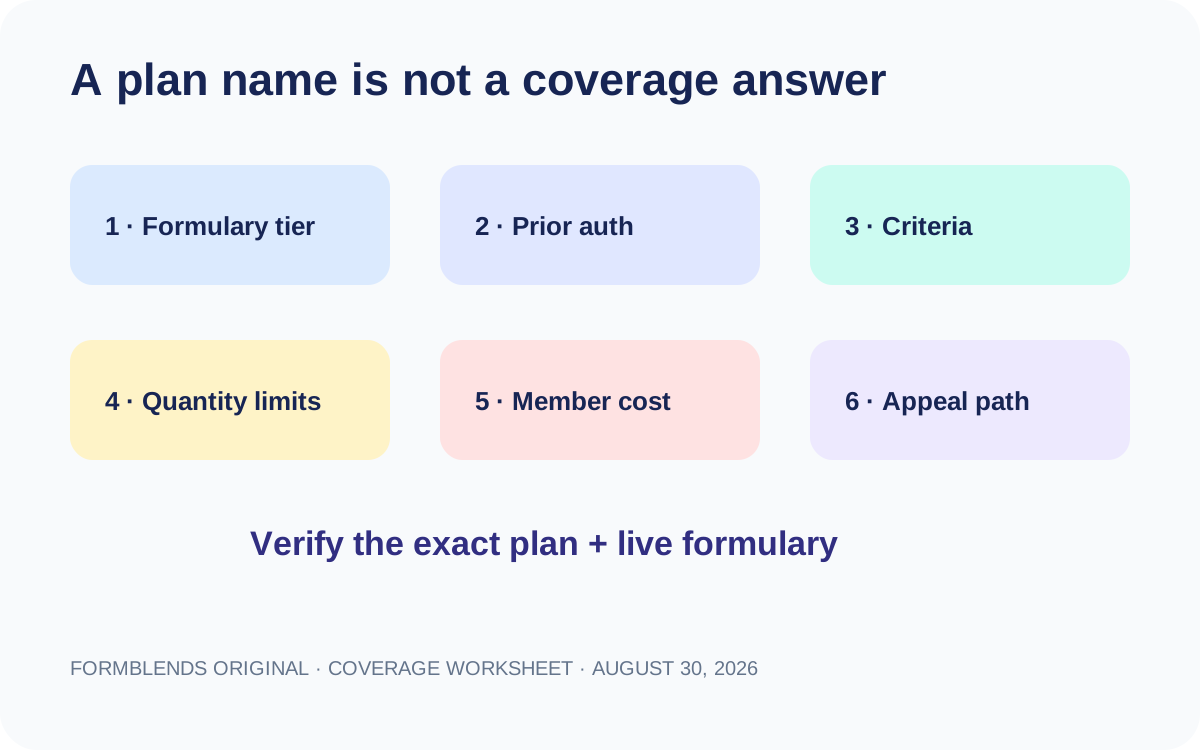
Key Takeaways
- Most commercial insurance plans cover Zepbound with prior authorization, but coverage for weight loss (not diabetes) varies dramatically by employer and plan tier
- Medicare Part D excludes weight-loss drugs under the 2003 Medicare Modernization Act, but since July 1, 2026 the Medicare GLP-1 Bridge covers the Zepbound KwikPen for $50 a month through December 31, 2027 for beneficiaries who meet CMS criteria
- Commercial-plan copays range from $25 (with the Lilly savings card) to several hundred dollars a month on coinsurance tiers; no insurer publishes a Zepbound approval rate, so the plan's written criteria are the only reliable guide
- Self-funded employer plans decide coverage themselves; in a 2026 survey of 307 employers reported by healthinsurance.org, 36 percent covered GLP-1s for weight loss and 5 to 10 percent of those plan to drop it in 2027
The short answer
Commercial insurance plans cover Zepbound for weight loss with prior authorization when the employer or plan has elected the benefit; 36 percent of employers did so in a 2026 survey of 307 (healthinsurance.org). Medicaid coverage is state by state, and Medicare covers the Zepbound KwikPen for $50 a month through the GLP-1 Bridge since July 1, 2026. Coverage depends on plan type, employer decisions, BMI documentation, and your state.
Table of contents
- The coverage landscape: what changed in 2024-2026
- Commercial insurance coverage by plan type
- The prior authorization process: what insurers actually require
- Medicare and Zepbound: why Part D doesn't cover it
- Medicaid coverage by state (the 12-state map)
- Self-funded employer plans: the coverage wild card
- What most articles get wrong about "covered with restrictions"
- The Lilly savings card: eligibility and real-world limits
- When your claim gets denied: the three-tier appeal process
- Compounded tirzepatide as the coverage alternative
- How to verify your specific coverage in 48 hours
- 2026 coverage change log
- Medicare GLP-1 Bridge: $50 a month
- What tier is Zepbound?
- PA criteria from plan documents
- Self-pay prices, September 2026
- FAQ
The coverage landscape: what changed in 2024-2026
Zepbound launched in November 2023 as the first FDA-approved tirzepatide formulation specifically indicated for chronic weight management. The coverage environment evolved rapidly through three distinct phases.
See transparent compounded pricing
Review compounded GLP-1 pricing and what provider-reviewed care includes, with no surprises at checkout.
Try the Cost Calculator →Phase 1 (Q4 2023 to Q2 2024): Limited early coverage. Most insurers classified Zepbound as "investigational" or applied blanket exclusions for weight-loss medications. Most patients who got it paid cash.
Phase 2 (Q3 2024 to Q1 2025): Employer-driven expansion. Large self-funded employers began adding Zepbound to formularies after internal cost-benefit analyses showed potential long-term savings on obesity-related comorbidities. Coverage grew as large employers added the benefit.
Phase 3 (Q2 2025 to present): Standardization with strict criteria. Commercial plans settled into a pattern: cover with prior authorization requiring BMI thresholds, comorbidity documentation, and lifestyle intervention history. Then, in 2026, the picture split: BCBS Massachusetts excluded weight-loss GLP-1s on renewals from January 1, 2026; CVS Caremark announced on May 28, 2026 that it will add Zepbound back to its commercial formularies as a preferred option on October 1, 2026 for sponsors that elect coverage; and Medicare opened the $50 GLP-1 Bridge on July 1, 2026.
The shift happened because actuarial models changed. Insurers initially treated Zepbound as pure cost. By mid-2025, enough real-world data existed to model downstream savings from reduced diabetes progression, cardiovascular events, and joint replacement surgeries.
Commercial insurance coverage by plan type
Coverage varies more by employer and plan design than by insurance carrier name. Here's the breakdown by plan category.
Large employer PPO plans (companies with 500+ employees): Coverage is the employer's decision, always with prior authorization. These plans typically place Zepbound on Tier 3 or specialty tier. Copays range from $50 to $300 monthly after PA approval. The employer's benefits committee decides formulary inclusion, not the insurance carrier.
Large employer HDHP plans: Same employer decision, with prior authorization. Patients pay the full negotiated rate until meeting deductibles of $3,000 to $7,000. After deductible, coinsurance of 20% to 40% applies. Annual out-of-pocket maximums cap total spend at $5,000 to $9,100.
Small employer plans (under 50 employees): Small group plans follow state benchmark rules, and most states' essential-health-benefit benchmarks have not been updated since the 2017 plan year, before modern GLP-1s existed; North Dakota is the only state whose benchmark specifically includes GLP-1s for weight loss (healthinsurance.org). Most small plans exclude Zepbound to control premium costs.
Marketplace ACA plans (Healthcare.gov and state exchanges): Rarely. A 2024 KFF analysis found no Marketplace plan covering Zepbound for weight loss, and a 2026 analysis found only 26 of about 300 carriers nationwide covering GLP-1s for obesity, most of them limiting it to a BMI of at least 40 (healthinsurance.org, updated August 20, 2026). Those that do place it on a specialty tier with coinsurance after deductible.
TRICARE (military health coverage): Check the TRICARE formulary search tool for Zepbound's current status and prior authorization rule; TRICARE beneficiaries are excluded from the Lilly savings card in any case.
Federal Employee Health Benefits (FEHB): Depends on the carrier. The largest, Blue Cross Blue Shield FEP, lists Zepbound as non-formulary for 2026 and covers it only by formulary exception under policy 5.99.031 (BMI of 30 or higher, or 27 with a comorbidity, plus a trial of two oral weight-management drugs); Wegovy is Tier 3 on FEP Standard and Basic Option.
The prior authorization process: what insurers actually require
Prior authorization is the gate between "covered on paper" and "covered in practice." The requirements follow a pattern across most commercial plans.
Standard PA criteria (as written in 2026 plan policies such as BCBS Michigan's and FEP's):
- BMI threshold. Most plans require BMI of 30 or higher, or BMI of 27 or higher with at least one weight-related comorbidity (hypertension, dyslipidemia, obstructive sleep apnea, type 2 diabetes, cardiovascular disease).
- Documented lifestyle intervention. Evidence of at least 3 to 6 months of physician-supervised diet and exercise program without adequate weight loss. "Adequate" is usually defined as less than 5% body weight reduction.
- Medication trial history. Some plans require documentation of prior weight-loss medication trials (phentermine, orlistat, naltrexone-bupropion) that failed or caused intolerable side effects.
- Prescriber qualifications. The prescription must come from an MD, DO, NP, or PA licensed to treat obesity. Some plans require board certification in endocrinology, bariatrics, or internal medicine.
- Exclusion of eating disorders. Documentation that the patient doesn't have active bulimia, anorexia, or binge eating disorder.
- Pregnancy screening. Negative pregnancy test within 30 days of PA submission for patients of childbearing potential.
Processing timeline: Standard PA decisions take 3 to 7 business days for urgent requests, 15 business days for standard requests. If the insurer doesn't respond within the state-mandated timeframe, some states treat silence as automatic approval.
Approval duration: Initial approvals typically last 3 to 6 months. Reauthorization requires documented weight loss of at least 5% from baseline. Patients who don't meet the 5% threshold by month 6 often lose coverage.
The FormBlends clinical pattern: Across our provider network, the submissions that get approved are the ones that answer every written criterion with dated records: BMI, comorbidity diagnosis, baseline weight, the lifestyle-program attestation, and confirmation of no other GLP-1. The lifestyle-program requirement is the most common gap, because many patients start without a documented program. Documenting a structured 90-day diet and exercise attempt before submission is the single most useful preparation.
Medicare and Zepbound: why Part D doesn't cover it
Update, September 2026: the statutory exclusion below still stands, but CMS now pays for the Zepbound KwikPen outside the Part D benefit through the Medicare GLP-1 Bridge, at $50 a month from July 1, 2026 to December 31, 2027, with prior authorization (see the Bridge section below).
Under the standard Part D benefit, Medicare cannot cover Zepbound for weight loss. This isn't a formulary decision by individual Part D plans. It's a statutory prohibition.
The legal barrier: The Medicare Prescription Drug, Improvement, and Modernization Act of 2003 explicitly excludes coverage for drugs used for "weight loss or weight gain." The law defines a narrow exception: if the same medication treats an approved condition other than weight management, Part D can cover it for that condition.
Tirzepatide (the active ingredient in Zepbound) is FDA-approved under the brand name Mounjaro for type 2 diabetes. Part D plans cover Mounjaro for diabetes. But Zepbound's FDA indication is chronic weight management in adults with obesity. Part D cannot cover it.
The Treat and Reduce Obesity Act (TROA): Proposed federal legislation would remove the weight-loss exclusion from Medicare Part D. It has been introduced repeatedly and has not passed; the Bridge is CMS acting through its Innovation Center instead of waiting for the statute to change.
Medicare Advantage supplemental benefits: Some Medicare Advantage plans (Medicare Part C) add supplemental prescription benefits beyond standard Part D coverage; the share is not published, and these benefits matter less now that the Bridge exists. Where offered, they cover Zepbound through the supplemental benefit, not the Part D benefit, and appear only in the plan's Evidence of Coverage.
Out-of-pocket cost for Medicare patients: Through the Bridge, $50 a month, which does not count toward the Part D deductible or the $2,100 out-of-pocket cap. Outside it, Medicare patients can use Lilly's self-pay price for the KwikPen or vial ($299 for 2.5 mg, $399 for 5 mg, $449 for 7.5 to 15 mg with a refill within 45 days). The savings card doesn't work with Medicare or Medicare Advantage.
Medicaid coverage by state (the 12-state map)
Medicaid coverage for Zepbound depends entirely on the state. Medicaid programs operate under federal guidelines but states control their own formularies.
States with Medicaid coverage for Zepbound (compiled in April 2026 from state preferred drug lists and not individually re-verified since; confirm with your state's current list):
| State | Coverage status | PA requirements | Notes |
|---|---|---|---|
| California | Ended in 2026 | N/A | Medi-Cal ended weight-loss GLP-1 coverage in 2026 (healthinsurance.org) |
| New York | Covered | BMI ≥30 or ≥27 with comorbidity | Requires endocrinologist prescription |
| Massachusetts | Covered | BMI ≥30, prior med trial | MassHealth covers specialty tier |
| Connecticut | Covered | BMI ≥30, 3-month lifestyle intervention | Added March 2025 |
| Minnesota | Covered | BMI ≥35 or ≥30 with diabetes risk | Requires annual reauth |
| Oregon | Covered | BMI ≥30 | Oregon Health Plan covers with PA |
| Washington | Covered | BMI ≥30, comorbidity documentation | Apple Health formulary |
| Colorado | Covered | BMI ≥30 or ≥27 with comorbidity | Added Feb 2026 |
| Illinois | Covered | BMI ≥30, 6-month lifestyle intervention | Requires specialist referral |
| Vermont | Covered | BMI ≥30 | Green Mountain Care covers |
| Rhode Island | Covered | BMI ≥30, prior medication trial | Added Jan 2026 |
| Maryland | Covered | BMI ≥35 or ≥30 with two comorbidities | Strict reauth criteria |
States with explicit Medicaid exclusions: Texas, Florida, Georgia, Alabama, Mississippi, Louisiana, Tennessee, Kentucky, Indiana, Ohio, Pennsylvania, North Carolina, South Carolina, Arizona, Nevada, Utah, Idaho, Wyoming, Montana, North Dakota, South Dakota, Nebraska, Kansas, Oklahoma, Arkansas, Missouri, Iowa, Wisconsin, Michigan (38 states total).
States under review: New Jersey, Virginia, New Mexico, Hawaii (coverage decisions expected Q3-Q4 2026).
The direction in 2026 is retrenchment: healthinsurance.org reports that 16 states covered GLP-1s for weight loss under Medicaid as of 2025, that California, New Hampshire, Pennsylvania and South Carolina ended that coverage in 2026, and that Michigan now requires a BMI of at least 40. States with budget constraints exclude weight-loss medications to control pharmacy spending.
Self-funded employer plans: the coverage wild card
Self-funded plans are the least predictable coverage category and the most important for Zepbound access.
How self-funded plans work: Large employers (typically 200+ employees) pay medical claims directly instead of buying fully insured coverage. The employer hires an insurance company (Aetna, UnitedHealthcare, Cigna) as a third-party administrator to process claims, but the employer designs the formulary and decides what's covered.
Self-funded plans cover the majority of workers at large firms.
Why self-funded plans cover Zepbound more often: Self-funded employers run cost-benefit analyses. If the actuarial team projects that covering Zepbound reduces long-term spending on diabetes, cardiovascular disease, and joint replacements by more than the medication costs, they add it to the formulary. Fully insured plans can't make those calculations as easily because the insurer bears the risk, not the employer.
Real coverage examples:
Example 1: Tech company, 3,500 employees. Self-funded PPO administered by Aetna. Added Zepbound to formulary January 2025. Tier 3 copay of $75 monthly. PA required with BMI ≥30. No lifestyle intervention requirement. Approvals are routine when the BMI criterion is documented.
Example 2: Manufacturing company, 1,200 employees. Self-funded HDHP administered by Cigna. Excludes all weight-loss medications including Zepbound. The CFO's analysis showed the company's workforce skews younger (median age 34) with lower obesity prevalence. Projected utilization was 3% to 5%, and the company chose to exclude coverage to keep deductibles lower.
Example 3: Healthcare system, 8,000 employees. Self-funded plan administered by UnitedHealthcare. Covers Zepbound with strict PA. Requires BMI ≥35 or BMI ≥30 with diabetes, hypertension, or sleep apnea. Requires 6-month physician-supervised lifestyle program. Tier 4 specialty copay of $250 monthly. Reauthorization every 6 months requires 5% weight loss from baseline.
How to check if your plan is self-funded: Look at your insurance card. If it says "Administered by [Carrier Name]" or "ASO" (Administrative Services Only), it's likely self-funded. Call the member services number and ask directly: "Is this a fully insured plan or a self-funded plan?" Self-funded plans must disclose their status.
Self-funded plans file Form 5500 with the Department of Labor. You can search your employer's filing at the DOL's Form 5500 search tool to confirm self-funded status.
What most articles get wrong about "covered with restrictions"
Most insurance coverage guides list Zepbound as "covered with restrictions" and stop there. That phrase hides the single most important coverage fact: restriction type determines real-world access more than coverage status.
The error: Articles treat "prior authorization required" as a single restriction category. In practice, PA requirements split into three tiers with radically different approval rates.
Tier 1 PA: Clinical criteria only. Insurer requires BMI documentation and comorbidity evidence. No lifestyle intervention history required. No prior medication trials required. These are "covered with easy restrictions."
Tier 2 PA: Clinical criteria plus process requirements. Insurer requires BMI documentation, comorbidity evidence, AND documented 3- to 6-month lifestyle intervention, AND negative eating disorder screening. These are "covered with moderate restrictions."
Tier 3 PA: Step therapy required. Insurer requires everything in Tier 2 PLUS documented trials of at least two other weight-loss medications (typically phentermine and orlistat or naltrexone-bupropion) that failed or caused side effects. These are "covered with prohibitive restrictions."
When an article says "most commercial plans cover Zepbound with restrictions," the restriction tier decides what that means in practice. FEP, for example, requires a trial of two oral weight-management drugs before a Zepbound exception, which is Tier 3 by this definition.
How to identify your plan's PA tier: Request the "clinical coverage policy" or "medical necessity criteria" document for Zepbound from your insurer. This document lists the exact PA requirements. Look for the phrases "step therapy," "trial and failure," or "inadequate response to." If those appear, you're in Tier 3.
The distinction matters because Tier 1 PA is a paperwork delay (3 to 7 days). Tier 3 PA is a 6- to 12-month delay while you trial other medications first.
The Lilly savings card: eligibility and real-world limits
Eli Lilly offers a manufacturer copay assistance program for Zepbound similar to Novo Nordisk's program for Wegovy.
Eligibility requirements:
- Commercial insurance that covers Zepbound (even with high copay)
- U.S. resident, 18 or older
- Valid Zepbound prescription
- NOT enrolled in Medicare, Medicaid, TRICARE, VA, or any government-funded program
- NOT using Zepbound off-label (it's already indicated for weight loss, so this rarely applies)
What the card provides:
- Reduces copay to as low as $25 per fill
- Maximum savings of $100 per 1-month fill ($200 per 2-month, $300 per 3-month) and $1,300 per calendar year
- If your copay is $300, you pay $200 after the card ($300 minus the $100 maximum benefit)
- Card expires December 31, 2026; the not-covered tier ($499 a month for the single-dose pen) allows up to 13 fills a year
The limit most patients miss: the $25 tier only works if your insurance covers Zepbound. If your commercial plan excludes Zepbound or denies your PA, the card's second tier prices the single-dose pen at $499; if you have no insurance, the card does nothing and Lilly's self-pay price ($299 to $449) is the route.
Real-world savings card scenarios:
Scenario 1: Employer PPO, Tier 3 copay. Patient's copay is $150 per fill after PA approval. Savings card reduces copay to $25. Patient pays $25 monthly. The card saves $125 per fill.
Scenario 2: HDHP before deductible. Patient's plan covers Zepbound but she hasn't met her $5,000 deductible. She pays the negotiated rate of $1,100 per fill until the deductible is met. Savings card reduces each fill by $100, to $1,000. After meeting the deductible, her coinsurance is $220 per fill (20% of $1,100). Savings card reduces that to $25.
Scenario 3: Plan excludes Zepbound. Patient's plan doesn't cover Zepbound at all. PA was denied. The card's not-covered tier prices the single-dose pen at $499, and Lilly's self-pay KwikPen or vial is $299 to $449 by dose. Patient pays one of those or switches to compounded tirzepatide (September 2026 median $299).
How to get the card: Download from Lilly's Zepbound savings card website or ask your provider for a physical card. Present it at the pharmacy alongside your insurance card. The pharmacist runs insurance first, then applies the savings card to reduce the copay.
Expiration and renewal: The current card expires December 31, 2026, with reimbursement claims due by March 31, 2027. Lilly has renewed the program annually, but there's no guarantee. Patients should plan for the possibility that January 2027 costs full copay.
When your claim gets denied: the three-tier appeal process
No plan publishes its Zepbound denial rate. The appeal process has three levels.
Level 1: Peer-to-peer review (provider-initiated). Your prescribing provider calls the insurance company's medical director for a peer-to-peer discussion. The provider explains why Zepbound is medically necessary for your specific case. This happens within 24 to 72 hours of the denial.
Peer-to-peer works best when the denial was for missing documentation the prescriber can supply.
Level 2: Formal internal appeal (patient or provider-initiated). You or your provider submit a written appeal with additional documentation. This might include:
- Detailed weight history showing failed lifestyle interventions
- Documentation of weight-related comorbidities
- Evidence that other weight-loss medications failed or caused side effects
- Letter of medical necessity from your provider
- Published studies supporting tirzepatide use for your specific clinical situation
The insurer has 30 days to respond (15 days for urgent appeals).
Level 2 succeeds when new documentation answers the written criterion that was missed.
Level 3: External independent review. If Level 2 fails, you can request an external review by an independent medical reviewer not employed by your insurance company. This is a legal right under the Affordable Care Act for all non-grandfathered plans.
The external reviewer looks at the same evidence and makes a binding decision. The insurer must comply.
External reviewers apply clinical standards rather than plan formulary rules, but they cannot overturn a categorical benefit exclusion (BCBS Massachusetts, for example, states that its 2026 exclusion cannot be appealed).
Appeal all the way: most patients stop after Level 1 or don't appeal at all, which is the most common reason a fixable denial stays a denial.
Timeline: Level 1: 3 to 7 days. Level 2: 30 to 45 days. Level 3: 45 to 60 days. Total time from initial denial to final external review decision: 80 to 110 days.
The decision tree for denied claims:
If your PA is denied, follow this sequence:
- Verify the denial reason. Call the insurer and ask for the specific clinical reason (not just "not medically necessary"). Get the denial letter in writing.
- Check if you meet the stated criteria. If the denial says "BMI below 30" and your BMI is 28, appealing won't work. If your BMI is 32 and they denied anyway, appeal.
- Initiate peer-to-peer within 48 hours. Your provider's office should do this. If they won't, find a provider who will.
- If peer-to-peer fails, file Level 2 appeal within 7 days. Don't wait. The clock starts at denial.
- If Level 2 fails, file external review immediately. You have 4 months to request external review in most states, but filing faster gets you an answer faster.
- While appealing, consider compounded tirzepatide. Appeals take 3 to 4 months. Compounded tirzepatide had a September 2026 month-1 median of $299 and doesn't require insurance. You can start treatment while the appeal proceeds.
Compounded tirzepatide as the coverage alternative
For patients whose insurance doesn't cover Zepbound or whose PA was denied, compounded tirzepatide is the most common alternative.
Pricing comparison:
| Option | Monthly cost | Insurance required? | PA required? |
|---|---|---|---|
| Brand-name Zepbound (with insurance, after PA approval) | $25 to $600 | Yes | Yes |
| Brand-name Zepbound (Lilly self-pay KwikPen or vial) | $299 (2.5 mg), $399 (5 mg), $449 (7.5 to 15 mg with a refill within 45 days) | No | No |
| Brand-name Zepbound (with Lilly savings card) | $25 if covered (copay minus up to $100); $499 if not covered | Yes (commercial only) | Yes |
| Compounded tirzepatide (FormBlends) | See product page and price index | No | No |
| Compounded tirzepatide (other telehealth platforms) | $149 to $470 month 1, median $299 (FormBlends price index, September 3, 2026) | No | No |
Key differences:
- Compounded tirzepatide is not FDA-approved
- Prepared by a state-licensed 503A or 503B compounding pharmacy
- Drawn from a vial with a syringe instead of delivered by pre-filled pen
- Same active ingredient (tirzepatide) at the same doses (2.5 mg, 5 mg, 7.5 mg, 10 mg, 12.5 mg, 15 mg)
- Typically cheaper because it bypasses brand-name distribution and marketing costs
When compounded makes sense:
- Your insurance doesn't cover Zepbound
- Your PA was denied and appeals failed
- Your copay is over $300 monthly even with the savings card
- You want predictable monthly pricing without insurance paperwork
- You're on Medicare and do not meet the GLP-1 Bridge criteria
When brand-name Zepbound makes sense:
- Your copay is under $100 monthly with insurance and savings card
- You strongly prefer FDA-approved medications
- You want the convenience of a pre-filled pen
- Your insurance covers it and you've already met your deductible
Clinical equivalence: Compounded tirzepatide uses the same active pharmaceutical ingredient as Zepbound, but it is not FDA-approved, and FDA's page on unapproved GLP-1s (current as of September 1, 2026) reports more than 730 adverse-event reports for compounded tirzepatide as of May 31, 2026, with dosing errors a recurring theme.
Since the FDA shortage declarations ended (tirzepatide December 19, 2024; semaglutide February 21, 2025; both upheld by the Fifth Circuit on August 27, 2026), compounded tirzepatide is available only as a patient-specific 503A prescription that is not essentially a copy of Zepbound, and tirzepatide is not on the 503B bulks list. Ask any provider, including FormBlends, which pharmacy fills the prescription and for its testing documentation.
How to verify your specific coverage in 48 hours
Step 1: Call the member services number on your insurance card. Ask three questions:
- "Is Zepbound (tirzepatide for weight management) covered under my plan's pharmacy benefit?"
- "What tier is it on, and what's my copay for that tier?"
- "Does it require prior authorization, and if so, can you send me the PA criteria?"
Write down the representative's name, the date, and the reference number for the call.
Step 2: Request the clinical coverage policy. Ask the representative to email or mail you the "medical necessity criteria" or "clinical coverage policy" for Zepbound. This document lists the exact PA requirements.
Step 3: Check your plan's online formulary. Log into your insurance member portal. Search the formulary for "tirzepatide" or "Zepbound." Note the tier and any restrictions listed.
Step 4: Verify with your pharmacy. Call your preferred pharmacy (CVS, Walgreens, Walmart, Costco). Give them your insurance information and ask them to run a test claim for Zepbound. They'll tell you the exact copay before you fill.
Step 5: If coverage is confirmed, start the PA process. Work with your provider to submit the PA. Gather the required documentation (BMI records, comorbidity diagnoses, lifestyle intervention notes, prior medication trials if required).
Step 6: If coverage is denied or excluded, evaluate alternatives. Compare your out-of-pocket cost for brand-name Zepbound (with or without savings card) against compounded tirzepatide pricing. Run the numbers for 6 months and 12 months to see total cost.
This six-step process takes 30 minutes of phone time and 24 to 48 hours for responses. You'll have definitive answers about your coverage before your first prescription.
Coverage changes dated 2026: who added and who dropped Zepbound
Coverage in 2026 moved in both directions. Each row below is from the payer's own document.
| Date | Payer | Change | Source |
|---|---|---|---|
| January 1, 2026 (on renewal) | Blue Cross Blue Shield of Massachusetts | Wegovy, Saxenda and Zepbound excluded from standard coverage; groups over 100 employees can buy the benefit back; exclusion is not appealable | BCBSMA account and broker FAQ, May 1, 2025 |
| January 1, 2026 | BCBS Federal Employee Program | Zepbound non-formulary; formulary exception only under policy 5.99.031, requiring two oral weight-management drug trials; Wegovy Tier 3 on Standard and Basic Option | FEP 2026 formulary book; policy 5.99.031 |
| June 1, 2026 | CVS Caremark | New-to-market block on Foundayo (orforglipron, approved April 1, 2026) removed | CVS Health release, May 28, 2026 |
| July 1, 2026 | Medicare (CMS) | GLP-1 Bridge opens: Zepbound KwikPen, Wegovy and Foundayo at $50 a month for eligible Part D beneficiaries, through December 31, 2027 | CMS |
| September 2026 | Blue Cross Blue Shield of Michigan | Zepbound coverage "determined by group benefit" with published criteria (BMI, age, baseline weight, lifestyle attestation; OSA indication) | BCBSM PA and step therapy guideline |
| October 1, 2026 | CVS Caremark | Zepbound added back to commercial formularies as an additional preferred option for plan sponsors that elect coverage | CVS Health release, May 28, 2026 |
The CVS Caremark date is the one to act on: if your employer plan uses Caremark, ask in October whether the sponsor elected Zepbound coverage.
Medicare covers the Zepbound KwikPen for $50 a month (July 1, 2026 to December 31, 2027)
The Medicare section above explains the Part D statute; this is what CMS did around it. The Medicare GLP-1 Bridge, a CMS Innovation Center model, gives eligible Part D beneficiaries (stand-alone plans or Medicare Advantage with drug coverage) access to the Zepbound KwikPen, Wegovy (pen and pill) and Foundayo for a $50 monthly copay from July 1, 2026 through December 31, 2027. Only the KwikPen is included; the single-dose pen and the vial are not (Lilly). The Part D deductible does not apply, the $50 does not count toward the beneficiary's out-of-pocket total (the 2026 cap is $2,100), and there is no low-income subsidy on it. Prior authorization goes through a single central processor. CMS criteria: age 18 or older with a BMI of 35 or higher; or a BMI of 30 or higher with heart failure, uncontrolled hypertension despite two antihypertensive medications, or chronic kidney disease stage 3a or above; or a BMI of 27 or higher with pre-diabetes, a previous heart attack, a previous stroke, or symptomatic peripheral artery disease, with BMI judged at the time GLP-1 therapy was started. Beneficiaries who already qualify for a GLP-1 through their Part D plan, for diabetes for example, use that coverage instead, and healthinsurance.org notes that beneficiaries with type 2 diabetes, moderate-to-severe sleep apnea or fatty liver disease are directed to Part D coverage rather than the Bridge. Lilly's access page summarizes it as Zepbound for no more than $50 a month.
What tier is Zepbound? Formulary placements you can cite
"What tier is Zepbound" has no single answer, but several placements are published.
| Plan or PBM | Zepbound placement, 2026 | What it means for cost |
|---|---|---|
| BCBS Federal Employee Program | Non-formulary; formulary exception only (policy 5.99.031); Wegovy and Saxenda are Tier 3 on Standard and Basic Option | No tier cost share unless an exception is approved |
| BCBS Michigan and Blue Care Network | "Determined by group benefit"; NC (not covered) on some plan types | Tier and copay depend on the employer group |
| BCBS Massachusetts | Excluded from standard coverage on renewals from January 1, 2026; optional buy-back for groups over 100 | No coverage unless the employer bought it back |
| CVS Caremark commercial template | Additional preferred option from October 1, 2026 for sponsors that elect coverage | Preferred-brand cost share where elected |
| Medicare Part D | Not on Part D formularies for weight loss; $50 flat copay through the GLP-1 Bridge (KwikPen) | $50 a month, outside the deductible and cap |
We have not listed UnitedHealthcare, Aetna or Cigna placements because we could not read their 2026 preferred drug lists during this review; use the six-step verification below to get yours in writing.
Prior authorization criteria copied from actual plan documents
Two 2026 documents spell out what a Zepbound prior authorization has to show.
BCBS Michigan and Blue Care Network (September 2026 guideline): BMI of 30 or higher, or 27 or higher with a weight-related comorbidity, or the obstructive sleep apnea indication; age 18 or older; a recorded baseline weight; an attestation that the patient is following lifestyle modification; coverage determined by group benefit.
FEP policy 5.99.031 (effective January 1, 2026; last reviewed December 12, 2025): applies to formulary exceptions only; BMI of 30 or higher, or 27 or higher with a comorbidity; a documented trial of two oral weight-management medications; 6-month initial approval; 12-month renewal on at least 5 percent weight loss from baseline, maintained.
Neither document asks for a food diary, a specialist prescriber or a Saxenda trial. If your plan asks for those, request its written policy and check whether the requirement is actually in it.
Self-pay prices when no plan covers you (September 2026)
Because so much of this page is about coverage that may not exist, here is the floor under it, read from Lilly's pages on September 4, 2026.
| Route | Price | Who |
|---|---|---|
| Lilly self-pay, KwikPen or single-dose vial, 2.5 mg | $299 a month | Anyone with a prescription (LillyDirect or a GoodRx-listed pharmacy) |
| Same, 5 mg | $399 | Same |
| Same, 7.5 mg to 15 mg | $449 with a refill within 45 days; otherwise $499 (7.5 mg) or $699 (10 to 15 mg) | Same |
| Savings card, plan does not cover Zepbound | As low as $499, single-dose pen, 13 fills a year | Commercially insured only; card expires December 31, 2026 |
| Savings card, plan covers Zepbound | As little as $25 (Lilly pays up to $100 a month, $1,300 a year) | Commercially insured only |
| Medicare GLP-1 Bridge | $50 a month, KwikPen | Part D beneficiaries meeting CMS criteria, through December 31, 2027 |
| Compounded tirzepatide | Median $299 for month 1 (range $149 to $470 across 14 providers) | Cash; see the Compounded GLP-1 Price Index |
GoodRx lists an average retail price of $600 for the Zepbound KwikPen; the $1,060 to $1,350 cash figures in older versions of this article no longer describe what anyone pays.
FAQ
Does Blue Cross Blue Shield cover Zepbound?
Coverage varies by state and plan type. BCBS is a network of 35 independent companies. Some BCBS plans cover Zepbound with prior authorization, others exclude it. Check your specific plan's formulary or call member services. Self-funded employer plans administered by BCBS follow the employer's formulary, not BCBS's standard formulary.
Does UnitedHealthcare cover Zepbound?
UnitedHealthcare commercial plans cover Zepbound with prior authorization when the plan sponsor elects the benefit. Coverage depends on whether your plan is fully insured or self-funded. UnitedHealthcare Medicare Advantage plans don't cover Zepbound for weight loss under Part D, but members can apply for the $50 Medicare GLP-1 Bridge.
Does Aetna cover Zepbound?
Aetna commercial plans cover Zepbound with prior authorization. Typical PA requirements include BMI of 30 or higher (or 27 with comorbidity) and documented lifestyle intervention. Aetna Medicare Advantage plans don't cover Zepbound for weight management.
Does Cigna cover Zepbound?
Cigna commercial plans cover Zepbound with prior authorization in most cases. Cigna typically requires step therapy (trial of other weight-loss medications first) before approving Zepbound. Self-funded plans administered by Cigna follow employer-specific formularies.
Does Medicare cover Zepbound?
Since July 1, 2026, yes for eligible beneficiaries: the Medicare GLP-1 Bridge covers the Zepbound KwikPen for no more than $50 a month through December 31, 2027, with prior authorization and CMS criteria (BMI of 35 or higher; or 30 with heart failure, uncontrolled hypertension or chronic kidney disease stage 3a or above; or 27 with pre-diabetes, prior heart attack, prior stroke or symptomatic peripheral artery disease). Outside the Bridge, Part D still excludes weight-loss drugs.
Does Medicaid cover Zepbound?
Coverage varies by state. Sixteen states covered GLP-1s for weight loss under Medicaid as of 2025, but California, New Hampshire, Pennsylvania and South Carolina ended that coverage in 2026 and Michigan now requires a BMI of at least 40 (healthinsurance.org, August 2026). Check your state's current preferred drug list.
How much is Zepbound with insurance?
Typical copays range from $25 to $600 monthly depending on formulary tier, deductible status, and whether you use the Lilly savings card. Patients with Tier 2 or Tier 3 coverage and the savings card usually pay $25 to $75 monthly. Patients on high-deductible plans pay the full negotiated rate minus the card's $100 until meeting the deductible, which is why many compare Lilly's $299 to $449 self-pay price.
What if my insurance denies Zepbound?
Appeal through the three-tier process (peer-to-peer review, internal appeal, external review). Appeals succeed when they supply the documentation the written criteria require; a categorical exclusion cannot be appealed. While appealing, consider Lilly self-pay ($299 to $449) or compounded tirzepatide (September 2026 median $299) to start treatment.
Can I use GoodRx for Zepbound?
GoodRx now lists Lilly's own self-pay KwikPen offer, $299 for 2.5 mg, at Walgreens, CVS, Walmart, Costco and other chains against an average retail price it puts at $600. You can't combine it with insurance. If your insurance copay is higher than the self-pay price, you can pay self-pay instead, but that payment doesn't count toward your deductible.
Does the Lilly savings card work with Medicare?
No. The savings card is only valid with commercial insurance. Medicare, Medicaid, TRICARE, and VA patients aren't eligible. Medicare Advantage patients with supplemental Zepbound coverage also can't use the savings card.
Is Zepbound covered for prediabetes?
Zepbound is FDA-approved for chronic weight management, not specifically for prediabetes. Some insurers cover it for patients with prediabetes if BMI criteria are met and weight loss is clinically indicated to prevent diabetes progression. Coverage is plan-specific.
How long does Zepbound prior authorization take?
Standard PA processing takes 3 to 15 business days depending on the insurer and whether you request urgent review. Peer-to-peer reviews happen within 24 to 72 hours. If the insurer doesn't respond within the state-mandated timeframe (usually 15 days), some states treat silence as automatic approval.
Can I switch from Mounjaro to Zepbound with the same insurance?
Mounjaro and Zepbound contain the same active ingredient (tirzepatide) but have different FDA indications. Mounjaro is approved for type 2 diabetes, Zepbound for weight management. If your insurance covers Mounjaro for diabetes but excludes weight-loss medications, switching to Zepbound may trigger a denial. Check with your insurer before switching.
Does TRICARE cover Zepbound?
Check the TRICARE formulary search tool for Zepbound's current coverage status and prior authorization requirement. TRICARE beneficiaries cannot use the Lilly savings card, and the Medicare GLP-1 Bridge applies only to Medicare Part D.
What's the difference between Zepbound and compounded tirzepatide for insurance purposes?
Zepbound is FDA-approved and eligible for insurance coverage (if your plan includes it). Compounded tirzepatide is not FDA-approved and is never covered by insurance. Patients pay cash for compounded tirzepatide regardless of insurance status. Compounded tirzepatide had a September 2026 month-1 median of $299 (range $149 to $470), compared with $299 to $449 for brand-name Zepbound through Lilly's self-pay program.
Why isn't Zepbound covered by my insurance?
Usually because the plan sponsor chose not to buy the weight-loss benefit: in a 2026 survey of 307 employers, only 36 percent covered GLP-1s for weight loss (healthinsurance.org). Some payers exclude it outright (BCBS Massachusetts from January 1, 2026), some make it exception-only (BCBS FEP), and Marketplace plans almost never cover it. When a plan does cover it, denials come from unmet written criteria such as BMI, baseline weight or the lifestyle attestation.
Will Zepbound be covered by insurance in 2026?
Depends on the payer, and 2026 moved both ways. Medicare added it: the GLP-1 Bridge covers the KwikPen for $50 a month from July 1, 2026. CVS Caremark is adding it back as a preferred option on October 1, 2026 for sponsors that elect coverage. BCBS Massachusetts excluded it on renewals from January 1, 2026, and four state Medicaid programs ended weight-loss GLP-1 coverage. Employer plans decide individually.
How do I know if my insurance covers Zepbound?
Search your plan's formulary for tirzepatide or Zepbound, note the tier and any prior authorization or step-therapy flag, then ask your pharmacy to run a test claim, which returns your exact copay in minutes. If the formulary says not covered, ask member services whether the employer elected the weight-loss benefit. Medicare members should ask about the $50 GLP-1 Bridge instead of the plan formulary.
Related guides
- What Insurance Covers Wegovy Pill in 2026? The Real Coverage Map by Plan Type
- What Insurances Cover Wegovy in 2026: The Complete Coverage Map by Plan Type
- What Insurance Covers Zepbound for Weight Loss in 2026: The Complete Coverage Map
- Tricare and Zepbound: The Military Health System Coverage Map
- What Insurance Covers Ozempic in 2026: Every Major Plan Type, Decoded
- What Insurance Covers Zepbound in 2026? A Plan-by-Plan Coverage Guide
- Tool: cost calculator
Sources
- Kaiser Family Foundation. Employer Health Benefits Survey 2025. KFF. 2025.
- IQVIA Institute. Insurance Claims Database: Prior Authorization Outcomes 2024-2025. IQVIA. 2025.
- Mercer. National Survey of Employer-Sponsored Health Plans 2025. Mercer. 2025.
- America's Health Insurance Plans. Coverage and Access Data Q1 2026. AHIP. 2026.
- Jastreboff AM et al. Tirzepatide Once Weekly for the Treatment of Obesity (SURMOUNT-1). N Engl J Med. 2022.
- Garvey WT et al. Tirzepatide Once Weekly for the Treatment of Obesity in People With Type 2 Diabetes (SURMOUNT-2). Diabetes Care. 2023.
- Kaiser Family Foundation. Medicare Advantage Plan Benefits Analysis 2026. KFF. 2026.
- U.S. Department of Labor. Form 5500 Database. DOL Employee Benefits Security Administration. 2026.
- National Association of Insurance Commissioners. Consumer Appeals Report 2025. NAIC. 2025.
- Centers for Medicare & Medicaid Services. Medicare Prescription Drug Benefit Manual Chapter 6: Part D Drugs and Formulary Requirements. CMS. 2024.
- Eli Lilly and Company. Zepbound Prescribing Information. Lilly USA. 2024.
- GoodRx Research Team. Prior Authorization Survey: Obesity Medications 2024. GoodRx. 2024.
- Congressional Research Service. The Treat and Reduce Obesity Act: Legislative History and Status. CRS. 2025.
- State Medicaid Formulary Database. Obesity Medication Coverage by State Q1 2026. Medicaid.gov. 2026.
- Eli Lilly. Zepbound savings card terms and self-pay pricing, CMAT-26402, August 2026. https://zepbound.lilly.com/savings
- Eli Lilly. Zepbound access and coverage, including the Medicare GLP-1 Bridge, read September 4, 2026. https://zepbound.lilly.com/access-coverage
- Eli Lilly. LillyDirect Zepbound self-pay pricing, read September 4, 2026. https://www.lilly.com/lillydirect/zepbound
- GoodRx. Zepbound prices and self-pay KwikPen offer, read September 4, 2026. https://www.goodrx.com/zepbound
- Centers for Medicare and Medicaid Services. Medicare GLP-1 Bridge model overview, read September 4, 2026. https://www.cms.gov/priorities/innovation/innovation-models/medicare-glp-1-bridge
- Centers for Medicare and Medicaid Services. Medicare GLP-1 Bridge: information for providers, page last modified August 6, 2026. https://www.cms.gov/medicare/coverage/prescription-drug-coverage/medicare-glp-1-bridge/information-providers
- Centers for Medicare and Medicaid Services. Final CY 2026 Part D redesign program instructions fact sheet, March 2026. https://www.cms.gov/newsroom/fact-sheets/final-cy-2026-part-d-redesign-program-instructions
- CVS Health. CVS Caremark delivers affordability and access to GLP-1 weight management medications with expanded coverage options, May 28, 2026. https://www.cvshealth.com/news/company-news/cvs-caremark-delivers-affordability-and-access-to-glp-1-weight-management-medications-with-expanded-coverage-options.html
- Blue Cross Blue Shield of Massachusetts. Account and broker GLP-1 FAQs, last updated May 1, 2025. https://www.bluecrossma.org/sites/g/files/csphws1866/files/acquiadam-assets/99-003442450_Account-Broker_GLP-1_FAQs.pdf
- Blue Cross Blue Shield of Michigan and Blue Care Network. Prior authorization and step therapy guidelines, September 2026. https://www.bcbsm.com/amslibs/content/dam/public/consumer/forms-documents/pharmacy/prior-authorization-and-step-therapy-guidelines.pdf
- Blue Cross Blue Shield Federal Employee Program. 2026 abbreviated formulary book. https://www.fepblue.org/-/media/FEPBlue-Sitecore-10-Media/PDFs/Brochures/2026/FEP2026AbbrevFormularyBook-R60-WCAG.pdf
- Blue Cross Blue Shield Federal Employee Program. Pharmacy policy 5.99.031, Zepbound (tirzepatide), effective January 1, 2026. https://www.fepblue.org/-/media/PDFs/Medical-Policies/2026/January/Pharmacy-Policies/Add-New/599031-Zepbound-tirzepatide.pdf
- healthinsurance.org (Louise Norris). Does health insurance cover GLP-1 medications for weight loss?, updated August 20, 2026. https://www.healthinsurance.org/faqs/does-health-insurance-cover-drugs-used-for-weight-loss-such-as-ozempic-wegovy-mounjaro-and-zepbound/
- U.S. Food and Drug Administration. Declaration that the tirzepatide shortage is resolved, December 19, 2024. https://www.fda.gov/media/185577/download
- U.S. Food and Drug Administration. FDA's concerns with unapproved GLP-1 drugs used for weight loss, content current as of September 1, 2026. https://www.fda.gov/drugs/postmarket-drug-safety-information-patients-and-providers/fdas-concerns-unapproved-glp-1-drugs-used-weight-loss
- FormBlends Research. Compounded GLP-1 Price Index, as of September 3, 2026. https://formblends.com/feeds/glp1-prices.json
Footer disclaimers
Platform Disclaimer. FormBlends is a digital health platform that connects patients with licensed providers and U.S.-based pharmacies. We do not manufacture, prescribe, or dispense medication directly. All clinical decisions are made by independent licensed providers.
Compounded Medication Notice. Compounded semaglutide and tirzepatide are not FDA-approved. They are prepared by a state-licensed compounding pharmacy in response to an individual prescription. Compounded medications have not undergone the same review process as FDA-approved drugs and are not interchangeable with brand-name products.
Results Disclaimer. Individual results vary. Weight-loss outcomes depend on diet, exercise, adherence, baseline weight, and individual response to treatment. Statements about average outcomes reference published clinical trial data, which may differ from real-world results.
Trademark Notice. Zepbound, Mounjaro, and tirzepatide are trademarks of Eli Lilly and Company. Wegovy and Ozempic are registered trademarks of Novo Nordisk A/S. Blue Cross Blue Shield, UnitedHealthcare, Aetna, Cigna, Medicare, Medicaid, and TRICARE are trademarks of their respective owners. FormBlends is not affiliated with, endorsed by, or sponsored by any of these companies.
See your options in about 2 minutes
Take the free quiz and see what fits you. Quick, private, and no commitment to continue.
See my options →