Quick Answer
This peptide is actively discussed in biohacking and clinical communities. Following the RFK Jr.
Medical Disclaimer: This article is for informational purposes only and does not constitute medical advice. Always consult a licensed healthcare provider before starting or changing any medication.
What the evidence says about NAD and brain health
The evidence for nad for brain health and neuroprotection comes from preclinical research, small human studies, and community-reported outcomes. Community discussions in r/Nootropics (378 upvotes) confirm this is an active topic among patients. Following the RFK Jr. reclassification on February 27, 2026, legal access expanded for most peptides, but the evidence base did not change. Evaluate nad for brain health and neuroprotection based on available data, not regulatory status.
View data table
| Category | Treatment Progress (%) | Detail |
|---|---|---|
| Week 1-2 | 25 | Appetite reduction begins |
| Month 1 | 45 | Nausea subsides, energy improves |
| Month 3 | 70 | Visible weight loss (~5-8%) |
| Month 6 | 85 | Significant results (~10-15%) |
| Month 12 | 95 | Full therapeutic benefit |
For patients specifically dealing with nad for brain health and neuroprotection, the approach depends on your treatment phase. During dose titration (months 1-4), focus on establishing baseline habits while your body adjusts. During active weight loss (months 3-12), nad for brain health and neuroprotection typically requires more attention as the medication reaches therapeutic doses. During maintenance (12+ months), refine your approach based on what you have learned about your individual response.
FormBlends providers address nad for brain health and neuroprotection as part of your ongoing care. Raise it at your next consultation, which is included in your plan.
| Phase | Timeline | What to Focus On |
|---|---|---|
| Starting | Weeks 1-4 | Hydration, protein, managing GI adjustment |
| Dose titration | Months 2-5 | Gradual dose increase, adding exercise |
| Active loss | Months 3-12 | Consistent habits, strength training, lab monitoring |
| Maintenance | 12+ months | Sustainable habits, possible dose reduction |
How strong is the preclinical and early trial data on NAD brain effects?
Peptide evidence comes from preclinical studies, small trials, and extensive community experience. The regulatory market shifted with RFK Jr. reclassification (Feb 27, 2026): 14 of 19 restricted peptides returned to Category 1.
Questions to bring to your provider about NAD and cognition
Talk to your FormBlends provider about your specific situation. Every patient responds differently. Personalized guidance based on your medical history and treatment goals is more valuable than general advice. FormBlends consultations are included in your plan.
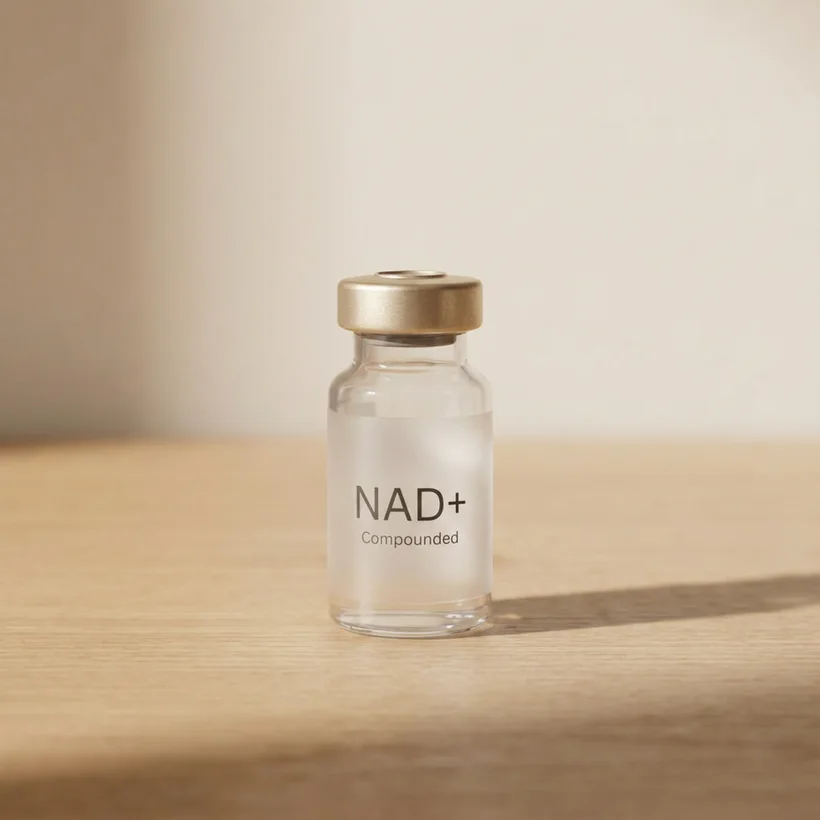
From the FormBlends catalog
NAD+ Peptide Complex
Restore cellular energy and DNA repair capacity · From $179/mo · compounded by a licensed 503A pharmacy, dispensed only after provider review.
View NAD+ Peptide Complex →Why is there so little patient discussion of NAD for the brain?
Dedicated community discussion on this specific topic is limited. As more patients share experiences, we will update this section with relevant threads.
r/bpc_157: "Best route of administration for gut health and brain health?"
6 upvotes, 9 comments
r/Ozempic thread: 917 upvotes and 247 comments
917 upvotes, 247 comments
Why GLP-1 users ask about NAD and neuroprotection
GLP-1 receptor agonists like semaglutide and tirzepatide are changing how we approach weight management and metabolic health. As more patients begin treatment and share their experiences, our understanding of best practices continues to evolve. What we know today comes from two sources: controlled clinical trials (STEP, SELECT, SURMOUNT) and the collective experience of over 1.5 million Americans using these medications as of January 2026.
The clinical data gives us the statistical foundation. The community data gives us the practical context. Both matter for making informed decisions about your treatment.
How long does GLP-1 treatment last and what side effects occur?
How long will I need to take this medication? Current evidence suggests GLP-1 medications work best as long-term treatment, similar to blood pressure or cholesterol medications. The STEP 1[1] extension data showed that patients who stopped semaglutide regained roughly two-thirds of their lost weight within a year. Some patients maintain their weight loss after stopping with lifestyle changes alone, but this is not the norm. Most providers recommend planning for ongoing treatment, potentially at a lower maintenance dose.
Will I build tolerance to the medication? The clinical data does not show tolerance development in the way that some other medications lose effectiveness over time. Weight loss does slow after 6-12 months, but this is because you weigh less and need fewer calories, not because the medication stops working. Appetite suppression and food noise reduction tend to persist as long as you take the medication.
What happens to my body composition during rapid weight loss? Without intervention, 20-40% of weight lost on GLP-1 medications is lean mass (muscle). Two strategies reduce this significantly: resistance training at least twice weekly and protein intake of 60-80g daily minimum. Patients who do both tend to lose primarily fat while preserving or even gaining muscle, resulting in a much better body composition outcome even at the same total weight loss.
Should I tell my other doctors about this medication? Yes, always. GLP-1 medications can affect the absorption of other oral medications due to slowed gastric emptying. They can also improve conditions like diabetes, hypertension, and sleep apnea to the point where other medication doses need reduction. Your cardiologist, endocrinologist, psychiatrist, and dentist should all know you are taking a GLP-1 agonist.
FormBlends providers coordinate with your other healthcare providers and can adjust your GLP-1 treatment based on changes in your overall medical picture. Consultations are included in your monthly plan.
Lessons from experienced NAD users on brain health goals
Patients who have navigated nad for brain health and neuroprotection during GLP-1 treatment share several consistent insights:
Start simple and adjust. The patients with the best outcomes related to nad for brain health and neuroprotection did not try to optimize everything from day one. They started with the basics (protein, water, medication adherence) and added complexity as they learned how their body responded.
Track what matters for your situation. For nad for brain health and neuroprotection specifically, the relevant metrics may differ from general weight loss tracking. Identify the 2-3 measurements that tell you whether your approach to nad for brain health and neuroprotection is working, and track those consistently.
Ask your provider early. Patients who raised nad for brain health and neuroprotection with their provider proactively reported better outcomes than those who waited until it became a problem. FormBlends providers hear about nad for brain health and neuroprotection regularly and can offer guidance based on what has worked for similar patients.
Which organs and brain regions do GLP-1 medicines affect?
The science connecting nad for brain health and neuroprotection to GLP-1 treatment involves the medication's multi-system effects. Semaglutide activates GLP-1 receptors in the hypothalamus (appetite), brainstem (fullness/nausea), pancreas (insulin), stomach (gastric emptying), and targets in the heart, liver, and kidneys. Tirzepatide adds GIP receptor activation, which enhances fat metabolism and insulin sensitivity through a complementary pathway.
For nad for brain health and neuroprotection specifically, the relevant mechanisms include peptide receptor binding, half-life engineering, and tissue-specific distribution. The SELECT trial[2] (N=17,604, NEJM 2023) demonstrated that these effects extend beyond weight loss to 20% cardiovascular risk reduction over 4 years.
Your Next Steps
If nad for brain health and neuroprotection is your primary concern right now: Schedule a focused discussion with your FormBlends provider. Rather than trying to address everything at once, identify the one action related to nad for brain health and neuroprotection that would have the most impact this week and start there.
If you are researching before starting treatment: NAD for Brain Health and Neuroprotection is a manageable aspect of GLP-1 therapy that your provider can help you plan for from day one. The free FormBlends consultation covers your specific concerns, including how nad for brain health and neuroprotection has been handled for patients in similar situations.
Track your experience: Note how nad for brain health and neuroprotection changes week to week. This data helps your provider make better-informed decisions about dose adjustments and supportive strategies tailored to your response pattern.
Frequently Asked Questions
Is semaglutide safe? What trial data shows
Semaglutide has been studied in over 20,000 patients across the STEP and SELECT trial programs. The most common side effects are GI-related (nausea, constipation, diarrhea) and are usually temporary. The SELECT trial showed a 20% reduction in cardiovascular[2] events, demonstrating a significant safety benefit.
Brand Wegovy vs compounded semaglutide: monthly price comparison
Brand Wegovy costs $1,300+/month without insurance. Compounded semaglutide ranges from $129-$349/month through telehealth providers. FormBlends compounded semaglutide starts at $99 for the first month, then $190 per month, or $165 per month with Subscribe & Save, with physician consultation and third-party purity testing included. Tirzepatide starts at $149 for the first month, then $239 per month, or $214 per month with Subscribe & Save.
Is a licensed provider evaluation needed to get semaglutide?
Yes. Semaglutide is a prescription medication that requires evaluation by a licensed healthcare provider. Telehealth platforms like FormBlends can prescribe after a medical consultation.
Does weight return after stopping semaglutide?
Semaglutide is considered a long-term treatment. The STEP 1 extension data showed weight regain after stopping. Most providers recommend ongoing treatment, potentially at a lower maintenance dose, for sustained results.
Is semaglutide safe alongside insulin or sulfonylureas?
Yes. Semaglutide (as Ozempic) is FDA-approved for type 2 diabetes. It improves blood sugar control and promotes weight loss. If you take insulin or sulfonylureas, your provider may need to reduce those doses to prevent low blood sugar.
What purity testing do compounded semaglutide batches get?
Yes. FormBlends compounded semaglutide starts at $99 for the first month, then $190 per month, or $165 per month with Subscribe & Save, through state-licensed 503A compounding pharmacies with third-party purity testing on every batch. Physician consultations are included.
Medical References
- Wilding JPH, Batterham RL, Calanna S, et al. Once-Weekly Semaglutide in Adults with Overweight or Obesity. N Engl J Med. 2021;384(11):989-1002. [PubMed | ClinicalTrials.gov | DOI]
- Lincoff AM, Brown-Frandsen K, Colhoun HM, et al. Semaglutide and Cardiovascular Outcomes in Obesity without Diabetes. N Engl J Med. 2023;389(24):2221-2232. [PubMed | ClinicalTrials.gov | DOI]
Sources
- Martens CR, Denman BA, Mazzo MR, et al. Chronic nicotinamide riboside supplementation is well-tolerated and elevates NAD+ in healthy middle-aged and older adults. Nat Commun. 2018;9(1):1286. PMID: 29599478.
- Airhart SE, Shireman LM, Risler LJ, et al. An open-label, non-randomized study of the pharmacokinetics of the nutritional supplement nicotinamide riboside (NR) and its effects on blood NAD+ levels in healthy volunteers. PLoS One. 2017;12(12):e0186459. PMID: 29211728.
- Trammell SA, Schmidt MS, Weidemann BJ, et al. Nicotinamide riboside is uniquely and orally bioavailable in healthy humans. Nature Communications. 2016;7:12948.
Ready when you are
NAD+ Peptide Complex
Restore cellular energy and DNA repair capacity · From $179/mo · compounded by a licensed 503A pharmacy, dispensed only after provider review.
View NAD+ Peptide Complex →