All GLP-1 medications from licensed 503A compounding pharmacies Browse Products
Glp 1 And Energy Levels Exercise When Fatigued
Fatigue is one of the most common complaints during GLP-1 treatment. This GLP-1 fatigue low energy exercise resource covers the essential information...
Fatigue is one of the most common complaints during GLP-1 treatment. This GLP-1 fatigue low energy exercise resource covers the important information you need to make informed decisions. You know you should exercise, but your body feels heavy. Your motivation is low.
Fatigue is one of the most common complaints during GLP-1 treatment. This GLP-1 fatigue low energy exercise resource covers the important information you need to make informed decisions. You know you should exercise, but your body feels heavy. Your motivation is low. Getting off the couch feels like a workout in itself. If you're dealing with GLP-1 fatigue, low energy, and the challenge of fitting in exercise, you aren't imagining things. This is a real side effect, and it's manageable.
Key Takeaways:
- Discover why glp-1 medication causes fatigue
- Timing Your Workouts for Better Energy
- Pre-Workout Nutrition When Appetite Is Low
- When to Rest vs. When to Push Through
This guide helps you understand why GLP-1 causes fatigue, how to time your workouts for maximum energy, and when resting is actually the smarter choice.
Why GLP-1 Medication Causes Fatigue
About the cause helps you find the solution. GLP-1 fatigue comes from several factors working together:
Calorie deficit. GLP-1 medications significantly reduce appetite. Many people eat 500 to 1,000 fewer calories per day without trying. That's a large energy deficit. Your body has less fuel to work with, and you feel it.
Blood sugar regulation. GLP-1 medications improve how your body manages blood sugar. This is a good thing for your health, but it can cause energy dips while your system adjusts. If you were used to running on blood sugar spikes and crashes, steady blood sugar can initially feel like low energy.
Dose adjustments. Every time you titrate up to a higher dose, your body needs time to adapt. Fatigue often peaks in the first one to two weeks after a dose increase, then gradually improves.
Dehydration. Reduced appetite often means reduced fluid intake too. Even mild dehydration causes fatigue, brain fog, and poor exercise performance. Many GLP-1 users aren't drinking enough water.
Poor sleep. Some GLP-1 users experience disrupted sleep, especially if GI side effects like acid reflux or nausea are worse at night. Poor sleep compounds daytime fatigue.
The good news: most people find their energy stabilizes within four to six weeks of starting treatment or after a dose change. In the meantime, strategic adjustments to your exercise routine can help.
New to GLP-1 treatment? to see if you qualify.
Timing Your Workouts for Better Energy
"What makes tirzepatide particularly interesting is the dual GIP/GLP-1 mechanism. We're seeing that GIP receptor activation appears to amplify the metabolic effects in ways we didn't fully anticipate from the preclinical data.") Dr. Ania Jastreboff, MD, PhD, Yale School of Medicine, lead author of SURMOUNT-1[1]
Lifestyle Factors Impact on GLP-1 Results. Based on GLP-1 lifestyle optimization research.
View data table
Bar chart showing lifestyle factors impact on glp-1 results: Protein Intake (90), Exercise (85), Sleep Quality (78), Hydration (72), Stress Mgmt (65)
Category
Impact on Treatment Outcomes (%)
Detail
Protein Intake
90
Preserves muscle mass
Exercise
85
Enhances weight loss
Sleep Quality
78
Supports metabolism
Hydration
72
Reduces side effects
Stress Mgmt
65
Cortisol reduction
When you exercise matters almost as much as whether you exercise. Here are strategies to work with your energy rather than against it:
Identify your energy window. Most GLP-1 users have a predictable energy pattern through the week. Track your energy levels for one to two weeks (use a simple 1 to 10 scale in the ). You'll likely notice that certain days and times of day feel better than others.
Schedule hard workouts for high-energy days. If your injection is on Friday, your toughest workout might be best on Tuesday or Wednesday, when side effects have eased. Save lighter activity like walking or stretching for the day of and day after your injection.
Morning may be better than evening. Many GLP-1 users report higher energy in the morning before the day depletes their limited reserves. If evening workouts feel impossible, try shifting to morning sessions.
Don't wait until you feel like it. On moderate-energy days, commit to starting a workout for just 10 minutes. If you still feel terrible after 10 minutes, stop. But most of the time, movement creates energy. You'll feel better at minute 15 than you did at minute 1.
Shorten, don't skip. A 15-minute workout beats a skipped workout every time. On low-energy days, cut your session in half rather than canceling entirely. You still get the muscle-preservation benefits, even in a shorter session.
Free Download: GLP-1 Strength Training Program (12-Week)
This program includes modifications for low-energy days so you never have to skip entirely. Designed for GLP-1 users with energy management built in. Get yours free (we'll email it to you instantly.
Patient Perspective:"I started resistance training three times a week when I began semaglutide, specifically to protect muscle mass. After 6 months, my body fat dropped from 38% to 27%, but I actually gained 2 pounds of lean mass. The strength training made a huge difference.") Tom H., 50, FormBlends patient (name changed for privacy)
[Download Now]
Pre-Workout Nutrition When Appetite Is Low
Exercising on an empty stomach is a recipe for dizziness, weakness, and a terrible workout. Even if you aren't hungry, your muscles need fuel. Here is how to eat enough to train without forcing a full meal:
From the FormBlends catalog
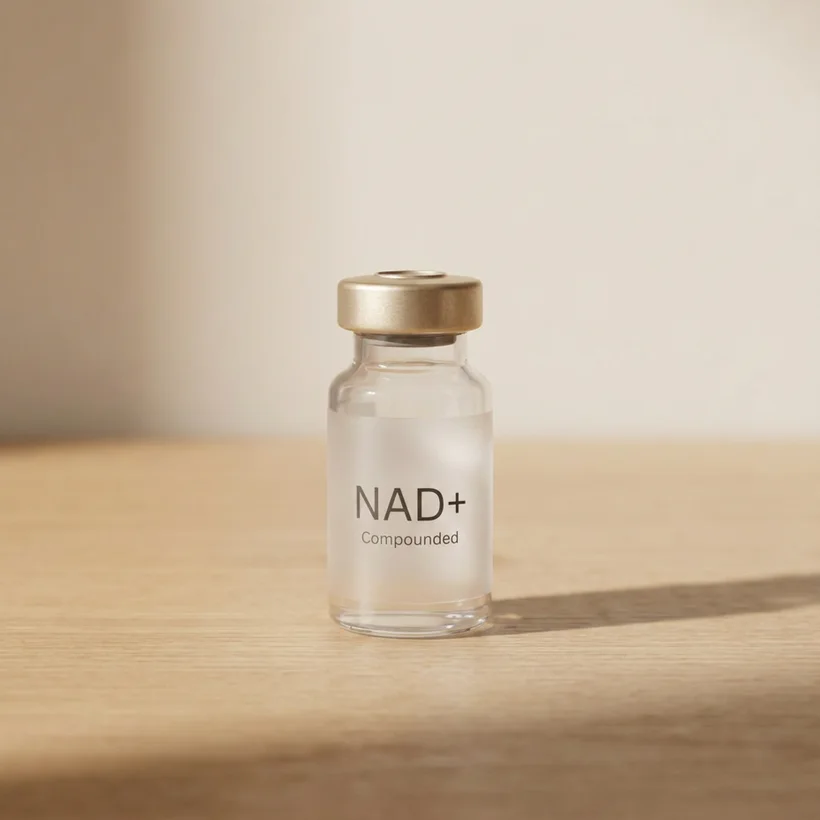
NAD+ Peptide Complex
Restore cellular energy and DNA repair capacity · From $179/mo · compounded by a licensed 503A pharmacy, dispensed only after provider review.
60 to 90 minutes before your workout, eat a small snack with carbs and protein:
- Half a banana with a tablespoon of peanut butter
- A small handful of crackers with cheese
- A few bites of a protein bar
- Half a cup of Greek yogurt with berries
- A small smoothie (protein powder, banana, milk)
Keep portions tiny. On GLP-1, your stomach empties slowly. A large pre-workout meal can cause nausea during exercise. Think 100 to 200 calories, not a full plate.
Liquid calories are your friend. If solid food doesn't appeal to you before a workout, drink your fuel. A protein shake with some fruit delivers energy without the heaviness.
Stay hydrated. Drink 16 ounces of water in the two hours before your workout. Dehydration is a major cause of exercise fatigue on GLP-1. Add electrolytes if you're sweating heavily.
Caffeine can help. A small coffee or green tea 30 to 60 minutes before exercise may boost your energy and performance. Be cautious if caffeine worsens GI symptoms. Start with a small amount.
For a full nutrition strategy on GLP-1, check out our .
Track your energy, nutrition, and workouts together. , free on iOS and Android.
When to Rest vs. When to Push Through
This is the hardest judgment call for GLP-1 users. Here is a framework to help:
Rest if you experience:
Dizziness or lightheadedness when standing
Active nausea or vomiting
Inability to eat or drink for 12 or more hours
Resting heart rate 10 or more beats above your normal
Fever or illness
Sharp or unusual pain (not normal muscle soreness)
Do a light workout if you experience:
General tiredness but no nausea
Low motivation but physically capable
Mild soreness from previous workouts
Slightly lower appetite than usual
Push through a full workout if:
You slept reasonably well
You ate something in the last few hours
You're hydrated
Your only symptom isn't feeling like it
Light workout options for low-energy days:
- 20-minute walk at an easy pace
- Gentle stretching or
- Light resistance band work (50 percent of normal effort)
- Swimming at an easy pace
The 10-minute rule. Start your workout with the intention of doing just 10 minutes. If your energy improves (it often does), keep going. If you feel worse, stop without guilt. Movement often generates its own energy, but not always. Listening to your body is a skill, not a weakness.
Talk to your if fatigue is severe or persistent. Dose adjustments, lab work to check for nutritional deficiencies, or changes to your treatment timing may help.
Frequently Asked Questions
How long does GLP-1 fatigue last?
Most people experience the worst fatigue during the first two to four weeks of treatment or after dose increases. Energy levels typically stabilize within four to six weeks as your body adjusts. If fatigue persists beyond this, talk to your provider about possible causes like nutritional deficiencies or dose adjustments.
Should I exercise on GLP-1 injection day?
Light activity like walking or gentle stretching is fine if you feel up to it. Most providers recommend avoiding intense workouts on injection day and the following day, when side effects tend to peak. Schedule your hardest training sessions for mid-week relative to your injection.
Can eating more help with GLP-1 fatigue?
Sometimes, yes. If you're eating too little (under 1,200 calories for women or 1,500 for men), increasing calorie intake may improve energy. Focus on nutrient-dense foods with protein and complex carbs. Talk to your provider or a dietitian if you're unsure whether your intake is adequate.
Does caffeine interact with GLP-1 medications?
There are no known direct interactions between caffeine and GLP-1 medications like semaglutide or tirzepatide. But caffeine can worsen nausea and acid reflux, which are common . Start with small amounts and see how your body responds.
Will exercise make my GLP-1 fatigue worse?
In most cases, moderate exercise actually improves energy levels over time. The challenge is getting started. Regular exercise improves sleep quality, cardiovascular fitness, and mood, all of which combat fatigue. Start with short, manageable sessions and build gradually.
What's Your Next Move?
You have the information. Now let a licensed provider help you put it into action. FormBlends makes it simple, answer a few questions and get a personalized recommendation.
Medical References
Jastreboff AM, Aronne LJ, Ahmad NN, et al. Tirzepatide Once Weekly for the Treatment of Obesity. N Engl J Med. 2022;387(3):205-216. [PubMed | ClinicalTrials.gov | DOI]
Wilding JPH, Batterham RL, Calanna S, et al. Once-Weekly Semaglutide in Adults with Overweight or Obesity. N Engl J Med. 2021;384(11):989-1002. [PubMed | ClinicalTrials.gov | DOI]
Davies M, Færch L, Jeppesen OK, et al. Semaglutide 2.4 mg once a week in adults with overweight or obesity, and type 2 diabetes (STEP 2). Lancet. 2021;397(10278):971-984. [PubMed | ClinicalTrials.gov | DOI]
Wadden TA, Bailey TS, Billings LK, et al. Effect of Subcutaneous Semaglutide vs Placebo as an Adjunct to Intensive Behavioral Therapy on Body Weight in Adults With Overweight or Obesity (STEP 3). JAMA. 2021;325(14):1403-1413. [PubMed | ClinicalTrials.gov | DOI]
Garvey WT, Batterham RL, Bhatt DL, et al. Two-year effects of semaglutide in adults with overweight or obesity (STEP 5). Nat Med. 2022;28(10):2083-2091. [PubMed | ClinicalTrials.gov | DOI]
Sources &. References
Wilding JPH, et al. STEP 1[2] (Wilding et al., NEJM, 2021) Supplementary Appendix. Body composition analysis via DXA. N Engl J Med. 2021;384(11). Doi:10.1056/NEJMoa2032183
Stierman B, Afful J, Carroll MD, et al. National Health and Nutrition Examination Survey 2017-March 2020 Prepandemic Data Files. NCHS Data Brief. No. 492. CDC/NCHS. 2023.
Sumithran P, Prendergast LA, Delbridge E, et al. Long-Term Persistence of Hormonal Adaptations to Weight Loss. N Engl J Med. 2011;365(17):1597-1604. Doi:10.1056/NEJMoa1105816
Wilding JPH, Batterham RL, Calanna S, et al. Once-Weekly Semaglutide in Adults with Overweight or Obesity. N Engl J Med. 2021;384(11):989-1002. Doi:10.1056/NEJMoa2032183
Davies M, Færch L, Jeppesen OK, et al. Semaglutide 2.4 mg once a week in adults with overweight or obesity, and type 2 diabetes (STEP 2 (Davies et al., Lancet, 2021)). Lancet. 2021;397(10278):971-984. Doi:10.1016/S0140-6736(21)00213-0
Wadden TA, Bailey TS, Billings LK, et al. Effect of Subcutaneous Semaglutide vs Placebo as an Adjunct to Intensive Behavioral Therapy on Body Weight in Adults With Overweight or Obesity (STEP 3 (Wadden et al., JAMA, 2021)). JAMA. 2021;325(14):1403-1413. Doi:10.1001/jama.2021.1831
Garvey WT, Batterham RL, Bhatt DL, et al. Two-Year Effects of Semaglutide in Adults with Overweight or Obesity (STEP 5 (Garvey et al., Nat Med, 2022)). Nat Med. 2022;28:2083-2091. Doi:10.1038/s41591-022-02026-4
Lincoff AM, Brown-Frandsen K, Colhoun HM, et al. Semaglutide and Cardiovascular Outcomes in Obesity without Diabetes. N Engl J Med. 2023;389(24):2221-2232. Doi:10.1056/NEJMoa2307563
This content is provided for informational and educational purposes only. It isn't a substitute for professional medical advice, diagnosis, or treatment. Always seek the advice of a licensed healthcare provider with any questions about a medical condition or treatment plan.
Last updated: 2026-03-24
Ready when you are
NAD+ Peptide Complex
Restore cellular energy and DNA repair capacity · From $179/mo · compounded by a licensed 503A pharmacy, dispensed only after provider review.
FormBlends does not claim an individual clinician byline unless a named reviewer is available. For this page, the editorial team checks medical and regulatory claims against primary sources, clinical trials, public datasets, and regulator guidance.
For Glp 1 And Energy Levels Exercise When Fatigued, FormBlends checks the page topic against primary trials, systematic reviews, guidelines, and current PubMed-indexed literature where available. These citations are context, not medical advice, proof of eligibility, or a claim that every study applies to every patient.
Use this page to decide if a provider review is the right next step
Direct answer
Glp 1 And Energy Levels Exercise When Fatigued research is most useful when it helps you compare eligibility, expected results, side effects, cost, and the supervision needed before treatment.
Fatigue is one of the most common complaints during GLP-1 treatment. This GLP-1 fatigue low energy exercise resource covers the essential information you need to make informed decisions. "Glp 1 And Energy Levels Exercise When Fatigued" earns its keep when it helps a reader move from a broad question to a cleaner next step. This is a medical education page where the useful answer depends on context, evidence quality, personal risk, and clinician guidance, and the reader usually needs help with safety and side-effect planning. Pay extra attention to side effects and related tags such as lifestyle, wellness, exercise. Because this article has 7 major sections, scan the headings first and then use the FAQ or summary sections to pressure-test the answer.
Confirm whether the page is discussing an FDA-approved use, a compounded option, or research-only context.
Ask a licensed clinician how the evidence applies to your health history, medications, labs, and side-effect risk.
Check the latest label, trial update, pharmacy policy, or state rule when the article touches medication access.
Original tools and data
Use the FormBlends research stack
These assets are built to be useful beyond a single article: shareable data pages, calculators, provider comparisons, and safety checks that give Google and readers something original to crawl.
Practical 2026 note for Glp 1 And Energy Levels Exercise When Fatigued
Glp 1 And Energy Levels Exercise When Fatigued now carries extra 2026 context around semaglutide, tirzepatide, safety signals, glp, energy, levels, because those are the subtopics readers tend to compare before they trust a medical or wellness recommendation.
Instead of adding filler, this page keeps the named treatment terms, practical verification points, and next-step questions close to glp 1 and energy levels exercise when fatigued.
Readers should use the section to check current eligibility, pharmacy or provider policies, and safety questions with a licensed professional before acting.
Custom 2026 image for Glp 1 And Energy Levels Exercise When Fatigued, lifestyle & wellness, and better treatment decision-making.
Image description: Unique image for this page covering Glp 1 And Energy Levels Exercise When Fatigued, lifestyle & wellness, safety, cost, provider selection, and patient decision-making.
Download the GLP-1 Lifestyle Guide
A printable guide covering nutrition, exercise, hydration, and sleep optimization on GLP-1 therapy.
Free download. We'll also send helpful GLP-1 guides to your inbox. Unsubscribe anytime.
Medical Disclaimer: This content is for informational purposes only and does not constitute medical advice. Always consult a qualified healthcare provider before starting, stopping, or changing any medication or treatment. FormBlends articles are source-checked against medical and regulatory references, but they are not a substitute for a personal medical consultation.
Written by FormBlends Editorial Research
Prepared by FormBlends Editorial Research. Claims are checked against primary regulatory, trial, label, and public-health sources where available. Reviewed against primary medical, regulatory, and trial sources for accuracy, sourcing, and patient-safety framing.
Ready to get started?
Provider-reviewed GLP-1 and peptide therapy, delivered to your door.