Key Takeaway
You know you should work out. This GLP-1 fatigue low energy exercise resource covers the important information you need to make informed decisions. But your body is saying no.
You know you should work out. This GLP-1 fatigue low energy exercise resource covers the important information you need to make informed decisions. But your body is saying no. GLP-1 fatigue and low energy are among the most common complaints people report, especially in the first few weeks on semaglutide or tirzepatide. The question is: should you push through, scale back, or skip exercise altogether when you're running on empty?
Key Takeaways: - Discover why glp-1 medication causes fatigue - When to Push Through vs. When to Rest - Low-Energy Workout Strategies - Pre-Workout Nutrition for Better Energy
The answer is nuanced. Sometimes moving is exactly what your tired body needs. Other times, rest is the smarter choice. This guide helps you tell the difference and gives you practical workout strategies for low-energy days on GLP-1 medication.
Why GLP-1 Medication Causes Fatigue
Knowing why you feel tired helps you address it. GLP-1 medications can affect your energy through several pathways.
Reduced calorie intake. Your appetite is lower. You're eating less. Fewer calories means less fuel for your body. If you were used to 2,500 calories and now you're eating 1,400, your body notices. It takes time for your metabolism to adapt to a lower energy intake.
Blood sugar regulation changes. GLP-1 medications improve insulin sensitivity and stabilize blood sugar. While this is beneficial long-term, the transition period can cause energy dips as your body adjusts to more stable (but sometimes lower) glucose levels.
GI side effects drain energy. Nausea, bloating, and GI discomfort take a toll. When your stomach is upset, your body diverts energy to digestion. There's less left over for everything else.
Dehydration. GLP-1 medications can cause increased fluid loss, especially through GI effects. Even mild dehydration) as little as 2%, reduces physical performance and increases perceived fatigue.
Poor sleep. Some people report disrupted sleep patterns when starting GLP-1 medication. GI discomfort, acid reflux, or nausea can interfere with sleep quality. Poor sleep cascading into daytime fatigue.
"GLP-1 receptor agonists represent the most significant advance in obesity pharmacotherapy in decades. For the first time, we have medications that produce weight loss approaching what was previously only achievable through bariatric surgery.", Dr. Robert Kushner, MD, Northwestern University, speaking at ObesityWeek 2023
The good news: most GLP-1 fatigue improves within 4-8 weeks as your body adjusts. If severe fatigue persists beyond that, talk to your about your dosage and overall nutrition.
When to Push Through vs. When to Rest
Not all fatigue is the same. Learning to read your body is a skill that pays off.
View data table
| Category | Impact on Treatment Outcomes (%) | Detail |
|---|---|---|
| Protein Intake | 90 | Preserves muscle mass |
| Exercise | 85 | Enhances weight loss |
| Sleep Quality | 78 | Supports metabolism |
| Hydration | 72 | Reduces side effects |
| Stress Mgmt | 65 | Cortisol reduction |

Move anyway if: - You feel generally tired but not sick - Your fatigue is more mental than physical (you don't want to work out, but physically you could) - You slept reasonably well but feel sluggish - You have mild nausea that's manageable - It has been more than 48 hours since your injection and side effects are fading
Free Download: GLP-1 Strength Training Program (12-Week) This program includes modified workouts for low-energy days. Every session has a "minimum effective dose" version for when fatigue hits. Get yours free (we'll email it to you instantly. [Email Input] [Download Button]
Patient Perspective: "I started resistance training three times a week when I began semaglutide, specifically to protect muscle mass. After 6 months, my body fat dropped from 38% to 27%, but I actually gained 2 pounds of lean mass. The strength training made a huge difference.") Tom H., 50, FormBlends patient (name changed for privacy)
Rest if: - You're actively nauseous or have vomiting - You feel dizzy or lightheaded when standing - You slept fewer than 5 hours - You have a headache that worsens with movement - It's injection day and your side effects are peaking - You have exercised 4+ days in a row without rest
Here is a rule that works: commit to 10 minutes. Start your workout. If after 10 minutes you still feel awful, stop. No guilt. But most of the time, those first 10 minutes are the hardest. Once blood starts flowing, energy often improves. Many people feel better after a light workout than they did before it.
Low-Energy Workout Strategies
When your energy is low, the goal shifts. You aren't trying to set personal records. You're trying to move your body, preserve muscle, and feel better. Here are your options.
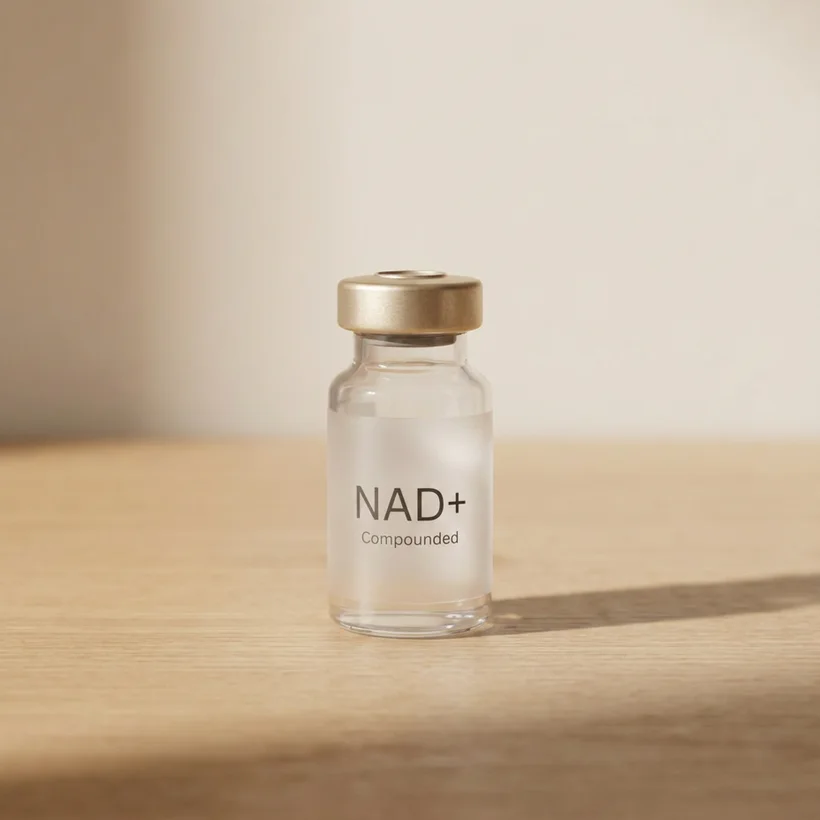
From the FormBlends catalog
NAD+ Peptide Complex
Restore cellular energy and DNA repair capacity · From $179/mo · compounded by a licensed 503A pharmacy, dispensed only after provider review.
View NAD+ Peptide Complex →The 15-minute minimum effective dose workout: - 5 bodyweight squats - 5 push-ups (or knee push-ups) - 30-second plank - 10 band pull-aparts - Repeat 3 times
This takes about 15 minutes. It hits your major muscle groups. It sends the muscle-preserving signal your body needs. And it's gentle enough for even your lowest energy days.
The walking option. When strength training feels like too much, walk. Even 15-20 minutes of walking provides benefits. Walking after meals may help with like nausea and bloating. Some people find that fresh air and gentle movement actually boost their energy.
The gentle yoga option. Yoga combines movement with deep breathing, which some people find helps with GLP-1-related nausea. Focus on gentle flows) no hot yoga or power vinyasa on low-energy days. Child's pose, cat-cow, gentle twists, and supported bridge pose are all appropriate.
The "just do one thing" approach. Some days, doing even a short circuit feels impossible. On those days, do one exercise. Five minutes of glute bridges. A single set of push-ups. A 10-minute walk around the block. Something is always better than nothing, and maintaining the habit matters more than any single workout.
Pre-Workout Nutrition for Better Energy
What you eat before exercise directly impacts your energy. When GLP-1 medication suppresses your appetite, you need to be strategic.
Eat something 1-2 hours before training. Even if you aren't hungry. A small snack with carbohydrates and protein gives your muscles fuel. Options that work well on a sensitive stomach: a banana, a small protein shake, a few crackers with peanut butter, or a handful of trail mix.
Caffeine can help. A small coffee or green tea 30 minutes before your workout may improve energy and performance. Just avoid caffeine if it worsens your GI symptoms. Some people find that caffeine on an empty stomach plus GLP-1 medication equals nausea.
Hydrate aggressively. Drink 16-20 ounces of water in the 2 hours before exercising. Dehydration is a sneaky energy thief. Add electrolytes (sodium, potassium, magnesium) if you're sweating or experiencing GLP-1-related fluid losses.
Prioritize protein throughout the day. Adequate protein supports stable energy. Aim for 0.7-1 gram per pound of body weight daily. Check our for ideas that work even when appetite is low.
If fatigue persists despite good nutrition and hydration, ask your provider to check your iron, vitamin D, B12, and thyroid levels. These are common deficiencies that cause fatigue independently of GLP-1 medication.
Frequently Asked Questions
How long does GLP-1 fatigue last?
Most people report that fatigue improves significantly within 4-8 weeks of starting or increasing their dose. Your body adapts to the new caloric intake and medication effects. If severe fatigue persists beyond 8 weeks, discuss it with your provider (it may indicate a nutritional deficiency or need for dose adjustment.
Should I skip exercise on GLP-1 injection day?
It depends on your side effects. Many people feel fine on injection day and can exercise normally. Others experience peak nausea and fatigue. The safest approach is to plan lighter activities on injection day and the following day. Schedule your hardest workouts for days 3-7 post-injection.
Can exercise actually boost my energy on GLP-1?
Yes. Research consistently shows that regular moderate exercise improves energy levels and reduces fatigue. The effect is both immediate (post-workout endorphin boost) and long-term (improved cardiovascular fitness, better sleep quality). Many GLP-1 users report feeling more energized on days they exercise.
What should I eat for energy before working out on GLP-1?
A small snack combining carbohydrates and protein 1-2 hours before exercise works best. Try a banana with a tablespoon of peanut butter, a small smoothie, or a few crackers with cheese. Keep portions small to avoid triggering nausea from your slower gastric emptying.
Is it dangerous to exercise when fatigued on GLP-1?
Mild fatigue is generally safe to exercise through, and movement often helps. But stop exercising immediately if you feel dizzy, lightheaded, extremely nauseous, or confused. These could be signs of dehydration, low blood sugar, or other issues that require rest and possibly medical attention.
Start your weight loss Today
Every transformation starts with a single step. Talk to a licensed FormBlends provider about whether this approach is right for you) consultations are free and confidential.
Medical References
- Wilding JPH, Batterham RL, Calanna S, et al. Once-Weekly Semaglutide in Adults with Overweight or Obesity. N Engl J Med. 2021;384(11):989-1002. [PubMed | ClinicalTrials.gov | DOI]
- Davies M, Færch L, Jeppesen OK, et al. Semaglutide 2.4 mg once a week in adults with overweight or obesity, and type 2 diabetes (STEP 2). Lancet. 2021;397(10278):971-984. [PubMed | ClinicalTrials.gov | DOI]
- Wadden TA, Bailey TS, Billings LK, et al. Effect of Subcutaneous Semaglutide vs Placebo as an Adjunct to Intensive Behavioral Therapy on Body Weight in Adults With Overweight or Obesity (STEP 3). JAMA. 2021;325(14):1403-1413. [PubMed | ClinicalTrials.gov | DOI]
- Garvey WT, Batterham RL, Bhatt DL, et al. Two-year effects of semaglutide in adults with overweight or obesity (STEP 5). Nat Med. 2022;28(10):2083-2091. [PubMed | ClinicalTrials.gov | DOI]
Sources &. References
- Wilding JPH, et al. STEP 1[1] (Wilding et al., NEJM, 2021) Supplementary Appendix. Body composition analysis via DXA. N Engl J Med. 2021;384(11). Doi:10.1056/NEJMoa2032183
- Stierman B, Afful J, Carroll MD, et al. National Health and Nutrition Examination Survey 2017-March 2020 Prepandemic Data Files. NCHS Data Brief. No. 492. CDC/NCHS. 2023.
- Sumithran P, Prendergast LA, Delbridge E, et al. Long-Term Persistence of Hormonal Adaptations to Weight Loss. N Engl J Med. 2011;365(17):1597-1604. Doi:10.1056/NEJMoa1105816
- Wilding JPH, Batterham RL, Calanna S, et al. Once-Weekly Semaglutide in Adults with Overweight or Obesity. N Engl J Med. 2021;384(11):989-1002. Doi:10.1056/NEJMoa2032183
- Davies M, Færch L, Jeppesen OK, et al. Semaglutide 2.4 mg once a week in adults with overweight or obesity, and type 2 diabetes (STEP 2 (Davies et al., Lancet, 2021)). Lancet. 2021;397(10278):971-984. Doi:10.1016/S0140-6736(21)00213-0
- Wadden TA, Bailey TS, Billings LK, et al. Effect of Subcutaneous Semaglutide vs Placebo as an Adjunct to Intensive Behavioral Therapy on Body Weight in Adults With Overweight or Obesity (STEP 3 (Wadden et al., JAMA, 2021)). JAMA. 2021;325(14):1403-1413. Doi:10.1001/jama.2021.1831
- Garvey WT, Batterham RL, Bhatt DL, et al. Two-Year Effects of Semaglutide in Adults with Overweight or Obesity (STEP 5 (Garvey et al., Nat Med, 2022)). Nat Med. 2022;28:2083-2091. Doi:10.1038/s41591-022-02026-4
- Lincoff AM, Brown-Frandsen K, Colhoun HM, et al. Semaglutide and Cardiovascular Outcomes in Obesity without Diabetes. N Engl J Med. 2023;389(24):2221-2232. Doi:10.1056/NEJMoa2307563
The information in this article is intended for educational use only and shouldn't be considered medical advice. Consult a qualified healthcare provider before making any changes to your medication or supplement regimen. FormBlends helps with connections with licensed providers for personalized medical guidance.
Last updated: 2026-03-24
Ready when you are
NAD+ Peptide Complex
Restore cellular energy and DNA repair capacity · From $179/mo · compounded by a licensed 503A pharmacy, dispensed only after provider review.
View NAD+ Peptide Complex →