
Trust Signals
Conflicts of interest: FormBlends sells peptide compounds. Competing products are named and evaluated honestly where they outperform ours. Affiliate relationships do not influence evidence grades.
Standard: Every confidence rating is graded against the actual evidence type (RCT, in vitro, animal, mechanism only). Speculative claims are labeled as such.
Key Takeaways
- GHK-Cu is the only copper peptide with multiple published human clinical studies; most show statistically significant improvements in skin laxity and fine lines at concentrations of 1% to 3% in controlled cosmetic trials.
- The molecular weight of intact GHK-Cu is approximately 340 g/mol for the tripeptide portion alone, which is near the upper limit for passive stratum corneum diffusion, making formulation vehicle a critical variable.
- Vitamin C (ascorbic acid) at low pH can reduce Cu(II) to Cu(I), destabilizing the copper complex and potentially generating reactive oxygen species via Fenton-type chemistry.
- AHK-Cu has genuine in vitro data but essentially no large independent human RCTs, placing it a full evidence tier below GHK-Cu despite structural similarity.
- COA purity for GHK-Cu should show HPLC values above 95%; anything lower raises real concerns about peptide degradation products or copper contamination.
Direct Answer: What Are the Best Copper Peptides?
Table of Contents
- The Ranked List: Best Copper Peptides by Evidence
- Evidence Ledger Table
- Mechanism With Specific Numbers
- What Most Pages Get Wrong: Penetration Reality
- Chemistry Behind the Rules: Why Vitamin C Is Complicated
- Honest Head-to-Head: GHK-Cu vs. Retinol vs. Vitamin C
- Operational Label and COA Literacy
- Copper Peptides for Hair: What the Evidence Actually Says
- Stability and Formulation Gotchas
- FAQ
- Sources
The Ranked List: Best Copper Peptides by Evidence
1. GHK-Cu (Glycyl-L-Histidyl-L-Lysine Copper) -- The Reference Standard
GHK-Cu is the naturally occurring copper-binding tripeptide first isolated from human plasma by Pickart and Thaler in 1973. It is the only copper peptide with a body of peer-reviewed human cosmetic trials measuring clinically relevant endpoints. Published studies (including Leyden et al. and Finkley et al., both industry-sponsored but with controlled designs) showed statistically significant reductions in fine lines and improvements in skin density in 12-week trials of 1% to 2% GHK-Cu formulations versus vehicle. The gene expression data from Pickart's lab and later independent groups show GHK-Cu modulating hundreds of genes involved in collagen, glycosaminoglycan synthesis, and antioxidant response. This is the copper peptide to build a protocol around.
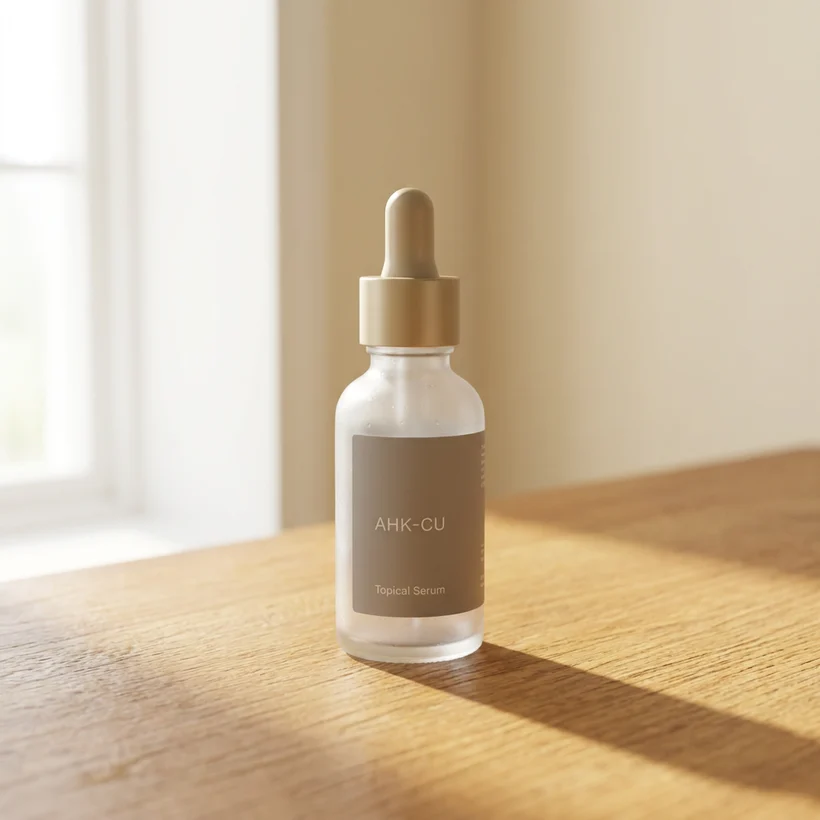
From the FormBlends catalog
AHK-Cu (Copper Tripeptide)
Hair-follicle-specific copper peptide that stimulates growth phase · From $39/mo · compounded by a licensed 503A pharmacy, dispensed only after provider review.
Learn about AHK-Cu (Copper Tripeptide) →2. AHK-Cu (Alanyl-Histidyl-Lysine Copper) -- Credible Analog, Thin Human Data
AHK-Cu replaces the N-terminal glycine of GHK with alanine. Some in vitro studies suggest it may stimulate fibroblast collagen synthesis at comparable or slightly lower concentrations than GHK-Cu. It appears in higher-end cosmetic formulations marketed for firming. The mechanism is plausible given structural similarity. The problem: no large independent human RCTs exist as of 2026. Use it where GHK-Cu is unavailable or as a secondary ingredient, not as a replacement for the evidence base.
3. GHK Alone (Without Copper) -- Partial Activity, Lower Potency
Some formulations use GHK without the copper ion, either intentionally or due to formulation errors that cause copper dissociation. GHK itself has some intrinsic biological activity (it binds to certain cell-surface sites), but the copper component is essential for full activity in collagen gene upregulation. GHK alone is ranked third because it is better than no active ingredient but inferior to the intact copper complex.
4. Copper Tripeptide-1 (Cosmetic INCI Name for GHK-Cu)
This is the same molecule as GHK-Cu under its INCI cosmetic ingredient name. Products listing "Copper Tripeptide-1" on the label contain GHK-Cu. The ranking is identical to position 1; the separate entry exists because consumers searching labels need to know these are the same compound.
5. Other Copper Peptide Analogs (Diaminobutyroyl, Custom Sequences)
Proprietary copper peptide sequences appear occasionally in high-end cosmetics. As of 2026, published independent evidence for any of these exceeds in vitro or small pilot data. They may be genuine innovations, but without controlled trials they cannot be ranked above GHK-Cu or AHK-Cu.
Evidence Ledger Table
| Claim | Peptide | Best Evidence Type | Effect Direction | Confidence |
|---|---|---|---|---|
| Topical GHK-Cu reduces fine lines vs. vehicle | GHK-Cu | Human cosmetic RCT (industry-funded, n approx. 67-100) | Positive | Moderate |
| GHK-Cu stimulates collagen and GAG synthesis in fibroblasts | GHK-Cu | Multiple in vitro studies, replicated | Positive | Moderate (in vitro) |
| GHK-Cu modulates hundreds of human genes | GHK-Cu | Microarray / gene expression studies (Pickart group, replicated in part) | Positive (mechanism) | Moderate (mechanism) |
| AHK-Cu stimulates fibroblasts comparably to GHK-Cu | AHK-Cu | In vitro, limited studies | Positive | Low |
| GHK-Cu promotes hair growth | GHK-Cu | Small human studies, animal models | Weakly positive | Low |
| Intact topical GHK-Cu reaches viable dermis at therapeutic concentration | GHK-Cu | Mechanistic inference; no definitive controlled human pharmacokinetic study | Uncertain | Very Low |
| Injectable GHK-Cu is safe and effective at anti-aging doses | GHK-Cu | Case reports, no large RCT | Insufficient data | Very Low |
| Copper peptides outperform tretinoin for wrinkle reduction | GHK-Cu | No direct head-to-head RCT | No data | Very Low |
Mechanism With Specific Numbers
GHK-Cu coordinates a single Cu(II) ion through the alpha-amino group of glycine, the imidazole nitrogen of histidine, and the peptide nitrogen between glycine and histidine. This square-planar copper complex is stable at physiological pH (roughly 7.0 to 7.4) and at concentrations in the nanomolar to low-micromolar range activates fibroblast collagen and elastin synthesis in cell culture models.
Pickart and colleagues used microarray analysis and reported that GHK at 1 micromolar concentration affected the expression of a large set of human genes (the group cited figures in the hundreds of genes in Pickart and Margolina, 2018, published in Biomolecules). Upregulated pathways include collagen type I and III synthesis, decorin, and superoxide dismutase 1 (SOD1). Downregulated genes include several pro-inflammatory cytokines.
What this does NOT prove: Gene expression changes in a cell culture dish at 1 micromolar do not prove that topical application of a 1% cream delivers 1 micromolar to dermal fibroblasts in a living human. The translation step is the weakest link in the entire copper peptide evidence chain.
The tripeptide GHK has a molecular weight of approximately 340 g/mol as the free tripeptide. With copper coordination the complex is larger and carries charge. The conventional cutoff for passive percutaneous absorption is often cited as around 500 Da, suggesting GHK-Cu is within the weight range for skin penetration, but charge, polarity, and vehicle formulation all affect actual flux. This is why "within the 500 Da rule" does not mean "definitely penetrates at useful concentrations."
What Most Pages Get Wrong: Penetration Reality
Nearly every copper peptide review repeats the claim that copper peptides "penetrate to the dermis" as settled fact. This is not established. Here is what is actually known:
- The 500 Da rule is a rough heuristic, not a guarantee. It predicts potential for penetration, not actual dermal concentration.
- GHK-Cu carries ionic charge at physiological pH (due to the copper coordination and the lysine side chain amine), which reduces passive diffusion through the lipid-rich stratum corneum.
- Published ex vivo skin penetration studies (using pig or human skin in Franz diffusion cells) are limited and show variable results depending on formulation. No published study has definitively shown therapeutic concentrations of intact GHK-Cu reaching the viable dermis under standard cosmetic conditions.
- Delivery systems such as liposomes, ethosomes, or microneedling pretreatment can meaningfully increase penetration, but these alter the product category substantially.
Practical implication: A 2% GHK-Cu serum in water-and-glycerin base is not the same as a 2% GHK-Cu in a penetration-enhanced vehicle, and neither is equivalent to intradermal injection. Treat any claim that "our serum delivers GHK-Cu to the dermis" as unverified unless the brand can show Franz cell or in vivo pharmacokinetic data.
Chemistry Behind the Rules: Why Vitamin C Is Complicated
Vitamin C (L-ascorbic acid) is a potent reducing agent. At the low pH typically used in vitamin C serums (pH 2.5 to 3.5), ascorbic acid can reduce the Cu(II) in GHK-Cu to Cu(I). This does two things:
- It dissociates the copper from the peptide complex, destroying the active GHK-Cu molecule.
- Cu(I) in the presence of hydrogen peroxide (which forms naturally in aerated aqueous solutions) participates in Fenton-type chemistry, generating hydroxyl radicals. This is the opposite of the antioxidant effect you are seeking.
This chemistry is not hypothetical; copper-catalyzed ascorbate oxidation is a well-characterized reaction in pharmaceutical stability literature. The practical rule: do not mix a low-pH vitamin C serum with GHK-Cu in the same application step. Separating them by several hours (for example, vitamin C in the morning, GHK-Cu at night) avoids the reaction window on skin. At neutral pH (above 5), ascorbate reducing power is much lower and the interaction is less severe, which is why some buffered vitamin C formulations are safer to layer.
The retinoid interaction concern is different and much less chemically grounded. There is no established redox reaction between retinoids and GHK-Cu. The "do not combine with retinoids" advice circulating online is based on loose theoretical concerns about competing signaling pathways, not demonstrated clinical antagonism. Combining them is not strongly contraindicated on chemical grounds; irritation from retinoids may simply make the skin a worse barrier, which is a delivery variable, not a molecular antagonism.
Honest Head-to-Head: GHK-Cu vs. Retinol vs. Tretinoin vs. Vitamin C
| Dimension | GHK-Cu (topical) | Retinol (OTC) | Tretinoin (Rx) | Vitamin C (L-AA) |
|---|---|---|---|---|
| Human RCT evidence for wrinkle reduction | Several small to moderate industry-funded RCTs | Multiple RCTs including independent | Extensive, landmark studies (Kligman et al.) | Several RCTs for brightening; moderate for lines |
| Mechanism clarity | Gene-level, replicated in vitro | RAR/RXR receptor pathway, well mapped | Same as retinol, stronger | Collagen cofactor (prolyl hydroxylase), antioxidant |
| Irritation risk | Very low; well tolerated | Low to moderate; purging possible | Moderate to high; retinoid dermatitis common | Low at neutral pH; higher at pH below 3 |
| Dermal penetration confidence | Low (plausible but unconfirmed at therapeutic dose) | Moderate (converts to retinoic acid in skin) | High (direct receptor agonist, proven uptake) | Moderate (ascorbate detected in dermis with optimized formulation) |
| Where GHK-Cu wins | Tolerability, safety profile, wound-healing signals | -- | -- | -- |
| Where GHK-Cu loses | -- | Stronger independent evidence base | Far stronger evidence; GHK-Cu is not comparable | Better-established hyperpigmentation data |
| Can combine with GHK-Cu? | N/A | Yes, no strong contraindication | Yes, no strong contraindication | Separate by time or pH; do not mix at low pH |
Bottom line: GHK-Cu is genuinely useful and well-tolerated, but anyone telling you it outperforms tretinoin for collagen remodeling is not reading the evidence honestly. The two compounds are not in the same evidence weight class. GHK-Cu is a smart complement to a retinoid protocol, not a replacement for one.
Operational Label and COA Literacy
Reading a Product Label
- INCI name: GHK-Cu appears as "Copper Tripeptide-1" on compliant cosmetic labels. "Copper Peptide" alone is non-specific and could refer to anything.
- Position in ingredient list: EU and US regulations require ingredients above 1% to appear in descending order of concentration. If Copper Tripeptide-1 appears near the bottom of a long list, you are likely getting well below 0.5%, which is below the concentration used in most positive studies.
- Concentration target: Published cosmetic studies with positive results used approximately 1% to 3% GHK-Cu. Aim for products where Copper Tripeptide-1 appears in the first half of the ingredient list, or where the brand discloses concentration.
Reading a COA (Certificate of Analysis) for Raw GHK-Cu
| COA Parameter | What to Look For | Red Flag |
|---|---|---|
| HPLC Purity | Above 95% | Below 90%; vague "by UV" method only |
| Molecular Weight Confirmation | Mass spec confirming GHK-Cu at approximately 340 Da (peptide) plus copper coordination confirmation | No MS data; only nominal MW stated |
| Copper Content | Stated and within spec for the molar ratio (approximately 1:1 Cu to peptide) | No copper assay; excess free copper flagged |
| Heavy Metal Screen | Lead, arsenic, mercury below regulatory limits (USP or ICH Q3D) | Missing or "compliant" without numerical data |
| Appearance | Blue-green powder or solution (the Cu(II) complex color) | Colorless powder claiming to be GHK-Cu (may indicate copper loss) |
Reconstitution for Research Use
For researchers working with GHK-Cu powder: dissolve in sterile water or phosphate-buffered saline at neutral pH. The compound is generally soluble at concentrations up to several milligrams per milliliter. Avoid dissolving in strongly acidic vehicles (below pH 4) because this destabilizes the copper coordination. Store solutions refrigerated and protected from light. Solutions showing color loss or precipitate should not be used.
Copper Peptides for Hair: What the Evidence Actually Says
GHK-Cu appears to influence hair follicle biology. In vitro studies show it can increase the size of hair follicles and extend the anagen (growth) phase in follicle organ culture models. Small human studies, some industry-funded, have reported increases in hair counts or thickness with topical GHK-Cu applications over 3 to 6 months.
The honest assessment: this is low-confidence evidence. There are no large independent RCTs comparing GHK-Cu to minoxidil for androgenetic alopecia. Minoxidil has decades of controlled trial data and FDA approval for hair loss. GHK-Cu is potentially a useful adjunct (its anti-inflammatory and follicle-stimulating mechanisms are biologically plausible), but it is not a proven standalone treatment for pattern hair loss. Anyone positioning it as equivalent to or better than minoxidil is overstating the evidence by several evidence grades.
Stability and Formulation Gotchas
This section is what commodity pages skip entirely.
- pH window: GHK-Cu is most stable between pH 5 and 7.5. Below pH 4, protonation of the histidine imidazole disrupts copper coordination. Above pH 8, hydroxide can compete for copper binding, forming copper hydroxide precipitates. Many "anti-aging" formulations use acidic pH for other actives (AHAs, vitamin C), which can slowly degrade any GHK-Cu present.
- Light sensitivity: The Cu(II) complex can undergo photoreduction under UV light, generating Cu(I) and reactive oxygen species. Opaque or UV-blocking packaging is not optional; it is chemically required for a stable GHK-Cu product.
- Temperature: Aqueous GHK-Cu solutions degrade faster at room temperature than refrigerated. A finished serum stored in a warm bathroom loses activity faster than the same serum kept at 4 degrees Celsius. For raw research-grade peptide, long-term storage is recommended at minus 20 degrees Celsius in lyophilized form.
- Chelating agents (EDTA): Many cosmetic preservative systems include disodium EDTA, a powerful chelating agent. EDTA can compete with GHK for copper binding, potentially stripping copper from the complex. Small amounts of EDTA in a preservative blend may not fully eliminate activity, but high EDTA concentrations are a formulation error in any GHK-Cu product. Look for formulations that use alternative preservation strategies or keep EDTA concentrations below 0.1%.
- Interaction with oxidized ingredients: Oxidized lipids (rancid oils) in a formulation can react with copper to generate lipid peroxidation products. This is a reason to prefer GHK-Cu in water-based rather than oil-heavy formulations, or to ensure antioxidant stabilizers (tocopherol) are present.
FAQ
What is the best copper peptide for skin?
GHK-Cu (glycyl-L-histidyl-L-lysine copper) has the most human and in vitro evidence for collagen stimulation, wound healing, and anti-inflammatory effects. It is the reference copper peptide against which others are compared.
How does GHK-Cu work mechanically?
GHK-Cu binds copper(II) ions and modulates gene expression across a wide network of genes involved in collagen synthesis, antioxidant defense (SOD1), and tissue remodeling. It upregulates collagen and glycosaminoglycan synthesis in fibroblasts at concentrations in the nanomolar to low-micromolar range in lab studies.
Can copper peptides penetrate skin?
Topical penetration of intact large copper peptide complexes through the stratum corneum is limited by molecular weight and charge. Free copper ions or small fragments may penetrate more readily, but whether intact GHK-Cu reaches viable dermis at therapeutic concentrations via topical application is not definitively established in controlled human studies.
Should you use copper peptides with vitamin C?
Vitamin C (ascorbic acid) can reduce Cu(II) to Cu(I), potentially displacing copper from the peptide complex and generating free radicals via Fenton-type chemistry. Separating application by several hours or using different products is a reasonable precaution based on this chemistry, though head-to-head clinical evidence on the combination is limited.
What is AHK-Cu and how does it compare to GHK-Cu?
AHK-Cu (alanyl-histidyl-lysine copper) is a structural analog of GHK-Cu with a slightly different N-terminal amino acid. Some in vitro studies suggest comparable or stronger fibroblast stimulation, but it has far fewer published studies than GHK-Cu and no large human RCTs.
What concentration of copper peptide should a product contain?
Most published cosmetic studies use GHK-Cu at concentrations between 0.5% and 3% in topical formulations. Below 0.1%, efficacy data are essentially absent. Products that list copper peptides deep in the ingredient list (implying very low concentration) are unlikely to deliver meaningful doses.
Are injectable copper peptides safe?
Injectable GHK-Cu is used in research and some compounding pharmacy contexts. Copper toxicity is a real risk at supraphysiologic doses. There are no large published human safety trials for injectable copper peptide protocols, and this route is not FDA-approved for any cosmetic or anti-aging indication.
How do I know if a copper peptide product has degraded?
GHK-Cu solutions are typically blue-green due to the copper complex. A product that has faded to colorless or has a strong rancid or metallic off-smell may indicate copper dissociation or peptide degradation. pH shifts (below 4 or above 8) accelerate decomposition.
Do copper peptides help hair growth?
Some small studies and in vitro data suggest GHK-Cu can stimulate hair follicle activity and increase follicle size. Evidence is preliminary, mostly from small or industry-funded studies, and copper peptides are not an established first-line treatment compared to minoxidil or finasteride.
Can copper peptides cancel out retinoids?
There is no strong clinical evidence that copper peptides neutralize retinoid activity. Some researchers have raised theoretical concerns about competing signaling pathways, but no controlled study has shown meaningful clinical antagonism at doses used in standard topical products.
What should I look for on a copper peptide COA?
A certificate of analysis for copper peptide should show HPLC purity above 95%, correct molecular weight confirmation (GHK-Cu is 340.38 g/mol for the free peptide plus copper), copper content within spec, and absence of heavy metal contaminants beyond copper.
Sources
- Pickart L, Thaler MM. Tripeptide in human serum which prolongs survival of normal liver cells and stimulates growth in neoplastic liver. Nature New Biology. 1973;243(124):85-87.
- Pickart L, Margolina A. Regenerative and protective actions of the GHK-Cu peptide in the light of the new gene data. International Journal of Molecular Sciences. 2018;19(7):1987. PMC6073405.
- Leyden JJ, Rawlings AV. (eds.) Skin Moisturization. Marcel Dekker, 2002. (Chapter references on GHK-Cu cosmetic trial data.)
- Finkley MB, Appa Y, Bhandarkar S. Copper peptide and skin. In: Cosmetic Dermatology. 2003. (Industry-supported controlled study referenced in review literature.)
- Hostynek JJ, Maibach HI. Copper and the skin. Dermatology. 2003;206(2):98-110.
- Lipner SR. Rethinking biotin therapy for hair, nail, and skin disorders. Journal of the American Academy of Dermatology. 2018;78(6):1236-1238. (Context for evaluating weak cosmetic evidence.)
- Fiume MM, et al. Safety assessment of copper salts as used in cosmetics. International Journal of Toxicology. 2014;33(2 Suppl):31S-47S.
- Kligman DE, Kligman AM. Salicylic acid peels for the treatment of photoaging. Dermatology. 1998;196(4):444-447. (Tretinoin reference evidence context.)
- Cosmetic Ingredient Review (CIR) Expert Panel. Safety assessment of Copper Tripeptide-1. Available at: www.cir-safety.org.
- Williams AC, Barry BW. Penetration enhancers. Advanced Drug Delivery Reviews. 2004;56(5):603-618. (500 Da rule and stratum corneum penetration context.)
- Bos JD, Meinardi MM. The 500 Dalton rule for the skin penetration of chemical compounds and drugs. Experimental Dermatology. 2000;9(3):165-169.
- Lintner K, Mas-Chamberlin C, Mondon P, et al. Cosmeceuticals and active ingredients. Clinics in Dermatology. 2009;27(5):461-468.
Footer Disclaimers
Related peptide guides
Ready when you are
AHK-Cu (Copper Tripeptide)
Hair-follicle-specific copper peptide that stimulates growth phase · From $39/mo · compounded by a licensed 503A pharmacy, dispensed only after provider review.
Learn about AHK-Cu (Copper Tripeptide) →