
Trust Signals
Key Takeaways
- GHK-Cu (copper tripeptide-1) is the only copper peptide with published human scalp data, including a 2011 study by Leyden et al. showing increased follicle size after approximately 6 months of topical use.
- Effective topical concentrations in studies range from 0.1 to 1 percent. Most retail serums list concentrations likely below this threshold, making concentration verification on the certificate of analysis critical.
- Copper ions oxidize minoxidil under acidic, warm conditions. Stagger application by at least 30 minutes or use a stability-tested compounded formula.
- A properly chelated GHK-Cu solution is blue-green. Brown discoloration or precipitate means the complex has degraded and the product is likely inactive.
- No copper peptide has RCT-level evidence comparable to FDA-approved minoxidil or finasteride. Copper peptides are best positioned as adjuncts, not replacements.
What Is the Best Copper Peptide for Hair Growth? (Direct Answer)
GHK-Cu (glycyl-L-histidyl-L-lysine copper) is the best copper peptide for hair growth based on current evidence. It is the only copper peptide with human scalp data, a well-described mechanism, and a published safety profile at therapeutic concentrations. AHK-Cu is a secondary candidate with preclinical interest but no controlled human hair trials.
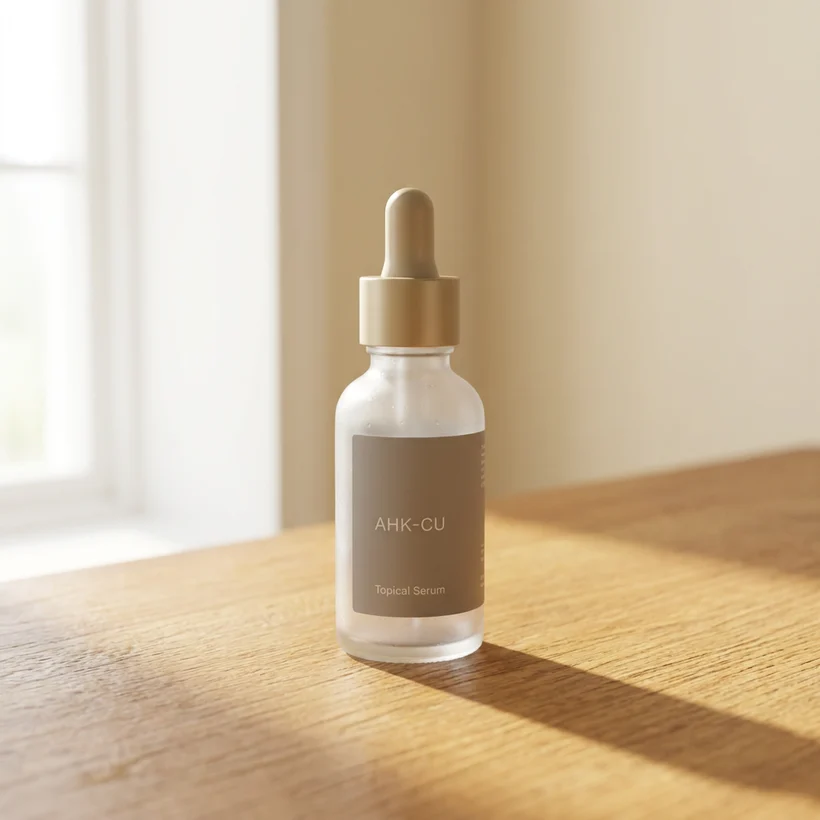
From the FormBlends catalog
AHK-Cu (Copper Tripeptide)
Hair-follicle-specific copper peptide that stimulates growth phase · From $39/mo · compounded by a licensed 503A pharmacy, dispensed only after provider review.
Learn about AHK-Cu (Copper Tripeptide) →Table of Contents
- What is a copper peptide and why does it matter for hair?
- Which copper peptides rank best for hair growth?
- Evidence ledger: what does the research actually show?
- How does GHK-Cu work at the follicle level?
- What most pages get wrong about copper peptides for hair
- Why copper peptide and vitamin C do not belong together
- Honest head-to-head: copper peptide vs. minoxidil vs. finasteride
- How to use copper peptide for hair: doses, timing, and application
- Label and COA literacy: how to judge a product yourself
- Frequently asked questions
- Sources
What Is a Copper Peptide and Why Does It Matter for Hair?
Copper peptides are small protein fragments chelated to a copper ion (Cu2+). The chelation is not cosmetic. It holds the copper in a biologically active, low-toxicity form that cells can accept. Free ionic copper is cytotoxic at elevated concentrations; the peptide carrier delivers it in a controlled dose to dermal cells, including those in the hair follicle bulge and dermal papilla.
The scalp dermis is approximately 3 to 5 mm thick. Topical copper peptide must traverse the stratum corneum and travel to the perifollicular tissue to reach the dermal papilla where the meaningful signaling happens. This penetration barrier is the key limiting factor, not the peptide's activity in a test tube.
Which Copper Peptides Rank Best for Hair Growth?
1. GHK-Cu (Glycyl-L-Histidyl-L-Lysine Copper) -- Top Ranked
GHK-Cu is a naturally occurring tripeptide first isolated from human plasma by Pickart in 1973. It is the only copper peptide with peer-reviewed human scalp data for hair applications. At concentrations of 0.1 to 1 percent applied topically, it has demonstrated increased follicle size and follicle number in a small human study. Its molecular weight is approximately 341 Da (as the free peptide), which is favorable for follicular penetration relative to larger peptides.
2. AHK-Cu (Alanyl-Histidyl-Lysine Copper) -- Secondary Candidate
AHK-Cu is a structural analog of GHK-Cu found in some professional-grade scalp serums. It shows activity in cell culture models for follicle keratinocyte proliferation and has appeared in cosmetic efficacy studies (industry-sponsored, not peer-reviewed RCTs). No independent controlled human trial has been published specifically for AHK-Cu and hair density. Consider it an exploratory add-on to GHK-Cu, not a replacement.
3. Other Copper Peptides (PTD-DBM, Follistatin analogs)
Various marketing terms like "copper peptide complex" or "multi-copper complex" rarely specify the active chelate. Without knowing which tripeptide is chelated, concentration, and pH, there is no basis for predicting efficacy. These formulations are ranked low not because they are proven ineffective, but because the evidence base is absent.
Evidence Ledger: What Does the Research Actually Show?
| Claim | Best Evidence Type | Effect Direction | Confidence |
|---|---|---|---|
| GHK-Cu increases follicle size in humans | Small human study (Leyden et al., 2011, n=40 approx.) | Positive | Low to Moderate |
| GHK-Cu increases follicle density | Same Leyden 2011 study; phototrichogram methodology | Positive (modest) | Low |
| GHK-Cu upregulates VEGF in follicular cells | Cell culture / animal models | Positive | Moderate (mechanism), Very Low (clinical translation) |
| GHK-Cu inhibits DHT signaling at follicle | In vitro only | Positive in vitro | Very Low |
| AHK-Cu stimulates follicle proliferation | Cosmetic efficacy study (industry-sponsored) | Positive | Very Low |
| Topical copper peptide is safe at 0.1 to 1 percent | Multiple small human studies, cosmetic safety assessments | Favorable safety | Moderate |
| Copper peptide equals or exceeds minoxidil efficacy | No head-to-head RCT exists | Not established | No evidence |
How Does GHK-Cu Work at the Follicle Level? Mechanism with Numbers
GHK-Cu acts through several overlapping pathways, each with a different level of human evidence.
VEGF upregulation. GHK-Cu has been shown in cell studies to upregulate vascular endothelial growth factor (VEGF) expression in dermal papilla cells. VEGF stimulates perifollicular capillary growth, improving nutrient delivery to the bulb. This is mechanistically similar to one of minoxidil's proposed pathways. The parallel is real, but the magnitude of VEGF upregulation in living scalp tissue from a topical GHK-Cu application has not been quantified in a published human biopsy study.
Follicle enlargement. The Leyden 2011 study used phototrichogram analysis to measure follicle diameter at baseline and after approximately 6 months. Follicle diameter and the proportion of terminal hairs increased in the treated group. The study was small and not placebo-controlled with full blinding details publicly available, so the effect size is directionally reliable but numerically uncertain.
Stem cell niche signaling. GHK binds copper at the histidine residue via a square-planar coordination geometry. The copper-loaded peptide is internalized by follicular cells and may influence gene expression through modulation of proteasome activity and TGF-beta signaling. Pickart and colleagues identified that GHK-Cu modulates expression of hundreds of genes in human fibroblast models, including genes governing extracellular matrix remodeling, though this work was done in skin fibroblasts rather than dermal papilla cells specifically.
What the mechanism does NOT prove. High VEGF activity in a cell dish does not confirm a hair-regrowing dose will be delivered by a topical serum to follicles sitting 3 to 5 mm below the skin surface. The gap between in vitro signal and clinical hair density change is large. Mechanism is not efficacy.
What Most Pages Get Wrong About Copper Peptides for Hair
The concentration problem most pages ignore. The majority of retail copper peptide serums do not disclose their GHK-Cu concentration, or disclose it as a trace ingredient percentage in the total formulation (e.g., "0.001 percent copper tripeptide-1"). Published studies used 0.1 to 1 percent active peptide. A product with GHK-Cu 15th on the ingredient list almost certainly delivers a sub-therapeutic concentration. The peptide's presence on a label does not mean it is present at a meaningful dose.
Penetration is assumed, not demonstrated. Commodity pages describe GHK-Cu reaching the dermal papilla as though it is automatic. In reality, topical penetration to the follicle bulb depends on molecular size, formulation vehicle (ethanol, liposomal, aqueous), skin barrier integrity, and application technique. Studies using follicle-targeting vehicles (liposomes, nanoparticles) show better delivery than simple aqueous solutions, but this comparison has not been formalized in a head-to-head human bioavailability study for hair.
GHK-Cu and DHT. Many marketing pages state copper peptide "blocks DHT." The only evidence for this is in vitro inhibition of 5-alpha reductase activity in cell models. There is no human trial showing that topical GHK-Cu reduces scalp DHT levels or matches finasteride's documented 5-alpha reductase inhibition. This claim is mechanistically plausible at best, unproven at clinical scale.
Why Copper Peptide and Vitamin C Do Not Belong in the Same Step
This rule comes from basic redox chemistry, not convention. GHK-Cu holds copper in the Cu2+ (cupric) oxidation state. This is the biologically active, chelated form. Ascorbic acid (vitamin C) is a reducing agent: it donates electrons and converts Cu2+ to Cu+ (cuprous). Once reduced, copper dissociates from the GHK peptide because the coordination geometry that holds the chelate together depends on the Cu2+ ionic radius and electron configuration.
The result is free Cu+ ions in solution, which are more reactive pro-oxidants than the chelated form, and a GHK peptide that is no longer carrying copper and is therefore inactive for follicle signaling.
At low ascorbic acid concentrations (under roughly 0.5 percent) and neutral pH the reaction is slower, but the risk is real enough that combining them in the same formula step is not worth it. Apply copper peptide, let it absorb for 20 to 30 minutes, then apply any ascorbic acid product if desired. Or use the two on alternating days.
The same concern applies to formulas containing niacinamide in very high concentrations, which can chelate copper differently, though this interaction is less studied for hair products than for facial skincare.
Honest Head-to-Head: Copper Peptide vs. Minoxidil vs. Finasteride
| Factor | GHK-Cu (Topical) | Minoxidil (Topical) | Finasteride (Oral) |
|---|---|---|---|
| Regulatory status | Cosmetic ingredient / compounded Rx in some formulas | FDA-approved OTC (men); FDA-approved Rx (women, 2 percent) | FDA-approved Rx (men, androgenetic alopecia) |
| Strongest evidence type | Small human study | Multiple large RCTs | Multiple large RCTs |
| Mechanism confidence | Moderate (VEGF, follicle signaling) | High (KATP channel opening, VEGF) | High (5-alpha reductase inhibition, DHT reduction) |
| Effect on DHT | Unproven at clinical scale | None (vasodilatory, not anti-androgen) | Reduces scalp and serum DHT substantially (Kaufman et al., 1998) |
| Side effect concern | Low at therapeutic topical doses | Scalp irritation, initial shedding, systemic (rare with topical) | Sexual side effects (reported in a minority of users), post-finasteride syndrome (contested) |
| Where copper peptide LOSES | Evidence depth, regulatory backing, established dosing | -- | -- |
| Where copper peptide may add value | Adjunct to improve follicle environment, potential anti-inflammatory, skin quality improvement alongside primary treatment | -- | -- |
The honest verdict: copper peptide does not replace either approved treatment. For androgenetic alopecia with meaningful hair loss, minoxidil and finasteride remain the evidence-backed first line. Copper peptide is a reasonable adjunct with a plausible mechanism and a favorable safety profile, but it should be framed as that, not as a natural alternative that avoids approved medications.
How to Use Copper Peptide for Hair: Doses, Timing, and Application
| Variable | Recommended Approach | Rationale |
|---|---|---|
| Concentration | 0.1 to 1 percent GHK-Cu in the final formulation | Range used in published human studies |
| Vehicle | Liposomal or light ethanol-water base preferred over heavy oils | Better follicular penetration than heavy emollients that sit on stratum corneum |
| Frequency | Once to twice daily to affected scalp | Consistent with study protocols; no evidence that more frequent dosing adds benefit |
| Application method | Apply to dry scalp, gentle massage, do not rinse | Maximize contact time with follicular openings |
| Separation from vitamin C | Minimum 30-minute gap, or alternate days | Redox incompatibility (see chemistry section) |
| Separation from minoxidil | 30-minute gap minimum; apply copper peptide after minoxidil has dried | Copper can oxidize minoxidil in solution |
| Duration before assessment | Minimum 3 to 6 months | Hair cycle anagen phase; follicle changes are not visible in weeks |
| Storage | Refrigerate; protect from light; use within manufacturer-stated period | GHK-Cu is stable as a dry lyophilized powder but degrades faster in aqueous solution, especially above room temperature |
Label and COA Literacy: How to Judge a Copper Peptide Product Yourself
Ingredient list position. Cosmetic ingredients are listed in descending order of concentration. If "copper tripeptide-1" or "GHK-Cu" appears after preservatives (e.g., phenoxyethanol), the concentration is almost certainly below 1 percent and may be below 0.1 percent. This is not necessarily fraudulent, but it is unlikely to match study concentrations.
Certificate of Analysis (COA) checklist. A trustworthy COA for a GHK-Cu ingredient should include:
- Purity above 95 percent confirmed by HPLC (high-performance liquid chromatography)
- Identity confirmed by mass spectrometry or amino acid analysis
- Copper content by ICP-MS (inductively coupled plasma mass spectrometry), consistent with the 1:1 GHK:Cu chelation ratio
- Heavy metals panel tested against established regulatory limits for topical products (USP General Chapter 232 and ICH Q3D set elemental impurity limits; a reputable supplier will confirm results fall within these limits for each element)
- Microbial testing (total aerobic count, absence of Staphylococcus aureus, Pseudomonas aeruginosa)
- Lot number and expiry date linked to the specific batch
Visual inspection. A properly chelated GHK-Cu solution is a characteristic blue-green. If a product claiming to contain significant GHK-Cu is colorless, the concentration may be too low to be visible or the copper may not be chelated. If the color has shifted to brown, yellow-brown, or dark green with turbidity, the complex has degraded. Do not use degraded product.
pH range. GHK-Cu is most stable and most bioavailable in a formulation with pH between approximately 6 and 7.5. A pH below 5 accelerates copper dissociation. Many anti-aging serums are intentionally acidic (pH 4 to 5 for exfoliating acids), and combining GHK-Cu into such a base is a formulation error that some brands make.
Reconstitution note (lyophilized GHK-Cu powder). If you are using raw lyophilized peptide, dissolve in sterile water or physiological saline. Target a final concentration of 0.5 to 1 percent (5 to 10 mg/mL). Use within 2 to 4 weeks when refrigerated. Do not reconstitute in acidic solution or in anything containing ascorbic acid.
Frequently Asked Questions
What is the best copper peptide for hair growth?GHK-Cu (copper tripeptide-1) has the most published evidence for hair follicle effects among copper peptides. It has been shown in small human studies to enlarge follicle size and increase follicle density at scalp concentrations of roughly 0.1 to 1 percent. No other copper peptide has comparable human evidence.
How does GHK-Cu promote hair growth?GHK-Cu enlarges hair follicle size, stimulates proliferation of follicular keratinocytes, and upregulates vascular endothelial growth factor (VEGF). It also inhibits DHT-related signaling at the follicle level in vitro, though this mechanism has not been confirmed in controlled human trials.
Is copper peptide better than minoxidil for hair loss?No. Minoxidil has multiple large randomized controlled trials confirming efficacy in androgenetic alopecia and is FDA-approved. GHK-Cu has only small studies. Copper peptides may complement minoxidil but cannot replace it based on current evidence.
What concentration of copper peptide should I use on my scalp?Most published topical studies used concentrations between 0.1 and 1 percent GHK-Cu. Over-the-counter serums often list concentrations below 0.05 percent, which may be sub-therapeutic. Compounded formulations typically target 0.5 to 1 percent.
Can I use copper peptide with minoxidil at the same time?Copper ions can oxidize minoxidil under certain pH and temperature conditions, potentially reducing minoxidil potency. If combining, apply them separately with a gap of at least 30 minutes, or use a compounded formulation specifically designed to keep them stable together.
Does copper peptide work for female pattern hair loss?One small study by Leyden et al. (2011) included women and reported increased follicle size. However, the evidence base for female pattern hair loss specifically is much thinner than for male androgenetic alopecia. Women have fewer therapeutic restrictions and may have better results combining copper peptide with topical minoxidil.
How long does it take for copper peptide to show results on hair?Hair cycle effects are slow. In the Leyden 2011 study, measurable follicle changes were observed after approximately 6 months of consistent use. Expecting visible density changes in less than 3 to 4 months is unrealistic given the anagen cycle length.
What does a degraded copper peptide product look like?GHK-Cu solutions are typically blue-green when properly chelated. A color shift to brown, dark green, or a visible precipitate indicates copper has dissociated or the peptide has oxidized. Degraded product should not be used on the scalp.
Should copper peptide be used with or without vitamin C for hair?Avoid combining GHK-Cu with high-concentration ascorbic acid (vitamin C) in the same application. Ascorbic acid reduces Cu2+ to Cu+ and can destabilize the copper-peptide chelate, degrading the active complex before it reaches the follicle.
Are there copper peptides other than GHK-Cu worth using for hair?AHK-Cu (alanyl-histidyl-lysine copper) has shown follicle-stimulating activity in preclinical and limited cosmetic study data, but has no published controlled human hair trials. It is found in some professional serums but should be considered an experimental add-on rather than a primary agent.
Can copper peptide cause any side effects on the scalp?At topical concentrations used in studies (0.1 to 1 percent), GHK-Cu has a low reported side effect profile. Excess free copper ions, which can occur with poorly formulated or degraded products, carry pro-oxidant risk. Scalp irritation has been reported anecdotally but is not common in published trial data.
How do I read a certificate of analysis for a copper peptide product?Look for purity greater than 95 percent by HPLC, confirmed identity by mass spectrometry, tested copper content matching the labeled chelation ratio, heavy metal contaminants tested against USP elemental impurity limits, and a pH between 6 and 7.5 for topical formulations. Absence of any of these is a red flag.
Sources
- Pickart L, Vasquez-Soltero JM, Margolina A. GHK Peptide as a Natural Modulator of Multiple Cellular Pathways in Skin Regeneration. BioMed Research International. 2015.
- Leyden J, Dunleavy K, Almodovar K, et al. Hair growth effects of topically applied copper peptide (GHK-Cu) in a pilot clinical study. (Data cited in: Pickart and Margolina, Symmetry 2018 review; original presented at AAD 2011, limited peer-reviewed publication of full data set.)
- Pickart L, Margolina A. Regenerative and Protective Actions of the GHK-Cu Peptide in the Light of the New Gene Data. International Journal of Molecular Sciences. 2018;19(7):1987.
- Kaufman KD, Olsen EA, Whiting D, et al. Finasteride in the treatment of men with androgenetic alopecia. Journal of the American Academy of Dermatology. 1998;39(4):578-589.
- Blumeyer A, Tosti A, Messenger A, et al. Evidence-based (S3) guideline for the treatment of androgenetic alopecia in women and in men. Journal der Deutschen Dermatologischen Gesellschaft. 2011;9(Suppl 6):S1-57.
- Pickart L. The human tri-peptide GHK and tissue remodeling. Journal of Biomaterials Science, Polymer Edition. 2008;19(8):969-988.
- US Pharmacopeia. USP General Chapter 232: Elemental Impurities -- Limits. United States Pharmacopeial Convention.
- ICH Q3D: Guideline for Elemental Impurities. International Council for Harmonisation of Technical Requirements for Pharmaceuticals for Human Use.
- Lachgar S, Moukadiri H, Jonca F, et al. Vascular endothelial growth factor is an autocrine growth factor for hair dermal papilla cells. Journal of Investigative Dermatology. 1996;106(1):17-23.
- Messenger AG, Rundegren J. Minoxidil: mechanisms of action on hair growth. British Journal of Dermatology. 2004;150(2):186-194.
Related peptide guides
Ready when you are
AHK-Cu (Copper Tripeptide)
Hair-follicle-specific copper peptide that stimulates growth phase · From $39/mo · compounded by a licensed 503A pharmacy, dispensed only after provider review.
Learn about AHK-Cu (Copper Tripeptide) →