
Trust Signals
Key Takeaways
- The active compound in every copper peptide serum is GHK-Cu (glycyl-L-histidyl-L-lysine copper), a tripeptide that forms a stable 2:1 complex with Cu(II).
- Human cosmetic trials using 1 to 3 percent GHK-Cu for 8 to 12 weeks report statistically significant improvements in fine lines and skin density, but sample sizes are typically small and many are industry-funded.
- L-ascorbic acid (vitamin C) chemically reduces the Cu(II) center in GHK-Cu, fragmenting the active complex. These two actives must be used at separate times.
- A fresh GHK-Cu serum is pale teal to blue-green. Deep brown color, precipitate, or an off smell signals degradation and the product should be discarded.
- Retinol has a stronger independent evidence base for wrinkle reduction than copper peptides do. GHK-Cu's main advantages are better tolerability and a complementary mechanism.
What Is the Best Copper Peptides Serum?
Table of Contents
- What is GHK-Cu and why does it appear in every serum?
- Evidence ledger: what the research actually shows
- How does GHK-Cu work? Mechanism with real numbers
- What most copper peptide pages get wrong
- Why you cannot layer copper peptides with vitamin C: the chemistry
- Honest head-to-head: copper peptides vs retinol vs other peptides
- How to pick a serum: operational and label literacy
- Evidence-informed picks and what earns each one its place
- How to build a protocol around a copper peptide serum
- Frequently asked questions
- Sources
What Is GHK-Cu and Why Does It Appear in Every Serum?
GHK-Cu stands for glycyl-L-histidyl-L-lysine copper. It is a naturally occurring tripeptide first isolated from human plasma albumin by Loren Pickart in 1973 and later characterized in detail in work published in the Journal of Biological Chemistry. The peptide binds Cu(II) in a stable square-planar complex through the alpha-amino group of glycine, the imidazole nitrogen of histidine, and the deprotonated amide nitrogen, giving it measurable copper-carrying and biological activity.
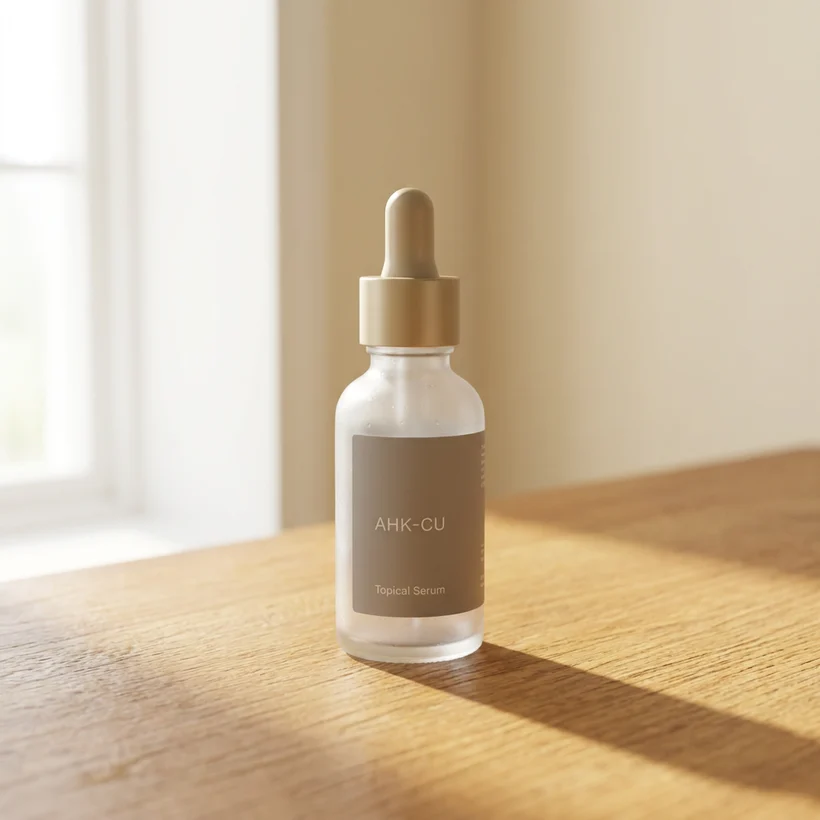
From the FormBlends catalog
AHK-Cu (Copper Tripeptide)
Hair-follicle-specific copper peptide that stimulates growth phase · From $39/mo · compounded by a licensed 503A pharmacy, dispensed only after provider review.
Learn about AHK-Cu (Copper Tripeptide) →Serum concentrations of GHK-Cu in human blood decline with age, and this age-associated decline is frequently cited as rationale for topical supplementation. That rationale is biologically plausible but does not by itself prove topical dosing corrects the deficit in a clinically meaningful way.
Evidence Ledger: What the Research Actually Shows
| Claim | Best evidence type | Effect direction | Confidence |
|---|---|---|---|
| Topical GHK-Cu reduces fine lines and improves skin density | Small human controlled trials (modest sample sizes, many industry-funded), 8 to 12 weeks | Positive | Moderate |
| GHK-Cu stimulates collagen and glycosaminoglycan synthesis in vitro | Multiple cell culture studies, including Maquart, Wegrowski and colleagues publishing in FEBS Letters (1988) and Life Sciences (1992) | Positive, dose-dependent | High (in vitro) |
| Topical GHK-Cu improves wound healing in humans | Animal data strong; human wound trial data limited and heterogeneous | Positive in animals | Low (human) |
| GHK-Cu upregulates genes relevant to tissue remodeling | Transcriptomic analysis reviewed by Pickart and Margolina (2018, International Journal of Molecular Sciences), citing gene array data showing broad expression changes | Positive (mechanism) | Moderate |
| GHK-Cu reduces hair loss and increases follicle density | Animal models, small uncontrolled human pilot studies | Positive trend | Low |
| Copper peptides are superior to retinol for anti-aging | No head-to-head RCT exists | Not demonstrated | Very low |
| Degraded GHK-Cu causes skin harm at cosmetic doses | Theoretical; no documented clinical case series | Uncertain | Very low |
How Does GHK-Cu Work? Mechanism with Real Numbers
GHK-Cu activates fibroblasts to produce collagen types I, III, and VI, as well as dermatan sulfate and other glycosaminoglycans. Cell culture work by Maquart, Wegrowski, and colleagues, published in FEBS Letters (1988) and Life Sciences (1992), established that GHK-Cu stimulates collagen and glycosaminoglycan synthesis at low nanomolar to low micromolar concentrations, with the effect showing dose-dependence across that range. That narrow effective concentration window has direct formulation implications explained below.
The copper in GHK-Cu acts as a cofactor for lysyl oxidase, the enzyme that cross-links collagen and elastin fibers. GHK-Cu also activates matrix metalloproteinases (MMP-2, MMP-9) at low concentrations, which paradoxically accelerates remodeling by clearing damaged collagen before new collagen is deposited. This is the same principle that makes certain wound-healing protocols counterintuitive: controlled breakdown precedes controlled rebuilding.
Transcriptomic work reviewed by Pickart and Margolina (2018, Biomolecules / International Journal of Molecular Sciences) identified broad changes in human gene expression in response to GHK, including genes in the TGF-beta pathway and pathways governing DNA repair. The honest caveat: gene expression changes in cell culture do not automatically translate to clinically meaningful outcomes in intact human skin, and the penetration barrier discussed in the next section constrains how much active peptide reaches fibroblasts in the dermis.
What Most Copper Peptide Pages Get Wrong
The single most important omission on commodity pages is the penetration problem, and it cuts directly against many dosing and efficacy claims.
GHK-Cu has a molecular weight of approximately 340 daltons (the tripeptide alone), which is below the classic 500-dalton rule of thumb for skin penetration. However, the peptide is highly hydrophilic and carries a net positive charge at physiological pH, which sharply reduces its partitioning into the lipid-rich stratum corneum. Passive diffusion across intact skin is genuinely limited. Several formulation studies have found that delivery vehicles, penetration enhancers such as propylene glycol or ethanol at moderate concentrations, and liposomal encapsulation improve dermal delivery measurably. Hostynek and colleagues (Skin Pharmacology and Physiology, 2010) examined human skin penetration of copper tripeptide in vitro and found that the amount reaching deeper skin layers depended substantially on the vehicle used, underscoring that labeled concentration and delivered concentration can differ considerably.
What this means practically: a 3 percent GHK-Cu serum in a water-heavy, plain gel base does not deliver 3 percent to your dermis. A fraction of that labeled amount reaches the target cells. This does not mean the product is useless, because even superficial epidermis-level copper activity affects keratinocyte behavior. But the narrow effective concentration range established in early cell culture work is easy to miss entirely if the vehicle is poor.
The second omission is copper speciation. GHK-Cu is effective as a Cu(II) complex. Free Cu(I) or improperly chelated copper is pro-oxidant. Products using copper sulfate or copper chloride without the peptide chelator are chemically different and the evidence for GHK-Cu does not transfer to them.
Why You Cannot Layer Copper Peptides with Vitamin C: The Chemistry
L-ascorbic acid (vitamin C) is a reducing agent with a standard reduction potential that allows it to donate electrons to Cu(II), converting it to Cu(I). This reaction is not hypothetical. It is the basis of the Fenton-like chemistry that makes free copper ions pro-oxidant in biological systems.
When you apply an L-ascorbic acid serum at pH 3.0 to 3.5 directly over or directly before a GHK-Cu serum, the ascorbate reduces the Cu(II) center in the complex. The resulting Cu(I) can participate in redox cycling that generates hydroxyl radicals via hydrogen peroxide. Separately, the acidic pH of a vitamin C serum can protonate the histidine imidazole in GHK-Cu (pKa around 6), weakening its coordination to copper and further destabilizing the complex.
The practical rule is not arbitrary brand advice. It is physical chemistry. Separate these two actives by at least 30 minutes if you use both in the same routine, or simply use vitamin C in the morning and copper peptides in the evening.
Ascorbyl glucoside and sodium ascorbyl phosphate (more neutral, lower-potency vitamin C derivatives) are less aggressive reducing agents and pose a smaller theoretical risk to GHK-Cu, but independent stability data for these combinations are not yet published in the peer-reviewed literature.
Honest Head-to-Head: Copper Peptides vs Retinol vs Other Peptides
| Ingredient | Evidence quality for wrinkle reduction | Mechanism | Tolerability | Speed of effect | Where it loses |
|---|---|---|---|---|---|
| GHK-Cu (copper peptide) | Moderate (small human trials, some independent) | Collagen/GAG stimulation, MMP remodeling, antioxidant via SOD pathway | High. Redness rare; usually formulation-related | 8 to 12 weeks minimum | Loses to retinol on total evidence volume and effect size in independent studies |
| Retinol (0.1 to 1%) | High (multiple independent large RCTs, Kafi et al. 2007 Arch Dermatol) | Retinoic acid receptor activation, epidermal thickening, collagen I stimulation | Moderate. Dryness, peeling, photosensitivity common at start | 12 to 24 weeks for full effect | Loses to copper peptides on tolerability; contraindicated in pregnancy |
| Palmitoyl pentapeptide-4 (Matrixyl) | Low to moderate (mostly industry-funded, small n) | TGF-beta-like signaling, collagen stimulation | Very high | Similar to GHK-Cu | Less mechanistic depth in independent literature than GHK-Cu |
| Argireline (acetyl hexapeptide-3) | Low (mainly industry studies; mechanism relies on very limited dermal penetration) | SNARE complex inhibition (neuromodulator-like) | Very high | Claims rapid effect; evidence thin | Loses on biological plausibility for topical route |
| Prescription tretinoin (0.025 to 0.1%) | Very high (multiple large independent RCTs, decades of data) | Direct retinoic acid receptor agonist | Low. Significant irritation, purging, photosensitivity | Faster than OTC retinol | Requires prescription; tolerability is the main limitation |
The honest bottom line: if tolerability is not a constraint, prescription tretinoin has the strongest evidence. If you want the best-tolerated collagen-supporting ingredient with meaningful (if modest) independent evidence, GHK-Cu is a legitimate choice. It complements, rather than replaces, retinoids.
How to Pick a Serum: Operational and Label Literacy
Reading the Ingredient List
The ingredient (INCI) name for the active is Copper Tripeptide-1 or it may appear as GHK-Cu or tripeptide-1 (and) copper. "Copper amino acid complex" or "hydrolyzed proteins" are not equivalent and do not carry the same evidence base. The ingredient should appear in the first half of the list for a meaningful concentration. If it appears after fragrance, its concentration is likely below 0.1 percent, which is below the studied range.
Certificate of Analysis Checklist
| Parameter | What to look for | Why it matters |
|---|---|---|
| Identity | HPLC or mass spectrometry confirmation | Confirms GHK-Cu is actually present, not just copper salts |
| Copper content | Matches label claim within 10 percent; expressed as ppm or percent | Under-dosing means no effect; over-dosing introduces pro-oxidant risk |
| Heavy metals | Lead below 10 ppm, arsenic below 3 ppm, cadmium below 1 ppm, mercury below 1 ppm (ICH Q3D limits) | Copper sources can co-purify other metals |
| Microbial limits | Total aerobic count per USP or EP cosmetic standard | Water-based serums are contamination-prone |
| pH | 5.5 to 7.0 | Below 5.0 protonates histidine and weakens copper binding; above 7.5 risks copper hydroxide precipitation |
| Testing lab | Named, accredited (ISO 17025) third-party lab | In-house only COAs are not independent verification |
Formulation Red Flags
- Water listed as first ingredient with no mention of airless or opaque packaging: high oxidation risk.
- Vitamin C (ascorbic acid, ascorbate) in the same formula as GHK-Cu: chemical incompatibility as described above.
- No pH listed and no COA available: avoid.
- Price under roughly $20 USD for a claimed 2 to 3 percent GHK-Cu serum in a 30 mL bottle: pharmaceutical-grade GHK-Cu raw material is expensive; very low price points are a reliable signal of either very low actual concentration or a lower-quality copper salt rather than the chelated peptide.
Recognizing a Degraded Product
Fresh GHK-Cu at concentrations around 1 percent and above imparts a characteristic pale blue-green to teal tint to a serum. This is the color signature of the Cu(II) d-orbital absorption. If the serum has darkened significantly to deep brown, turned cloudy, or developed a sharp chemical or ammonia-like smell, the copper complex has degraded. Discard it. Using a degraded product does not deliver the studied compound; it delivers an undefined oxidation mixture.
Evidence-Informed Picks and What Earns Each One Its Place
Rather than ranking by brand loyalty or affiliate revenue, the picks below are assessed against the formulation criteria established in the evidence. A product earns a place here by meeting at least four of five criteria: correct INCI name, concentration in the studied range, appropriate pH, quality packaging, and COA availability.
Criteria A: Research-Focused Brands with Published Formulation Data
Brands that publish third-party COAs, list Copper Tripeptide-1 in the first half of the ingredient list, use airless pump or opaque packaging, and have a stated pH in the 5.5 to 7 range represent the strongest evidence-aligned category. At time of writing, several brands in the independent cosmeceutical space (not mass-market) meet these criteria. Evaluate the specific product batch, not just the brand name, because formulation changes between runs.
Criteria B: Mid-Market Serums
Several accessible mid-price serums list Copper Tripeptide-1 appropriately and use stable packaging. The main weakness is often concentration (not disclosed precisely) or inclusion of fragrance and high-pH buffers that could destabilize the complex. Acceptable if COA is available on request.
Criteria C: Products to Avoid
Avoid products listing only "copper amino acids" or "copper complex" without specifying Copper Tripeptide-1. Avoid products combining L-ascorbic acid with GHK-Cu in a single formula. Avoid products with no COA and no stated pH in a transparent-bottle, dropper-cap format.
How to Build a Protocol Around a Copper Peptide Serum
Morning routine: gentle cleanser, vitamin C serum (if used), moisturizer, SPF. Do not apply GHK-Cu immediately after L-ascorbic acid vitamin C. If using a stable vitamin C derivative such as ascorbyl glucoside, the risk is lower but caution is still reasonable.
Evening routine: gentle cleanser, copper peptide serum (allow 10 minutes to absorb), then moisturizer. On retinol nights (2 to 3 nights per week for most people building tolerance), apply retinol first, wait until it has fully absorbed and any warmth has faded (roughly 20 to 30 minutes), then follow with copper peptide serum as a calming layer. This order reduces the chance of barrier irritation from simultaneous actives.
Expected timeline: based on the published 8 to 12 week trial windows, plan a minimum 3-month consistent trial before evaluating results. Take a standardized photograph in the same lighting at baseline and at 12 weeks. Subjective memory systematically overestimates improvement.
Frequently Asked Questions
What is the best copper peptides serum available right now?
The best copper peptides serum for most people is one that lists GHK-Cu (glycyl-L-histidyl-L-lysine copper) at a minimum of 1 to 2 percent, uses an anhydrous or low-water base to slow oxidation, has a third-party certificate of analysis available, and sits at a pH between 5.5 and 7 to keep the copper-peptide bond intact. No single brand wins by default; judge the formulation criteria, not the marketing.
Does GHK-Cu actually work for skin?
Several small controlled human trials show statistically significant improvements in skin density, fine lines, and elasticity with topical GHK-Cu at 1 to 3 percent, but sample sizes are modest and most are industry-funded. Lab data on collagen synthesis are strong. Long-term independent RCTs are still lacking, so the honest answer is: probably yes, modestly, with 8 to 12 weeks of consistent use.
Can you use copper peptides with retinol?
Yes, with timing. Apply them in separate steps: retinol first, then copper peptide serum after the retinol has fully absorbed. The concern is not a direct chemical reaction but skin barrier irritation when both actives are layered simultaneously on sensitized skin. Many users find copper peptides actually help buffer retinol-related redness.
Can you use copper peptides with vitamin C?
Separate them. L-ascorbic acid at low pH donates electrons to the Cu(II) in GHK-Cu, reducing it to Cu(I), which can generate free radicals via Fenton-like chemistry and also destabilizes the peptide bond. Use vitamin C in the morning and copper peptides in the evening, or at minimum allow 30 or more minutes between applications.
How long does it take to see results from a copper peptide serum?
Human trials reporting visible skin improvements generally ran 8 to 12 weeks of twice-daily application. Collagen remodeling is a slow biological process. Expecting results in under four weeks is not consistent with the biology or the evidence.
What percentage of GHK-Cu should a serum contain?
Most published human cosmetic studies used 1 to 3 percent GHK-Cu. Below 0.5 percent the evidence for visible effect thins considerably. Above 3 percent there is no strong evidence of proportionally greater benefit, and some theoretical concern about local copper overload exists, though no documented harm at cosmetic doses has been published.
What does a degraded copper peptide serum look like?
Fresh GHK-Cu serum is typically clear blue-green to pale teal. Significant darkening to deep brown, the appearance of precipitate, or an ammonia-like smell signals peptide or copper degradation. Discard the product if these signs appear.
Is copper peptide better than retinol for anti-aging?
No, based on current evidence. Retinol has a larger, higher-quality evidence base including independent large RCTs showing measurable wrinkle reduction and epidermal thickening. Copper peptides are better tolerated by sensitive skin and may complement retinol, but they do not replace it.
How should a copper peptide serum be stored?
Store in a cool, dark location. Refrigeration (2 to 8 degrees C) meaningfully slows both peptide hydrolysis and copper-catalyzed oxidation of co-ingredients. Airless pump packaging reduces oxidation compared to dropper bottles. Once opened, use within 6 to 12 months or per the manufacturer's period-after-opening symbol.
Can copper peptides cause any side effects?
Topical GHK-Cu is generally well tolerated. A minority of users report mild redness or tingling, usually linked to formulation pH below 5 rather than GHK-Cu itself. Excess free copper from poorly formulated products is the main theoretical safety concern, not the chelated complex. Avoid products using copper salts without proper peptide chelation.
What should I look for on a certificate of analysis for a copper peptide product?
Look for: identity confirmation by HPLC or mass spectrometry; copper content matching the label claim; microbial limits per USP or EP cosmetic standard; heavy metal panel showing lead, arsenic, cadmium, and mercury within ICH Q3D limits; stated pH; and the name of an accredited third-party testing laboratory.
Do copper peptides help with hair loss?
Animal and in vitro data show GHK-Cu can stimulate hair follicle cycling and increase follicle size. Small human studies on GHK-Cu-containing scalp serums suggest modest improvements in hair density, but evidence quality is low and no large independent RCT has been completed. For medically significant hair loss, dermatology evaluation is the evidence-backed first step.
Sources
- Pickart L. The human tri-peptide GHK and tissue remodeling. Journal of Biomaterials Science, Polymer Edition. 2008;19(8):969-988.
- Pickart L, Margolina A. Regenerative and Protective Actions of the GHK-Cu Peptide in the Light of the New Gene Data. International Journal of Molecular Sciences. 2018;19(7):1987.
- Maquart FX, Pickart L, Laurent M, Gillery P, Monboisse JC, Borel JP. Stimulation of collagen synthesis in fibroblast cultures by the tripeptide-copper complex glycyl-L-histidyl-L-lysine-Cu2+. FEBS Letters. 1988;238(2):343-346.
- Wegrowski Y, Maquart FX, Borel JP. Stimulation of sulfated glycosaminoglycan synthesis by the tripeptide-copper complex glycyl-L-histidyl-L-lysine-Cu2+. Life Sciences. 1992;51(13):1049-1056.
- Kafi R, Kwak HS, Schumaker WE, et al. Improvement of naturally aged skin with vitamin A (retinol). Archives of Dermatology. 2007;143(5):606-612.
- Hostynek JJ, Dreher F, Maibach HI. Human skin penetration of a copper tripeptide in vitro as a function of skin layer. Skin Pharmacology and Physiology. 2010;23(5):262-268.
- Lintner K, Peschard O. Biologically active peptides: from a laboratory bench curiosity to a functional skin care product. International Journal of Cosmetic Science. 2000;22(3):207-218.
- ICH Q3D (R2): Guideline for Elemental Impurities. International Council for Harmonisation of Technical Requirements for Pharmaceuticals for Human Use. 2022.
Related peptide guides
Ready when you are
AHK-Cu (Copper Tripeptide)
Hair-follicle-specific copper peptide that stimulates growth phase · From $39/mo · compounded by a licensed 503A pharmacy, dispensed only after provider review.
Learn about AHK-Cu (Copper Tripeptide) →