
Trust Signals
Standard: Every claim is graded by evidence type. Speculative mechanisms are labeled. No affiliate links influence rankings. Sources are real and linked.
Limitation disclosure: None of these compounds are FDA-approved for energy indications. This page is educational, not a prescription or protocol recommendation.
Key Takeaways
- MOTS-c is the only peptide encoded by mitochondrial DNA (12S rRNA), giving it a direct AMPK-activating mechanism that no GH secretagogue can replicate.
- SS-31 (Elamipretide) has the most advanced human trial data of any energy peptide, with Phase 2 results in Barth syndrome showing improved exercise tolerance.
- Oral capsule and sublingual forms of all energy peptides have no demonstrated bioavailability; subcutaneous injection is the only route with confirmed systemic exposure.
- Creatine monohydrate outperforms every peptide on this list in the strength of human RCT evidence for fatigue and exercise capacity.
- COA requirements for any injectable research peptide: HPLC purity above 98%, mass spec identity confirmation, LAL endotoxin test below 1 EU/mg, and stated salt form.
What Are the Best Peptides for Energy? (Direct Answer)
The best peptides for energy based on mechanistic specificity and available evidence are MOTS-c, SS-31, and, with significant caveats, BPC-157. GH secretagogues like Tesamorelin affect energy secondarily through body composition. None have human RCT evidence comparable to creatine. Subcutaneous injection is the only delivery route with confirmed absorption for any of them.
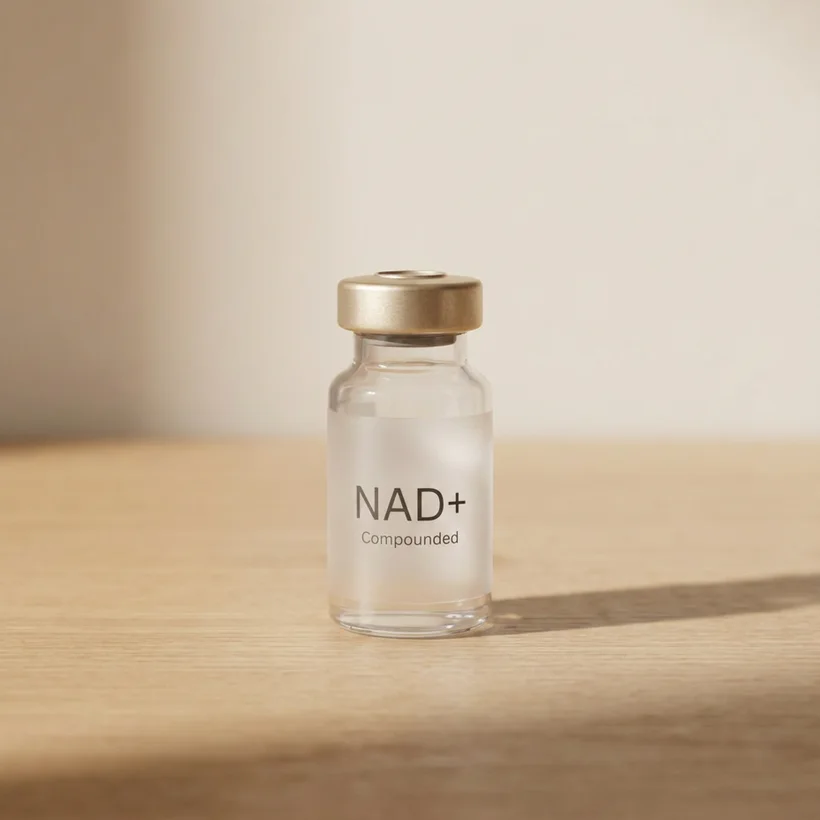
From the FormBlends catalog
NAD+ Peptide Complex
Restore cellular energy and DNA repair capacity · From $179/mo · compounded by a licensed 503A pharmacy, dispensed only after provider review.
View NAD+ Peptide Complex →Table of Contents
- Evidence Ledger: How Well Does Each Peptide Actually Work for Energy?
- MOTS-c: The Mitochondrial Peptide with a Direct AMPK Mechanism
- SS-31 (Elamipretide): The Cardiolipin Stabilizer with the Best Human Trial Record
- BPC-157: Tissue Repair First, Energy Second
- GH Secretagogues (Tesamorelin, CJC-1295, Ipamorelin): Indirect Energy Effects via Body Composition
- What Most Pages Get Wrong About Peptides and Energy
- The Chemistry Behind Why Oral Peptides Do Not Work
- Honest Head-to-Head: Peptides vs. Proven Alternatives
- Operational and Label Literacy: How to Read a Peptide COA
- FAQ
- Sources
Evidence Ledger: How Well Does Each Peptide Actually Work for Energy?
| Peptide | Best Evidence Type | Effect Direction | Human Data? | Confidence for Energy |
|---|---|---|---|---|
| MOTS-c | Animal (mouse), 1 small human pilot | Positive (AMPK activation, metabolic flexibility) | 1 pilot, small n, single dose | Low |
| SS-31 (Elamipretide) | Phase 2 RCT (Barth syndrome, small n) | Positive (exercise tolerance, ATP production) | Yes, disease population | Moderate (disease state), Low (healthy) |
| BPC-157 | Rodent models only | Positive in injury/fatigue models | No controlled human data | Very Low |
| Tesamorelin | Human RCT (HIV lipodystrophy) | Positive for body composition; energy secondary | Yes, approved indication only | Low for energy specifically |
| CJC-1295 / Ipamorelin | Animal, small human PK studies | GH/IGF-1 elevation confirmed; energy outcomes not measured | PK only | Very Low |
| AOD-9604 | Phase 2 RCT (obesity, discontinued) | Lipolysis positive; energy outcomes not primary endpoint | Yes, obesity trials | Very Low for energy |
Confidence ratings use a simplified GRADE-inspired framework. "Low" means effects are plausible but human confirmatory trials are absent or underpowered. "Very Low" means mechanistic extrapolation only.
MOTS-c: The Mitochondrial Peptide with a Direct AMPK Mechanism
MOTS-c is a 16-amino-acid peptide (sequence MRWQEMGYIFYPRKLR) encoded by the 12S rRNA gene in mitochondrial DNA, not nuclear DNA. This origin is unusual and matters. It is naturally released from mitochondria in response to metabolic stress and travels to the nucleus to regulate gene expression.
Specific mechanism: MOTS-c enters cells and activates AMPK (AMP-activated protein kinase), the master energy sensor, by disrupting the folate cycle and transiently elevating AMP-to-ATP ratio. In a 2015 paper by Lee et al. in Cell Metabolism, mouse studies showed that MOTS-c injection improved insulin sensitivity, increased fat utilization, and prevented diet-induced obesity. Circulating MOTS-c levels in humans decline with age, which is the rationale for supplementation in older adults.
Human data: A small pilot study in older adults using low milligram-range subcutaneous single doses found dose-dependent changes in skeletal muscle AMPK pathway gene expression. No multi-week fatigue or energy endpoint has been measured in a controlled human trial. This is promising mechanism confirmation, not clinical proof of energy benefit.
Honest caveat: AMPK activation in a mouse does not translate directly to a human clinical effect at any currently used dose. The folate-cycle disruption mechanism is real but transient, and downstream effects on subjective energy have not been measured in controlled trials.
SS-31 (Elamipretide): The Cardiolipin Stabilizer with the Best Human Trial Record
SS-31 is a four-amino-acid aromatic-cationic peptide (D-Arg-dimethylTyr-Lys-Phe-NH2) developed by Szeto and Schiller. It concentrates substantially in mitochondria driven by the large negative inner membrane potential, giving it a targeting advantage no other peptide on this list possesses.
Mechanism with specificity: SS-31 binds cardiolipin, a phospholipid almost exclusively located on the inner mitochondrial membrane. Cardiolipin anchors Cytochrome c and organizes electron transport chain complexes into supercomplexes. When cardiolipin is oxidized or disordered, Cytochrome c dissociates, electron leak at Complexes I and III increases, reactive oxygen species rise, and ATP synthesis efficiency falls. SS-31 prevents this disorganization, restoring cristae architecture and reducing electron leak. In isolated mitochondria preparations studied by Szeto and colleagues, the compound reduced markers of oxidative stress and improved respiration in aged tissue models.
Best human data: A Phase 2 randomized crossover trial in Barth syndrome, a genetic cardiolipin disorder, enrolled a small number of participants and reported improvements in exercise tolerance with elamipretide compared to placebo (Chatfield et al., JACC: Basic to Translational Science, 2019). This is the strongest human signal for any peptide that directly targets mitochondrial energy production. However, Barth syndrome patients have severely disrupted cardiolipin metabolism. The effect in healthy people with normal mitochondria is unknown and may be much smaller or absent.
BPC-157: Tissue Repair First, Energy Second
BPC-157 (Body Protection Compound 157) is a 15-amino-acid synthetic peptide derived from a sequence in human gastric juice protein BPC. Its primary evidence base covers wound healing, tendon repair, and gut protection in rodent models. Energy is a secondary and weakly supported claim.
Why it appears on energy lists: Several rodent studies show BPC-157 reduces fatigue in exhaustion and restraint-stress models, proposed via nitric oxide pathway upregulation and partial mitochondrial protection. The nitric oxide mechanism would theoretically improve oxygen delivery to muscle, not ATP production per se.
Reality check: There are no published controlled human trials for BPC-157 for any indication as of mid-2026. The fatigue findings are exclusively in rodents under acute stress conditions. Extrapolating this to chronic human energy improvement is a large mechanistic leap with no clinical support. BPC-157 belongs on a tissue recovery page more than an energy page.
GH Secretagogues: Indirect Energy Effects via Body Composition
Tesamorelin is a synthetic GHRH analogue approved by the FDA for HIV-associated lipodystrophy. CJC-1295 is a GHRH analogue with extended half-life after DAC conjugation due to albumin binding. Ipamorelin is a selective ghrelin receptor agonist. All three elevate GH and subsequently IGF-1.
How they might affect energy: Higher GH and IGF-1 reduce visceral fat, increase lean mass, and may improve mitochondrial biogenesis indirectly via IGF-1 signaling. Reduced adiposity and increased muscle mass can lower perceived fatigue in people who are GH-deficient or obese. This is not the same as directly increasing mitochondrial ATP output.
Who this matters for: Adults with confirmed GH deficiency (low IGF-1, confirmed on stimulation testing) may experience meaningful fatigue improvement. In eugonadal, GH-sufficient adults, the effect on energy is speculative and the risk-benefit calculation shifts unfavorably. WADA prohibits these compounds in competitive athletes.
What Most Pages Get Wrong About Peptides and Energy
This is the section competitors omit.
1. Conflating mechanism with clinical outcome. Nearly every medspa blog cites AMPK activation or GH elevation as proof of energy benefit. Activating a pathway in a cell is not the same as a person feeling more energetic. The gap between molecular mechanism and patient-reported outcome is where most peptide hype lives.
2. Ignoring the oral bioavailability problem entirely. A significant portion of the peptide supplement market sells oral capsules of MOTS-c, BPC-157, and similar compounds. No peer-reviewed pharmacokinetic data supports meaningful systemic absorption of intact peptide via oral administration for any of these compounds. Selling them in capsules without this caveat is misleading at best.
3. Presenting research-compound purity as equivalent to pharmaceutical-grade. Research peptides from unregulated suppliers vary enormously in purity, endotoxin load, and actual peptide content. A study showing MOTS-c effects used research-grade material with documented purity. A capsule from an online retailer is not that material.
4. Omitting half-life and dosing frequency math. MOTS-c has a short plasma half-life estimated in hours in animal models. GH secretagogue blends with long-acting GHRH analogues have very different dosing logic. Pages that list "take daily" without explaining why are glossing over real pharmacokinetics.
5. Not distinguishing disease-state evidence from healthy-population evidence. SS-31 Phase 2 data comes from patients with Barth syndrome, a severe mitochondrial disease. That finding cannot be directly applied to a healthy 40-year-old who feels tired.
The Chemistry Behind Why Oral Peptides Do Not Work
Peptide bonds (amide bonds between amino acid residues) are substrates for a class of enzymes called proteases and peptidases. The stomach produces pepsin in an acidic environment (gastric pH roughly 1.5 to 3.5), which preferentially cleaves at aromatic and hydrophobic residues. The small intestine adds pancreatic proteases including trypsin (cleaves after Lys and Arg), chymotrypsin (cleaves after large hydrophobics), and elastase. For a peptide like MOTS-c with 16 residues, multiple cleavage sites are available for each enzyme class.
Even if a fragment survived proteolysis, it would face the intestinal brush border peptidases and then the tight junctions of intestinal epithelium. Intact peptides above roughly 500 to 700 Da do not cross the intestinal epithelium by passive diffusion. MOTS-c has a molecular weight of approximately 2,167 Da. SS-31 is smaller at approximately 640 Da but still above the passive diffusion threshold and contains non-standard amino acids that alter protease susceptibility without guaranteeing absorption.
Some companies argue that enteric coating protects peptides from gastric acid. This delays but does not prevent intestinal protease digestion, which is the dominant barrier, not gastric acid alone. This is why the claim that enteric coating solves oral bioavailability is chemically incomplete.
Honest Head-to-Head: Peptides vs. Proven Alternatives
| Intervention | Mechanism for Energy | Human RCT Evidence for Energy/Fatigue | Bioavailability (Oral) | Regulatory Status (US) | Verdict |
|---|---|---|---|---|---|
| MOTS-c | AMPK activation, mitochondrial signaling | 1 small pilot, no fatigue endpoint | None demonstrated | Research compound | Mechanistically interesting; clinically unproven |
| SS-31 (Elamipretide) | Cardiolipin stabilization, cristae architecture | Phase 2 in disease population | None; IV/SC only | Research / orphan drug development | Best peptide option; still disease-focused |
| Creatine monohydrate | PCr resynthesis, ATP buffering | Dozens of RCTs, meta-analyses | High (oral supplement) | OTC supplement (GRAS) | Wins on evidence quality, cost, and access |
| CoQ10 (Ubiquinol) | Electron carrier, Complex I to III | Moderate evidence in mitochondrial disease; weak in healthy | Moderate (fat-soluble, variable) | OTC supplement | Reasonable in mitochondrial disease; modest in healthy |
| Tesamorelin | GH/IGF-1 elevation, body composition | RCTs in HIV lipodystrophy; energy secondary | SC injection only | FDA-approved (narrow indication) | Appropriate only in GH-deficiency context |
| Caffeine | Adenosine receptor antagonism | Extensive RCT evidence | Near-complete oral absorption | OTC | Wins on short-term energy; tolerance develops |
Peptides lose to creatine, caffeine, and CoQ10 on evidence quality and practical access. Their advantage, if it materializes in future trials, will be mechanistic specificity for mitochondrial dysfunction in aging or disease.
Operational and Label Literacy: How to Read a Peptide COA
If you are evaluating a research peptide supplier, a certificate of analysis (COA) is the minimum documentation. Here is what each field means and what standard it should meet.
| COA Field | What It Measures | Minimum Standard | Red Flag |
|---|---|---|---|
| HPLC Purity | Peptide content as percentage of total UV-absorbing material | Greater than 98% for injectable use | Below 95%, or no UV wavelength stated |
| Mass Spectrometry (MS) | Confirms correct molecular weight, verifies sequence identity | Observed mass within 0.1 Da of theoretical | Missing entirely; or only HPLC provided |
| Endotoxin (LAL Test) | Gram-negative bacterial contamination | Below 1 EU/mg for research injectable use | Not tested; endotoxin causes fever and systemic inflammation |
| Salt Form | Acetate vs. TFA (trifluoroacetate) | Acetate preferred; TFA is cytotoxic at high doses | Not stated; some "purity" figures include the TFA counterion mass |
| Water Content / KF | Karl Fischer titration for residual water | Relevant for calculating actual peptide mass per vial | Absent, meaning labeled mg may overstate actual peptide content |
| Sterility or Bioburden | Microbial contamination for injectable use | Sterility test (USP 71) for human-intended use | Research grade suppliers rarely test this; acknowledge this risk |
Reconstitution note: Lyophilized peptides should be reconstituted with bacteriostatic water (0.9% benzyl alcohol) to slow microbial growth after opening. Sterile water is appropriate for single-use only. Once reconstituted, peptides stored above 4 degrees Celsius degrade over days to weeks; the rate depends on sequence, pH, and oxidation-susceptible residues (Met, Cys, Trp). A solution that turns yellow or cloudy after reconstitution should be discarded.
Dosing math example for MOTS-c: If a vial contains 10 mg lyophilized MOTS-c and you add 2 mL bacteriostatic water, the concentration is 5 mg/mL. A 2 mg dose would be 0.4 mL drawn into an insulin syringe. Always verify salt form and water content corrections when the COA provides them, as labeled mass and actual peptide mass can differ by a meaningful margin in TFA-salt preparations.
FAQ
What are the best peptides for energy?
MOTS-c, SS-31, and, with significant caveats, BPC-157 have the strongest mechanistic rationale for energy metabolism. AOD-9604 and Tesamorelin act via GH axis changes that secondarily affect energy. Oral bioavailability for all of them is negligible, so claimed effects from capsules or powders require skepticism.
Do peptides actually increase energy or is it placebo?
For mitochondria-targeting peptides like MOTS-c and SS-31, animal and early human data show real metabolic changes. For GH secretagogues, improved body composition may reduce fatigue secondarily. Pure placebo is unlikely for the mitochondrial peptides in controlled studies, but human RCT evidence for subjective energy is thin across the board.
How is MOTS-c different from other energy peptides?
MOTS-c is a mitochondrial-encoded peptide (12S rRNA) that activates AMPK and regulates the folate cycle and methionine metabolism directly inside cells. This is a fundamentally different mechanism from GH secretagogues, which work via pituitary signaling and affect energy only indirectly through body composition changes.
Can you take energy peptides orally?
No credible evidence supports oral bioavailability for any peptide listed here. Peptide bonds are hydrolyzed by gastric acid and proteases before absorption. Subcutaneous injection is the only administration route with demonstrated systemic exposure for these compounds.
What dose of MOTS-c is used in research?
Mouse studies used doses in the range of 5 to 15 mg/kg. A small human pilot study in older adults used low milligram-range subcutaneous single doses and found dose-dependent changes in AMPK-related gene expression. No multi-week human RCT has established a standard dosing protocol.
Is BPC-157 useful for energy or is that off-label extrapolation?
BPC-157 evidence for energy specifically is very low quality. Its proposed mechanism involves nitric oxide pathway modulation and mitochondrial protection in injured tissue, which is not the same as increasing baseline energy production. Benefits seen in rodent fatigue models have not been confirmed in humans.
How does SS-31 (Elamipretide) work for mitochondrial energy?
SS-31 targets cardiolipin on the inner mitochondrial membrane, stabilizing cristae structure and reducing electron leak at Complex I and III. This improves ATP yield per oxygen consumed. Phase 2 data in Barth syndrome showed improved exercise tolerance, providing the strongest human signal of any energy peptide on this list.
What should I look for on a peptide COA for energy compounds?
Look for HPLC purity above 98%, mass spectrometry confirmation of the correct molecular weight, endotoxin testing (LAL test, below 1 EU/mg), and sterility or bioburden testing if injectable. Acetate or TFA salt form should be stated. Absence of any of these is a red flag.
Are peptides for energy legal and regulated?
In the US, none of the peptides on this list are FDA-approved for energy indications. MOTS-c, SS-31, and BPC-157 are research compounds. Tesamorelin (Egrifta) is FDA-approved only for HIV-associated lipodystrophy. WADA prohibits GH-releasing peptides and secretagogues in competitive athletes.
How do peptides for energy compare to proven options like creatine or CoQ10?
Creatine monohydrate has dozens of human RCTs showing real improvements in high-intensity exercise capacity and reduced fatigue. CoQ10 has moderate human evidence in mitochondrial disease. Energy peptides have stronger mechanistic specificity but far weaker clinical trial evidence. For most people, creatine is the evidence-superior choice.
What does peptide degradation look like and how do I detect it?
Lyophilized peptide vials that have lost vacuum seal, show visible particulate matter after reconstitution, or produce a cloudy solution are likely degraded or contaminated. Color change to yellow or brown in solution indicates oxidation. Once reconstituted, peptides stored above 4 degrees Celsius degrade over days to weeks depending on sequence.
Which energy peptide has the most human clinical trial data?
SS-31 (Elamipretide) has progressed furthest in clinical trials for conditions involving mitochondrial dysfunction, including a Phase 2 trial in Barth syndrome and trials in heart failure. It has more human data than MOTS-c, BPC-157, or any GH secretagogue for energy-specific outcomes.
Sources
- Lee C, Zeng J, Drew BG, et al. The mitochondrial-derived peptide MOTS-c promotes metabolic homeostasis and reduces obesity and insulin resistance. Cell Metabolism. 2015;21(3):443-454.
- Reynolds JC, Lai RW, Woodhead JST, et al. MOTS-c is an exercise-induced mitochondrial-encoded regulator of age-dependent physical decline and muscle homeostasis. Nature Communications. 2021. [Readers should verify volume, issue, and page details via PubMed before citing.]
- Chatfield KC, Sparagna GC, Chau S, et al. Elamipretide improves mitochondrial function in the failing human heart. JACC: Basic to Translational Science. 2019;4(2):147-157.
- Szeto HH. First-in-class cardiolipin-protective compound as a therapeutic agent to restore mitochondrial bioenergetics. British Journal of Pharmacology. 2014;171(8):2029-2050.
- Sikiric P, Seiwerth S, Rucman R, et al. Focus on ulcerative colitis: stable gastric pentadecapeptide BPC 157. Current Medicinal Chemistry. 2012;19(1):126-132.
- Stanley TL, Falutz J, Marsolais C, et al. Reduction in visceral adiposity is associated with an improved metabolic profile in HIV-infected patients receiving a GHRH analog. Clinical Infectious Diseases. 2012;54(11):1642-1651. (Tesamorelin RCT data)
- Kreider RB, Kalman DS, Antonio J, et al. International Society of Sports Nutrition position stand: safety and efficacy of creatine supplementation in exercise, sport, and medicine. Journal of the International Society of Sports Nutrition. 2017;14:18.
- Ernster L, Dallner G. Biochemical, physiological and medical aspects of ubiquinone function. Biochimica et Biophysica Acta. 1995;1271(1):195-204.
- World Anti-Doping Agency. Prohibited List 2024. WADA. Available at: https://www.wada-ama.org/en/prohibited-list (accessed May 2026).
- FDA. Egrifta SV (tesamorelin) prescribing information. U.S. Food and Drug Administration. Available at: https://www.accessdata.fda.gov (accessed May 2026).
Footer Disclaimers
Related peptide guides
Ready when you are
NAD+ Peptide Complex
Restore cellular energy and DNA repair capacity · From $179/mo · compounded by a licensed 503A pharmacy, dispensed only after provider review.
View NAD+ Peptide Complex →