
Trust Signals
Key Takeaways
- Tesamorelin is the only peptide with FDA approval specifically for visceral fat, validated in Phase 3 trials showing roughly 15 to 18% visceral adipose tissue reduction versus placebo.
- GLP-1 receptor agonists (semaglutide, tirzepatide) have the strongest body-composition evidence of any injectable class, including the STEP and SURMOUNT trial series, but they are not technically peptide hormones in the same secretagogue class most pages discuss.
- CJC-1295 plus ipamorelin raises growth hormone pulse amplitude but lacks a single large human RCT measuring visceral fat as a primary endpoint.
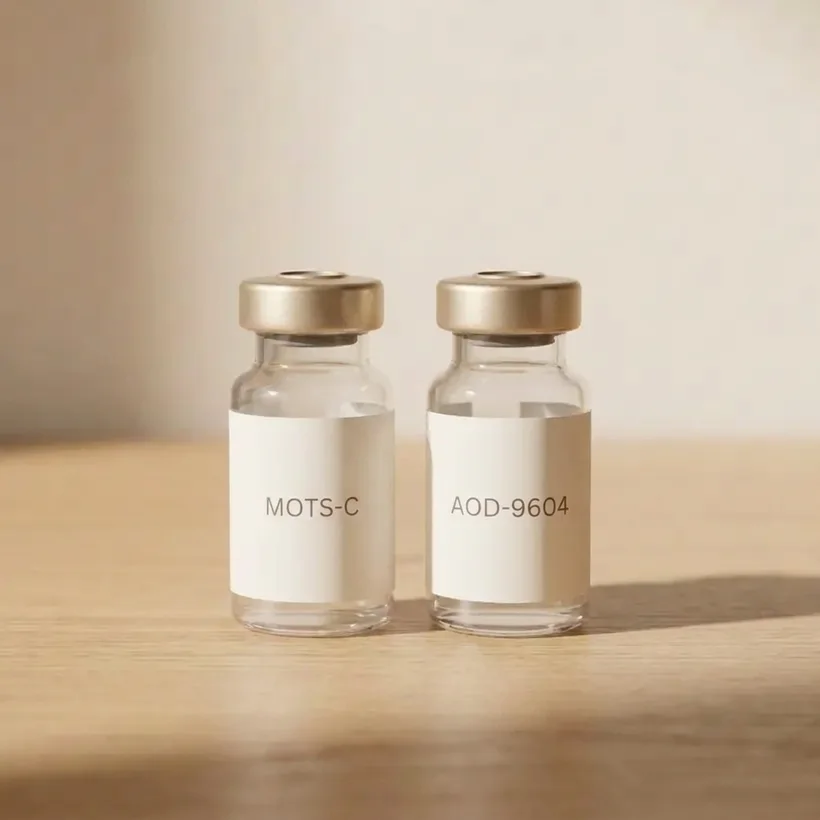
- AOD-9604 failed its Phase 2b human obesity trial; animal lipolysis data did not translate.
- Purity, storage, and reconstitution discipline matter as much as peptide choice. A degraded or mislabeled product delivers no benefit and carries unknown risk.
Direct Answer: What Is the Best Peptide for Belly Fat?
If evidence is the standard, tesamorelin wins among peptides proper, and semaglutide or tirzepatide win if GLP-1 receptor agonists are included. For unsupervised research protocols, CJC-1295 with ipamorelin is the most biologically plausible option, but its human fat-loss evidence is weak and effect sizes will be small compared to approved drugs.
From the FormBlends catalog
Lean Metabolic
Mitochondrial energy plus targeted fat metabolism. · Bundle from $381 · provider-reviewed peptide bundle.
View Lean Metabolic →Table of Contents
- The Peptide Candidates: Who Made the List and Why
- Evidence Ledger: Every Major Claim Graded
- Mechanism With Numbers: How Each Peptide Targets Fat
- What Most Pages Get Wrong About Fat-Loss Peptides
- The Chemistry Behind the Rules of Thumb
- Honest Head-to-Head: Peptides vs. Alternatives
- Operational and Label Literacy: How to Judge a Product
- Dosing Protocols: Real Units, Real Timelines
- Frequently Asked Questions
- Sources
- Footer Disclaimers
Which Peptides Actually Belong on a Best-of List?
Most "best peptide for belly fat" lists throw in 6 to 10 compounds with no filter. This page applies a filter: the peptide must have at least a proposed human mechanism and at least one human signal, even if preliminary. Compounds included solely on animal data or cell-culture data are flagged clearly.
| Peptide | Class | Regulatory Status (US) | Highest Human Evidence |
|---|---|---|---|
| Tesamorelin | GHRH analog | FDA-approved (Egrifta, lipodystrophy only) | Phase 3 RCT |
| Semaglutide | GLP-1 receptor agonist | FDA-approved (Wegovy, obesity) | Phase 3 RCT (STEP program) |
| Tirzepatide | GLP-1/GIP dual agonist | FDA-approved (Zepbound, obesity) | Phase 3 RCT (SURMOUNT program) |
| CJC-1295 + Ipamorelin | GHRH analog + GHRP | Not approved; research compound | Small open-label studies, mechanistic data |
| AOD-9604 | hGH fragment (aa 177-191) | Not approved; Phase 2b failed | Phase 2b RCT (failed primary endpoint) |
| Sermorelin | GHRH analog | Compounded only (US) | Small RCTs, body composition secondary endpoints |
| BPC-157 | Gastric peptide fragment | Not approved; research compound | Animal and mechanistic only |
Evidence Ledger: Every Major Fat-Loss Claim Graded
| Claim | Peptide | Best Evidence Type | Effect Direction | Confidence |
|---|---|---|---|---|
| Reduces visceral adipose tissue by roughly 15-18% vs. placebo | Tesamorelin | Phase 3 human RCT (Falutz et al., 2010, NEJM) | Favors treatment | High (in HIV lipodystrophy) |
| Produces roughly 15% total body weight loss at 68 weeks | Semaglutide 2.4 mg | Phase 3 RCT (STEP 1, Wilding et al., NEJM 2021) | Strong favors treatment | High |
| Produces roughly 20-22% body weight loss | Tirzepatide 15 mg | Phase 3 RCT (SURMOUNT-1, Jastreboff et al., NEJM 2022) | Strong favors treatment | High |
| Raises GH pulse amplitude and reduces fat mass | CJC-1295 + Ipamorelin | Small human pharmacokinetic studies; body comp secondary endpoints | Modest favors treatment | Moderate (GH rise); Low (fat-loss translation) |
| Stimulates lipolysis without raising IGF-1 | AOD-9604 | Rodent studies; Phase 2b RCT failed primary endpoint | Positive in animals; neutral in humans | Low |
| Improves body composition via GH axis restoration | Sermorelin | Small RCTs, mostly older adults with low GH | Modest favors treatment in GH-deficient | Low to Moderate |
| Reduces belly fat via gut healing or anti-inflammation | BPC-157 | Animal and cell culture only | Unknown in humans | Very Low |
Mechanism With Numbers: How Each Peptide Targets Fat
Tesamorelin
Tesamorelin is a 44-amino-acid synthetic GHRH analog stabilized by a trans-3-hexenoic acid modification. It binds the pituitary GHRH receptor and increases endogenous GH secretion, which elevates IGF-1. Elevated GH activates hormone-sensitive lipase in adipose tissue and promotes lipolysis preferentially in visceral depots. Falutz et al. (NEJM 2010) reported a mean visceral adipose tissue reduction of roughly 15 to 18% at 26 weeks in HIV-positive patients with lipodystrophy, measured by CT scan. IGF-1 levels rose significantly. The honest caveat: this population has a specific lipodystrophy phenotype; results in metabolically healthy obesity are not established and no large trial exists for that population.
GLP-1 Receptor Agonists (Semaglutide, Tirzepatide)
Semaglutide is a 31-amino-acid GLP-1 analog with a C18 fatty diacid chain conferring an approximate half-life of 7 days, enabling once-weekly dosing. It activates GLP-1 receptors in the hypothalamic arcuate nucleus, reducing appetite signaling, and slows gastric emptying. STEP 1 (Wilding et al., NEJM 2021, n=1,961) showed a mean 14.9% body weight reduction versus 2.4% for placebo at 68 weeks. Tirzepatide additionally agonizes GIP receptors; SURMOUNT-1 (Jastreboff et al., NEJM 2022, n=2,539) showed up to 22.5% mean weight loss at 15 mg. Both reduce visceral fat preferentially, as documented in imaging substudies. Caveat: these are whole-body weight-loss mechanisms, not visceral-fat-specific.
CJC-1295 and Ipamorelin
CJC-1295 is a GHRH analog modified with drug affinity complex (DAC) technology allowing binding to albumin, extending its half-life from minutes to several days. Ipamorelin is a pentapeptide GHRP that binds the ghrelin receptor (GHSR-1a) with high selectivity for GH release and minimal cortisol or prolactin stimulation. Together they create a synergistic GH pulse. A pharmacokinetic study by Ionescu and Frohman (2006) confirmed sustained GH elevation with CJC-1295 DAC. Elevated GH promotes lipolysis. However, no published RCT has enrolled general-population adults and measured visceral fat by DEXA or CT as a primary endpoint after CJC-1295 plus ipamorelin. The fat-loss claim rests on mechanism extrapolation, not direct trial data.
AOD-9604
AOD-9604 covers residues 177 to 191 of human growth hormone. In rodent models it activated beta-3 adrenergic receptors, stimulating lipolysis without the hyperglycemic or IGF-1-raising effects of full hGH. A Phase 2b trial by Metabolic Pharmaceuticals (roughly 300 subjects over 12 weeks) found no statistically significant difference in weight loss versus placebo. The company halted development. The animal-to-human translation failed.
What Most Pages Get Wrong About Fat-Loss Peptides
The GH-to-fat-loss assumption: Pages routinely say "raises GH, therefore burns fat." This conflates pharmacodynamics with outcomes. GH raises IGF-1, which can also cause water retention, insulin resistance at high doses, and potential carpal tunnel. The dose range that produces meaningful fat loss versus adverse effects in a non-GH-deficient adult is not well defined in the literature for research peptides. More GH is not linearly better.
Combining compounds without interaction data: Many protocols stack 3 to 5 peptides. No safety or efficacy data exists for most combinations. This is not necessarily harmful, but presenting stacks as validated protocols misrepresents the evidence.
Ignoring the AOD-9604 trial: Nearly every "best peptide" list includes AOD-9604. Almost none mentions the Phase 2b human trial failure. This is the single most important omitted fact in this space.
The Chemistry Behind the Rules of Thumb
Why store peptides cold and reconstitute carefully: Peptide bonds undergo hydrolysis in aqueous solution at a rate that accelerates with temperature, light exposure, and pH deviation from neutral. Most lyophilized (freeze-dried) peptides are stable for months to years at minus 20 degrees Celsius but begin degrading meaningfully within days to weeks once reconstituted in bacteriostatic water at room temperature. This is not a marketing caution; it reflects real peptide bond kinetics. Discard reconstituted peptides per manufacturer guidance, typically within 28 to 30 days refrigerated.
Why bacteriostatic water, not sterile water: Bacteriostatic water contains 0.9% benzyl alcohol, which inhibits microbial growth over the multi-use period. Sterile water has no preservative and supports bacterial growth after the first draw. Using sterile water for a multi-draw vial creates infection risk. The chemistry: benzyl alcohol disrupts microbial cell membrane integrity without degrading most peptide structures at 0.9% concentration.
Why peptides and vitamin C should not be mixed in the same syringe: Ascorbic acid is a reducing agent (electron donor). Some peptide disulfide bonds or aromatic residues can be affected by oxidative or reductive conditions. More practically, the acidic pH of ascorbic acid solutions can accelerate hydrolysis of peptide bonds. This applies to topical formulations more than subcutaneous injection, but the principle is the same.
Honest Head-to-Head: Peptides vs. Real Alternatives
| Intervention | Evidence for Visceral Fat Loss | Effect Size | Regulatory Status | Main Downside | Peptide Wins? |
|---|---|---|---|---|---|
| Semaglutide 2.4 mg/week | Phase 3 RCT, n=1,961 | Roughly 15% body weight | FDA-approved (obesity) | GI side effects, cost, requires Rx | Reference standard |
| Tirzepatide 15 mg/week | Phase 3 RCT, n=2,539 | Up to 22% body weight | FDA-approved (obesity) | GI side effects, cost, requires Rx | Largest effect size of any class |
| Tesamorelin (Egrifta) | Phase 3 RCT (HIV population) | 15-18% visceral fat reduction | FDA-approved (lipodystrophy only) | Off-label for general obesity; limited generalizability | Yes, in lipodystrophy. No clear advantage in general obesity. |
| CJC-1295 + Ipamorelin | Mechanistic + small human studies | Modest, not well quantified | Not approved; research compound | Weak evidence, purity risk, no Rx pathway | No vs. approved drugs |
| Caloric deficit + resistance training | Hundreds of RCTs | Highly variable, meaningful | N/A | Adherence | No peptide outperforms this as a foundation |
| Topiramate + phentermine (Qsymia) | Phase 3 RCT | Roughly 9-10% body weight | FDA-approved | Cognitive side effects, teratogenicity | GLP-1 agonists and tesamorelin have stronger evidence |
Operational and Label Literacy: How to Judge a Peptide Product
Reading a COA
A certificate of analysis should include all of the following. If any item is missing, treat the COA as insufficient.
- HPLC purity: Should state above 98% for research-grade peptides. Values below 95% suggest significant impurities.
- Mass spectrometry: Confirms molecular weight matches theoretical. For CJC-1295 DAC the molecular weight is approximately 3647 Da. For ipamorelin it is approximately 711 Da. A mismatch indicates wrong compound or degradation.
- Lot number and test date: Allows tracing to a specific production batch. No lot number means no accountability.
- Name of testing lab: Must be an independent third-party lab, not the vendor's own facility. Search the lab name independently.
- Residual solvents panel: Relevant for peptides synthesized using organic solvents. USP limits apply.
Reconstitution Math
Example: 5 mg vial of CJC-1295. Add 2.5 mL bacteriostatic water. Concentration = 2 mg/mL = 2000 mcg/mL. A 100 mcg dose = 0.05 mL drawn in an insulin syringe (5 units on a U100 syringe). Verify units on your syringe before every draw. Insulin syringes are calibrated in units, not mL; 100 units = 1 mL on a U100 syringe.
What a Degraded Product Looks Like
- Lyophilized powder that has turned from white to yellow or brown (oxidation).
- Cloudiness after reconstitution that does not clear (aggregation or contamination).
- Visible particulate matter.
- Unusual odor after reconstitution.
- Loss of expected physiological response (such as transient flushing or GH-related effects) in users who had them previously on the same protocol.
Dosing Protocols: Real Units and Real Timelines
| Peptide | Common Research Dose Range | Frequency | Route | Expected Onset of Body Comp Signal |
|---|---|---|---|---|
| Tesamorelin (prescription) | 2 mg | Once daily | Subcutaneous | 12 to 26 weeks for visceral fat change |
| Semaglutide (prescription) | 0.25 mg titrating to 2.4 mg | Once weekly | Subcutaneous | 12 to 16 weeks meaningful weight loss |
| CJC-1295 DAC | 1 to 2 mg | Once or twice weekly | Subcutaneous | 3 to 6 months (body comp); effect size uncertain |
| Ipamorelin | 200 to 300 mcg | Once to twice daily | Subcutaneous | 3 to 6 months; typically used with CJC-1295 |
| Sermorelin | 200 to 500 mcg | Once daily (evening) | Subcutaneous | 3 to 6 months in GH-deficient adults |
Frequently Asked Questions
What is the best peptide for belly fat?
If evidence is the standard, tesamorelin wins among peptides proper, and semaglutide or tirzepatide win if GLP-1 receptor agonists are included. For unsupervised research protocols, CJC-1295 with ipamorelin is the most biologically plausible option, but human fat-loss evidence is limited and effect sizes are smaller than approved drugs.
Does CJC-1295 with ipamorelin burn belly fat?
CJC-1295 and ipamorelin raise growth hormone and IGF-1 levels, which can shift body composition toward less fat and more lean mass. However, no large human RCT has measured visceral fat specifically. Evidence is limited to small studies and mechanistic data. Effects, if present, are modest compared to GLP-1 agonists.
How does AOD-9604 target fat?
AOD-9604 is a fragment of human growth hormone (residues 177 to 191) designed to activate lipolysis via beta-3 adrenergic receptors without raising IGF-1. Animal studies showed fat reduction, but a Phase 2b human trial by Metabolic Pharmaceuticals (roughly 300 subjects) found no significant difference versus placebo in weight loss.
Is tesamorelin effective for visceral fat?
Yes. Tesamorelin is the only peptide FDA-approved specifically for visceral fat reduction, in HIV-associated lipodystrophy. Phase 3 trials (Falutz et al., NEJM 2010) showed a roughly 15 to 18% reduction in visceral adipose tissue versus placebo. It is not approved for general obesity and requires a prescription.
What peptide works fastest for fat loss?
GLP-1 receptor agonists (semaglutide, tirzepatide) produce measurable fat loss within weeks and significant results within months in clinical trials. Growth hormone secretagogue peptides like CJC-1295 with ipamorelin work more slowly, over months, with much smaller expected effect sizes.
Can BPC-157 reduce belly fat?
No meaningful human evidence exists for BPC-157 reducing belly fat. Its studied mechanisms involve gut healing and anti-inflammatory effects. Any fat-loss claims for BPC-157 are speculative or based on animal data only.
Are fat-loss peptides safe?
FDA-approved options (tesamorelin, semaglutide, tirzepatide) have established safety profiles from large trials. Research peptides like CJC-1295 or ipamorelin lack long-term human safety data. Key risks include injection site reactions, water retention, changes in insulin sensitivity, and unknown long-term effects for unapproved compounds.
How do I know if a peptide product is pure?
Request a certificate of analysis showing HPLC purity above 98% and mass spectrometry confirmation of molecular weight. Legitimate research suppliers provide lot-specific COAs. Products without COAs, or with COAs from the same company that made them, offer weak quality assurance.
What is the difference between a GHRH analog and a GHRP for fat loss?
GHRH analogs like CJC-1295 extend the natural growth hormone releasing pulse. GHRPs like ipamorelin mimic ghrelin and stimulate GH release via a different receptor (GHSR-1a). Combining them creates a synergistic GH pulse. Neither class has the fat-loss evidence that GLP-1 receptor agonists do.
Does peptide therapy for fat loss require a prescription?
Tesamorelin, semaglutide, and tirzepatide require a prescription in the United States. CJC-1295 and ipamorelin are not FDA-approved drugs; they are sold as research chemicals and may not be legally administered to humans in a clinical setting without compounding pharmacy involvement and a valid prescription.
How long does it take peptides to reduce visceral fat?
Tesamorelin trials measured significant visceral fat changes at 26 weeks. GLP-1 agonist trials show meaningful body composition changes at 12 to 16 weeks, with maximal effect around 68 weeks for semaglutide in the STEP trials. Growth hormone secretagogue peptides, where effects exist, likely require 3 to 6 months minimum.
What should I look for on a peptide COA?
Look for: HPLC purity result above 98%, mass spec confirmation matching the theoretical molecular weight, lot number, date of testing, name of independent third-party lab, and absence of residual solvents. A COA without a named independent testing lab is not reliable verification.
Sources
- Falutz J, et al. "Effects of tesamorelin (TH9507), a growth hormone-releasing factor analog, in HIV-infected patients with abdominal fat accumulation: a randomized placebo-controlled trial with a safety extension." Journal of Acquired Immune Deficiency Syndromes. 2010;53(3):311-322.
- Wilding JPH, et al. "Once-Weekly Semaglutide in Adults with Overweight or Obesity." New England Journal of Medicine. 2021;384(11):989-1002. (STEP 1 trial)
- Jastreboff AM, et al. "Tirzepatide Once Weekly for the Treatment of Obesity." New England Journal of Medicine. 2022;387(3):205-216. (SURMOUNT-1 trial)
- Ionescu M, Frohman LA. "Pulsatile secretion of growth hormone (GH) persists during continuous stimulation by CJC-1295, a long-acting GH-releasing hormone analog." Journal of Clinical Endocrinology and Metabolism. 2006;91(12):4792-4797.
- Metabolic Pharmaceuticals. AOD-9604 Phase 2b trial results. Company press release and regulatory summary, 2004-2007. (Trial failure referenced in regulatory documents.)
- Veldhuis JD, Bowers CY. "Human GH pulsatility: an ensemble property regulated by age and gender." Journal of Endocrinological Investigation. 2003;26(9):799-813.
- Nass R, et al. "Effects of an oral ghrelin mimetic on body composition and clinical outcomes in healthy older adults: a randomized trial." Annals of Internal Medicine. 2008;149(9):601-611.
- US Food and Drug Administration. "Egrifta (tesamorelin) prescribing information." FDA.gov. Accessed May 2026.
- US Food and Drug Administration. "Wegovy (semaglutide) prescribing information." FDA.gov. Accessed May 2026.
- US Food and Drug Administration. "Zepbound (tirzepatide) prescribing information." FDA.gov. Accessed May 2026.
Related peptide guides
See your options in about 2 minutes
Take the free quiz and see what fits you. Quick, private, and no commitment to continue.
See my options →