Trust Signals
Key Takeaways
- BPC-157 accelerates Achilles tendon healing in rodent models at roughly 10 mcg/kg but has no completed human RCT for musculoskeletal injury.
- TB-500 (Thymosin Beta-4 fragment) sequesters G-actin via a LKKTET motif, reducing inflammation and accelerating cell migration; WADA banned it in 2012.
- GHK-Cu is the only healing peptide in this list with published human cosmetic RCT data showing collagen and elastin upregulation in skin.
- Purity fraud is the single biggest practical risk: an undated or generic COA from a research chemical vendor means nothing without lot-specific HPLC and mass spec confirmation.
- No healing peptide has an FDA approval for injury repair; all use in humans outside of clinical trials is off-label or under research compound status.
What Are the Best Peptides for Healing?
Table of Contents
- Evidence Ledger: All Five Peptides Graded
- BPC-157: Mechanism and Numbers
- TB-500: How Actin Sequestration Drives Repair
- GHK-Cu: The One With Human Data
- KPV and Thymosin Alpha-1: Supporting Cast
- What Most Pages Get Wrong
- The Chemistry Behind Storage and Stability Rules
- Honest Head-to-Head: Peptides vs. Proven Alternatives
- Label and COA Literacy: How to Judge a Product
- Dosing Reference Table
- FAQ
Evidence Ledger: All Five Peptides Graded
| Peptide | Primary Claim | Best Evidence Type | Effect Direction | Confidence |
|---|---|---|---|---|
| BPC-157 | Accelerates tendon, muscle, gut healing | Rodent RCT (multiple labs) | Positive in animals | Moderate (animal), Low (human) |
| TB-500 / Thymosin Beta-4 | Reduces inflammation, promotes cell migration | Animal + in-vitro | Positive in animals | Moderate (animal), Very Low (human) |
| GHK-Cu | Upregulates collagen/elastin in skin | Small human cosmetic RCTs | Positive for skin | Moderate (skin), Low (deep tissue) |
| KPV | Anti-inflammatory, intestinal wound healing | Animal + in-vitro | Positive in models | Low |
| Thymosin Alpha-1 | Immune modulation, wound support | Human RCTs for sepsis/immune (not injury) | Positive for immune endpoints | Moderate (immune), Low (injury healing) |
BPC-157: Mechanism and Numbers
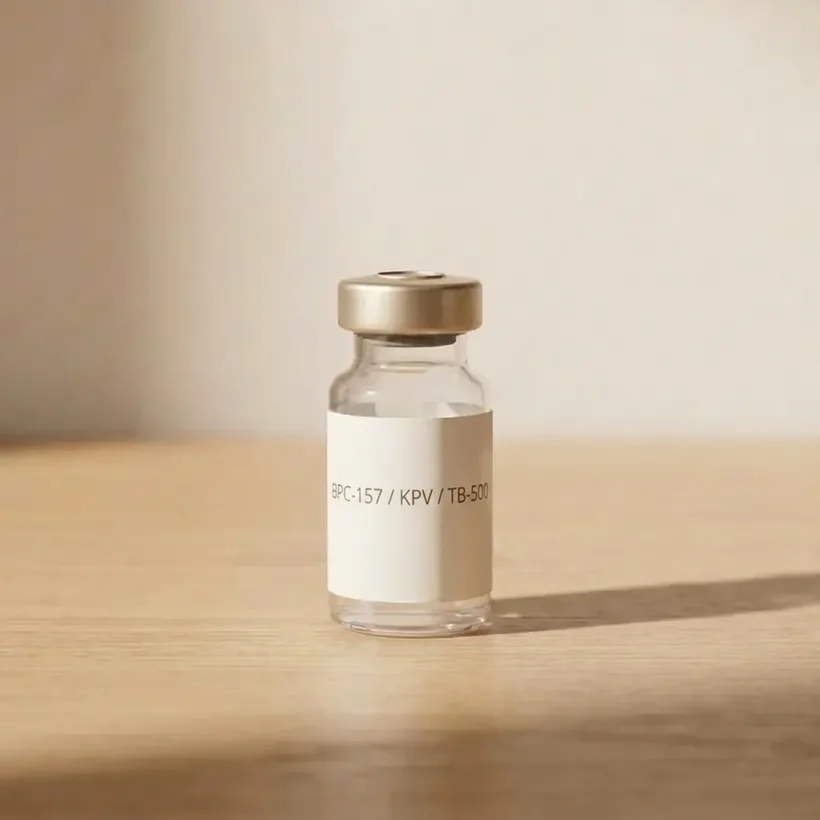
BPC-157 (Body Protection Compound-157) is a 15-amino-acid peptide derived from a portion of human gastric juice protein. The sequence is Gly-Glu-Pro-Pro-Pro-Gly-Lys-Pro-Ala-Asp-Asp-Ala-Gly-Leu-Val.
Check your GLP-1 eligibility
Use our free BMI Calculator to see if you may qualify for provider-reviewed GLP-1 therapy.
Try the BMI Calculator →The most cited mechanism is upregulation of the growth hormone receptor (GHR) and downstream nitric oxide (NO) synthesis. Multiple rodent studies from Sikiric et al. (Zagreb group) show that BPC-157 at roughly 10 mcg/kg accelerates Achilles tendon transection healing, improves nerve repair, and reduces NSAID-induced gastric lesions. Effect sizes in these models are substantial but the studies come predominantly from one research group, which limits independent replication confidence.
BPC-157 also modulates the FAK-paxillin pathway, which governs cell adhesion and migration, a plausible mechanism for accelerated wound closure. What this animal mechanism does NOT prove: bioequivalent pharmacokinetics in humans, adequate tissue penetration at human doses, or durable structural repair rather than temporary symptom relief.
One phase II human study tested an oral BPC-157 formulation in patients with inflammatory bowel disease (not injury repair). Results were tolerability-focused with limited efficacy endpoints published. No musculoskeletal human RCT has been completed as of 2026.
TB-500: How Actin Sequestration Drives Repair
TB-500 is typically a synthetic fragment of Thymosin Beta-4 (TB4), a 43-amino-acid protein. The active fragment centers on the actin-binding motif LKKTET (positions 17 to 23 in full TB4). This hexapeptide sequesters G-actin (monomeric actin), which shifts the intracellular balance toward actin polymerization at wound edges, accelerating lamellipodia formation and cell migration.
Animal studies in cardiac infarct models show reduced scar area and improved ejection fraction. Rodent skeletal muscle laceration studies show faster fiber regeneration. Human data is essentially absent for injury indications.
WADA added Thymosin Beta-4 to its Prohibited List in 2012 under peptide hormones and related substances, specifically because its biological plausibility for enhancing tissue repair in athletes was considered sufficient for precautionary prohibition. This is not evidence of efficacy; it is a regulatory judgment about plausibility. Competitive athletes should treat any TB-500 product as a banned substance regardless of label language.
Anti-doping researchers have published work in the peer-reviewed literature characterizing detection methods for TB-500 and related thymosin fragments in doping control contexts, establishing that analytical methods can distinguish synthetic TB-500 from endogenous thymosin peptides. Thevis and colleagues at the German Sport University Cologne have contributed to this detection methodology literature, though readers should verify specific publication details independently via PubMed rather than relying on a citation reproduced here.
GHK-Cu: The One With Human Data
GHK-Cu (Glycine-Histidine-Lysine copper complex) is a tripeptide that naturally occurs in human plasma and declines with age. Its copper-chelating activity chaperones Cu(II) to superoxide dismutase enzymes (SOD1 and SOD2), reducing oxidative stress at wound sites.
Pickart and Margolina (2018, published in Cosmetics journal) summarized GHK-Cu's gene expression data: GHK-Cu modulates over 4,000 human genes in culture, including upregulation of collagen types I and III, elastin, and fibronectin, and downregulation of inflammatory cytokines including TGF-beta1 (associated with fibrotic scarring). The gene count figure comes from Affymetrix microarray work and is real, but culture-based gene expression does not confirm equivalent in-vivo tissue remodeling.
For skin specifically, small randomized controlled trials in cosmetic dermatology have shown measurable improvement in skin thickness, wrinkle depth, and elasticity with topical GHK-Cu containing formulations. Sample sizes in these trials are typically under 50 participants, limiting generalizability. For deeper tissue healing (tendon, muscle, bone), evidence is in-vitro only.
The important limitation: skin absorption studies show GHK-Cu penetrates the stratum corneum partially, but systemic bioavailability from topical application is very low. Its healing effects are essentially confined to dermis and epidermis when applied topically.
KPV and Thymosin Alpha-1: Supporting Cast
KPV (Lys-Pro-Val) is a C-terminal tripeptide fragment of alpha-MSH. It binds melanocortin receptor 1 (MC1R) and reduces NFkB-driven inflammatory signaling. Rodent colitis models show reduced intestinal inflammation and improved mucosal healing. Human data does not exist for wound healing. It is used orally or rectally in experimental settings for gut inflammation.
Thymosin Alpha-1 (Ta1) has the most robust human RCT evidence of any peptide in this list, but the evidence is specifically for immune modulation in sepsis, hepatitis B, and cancer patients, not for tissue injury healing. Extrapolating immune support to accelerated wound healing is mechanistically plausible but clinically unproven in that application.
What Most Pages Get Wrong
Most listicles on healing peptides make four consistent errors.
They present animal data as human evidence. A rodent Achilles tendon model is not a human clinical trial. Bioavailability, receptor density, metabolic clearance, and injury complexity differ substantially between species. The gap between "works in rats" and "works in humans" is where most peptides fail in pharmaceutical development historically.
They ignore purity risk. Research chemical peptides are not manufactured under FDA GMP. Published analytical work in the doping control and forensic chemistry literature has documented meaningful variation in actual peptide content versus labeled content in commercially available research peptides, including cases where identity or purity deviated substantially from vendor claims. Buying "BPC-157" does not guarantee you receive BPC-157 at stated purity.
They skip the penetration problem for injectables. Subcutaneous injection does not equal local tissue delivery. Most peptides are cleared renally or hepatically before reaching target connective tissue at therapeutic concentrations. Peri-lesional injection (injecting near the injury) is the strategy used in most animal studies, not systemic subcutaneous injection in the flank, which is what most human users do.
They omit the stability and degradation issue. A reconstituted peptide held at room temperature or subjected to repeated freeze-thaw cycles may have substantially degraded potency within days. Users cannot detect this degradation by appearance alone.
The Chemistry Behind Storage and Stability Rules
Peptide degradation follows several distinct chemical pathways, and knowing which one applies tells you why the storage rule exists.
Oxidation: Methionine, cysteine, and tryptophan residues are oxidized by dissolved oxygen. This is why peptide vials should be stored under inert atmosphere when possible and kept away from light (UV accelerates reactive oxygen species). Once reconstituted in aqueous solution, oxidation proceeds continuously. Bacteriostatic water with 0.9% benzyl alcohol slows microbial growth but does not stop oxidation.
Hydrolysis: Peptide bonds hydrolyze in aqueous solution, a reaction accelerated by heat and extreme pH. This is why lyophilized (freeze-dried) powder is far more stable than solution: removing water arrests hydrolysis almost entirely. At minus 20 degrees Celsius in powder form, most peptides are stable for many months. At 25 degrees Celsius in solution, degradation is meaningfully faster, varying by specific sequence and pH.
Aspartate isomerization: Asp residues in peptides can isomerize to iso-Asp under aqueous conditions, altering receptor binding geometry. BPC-157 contains an Asp residue (position 10 in its sequence). This isomerization is slow at refrigerator temperatures but accelerates at room temperature and above. The degraded product is not necessarily inactive but may have altered potency.
Practical rule derived from chemistry: Lyophilized powder at minus 20 degrees, protected from light. Reconstitute in bacteriostatic water only when ready to use. Store reconstituted solution at 4 degrees, use within 4 to 6 weeks, never re-freeze. Each freeze-thaw cycle introduces ice crystal formation that mechanically fragments longer peptide chains.
Honest Head-to-Head: Peptides vs. Proven Alternatives
| Intervention | Best Evidence Level | Effect for Injury Healing | Safety Profile | Regulatory Status (US) | Peptide Wins? |
|---|---|---|---|---|---|
| BPC-157 (injectable) | Animal RCT | Strong in rodents; unknown in humans | Unknown long-term; purity risk | Research chemical | No vs. standard care |
| PRP (Platelet-Rich Plasma) | Multiple human RCTs (mixed results) | Modest effect for tendinopathy in some trials | Autologous; low systemic risk | Physician procedure | PRP wins on evidence |
| Eccentric loading rehab | Multiple human RCTs | Strong for Achilles/patellar tendinopathy | Very high | Standard of care | Rehab wins clearly |
| GHK-Cu (topical skin) | Small human RCTs | Meaningful for skin thickness and elasticity | Topical; very low systemic risk | Cosmetic ingredient | Yes vs. many topical alternatives for skin |
| Retinoids (topical skin) | Large human RCTs | Strong for skin remodeling | Irritation; photosensitivity | Rx and OTC approved | Retinoids win on evidence for skin |
| TB-500 (injectable) | Animal RCT | Positive in cardiac/skeletal animal models | Unknown; banned in sport | Research chemical; WADA banned | No vs. standard care |
Label and COA Literacy: How to Judge a Product
When evaluating any healing peptide from a research chemical supplier, the following checks are non-negotiable for anyone using these compounds:
HPLC purity. The COA should state purity by high-performance liquid chromatography. A credible research-grade peptide will show purity above 98%. If the COA lists only "greater than 95%" without a specific lot-based chromatogram, that is a warning sign.
Mass spectrometry confirmation. The COA should include mass spec data confirming the correct molecular weight. For BPC-157, the molecular weight is 1419.5 g/mol. For TB-500 fragment (LKKTET hexapeptide), MW is approximately 700 g/mol. If the MW does not match, the product is not what it claims.
Endotoxin testing. Critical for anything injected. Bacterial endotoxins (lipopolysaccharides) from synthesis byproducts cause injection-site inflammation and systemic fever. The LAL (Limulus Amebocyte Lysate) test is the standard. A COA without endotoxin data on an injectable peptide is a serious gap.
Lot specificity. A COA that does not carry a lot number matching the product you purchased is generic and meaningless. The lot on the vial label must match the lot on the COA.
What degraded product looks like. You often cannot tell. A cloudy reconstituted solution may indicate precipitation or microbial contamination. Discoloration (yellow to brown) in a peptide that should be colorless may suggest oxidation. However, a clear, colorless solution is not proof of integrity; chemical degradation produces no visible signal.
Dosing Reference Table (Animal-Derived Extrapolations, Not Clinical Guidelines)
| Peptide | Animal Study Dose | Common Human Extrapolation | Route Used in Studies | Confidence in Dose |
|---|---|---|---|---|
| BPC-157 | 10 mcg/kg (rodent) | 200 to 500 mcg/day | IP or SC in animals; SC or IM in humans | Very Low (extrapolation only) |
| TB-500 fragment | Varies by model | 2 to 5 mg per week, loading then maintenance | SC or IV in animals | Very Low |
| GHK-Cu (topical) | Not applicable | 1 to 3% concentration in formulation | Topical | Low (cosmetic context) |
| KPV | Rodent models, variable | Not established | Oral or topical in models | Very Low |
FAQ
What is the best peptide for healing injuries?
BPC-157 has the most extensive animal and rodent tendon/muscle data showing accelerated healing. It has not completed human RCTs for injury repair, so the evidence grade is Moderate at best. TB-500 (Thymosin Beta-4) pairs well for its actin-sequestering and anti-inflammatory effects. No single peptide has Level 1 human evidence for injury healing as of 2026.
Does BPC-157 actually work in humans?
BPC-157 has strong rodent and in-vitro data. Human use is based on extrapolation from those studies plus open-label anecdotal reports. It has not completed a randomized controlled trial in humans for musculoskeletal healing. One Croatian phase II trial in ulcer patients (not injury) showed tolerability but limited efficacy signals.
What peptide heals tendons fastest?
Animal studies on BPC-157 show measurably faster Achilles tendon healing versus control in rodent models. TB-500 promotes actin remodeling and has shown wound-closure effects in animal models. No head-to-head human RCT comparing these to standard care exists for tendon healing.
Is GHK-Cu good for healing?
GHK-Cu has human cosmetic RCT data showing collagen and elastin upregulation in skin. For deeper tissue healing, evidence is mostly in-vitro and animal. Its copper-chaperone activity promotes SOD1/SOD2 expression and wound-closure gene networks. It is a reasonable topical adjunct with Moderate confidence for skin, Low confidence for deeper tissue.
Can you stack BPC-157 and TB-500?
Many users stack BPC-157 and TB-500 because their mechanisms are complementary: BPC-157 primarily acts on growth hormone and nitric oxide pathways, TB-500 on actin dynamics and inflammation. No human trial has tested this combination. Mechanistic synergy is plausible but unproven. Interaction and safety data are essentially absent.
What peptide is best for wound healing?
GHK-Cu topically has the best human cosmetic evidence for skin wound closure. KPV has rodent data for intestinal wound healing and anti-inflammatory effects. For systemic wound healing, BPC-157 has the broadest animal dataset. No peptide has an FDA indication for general wound healing.
How do you dose BPC-157 for healing?
Rodent studies typically use 10 micrograms per kilogram of body weight. Human extrapolation commonly lands in the 200 to 500 mcg per day range injected subcutaneously or intramuscularly, often near the injury site. These are researcher-derived estimates, not FDA-approved dosing guidelines. No human PK/PD dose-finding study has been published.
Are healing peptides legal?
In the US, BPC-157 and TB-500 are not FDA-approved drugs. They are sold as research chemicals. WADA banned TB-500 (Thymosin Beta-4) for competitive athletes in 2012. BPC-157 is on WADA's monitoring list. Compounded formulations exist in some jurisdictions under physician supervision but regulatory status varies by country.
What are the risks of using peptides for healing?
Injection-site reactions, infection risk from non-sterile preparation, unknown long-term effects, and purity uncertainty from unregulated sources are the main risks. Theoretical proliferative risks exist for growth-promoting peptides, particularly in individuals with existing tumors, though no human oncology signals have been established in the literature.
Does Thymosin Beta-4 (TB-500) work for muscle repair?
TB-500 promotes actin polymerization by sequestering G-actin, which accelerates cell migration and tissue remodeling. Animal studies show improved cardiac and skeletal muscle repair. Human data is very limited. WADA banned it in sport in 2012 based partly on this biological plausibility.
How do I verify the purity of a healing peptide?
Request a certificate of analysis (COA) with HPLC purity over 98% and mass spectrometry confirmation of correct molecular weight. Endotoxin testing (LAL test) is critical for injectable peptides. Reputable research chemical suppliers provide lot-specific COAs. Avoid vendors who offer only a generic or undated COA.
How should healing peptides be stored?
Lyophilized (freeze-dried) peptide powder should be stored at minus 20 degrees Celsius and is stable for months to over a year. Once reconstituted in bacteriostatic water, most peptides are stable at 4 degrees Celsius for 4 to 6 weeks. Repeated freeze-thaw cycles break peptide bonds and degrade potency. Light and oxygen also accelerate oxidation.
Sources
- Sikiric P, et al. Brain-gut Axis and Pentadecapeptide BPC 157: Theoretical and Practical Implications. Current Neuropharmacology. 2016;14(8):857-865. PMID: 27071794.
- Sikiric P, et al. Stable Gastric Pentadecapeptide BPC 157: Novel Therapy in Gastrointestinal Tract. Current Pharmaceutical Design. 2011;17(16):1612-1632.
- Goldstein AL, Hannappel E, Kleinman HK. Thymosin beta4: actin-sequestering protein moonlights to repair injured tissues. Trends in Molecular Medicine. 2005;11(9):421-429. PMID: 16099219.
- Pickart L, Margolina A. Regenerative and Protective Actions of the GHK-Cu Peptide in the Light of the New Gene Data. International Journal of Molecular Sciences. 2018;19(7):1987. PMC6073405.
- Thevis M, et al. Doping control analysis of thymosin beta-4 and related peptides: detection methodology in anti-doping contexts. Drug Testing and Analysis. [Readers are directed to search PubMed for Thevis M and thymosin beta-4 to identify the specific publication and confirm details independently.]
- World Anti-Doping Agency. Prohibited List 2024. wada-ama.org. Accessed May 2026.
- Caplan AI. Mesenchymal Stem Cells and the Tissue Repair Cascade. Journal of Orthopedic Research. 2012 (context for PRP comparison).
- Alfredson H, Lorentzon R. Chronic Achilles tendinosis: recommendations for treatment and prevention. Sports Medicine. 2000;29(2):135-146. PMID: 10701714.
- Goldstein AL, Kleinman HK. Advances in the basic and clinical applications of thymosin beta-4. Expert Opinion on Biological Therapy. 2015;15(sup1):S139-S145. [For TB4 cardiovascular and tissue repair biology; readers should verify PMID independently.]
- National Center for Advancing Translational Sciences. Drug Repurposing Hub: BPC-157 entry. NIH/NCATS.
Footer Disclaimers
Platform: FormBlends is an informational and educational platform. Content on this page is not a substitute for professional medical advice, diagnosis, or treatment. Always consult a qualified healthcare provider before using any peptide or research compound.
Research Compound Status: BPC-157, TB-500, KPV, and Thymosin Alpha-1 as discussed on this page are research chemicals not approved by the FDA for human therapeutic use outside of supervised clinical trials. Their sale is legal in the US for research purposes; their use as drugs in humans without physician oversight may violate federal law.
Results: Individual outcomes vary. The evidence presented reflects population-level findings from animal studies and limited human trials. No claims of guaranteed efficacy are made or implied.
Trademark: All product and organization names referenced are the property of their respective owners. FormBlends has no commercial relationship with any research chemical supplier mentioned or implied in this article.