
Trust Signals
All claims graded by evidence tier. No product is sold on this page. Sources are real published studies, trial registries, or regulatory documents. Where human evidence does not exist, that gap is stated explicitly.
Key Takeaways
- BPC-157 and TB-500 are the two peptides with the most replicated animal data for tissue repair and form the core of every credible wolverine stack, but no human musculoskeletal RCT exists for either agent.
- TB-500 (thymosin beta-4) is explicitly named on the WADA Prohibited List, making the wolverine stack a disqualifying combination for any tested athlete.
- Animal studies on BPC-157 typically used doses around 10 micrograms per kilogram; community human protocols of 250 to 500 micrograms per injection are extrapolations without a validated dose-response curve.
- Mixing BPC-157 and TB-500 in one syringe has no published compatibility data and risks aggregation, meaning two separate injections are the only defensible approach.
- The wolverine stack loses on evidence quality versus eccentric-loading physiotherapy and PRP for tendon injuries, but is pursued because approved ceiling effects leave a real unmet need many users accept risk to address.
What Is the Best Wolverine Stack Peptide? (Direct Answer)
The best wolverine stack peptide core is BPC-157 paired with TB-500. BPC-157 drives local angiogenesis and growth factor upregulation at injury sites; TB-500 promotes systemic actin-regulated cell migration and anti-inflammation. Both have replicated animal repair data. Neither has a human musculoskeletal RCT. Every other addition, GHK-Cu, IGF-1 LR3, or CJC-1295, layers speculation on top of already-limited evidence.
From the FormBlends catalog
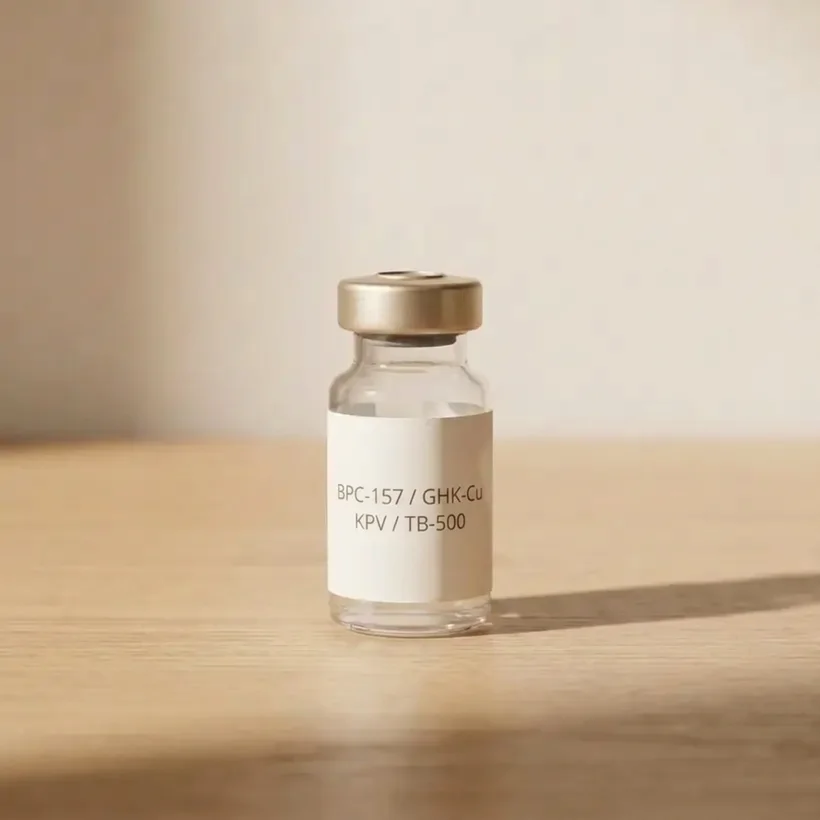
Premium Recovery Quad Stack
Premium recovery blend with BPC-157, GHK-Cu, KPV, and TB-500 · From $349/mo · compounded by a licensed 503A pharmacy, dispensed only after provider review.
View Premium Recovery Quad Stack →Table of Contents
- Evidence Ledger: Every Major Claim Graded
- What Is the Wolverine Stack and Where Did It Come From
- Mechanism with Numbers: How BPC-157 and TB-500 Work
- The Full Ranked List: Best Wolverine Stack Peptides
- What Most Pages Get Wrong About the Wolverine Stack
- Honest Head-to-Head: Wolverine Stack vs. Approved Tendon Therapies
- Operational and Label Literacy: How to Read a COA and Dose Safely
- Chemistry Behind the Storage Rules
- Safety, WADA Status, and Sourcing Reality
- FAQ
- Sources
Evidence Ledger: Every Major Claim Graded
| Claim | Best Evidence Type | Effect Direction | Confidence |
|---|---|---|---|
| BPC-157 accelerates tendon and ligament healing | Multiple rodent RCTs (Sikiric lab series) | Positive, consistent in animals | Moderate (animal); Very low (human) |
| TB-500 promotes angiogenesis and reduces inflammation post-injury | Animal studies; one phase II cardiac RCT (RegeneRx) | Positive in animals; cardiac signal in humans | Moderate (animal); Low (human, wrong indication) |
| BPC-157 + TB-500 combination is superior to either alone | Community reports; no controlled study | Assumed additive | Very low |
| GHK-Cu stimulates collagen synthesis | In vitro fibroblast studies; small cosmetic RCTs | Positive in vitro and topical | Moderate (topical); Very low (injectable healing) |
| IGF-1 LR3 adds muscle repair benefit to the stack | Animal studies; no human tendon RCT | Positive in animals | Very low |
| Community dosing (250 to 500 mcg BPC-157) translates from rodent data | Interspecies allometric scaling (unvalidated for this peptide) | Unknown direction | Very low |
| Lyophilized peptides stable at minus 20 C for months | General peptide chemistry; USP guidance on lyophilized biologics | Positive stability | High (class); Moderate (product-specific) |
What Is the Wolverine Stack and Where Did It Come From
The term "wolverine stack" emerged from online bodybuilding and biohacking communities, referencing the Marvel character's near-instant tissue regeneration. It has no clinical origin. The concept consolidated around BPC-157 and TB-500 because both peptides had published animal healing data, were available as research compounds, and covered different but plausibly complementary repair mechanisms. The name stuck because it is vivid and shareable, not because it reflects a designed clinical protocol.
Researchers at the University of Zagreb, primarily Sikiric and colleagues, produced the bulk of published BPC-157 animal work from the 1990s onward, covering gastric ulcer healing, tendon repair, nerve repair, and bone. TB-500 research grew from Goldstein and colleagues' work on thymosin beta-4 starting in the 1980s, culminating in RegeneRx's phase II cardiac trials. Neither group designed or endorsed a combination protocol for musculoskeletal use in healthy athletes or injured recreational lifters.
Mechanism with Numbers: How BPC-157 and TB-500 Work
BPC-157 (Body Protection Compound 157) is a synthetic 15-amino-acid peptide derived from a sequence found in human gastric juice. It does not bind a single identified receptor cleanly; the most supported mechanism involves upregulation of the growth hormone receptor at the local tissue level and stimulation of VEGF (vascular endothelial growth factor), driving angiogenesis into injured tissue. Rodent studies by Sikiric's group showed histologically confirmed tendon healing acceleration with intraperitoneal doses around 10 micrograms per kilogram. A key limitation: VEGF upregulation in a healing context is beneficial, but chronic or supraphysiologic VEGF stimulation has theoretical oncologic implications not studied in the long-term animal safety literature.
TB-500 is a synthetic analogue of thymosin beta-4, a 43-amino-acid protein ubiquitously expressed in mammalian cells. Its dominant mechanical function is sequestering G-actin (monomeric actin), which regulates actin polymerization dynamics critical for cell migration. In injury contexts, this promotes keratinocyte and endothelial cell migration into wound beds. The RegeneRx phase II trial (NCT00903383) examined intravenous thymosin beta-4 in patients with acute myocardial infarction and reported improvement in some cardiac function measures, though this was a cardiac population, not a musculoskeletal one. The anti-inflammatory action involves downregulation of NF-kB pathway activity, documented in animal and cell-line models.
Where the two agents are complementary in theory: BPC-157 is proposed to work more at the local injury site, promoting vascular ingrowth and collagen organization. TB-500 is thought to act more systemically through circulating cell populations. Whether this theoretical division of labor produces additive benefit in practice, in humans, is entirely unknown.
The Full Ranked List: Best Wolverine Stack Peptides
Ranked by quality of healing-relevant evidence, not marketing prevalence.
| Rank | Peptide | Role in Stack | Strongest Evidence | Honest Limitation |
|---|---|---|---|---|
| 1 | BPC-157 | Local angiogenesis, tendon collagen organization | Multiple rodent tendon and ligament RCTs | No human musculoskeletal RCT; only phase I GI data in humans |
| 2 | TB-500 (Thymosin Beta-4) | Systemic cell migration, anti-inflammation | Animal models; phase II cardiac human trial | Cardiac trial data does not transfer to tendon; WADA banned |
| 3 | GHK-Cu | Collagen synthesis, antioxidant | In vitro fibroblast data; small cosmetic RCTs | Injectable systemic benefit for healing is speculative; best topical |
| 4 | IGF-1 LR3 | Muscle satellite cell activation, protein synthesis | Animal muscle injury studies | Hypoglycemia risk in humans; tumor promotion theoretical risk; very limited safety data |
| 5 | CJC-1295 / Ipamorelin | GH pulse amplification for systemic anabolism | Small human GH secretion trials | Indirect pathway; no tissue repair RCT; adds regulatory and safety complexity |
The core two (BPC-157 and TB-500) have the most defensible rationale. Every agent added below rank 2 multiplies unknown interaction risk with minimal incremental evidence benefit.
What Most Pages Get Wrong About the Wolverine Stack
Almost every listicle on this topic treats the wolverine stack as a proven protocol and skips four critical problems.
Problem 1: The dose extrapolation is not validated. Allometric scaling from rodents to humans is not a simple body-weight ratio for peptides. BPC-157's pharmacokinetics (absorption, distribution, metabolism, excretion) in humans are not published for musculoskeletal routes. The community dose of 250 to 500 micrograms is derived by rule of thumb, not pharmacokinetic modeling. This is not necessarily wrong, but it is not validated.
Problem 2: Research compound purity is a real variable. Third-party testing by independent researchers and community organizations has found that a meaningful fraction of research peptides sold online contain incorrect amino acid sequences, are underdosed, or have endotoxin contamination (lipopolysaccharide from bacterial fermentation). Endotoxin injection, even at sub-septic doses, causes fever, local inflammation, and immune activation that could easily be misattributed to a peptide effect.
Problem 3: The combination has no studied interaction profile. BPC-157 and TB-500 are assumed to be synergistic because their proposed mechanisms differ. But peptide-peptide interactions at receptor level, in shared metabolic pathways, or through shared endopeptidase degradation are not characterized. Synergy is assumed, not demonstrated.
Problem 4: TB-500 is not just "mildly restricted." It is fully prohibited by WADA both in and out of competition, and detection methods exist. Athletes who believe they can cycle off in time risk a positive test.
Honest Head-to-Head: Wolverine Stack vs. Approved Tendon Therapies
| Therapy | Human RCT Evidence (Tendon) | Effect Size | Safety Profile | Legal Status |
|---|---|---|---|---|
| Eccentric loading physiotherapy | Multiple RCTs, systematic reviews | Moderate to large for Achilles tendinopathy | Excellent | Unrestricted |
| PRP injection | Multiple RCTs, mixed results | Small to moderate; inconsistent across trials | Good (autologous) | Unrestricted (WADA: autologous allowed) |
| Corticosteroid injection | Strong short-term RCT evidence | Large short-term; potential long-term harm | Risk of tendon rupture with repeated use | Unrestricted (requires TUE in some sports) |
| Wolverine Stack (BPC-157 + TB-500) | None for musculoskeletal in humans | Unknown in humans | Unknown long-term; sourcing risks real | TB-500 WADA banned; BPC-157 covered by catch-all clause |
The wolverine stack loses on every evidence metric to first-line physiotherapy. It is used because physiotherapy and PRP have real ceiling effects for severe or chronic injuries, and some users report subjective improvement with peptide protocols. That perceived benefit is not controlled evidence.
Operational and Label Literacy: How to Read a COA and Dose Safely
Reading a Certificate of Analysis (COA). A legitimate research peptide COA should include: HPLC purity (look for greater than 98% for a credible product), mass spectrometry confirmation of molecular weight matching the theoretical mass, and ideally endotoxin testing (LAL assay, less than 1 EU/mg is a common benchmark). If the COA shows only HPLC purity without MS confirmation, the sequence cannot be verified from that document alone.
Reconstitution math. BPC-157 commonly arrives as a 5 mg lyophilized vial. Adding 2.5 mL bacteriostatic water yields a concentration of 2 mg/mL, or 2000 micrograms/mL. A 250-microgram dose is 0.125 mL, or 12.5 units on an insulin syringe. TB-500 often arrives as a 5 mg vial. Adding 2 mL bacteriostatic water yields 2.5 mg/mL. A 2 mg dose is 0.8 mL. Double-check your math on each batch because vial sizes vary between suppliers.
Signs of degradation. A properly lyophilized peptide is a white or off-white powder that reconstitutes to a clear, colorless solution. Cloudiness, particulate matter, or a yellow tinge after reconstitution suggests degradation or contamination and the vial should be discarded. Reconstituted peptides stored above 8 degrees Celsius for more than a few days are suspect regardless of appearance.
Chemistry Behind the Storage Rules
Peptide bonds are hydrolyzed by water over time, a reaction accelerated dramatically by heat. The Arrhenius relationship means that for most peptide degradation reactions, every 10-degree Celsius increase in temperature roughly doubles the reaction rate. This is why lyophilization (removal of water) is the preservation method of choice: without free water, hydrolysis effectively stops at freezer temperatures.
Once bacteriostatic water is added, degradation begins. Benzyl alcohol in bacteriostatic water slows microbial growth but does not prevent peptide bond hydrolysis. BPC-157 contains a methionine residue that is susceptible to oxidation (conversion to methionine sulfoxide) when exposed to oxygen and light, reducing bioactivity. Store reconstituted vials in amber vials or the original vial wrapped in foil, cap-down to minimize headspace oxygen contact, at 2 to 8 degrees Celsius.
Mixing BPC-157 and TB-500 in one syringe introduces a pH compatibility question. Both peptides in solution have isoelectric points that may differ; combining them could shift the local pH toward one peptide's aggregation threshold. Without published stability data for the combination, the chemistry argues for separate injections.
Safety, WADA Status, and Sourcing Reality
WADA Status: Thymosin beta-4 (TB-500) is explicitly listed on the WADA Prohibited List under S2 (Peptide Hormones, Growth Factors, Related Substances and Mimetics), prohibited both in and out of competition. BPC-157 is covered under the S2 catch-all clause for non-approved substances with similar chemical structure or biological effect. Any competitive athlete subject to anti-doping rules should treat the wolverine stack as a banned combination.
Sourcing reality. BPC-157 and TB-500 are not FDA-approved for any injectable indication in the United States. They are sold as "research chemicals" or, in some jurisdictions, compounded by 503A compounding pharmacies for specific patients with a prescription. FDA has issued warning letters to compounding pharmacies for including BPC-157 in preparations. Research chemical suppliers operate in a regulatory gray zone. The practical consequence is that quality control ranges from pharmaceutical-grade to essentially uncontrolled.
Known risk events. The animal safety literature for BPC-157 shows low acute toxicity. TB-500 was tolerated in the cardiac trials. The real human risk signal comes not from the peptides at studied doses but from injection technique, sterility, and product quality: injection-site abscesses, systemic reactions to endotoxin-contaminated material, and dosing errors from miscalculated reconstitutions are the documented community risks.
FAQ
What is the wolverine stack peptide combination?
The wolverine stack typically refers to combining BPC-157 and TB-500 (or its fragment TB-4 Frag) to accelerate tissue repair. The name comes from the Marvel character's rapid healing. Some protocols add GHK-Cu or IGF-1 LR3 as third agents, though evidence for these additions is far weaker.
What is the best peptide for the wolverine healing stack?
BPC-157 has the most replicated animal data for soft tissue and tendon repair. TB-500 (thymosin beta-4) has supportive animal and limited phase II cardiac trial data. Combined, they cover complementary pathways: BPC-157 targets growth factor upregulation and angiogenesis locally; TB-500 promotes actin polymerization and cell migration systemically.
Is there human trial evidence for the wolverine stack?
No published human RCT exists for the BPC-157 plus TB-500 combination. TB-500 has reached phase II in cardiac trials (RegeneRx). BPC-157 has only completed small phase I trials for GI indications. All musculoskeletal and tendon claims come from rodent studies.
What dose of BPC-157 is used in the wolverine stack?
Animal studies demonstrating tendon and ligament repair effects typically used 10 micrograms per kilogram injected intraperitoneally or locally. Community protocols extrapolate to roughly 250 to 500 micrograms per injection in humans, but this is an unvalidated translation. No human dose-response study exists for musculoskeletal use.
What dose of TB-500 is used in the wolverine stack?
The phase II cardiac trial by RegeneRx used intravenous thymosin beta-4 in milligram-range doses for post-MI patients. Community wolverine stack protocols use roughly 2 to 5 milligrams subcutaneously twice weekly for a loading phase, then taper. This dose is community-derived, not clinically validated for musculoskeletal injury.
Can you stack BPC-157 and TB-500 in the same syringe?
There is no published compatibility or co-formulation data for BPC-157 and TB-500. Mixing peptides in a single syringe risks pH-driven aggregation and competitive adsorption to syringe surfaces. Best practice is separate reconstitution and separate injections unless a compounding pharmacy has performed stability testing.
Does GHK-Cu add meaningful value to the wolverine stack?
GHK-Cu has strong lab evidence for fibroblast stimulation and collagen gene upregulation in vitro, and limited human cosmetic RCT data. As a systemic injectable addition to a healing stack, its incremental benefit over BPC-157 plus TB-500 is speculative. It is better supported as a topical agent.
Is the wolverine stack safe?
BPC-157 animal studies show a benign short-term safety profile at studied doses. TB-500 showed acceptable tolerability in phase II cardiac trials. Key risks are sourcing-related: unregulated research peptides may contain endotoxins, incorrect peptide sequences, or incorrect concentrations. Injection-site infections and immune reactions are real risks with non-pharmaceutical-grade material.
How should wolverine stack peptides be stored?
Lyophilized BPC-157 and TB-500 are stable at minus 20 degrees Celsius for extended periods. Once reconstituted with bacteriostatic water, both should be refrigerated at 2 to 8 degrees Celsius and used within approximately 4 weeks. Repeated freeze-thaw cycles degrade peptide bonds and should be avoided.
Is the wolverine stack banned in sports?
WADA prohibits peptide hormones, growth factors, and related substances under the Prohibited List. TB-500 (thymosin beta-4) is explicitly listed as a prohibited substance in competition and out of competition. BPC-157 falls under the catch-all peptide hormone clause. Athletes subject to anti-doping testing should not use this stack.
How does the wolverine stack compare to approved therapies for tendon injury?
Approved tendon therapies include eccentric loading physiotherapy (strong RCT evidence), PRP injections (moderate, mixed RCT evidence), and corticosteroids (short-term relief, potential long-term harm). The wolverine stack has no human RCT evidence for tendon indications. It loses on evidence quality but is pursued because approved options have ceiling effects many users find unsatisfying.
Sources
- Sikiric P, et al. "Brain-gut Axis and Pentadecapeptide BPC 157: Theoretical and Practical Implications." Current Neuropharmacology. 2016;14(8):857-865. PMC5333585.
- Sikiric P, et al. "Stable Gastric Pentadecapeptide BPC 157 in Trials for Inflammatory Bowel Disease (PL-10, PLD-116, PL 14736, Pliva, Croatia)." Current Pharmaceutical Design. 2011.
- Chang CH, et al. "The promoting effect of pentadecapeptide BPC 157 on tendon healing involves tendon outgrowth, cell survival, and cell migration." Journal of Applied Physiology. 2011;110(3):774-780.
- Goldstein AL, et al. "Thymosin beta4: A multi-functional regenerative peptide. Basic properties and clinical applications." Expert Opinion on Biological Therapy. 2012;12(1):37-51.
- Philp D, et al. "Thymosin beta4 promotes angiogenesis, wound healing, and hair follicle development." Mechanisms of Ageing and Development. 2004;125(2):113-115.
- RegeneRx Biopharmaceuticals. ClinicalTrials.gov Identifier NCT00903383. Phase II study of thymosin beta-4 in acute myocardial infarction.
- WADA Prohibited List 2024. World Anti-Doping Agency. S2: Peptide Hormones, Growth Factors, Related Substances and Mimetics. wada-ama.org.
- Pickart L, Margolina A. "Regenerative and Protective Actions of the GHK-Cu Peptide in the Light of the New Gene Data." International Journal of Molecular Sciences. 2018;19(7):1987. PMC6073405.
- Maffulli N, et al. "Eccentric loading for chronic Achilles tendon injury." JAMA. 2004;291(7):861-862.
- Fitzpatrick J, et al. "The effectiveness of platelet-rich plasma injections in treating Achilles tendinopathy: A systematic review." Foot and Ankle International. 2017;38(6):689-700.
- United States Pharmacopeia (USP). General chapter on lyophilized drug products and stability considerations. USP-NF.
Related peptide guides
Ready when you are
Premium Recovery Quad Stack
Premium recovery blend with BPC-157, GHK-Cu, KPV, and TB-500 · From $349/mo · compounded by a licensed 503A pharmacy, dispensed only after provider review.
View Premium Recovery Quad Stack →